




AGREEMENT ON THE CONSERVATION OF AFRICAN-EURASIAN MIGRATORY WATERBIRDS
As amended at the 8th Session of the Meeting of the Parties to AEWA 26 - 30 September 2022, Budapest, Hungary and corrected by the Contracting Parties via silence procedure with effect as of 10 August 2023
THE CONTRACTING PARTIES,
RECALLING that the Convention on the Conservation of Migratory Species of Wild Animals, 1979, encourages international cooperative action to conserve migratory species;
RECALLING further that the first meeting of the Conference of the Parties to the Convention, held in Bonn in October 1985, instructed the Secretariat of the Convention to take appropriate measures to develop an Agreement on Western Palearctic Anatidae;
CONSIDERING that migratory waterbirds constitute an important part of the global biological diversity which, in keeping with the spirit of the Convention on Biological Diversity, 1992, and Agenda 21 should be conserved for the benefit of present and future generations;
AWARE of the economic, social, cultural and recreational benefits accruing from the taking of certain species of migratory waterbirds and of the environmental, ecological, genetic, scientific, aesthetic, recreational, cultural, educational, social and economic values of waterbirds in general;
CONVINCED that any taking of migratory waterbirds must be conducted on a sustainable basis, taking into account the conservation status of the species concerned over their entire range as well as their biological characteristics;
CONSCIOUS that migratory waterbirds are particularly vulnerable because they migrate over long distances and are dependent on networks of wetlands that are decreasing in extent and becoming degraded through non-sustainable human activities, as is expressed in the Convention on Wetlands of International Importance, especially as Waterfowl Habitat, 1971;
RECOGNIZING the need to take immediate action to stop the decline of migratory waterbird species and their habitats in the geographic area of the African-Eurasian waterbird migration systems;
CONVINCED that the conclusion of a multilateral Agreement and its implementation through coordinated or concerted action will contribute significantly to the conservation of migratory waterbirds and their habitats in the most efficient manner, and will have ancillary benefits for many other species of animals and plants; and
ACKNOWLEDGING that effective implementation of such an Agreement will require assistance to be provided to some Range States for research, training and monitoring of migratory waterbird species and their habitats, for the management of those habitats as well as for the establishment or improvement of scientific and administrative institutions for the implementation of this Agreement,
HAVE AGREED AS FOLLOWS:
ARTICLE I
Scope, Definitions and Interpretation
1. The geographic scope of this Agreement is the area of the migration systems of African-Eurasian waterbirds, as defined in Annex 1 to this Agreement, hereafter referred to as the "Agreement Area".
2. For the purpose of this Agreement:
(a) "Convention" means the Convention on the Conservation of Migratory Species of Wild Animals, 1979;
(b) "Convention Secretariat" means the body established under Article IX of the Convention;
(c) "Waterbirds" means those species of birds that are ecologically dependent on wetlands for at least part of their annual cycle, have a range which lies entirely or partly within the Agreement Area and are listed in Annex 2 to this Agreement;
(d) "Agreement secretariat" means the body established under Article VI, paragraph 7, subparagraph (b), of this Agreement;
(e) "Parties" means, unless the context otherwise indicates, Parties to this Agreement; and
(f) "Parties present and voting" means the Parties present and casting an affirmative or negative vote; those abstaining from voting shall not be counted amongst the Parties present and voting.
In addition, the terms defined in Article I, subparagraphs 1(a) to (k), of the Convention shall have the same meaning, mutatis mutandis, in this Agreement.
3. This Agreement is an AGREEMENT within the meaning of Article IV, paragraph 3, of the Convention.
4. The annexes to this Agreement form an integral part thereof. Any reference to the Agreement includes a reference to its annexes.
ARTICLE II
Fundamental Principles
1. Parties shall take co-ordinated measures to maintain migratory waterbird species in a favourable conservation status or to restore them to such a status. To this end, they shall apply within the limits of their national jurisdiction the measures prescribed in Article III, together with the specific actions determined in the Action Plan provided for in Article IV, of this Agreement.
2. In implementing the measures prescribed in paragraph 1 above, Parties should take into account the precautionary principle.
ARTICLE III
General Conservation Measures
1. The Parties shall take measures to conserve migratory waterbirds, giving special attention to endangered species as well as to those with an unfavourable conservation status.
2. To this end, the Parties shall:
(a) accord the same strict protection for endangered migratory waterbird species in the Agreement Area as is provided for under Article III, paragraphs 4 and 5, of the Convention;
(b) ensure that any use of migratory waterbirds is based on an assessment of the best available knowledge of their ecology and is sustainable for the species as well as for the ecological systems that support them;
(c) identify sites and habitats for migratory waterbirds occurring within their territory and encourage the protection, management, rehabilitation and restoration of these sites, in liaison with those bodies listed in Article IX, paragraphs (a) and (b) of this Agreement, concerned with habitat conservation;
(d) coordinate their efforts to ensure that a network of suitable habitats is maintained or, where appropriate, re-established throughout the entire range of each migratory waterbird species concerned, in particular where wetlands extend over the area of more than one Party to this Agreement;
(e) investigate problems that are posed or are likely to be posed by human activities and endeavour to implement remedial measures, including habitat rehabilitation and restoration, and compensatory measures for loss of habitat;
(f) cooperate in emergency situations requiring international concerted action and in identifying the species of migratory waterbirds which are the most vulnerable to these situations as well as cooperate in developing appropriate emergency procedures to provide increased protection to these species in such situations and in the preparation of guidelines to assist individual Parties in tackling these situations;
(g) prohibit the deliberate introduction of non-native waterbird species into the environment and take all appropriate measures to prevent the unintentional release of such species if this introduction or release would prejudice the conservation status of wild flora and fauna; when non-native waterbird species have already been introduced, the Parties shall take all appropriate measures to prevent these species from becoming a potential threat to indigenous species;
(h) initiate or support research into the biology and ecology of migratory waterbirds including the harmonization of research and monitoring methods and, where appropriate, the establishment of joint or cooperative research and monitoring programmes;
(i) analyze their training requirements for, inter alia, migratory waterbird surveys, monitoring, ringing and wetland management to identify priority topics and areas for training and cooperate in the development and provision of appropriate training programmes;
(j) develop and maintain programmes to raise awareness and understanding of migratory waterbird conservation issues in general and of the particular objectives and provisions of this Agreement;
(k) exchange information and results from research, monitoring, conservation and education programmes; and
(l) cooperate with a view to assisting each other to implement this Agreement, particularly in the areas of research and monitoring.
ARTICLE IV
Action Plan and Conservation Guidelines
1. An Action Plan is appended as Annex 3 to this Agreement. It specifies actions which the Parties shall undertake in relation to priority species and issues, under the following headings, consistent with the general conservation measures specified in Article III of this Agreement:
(a) species conservation;
(b) habitat conservation;
(c) management of human activities;
(d) research and monitoring;
(e) education and information; and
(f) implementation.
2. The Action Plan shall be reviewed at each ordinary session of the Meeting of the Parties, taking into account the Conservation Guidelines.
3. Any amendment to the Action Plan shall be adopted by the Meeting of the Parties, taking into consideration the provisions of Article III of this Agreement.
4. The Conservation Guidelines shall be submitted to the Meeting of the Parties for adoption at its first session, and shall be regularly reviewed.
ARTICLE V
Implementation and Financing
1. Each Party shall:
(a) designate the Authority or Authorities to implement this Agreement which shall, inter alia, monitor all activities that may have impact on the conservation status of those migratory waterbird species of which the Party is a Range State;
(b) designate a contact point for the other Parties, and communicate without delay its name and address to the Agreement secretariat to be circulated forthwith to the other Parties; and
(c) prepare for each ordinary session of the Meeting of the Parties, beginning with the second session, a report on its implementation of the Agreement with particular reference to the conservation measures it has undertaken. The format of such reports shall be determined by the first session of the Meeting of the Parties and reviewed as may be necessary at any subsequent session of the Meeting of the Parties. Each report shall be submitted to the Agreement secretariat not less than one hundred and twenty days before the ordinary session of the Meeting of the Parties for which it has been prepared, and copies shall be circulated forthwith to the other Parties by the Agreement secretariat.
2. (a) Each Party shall contribute to the budget of the Agreement in accordance with the United Nations scale of assessment. The contributions shall be restricted to a maximum of 25 per cent of the total budget for any Party that is a Range State. No regional economic integration organization shall be required to contribute more than 2.5 per cent of the administrative costs.
(b) Decisions relating to the budget and any changes to the scale of assessment that may be found necessary shall be adopted by the Meeting of the Parties by consensus.
3. The Meeting of the Parties may establish a conservation fund from voluntary contributions of Parties or from any other source for the purpose of financing monitoring, research, training and projects relating to the conservation, including protection and management, of migratory waterbirds.
4. Parties are encouraged to provide training and technical and financial support to other Parties on a multilateral or bilateral basis to assist them in implementing the provisions of this Agreement.
ARTICLE VI
Meeting of the Parties
1. The Meeting of the Parties shall be the decision-making body of this Agreement.
2. The Depositary shall, in consultation with the Convention Secretariat, convene a session of the Meeting of the Parties not later than one year after the date of the entry into force of this Agreement. Thereafter, the Agreement secretariat shall convene, in consultation with the Convention Secretariat, ordinary sessions of the Meeting of the Parties at intervals of not more than three years, unless the Meeting of the Parties decides otherwise. Where it is possible to do so, such sessions should be held in conjunction with the ordinary meetings of the Conference of the Parties to the Convention.
3. On the written request of at least one third of the Parties, the Agreement secretariat shall convene an extraordinary session of the Meeting of the Parties.
4. The United Nations, its Specialized Agencies, the International Atomic Energy Agency, any State not a Party to the Agreement, and the secretariats of international conventions concerned inter alia with the conservation, including protection and management, of migratory waterbirds may be represented by observers in sessions of the Meeting of the Parties. Any agency or body technically qualified in such conservation matters or in research on migratory waterbirds may also be represented at sessions of the Meeting of the Parties by observers, unless at least one third of the Parties present object.
5. Only Parties have the right to vote. Each Party shall have one vote, but regional economic integration organizations which are Parties to this Agreement shall, in matters within their competence, exercise their right to vote with a number of votes equal to the number of their Member States which are Parties to the Agreement. A regional economic integration organization shall not exercise its right to vote if its Member States exercise theirs, and vice versa.
6. Unless provided otherwise in this Agreement, decisions of the Meeting of the Parties shall be adopted by consensus or, if consensus cannot be achieved, by a two-thirds majority of the Parties present and voting.
7. At its first session, the Meeting of the Parties shall:
(a) adopt its rules of procedure by consensus;
(b) establish an Agreement secretariat within the Convention Secretariat to perform the secretariat functions listed in Article VIII of this Agreement;
(c) establish the Technical Committee provided for in Article VII of this Agreement;
(d) adopt a format for the reports to be prepared according to Article V, paragraph 1, subparagraph (c), of this Agreement; and
(e) adopt criteria to define emergency situations which require urgent conservation measures, and determine the modalities for assigning responsibility for action to be taken.
8. At each of its ordinary sessions, the Meeting of the Parties shall:
(a) consider actual and potential changes in the conservation status of migratory waterbirds and the habitats important for their survival, as well as the factors which may affect them;
(b) review the progress made and any difficulty encountered in the implementation of this Agreement;
(c) adopt a budget and consider any matters relating to the financial arrangements for this Agreement;
(d) deal with any matter relating to the Agreement secretariat and the membership of the Technical Committee;
(e) adopt a report for communication to the Parties to this Agreement and to the Conference of the Parties of the Convention; and
(f) determine the time and venue of the next session.
9. At any of its sessions, the Meeting of the Parties may:
(a) make recommendations to the Parties as it deems necessary or appropriate;
(b) adopt specific actions to improve the effectiveness of this Agreement and, as the case may be, emergency measures as provided for in Article VII, paragraph 4, of this Agreement;
(c) consider and decide upon proposals to amend this Agreement;
(d) amend the Action Plan in accordance with Article IV, paragraph 3, of this Agreement;
(e) establish such subsidiary bodies as it deems necessary to assist in the implementation of this Agreement, in particular for coordination with bodies established under other international treaties, conventions and agreements with overlapping geographic and taxonomic coverage; and
(f) decide on any other matter relating to the implementation of this Agreement.
ARTICLE VII
Technical Committee
1. The Technical Committee shall comprise:
(a) nine experts representing different regions of the Agreement Area, in accordance with a balanced geographical distribution;
(b) one representative from the International Union for Conservation of Nature and Natural Resources (IUCN), one from the International Waterfowl and Wetlands Research Bureau (IWRB) and one from the International Council for Game and Wildlife Conservation (CIC); and
(c) one expert from each of the following fields: rural economics, game management, and environmental law.
The procedure for the appointment of the experts, the term of their appointment and the procedure for designation of the Chairman of the Technical Committee shall be determined by the Meeting of the Parties. The Chairman may admit a maximum of four observers from specialized international inter- governmental and non-governmental organizations.
2. Unless the Meeting of the Parties decides otherwise, meetings of the Technical Committee shall be convened by the Agreement secretariat in conjunction with each ordinary session of the Meeting of the Parties and at least once between ordinary sessions of the Meeting of the Parties.
3. The Technical Committee shall:
(a) provide scientific and technical advice and information to the Meeting of the Parties and, through the Agreement secretariat, to Parties;
(b) make recommendations to the Meeting of the Parties concerning the Action Plan, implementation of the Agreement and further research to be carried out;
(c) prepare for each ordinary session of the Meeting of the Parties a report on its activities, which shall be submitted to the Agreement secretariat not less than one hundred and twenty days before the session of the Meeting of the Parties, and copies shall be circulated forthwith by the Agreement secretariat to the Parties; and
(d) carry out any other tasks referred to it by the Meeting of the Parties.
4. Where in the opinion of the Technical Committee there has arisen an emergency which requires the adoption of immediate measures to avoid deterioration of the conservation status of one or more migratory waterbird species, the Technical Committee may request the Agreement secretariat to convene urgently a meeting of the Parties concerned. These Parties shall meet as soon as possible thereafter to establish rapidly a mechanism to give protection to the species identified as being subject to particularly adverse threat. Where a recommendation has been adopted at such a meeting, the Parties concerned shall inform each other and the Agreement secretariat of measures they have taken to implement it, or of the reasons why the recommendation could not be implemented.
5. The Technical Committee may establish such working groups as may be necessary to deal with specific tasks.
ARTICLE VIII
Agreement Secretariat
The functions of the Agreement secretariat shall be:
(a) to arrange and service the sessions of the Meeting of the Parties as well as the meetings of the Technical Committee;
(b) to execute the decisions addressed to it by the Meeting of the Parties;
(c) to promote and coordinate activities under the Agreement, including the Action Plan, in accordance with decisions of the Meeting of the Parties;
(d) to liaise with non-Party Range States and to facilitate coordination between the Parties and with international and national organizations, the activities of which are directly or indirectly relevant to the conservation, including protection and management, of migratory waterbirds;
(e) to gather and evaluate information which will further the objectives and implementation of the Agreement and to arrange for appropriate dissemination of such information;
(f) to invite the attention of the Meeting of the Parties to matters pertaining to the objectives of this Agreement;
(g) to circulate copies of the reports of the Authorities referred to in Article V, paragraph 1, subparagraph (a), of this Agreement and of the Technical Committee, along with copies of the reports it must provide pursuant to paragraph (h) of this Article, to each Party not less than sixty days before the commencement of each ordinary session of the Meeting of the Parties;
(h) to prepare, on an annual basis and for each ordinary session of the Meeting of the Parties, reports on the work of the secretariat and on the implementation of the Agreement;
(i) to administer the budget for the Agreement and, if established, its conservation fund;
(j) to provide information for the general public concerning the Agreement and its objectives; and
(k) to perform such other functions as may be entrusted to it under the Agreement or by the Meeting of the Parties.
ARTICLE IX
Relations with International Bodies dealing with Migratory Waterbirds and their Habitats
The Agreement secretariat shall consult:
(a) on a regular basis, the Convention Secretariat and, where appropriate, the bodies responsible for the secretariat functions under Agreements concluded pursuant to Article IV, paragraphs 3 and 4, of the Convention which are relevant to migratory waterbirds, the Convention on Wetlands of International Importance, especially as Waterfowl Habitat, 1971, the Convention on International Trade in Endangered Species of Wild Fauna and Flora, 1973, the African Convention on the Conservation of Nature and Natural Resources, 1968, the Convention on the Conservation of European Wildlife and Natural Habitats, 1979, and the Convention on Biological Diversity, 1992, with a view to the Meeting of the Parties cooperating with the Parties to these conventions on all matters of common interest and, in particular, in the development and implementation of the Action Plan;
(b) the secretariats of other pertinent conventions and international instruments in respect of matters of common interest; and
(c) other organizations competent in the field of conservation, including protection and management, of migratory waterbirds and their habitats, as well as in the fields of research, education and awareness raising.
ARTICLE X
Amendment of the Agreement
1. This Agreement may be amended at any ordinary or extraordinary session of the Meeting of the Parties.
2. Proposals for amendment may be made by any Party.
3. The text of any proposed amendment and the reasons for it shall be communicated to the Agreement secretariat not less than one hundred and fifty days before the opening of the session. The Agreement secretariat shall transmit copies forthwith to the Parties. Any comments on the text by the Parties shall be communicated to the Agreement secretariat not less than sixty days before the opening of the session. The Secretariat shall, as soon as possible after the last day for submission of comments, communicate to the Parties all comments submitted by that day.
4. An amendment to the Agreement other than an amendment to its annexes shall be adopted by a two- thirds majority of the Parties present and voting and shall enter into force for those Parties which have accepted it on the thirtieth day after the date on which two thirds of the Parties to the Agreement at the
date of the adoption of the amendment have deposited their instruments of acceptance of the amendment with the Depositary. For each Party which deposits an instrument of acceptance after the date on which two thirds of the Parties have deposited their instruments of acceptance, the amendment shall enter into force on the thirtieth day after the date on which it deposits its instrument of acceptance.
5. Any additional annexes and any amendment to an annex shall be adopted by a two-thirds majority of the Parties present and voting and shall enter into force for all Parties on the ninetieth day after the date of its adoption by the Meeting of the Parties, except for Parties which have entered a reservation in accordance with paragraph 6 of this Article.
6. During the period of ninety days provided for in paragraph 5 of this Article, any Party may by written notification to the Depositary enter a reservation with respect to an additional annex or an amendment to an annex. Such reservation may be withdrawn at any time by written notification to the Depositary, and thereupon the additional annex or the amendment shall enter into force for that Party on the thirtieth day after the date of withdrawal of the reservation.
ARTICLE XI
Effect of this Agreement on International Conventions and Legislation
1. The provisions of this Agreement do not affect the rights and obligations of any Party deriving from existing international treaties, conventions or agreements.
2. The provisions of this Agreement shall in no way affect the right of any Party to maintain or adopt stricter measures for the conservation of migratory waterbirds and their habitats.
ARTICLE XII
Settlement of Disputes
1. Any dispute which may arise between two or more Parties with respect to the interp retation or application of the provisions of this Agreement shall be subject to negotiation between the Parties involved in the dispute.
2. If the dispute cannot be resolved in accordance with paragraph 1 of this Article, the Parties may, by mutual consent, submit the dispute to arbitration, in particular that of the Permanent Court of Arbitration at The Hague, and the Parties submitting the dispute shall be bound by the arbitral decision.
ARTICLE XIII
Signature, Ratification, Acceptance, Approval, Accession
1. This Agreement shall be open for signature by any Range State, whether or not areas under its jurisdiction lie within the Agreement Area, or regional economic integration organization, at least one member of which is a Range State, either by:
(a) signature without reservation in respect of ratification, acceptance or approval; or
(b) signature with reservation in respect of ratification, acceptance or approval, followed by ratification, acceptance or approval.
2. This Agreement shall remain open for signature at The Hague until the date of its entry into force.
3. This Agreement shall be open for accession by any Range State or regional economic integration organization mentioned in paragraph 1 above on and after the date of entry into force of the Agreement.
4. Instruments of ratification, acceptance, approval or accession shall be deposited with the Depositary.
ARTICLE XIV
Entry into Force
1. This Agreement shall enter into force on the first day of the third month after at least fourteen Range States or regional economic integration organizations, comprising at least seven from Africa and seven from Eurasia, have signed without reservation in respect of ratification, acceptance or approval, or have deposited their instruments of ratification, acceptance or approval in accordance with Article XIII of this Agreement.
2. For any Range State or regional economic integration organization which has:
(a) signed without reservation in respect of ratification, acceptance, or approval;
(b) ratified, accepted, or approved; or
(c) acceded to
this Agreement after the date on which the number of Range States and regional economic integration organizations necessary to enable entry into force have signed it without reservation or have ratified, accepted or approved it, this Agreement shall enter into force on the first day of the third month following the signature without reservation, or deposit, by that State or organization, of its instrument of ratification, acceptance, approval or accession.
ARTICLE XV
Reservations
The provisions of this Agreement shall not be subject to general reservations. However, a specific reservation may be entered by any State or regional economic integration organization on signature without reservation in respect of ratification, acceptance or approval or, as the case may be, on depositing its instrument of ratification, acceptance, approval or accession in respect of any species covered by the Agreement or any specific provision of the Action Plan. Such a reservation may be withdrawn at any time by the State or regional economic integration organisation which had entered it, by notification in writing to the Depositary; such a State or organization shall not be bound by the provisions which are the object of the reservation until thirty days after the date on which the reservation has been withdrawn.
ARTICLE XVI
Denunciation
Any Party may denounce this Agreement by written notification to the Depositary at any time. The denunciation shall take effect twelve months after the date on which the Depositary has received the notification.
ARTICLE XVII
Depositary
1. The original of this Agreement, in the Arabic, English, French and Russian languages, each version being equally authentic, shall be deposited with the Government of the Kingdom of the Netherlands which shall be the Depositary. The Depositary shall transmit certified copies of these versions to all States and regional economic integration organizations referred to in Article XIII, paragraph 1, of this Agreement, and to the Agreement secretariat after it has been established.
2. As soon as this Agreement enters into force, a certified copy thereof shall be transmitted by the Depositary to the Secretariat of the United Nations for registration and publication in accordance with Article 102 of the Charter of the United Nations.
3. The Depositary shall inform all States and regional economic integration organizations that have signed or acceded to the Agreement, and the Agreement secretariat, of:
(a) any signature;
(b) any deposit of instruments of ratification, acceptance, approval or accession;
(c) the date of entry into force of this Agreement and of any additional annex as well as of any amendment to the Agreement or to its annexes;
(d) any reservation with respect to an additional annex or to an amendment to an annex;
(e) any notification of withdrawal of a reservation; and (f) any notification of denunciation of the Agreement.
The Depositary shall transmit to all States and regional economic integration organizations that have signed or acceded to this Agreement, and to the Agreement secretariat, the text of any reservation, of any additional annex and of any amendment to the Agreement or to its annexes.
In witness whereof the undersigned, being duly authorized to that effect, have signed this Agreement.
Annex 1
Definition of the Agreement Area
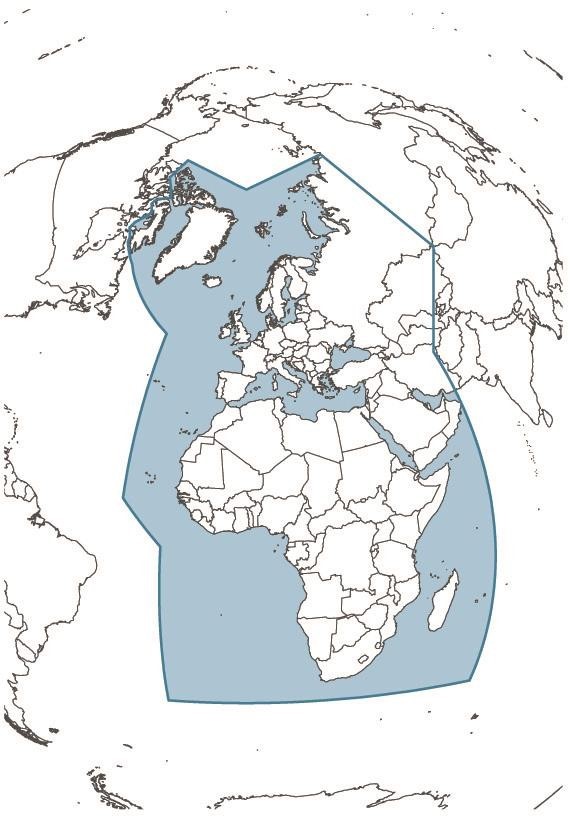
The boundary of the Agreement area is defined as follows: from the North Pole south along the 130°W line of longitude to 75oN; thence east and southeast through Viscount Melville Sound, Prince Regent Inlet, the Gulf of Boothia, Foxe Basin, Foxe Channel and Hudson Strait to a point in the northwest Atlantic at 60°N, 60°W; thence southeast through the northwest Atlantic to a point at 50°N, 30°W; thence south along the 30oW line of longitude to 10°N; thence southeast to the Equator at 20°W; thence south along the 20°W line of longitude to 40°S; thence east along the 40°S line of latitude to 60°E; thence north along the 60oE line of longitude to 35oN; thence east- northeast on a great circle to a point in the western Altai at 49°N, 87°27'E; thence northeast on a great circle to the coast of the Arctic Ocean at 130°E; thence north along the 130oE line of longitude to the North Pole. The outline of the Agreement Area is illustrated on the following map.
Annex 1 a
Map of the Agreement Area
Annex 2
Waterbird species to which the Agreement applies
As amended by the 8th Session of the Meeting of the Parties to AEWA, 26 - 30 September 2022, Budapest, Hungary
Family ANATIDAE (ducks, geese, swans)
Dendrocygna viduata White-faced Whistling-duck
Dendrocygna bicolor Fulvous Whistling-duck
Thalassornis leuconotus White-backed Duck
Oxyura maccoa Maccoa Duck
Oxyura leucocephala White-headed Duck
Cygnus olor Mute Swan
Cygnus cygnus Whooper Swan
Cygnus columbianus Tundra Swan
Branta bernicla Brent Goose
Branta leucopsis Barnacle Goose
Branta ruficollis Red-breasted Goose
Anser anser Greylag Goose
Anser fabalis Bean Goose
Anser brachyrhynchus Pink-footed Goose
Anser albifrons Greater White-fronted Goose
Anser erythropus Lesser White-fronted Goose
Clangula hyemalis Long-tailed Duck
Somateria spectabilis King Eider
Somateria mollissima Common Eider
Polysticta stelleri Steller's Eider
Melanitta fusca Velvet Scoter
Melanitta nigra Common Scoter
Bucephala clangula Common Goldeneye
Mergellus albellus Smew
Mergus merganser Goosander
Mergus serrator Red-breasted Merganser
Alopochen aegyptiaca Egyptian Goose
Tadorna tadorna Common Shelduck
Tadorna ferruginea Ruddy Shelduck
Tadorna cana South African Shelduck
Plectropterus gambensis Spur-winged Goose
Sarkidiornis melanotos African Comb Duck
Nettapus auritus African Pygmy-goose
Marmaronetta angustirostris Marbled Teal
Netta rufina Red-crested Pochard
Netta erythrophthalma Southern Pochard
Aythya ferina Common Pochard
Aythya nyroca Ferruginous Pochard
Aythya fuligula Tufted Duck
Aythya marila Greater Scaup
Spatula querquedula Garganey
Spatula hottentota Spotted Teal
Spatula clypeata Northern Shoveler
Mareca strepera Gadwall
Mareca penelope Eurasian Wigeon
Anas undulata Yellow-billed Duck
Anas platyrhynchos Mallard
Anas capensis Cape Teal
Anas erythrorhyncha Red-billed Teal
Anas acuta Northern Pintail
Anas crecca Common Teal
Family PODICIPEDIDAE (grebes)
Tachybaptus ruficollis Little Grebe
Podiceps grisegena Red-necked Grebe
Podiceps cristatus Great Crested Grebe
Podiceps auritus Horned Grebe
Podiceps nigricollis Black-necked Grebe
Family PHOENICOPTERIDAE (flamingos)
Phoenicopterus roseus Greater Flamingo
Phoeniconaias minor Lesser Flamingo
Family PHAETHONTIDAE (tropicbirds)
Phaethon aethereus Red-billed Tropicbird
Phaethon rubricauda Red-tailed Tropicbird
Phaethon lepturus White-tailed Tropicbird
Family RALLIDAE (rails, gallinules, coots)
Sarothrura elegans Buff-spotted Flufftail
Sarothrura boehmi Streaky-breasted Flufftail
Sarothrura ayresi White-winged Flufftail
Rallus aquaticus Western Water Rail
Rallus caerulescens African Rail
Crex egregia African Crake
Crex crex Corncrake
Porzana porzana Spotted Crake
Zapornia flavirostra Black Crake
Zapornia parva Little Crake
Zapornia pusilla Baillon's Crake
Amaurornis marginalis Striped Crake
Porphyrio alleni Allen’s Gallinule
Gallinula chloropus Common Moorhen
Paragallinula angulata Lesser Moorhen
Fulica cristata Red-knobbed Coot
Fulica atra Common Coot
Family GRUIDAE (cranes)
Balearica regulorum Grey Crowned Crane
Balearica pavonina Black Crowned Crane
Leucogeranus leucogeranus Siberian Crane
Bugeranus carunculatus Wattled Crane
Anthropoides paradiseus Blue Crane
Anthropoides virgo Demoiselle Crane
Grus grus Common Crane
Family GAVIIDAE (loons / divers)
Gavia stellata Red-throated Loon
Gavia arctica Black-throated Loon
Gavia immer Common Loon
Gavia adamsii Yellow-billed Loon
Family SPHENISCIDAE (penguins)
Spheniscus demersus African Penguin
Family CICONIIDAE (storks)
Leptoptilos crumenifer Marabou
Mycteria ibis Yellow-billed Stork
Anastomus lamelligerus African Openbill
Ciconia nigra Black Stork
Ciconia abdimii Abdim’s Stork
Ciconia microscelis African Woollyneck
Ciconia ciconia White Stork
Family THRESKIORNITHIDAE (ibises, spoonbills)
Platalea alba African Spoonbill
Platalea leucorodia Eurasian Spoonbill
Threskiornis aethiopicus African Sacred Ibis
Geronticus eremita Northern Bald Ibis
Plegadis falcinellus Glossy Ibis
Family ARDEIDAE (herons)
Botaurus stellaris Eurasian Bittern
Ixobrychus minutus Common Little Bittern
Ixobrychus sturmii Dwarf Bittern
Nycticorax nycticorax Black-crowned Night-heron
Ardeola ralloides Squacco Heron
Ardeola idae Madagascar Pond-heron
Ardeola rufiventris Rufous-bellied Heron
Bubulcus ibis Cattle Egret
Ardea cinerea Grey Heron
Ardea melanocephala Black-headed Heron
Ardea purpurea Purple Heron
Ardea alba Great White Egret
Ardea brachyrhyncha Yellow-billed Egret
Egretta ardesiaca Black Heron
Egretta vinaceigula Slaty Egret
Egretta garzetta Little Egret
Egretta gularis Western Reef-egret
Family BALAENICIPITIDAE (shoebill)
Balaeniceps rex Shoebill
Family PELECANIDAE (pelicans)
Pelecanus crispus Dalmatian Pelican
Pelecanus rufescens Pink-backed Pelican
Pelecanus onocrotalus Great White Pelican
Family FREGATIDAE (frigatebirds)
Fregata ariel Lesser Frigatebird
Fregata minor Great Frigatebird
Family SULIDAE (gannets, boobies)
Morus bassanus Northern Gannet
Morus capensis Cape Gannet
Sula dactylatra Masked Booby
Family PHALACROCORACIDAE (cormorants)
Microcarbo coronatus Crowned Cormorant
Microcarbo pygmaeus Pygmy Cormorant
Gulosus aristotelis European Shag
Phalacrocorax carbo Great Cormorant
Phalacrocorax capensis Cape Cormorant
Phalacrocorax nigrogularis Socotra Cormorant
Phalacrocorax neglectus Bank Cormorant
Family BURHINIDAE (thick-knees)
Burhinus senegalensis Senegal Thick-knee
Family PLUVIANIDAE (Egyptian plover)
Pluvianus aegyptius Egyptian Plover
Family HAEMATOPODIDAE (oystercatchers)
Haematopus moquini African Oystercatcher
Haematopus ostralegus Eurasian Oystercatcher
Family RECURVIROSTRIDAE (avocets, stilts)
Recurvirostra avosetta Pied Avocet
Himantopus himantopus Black-winged Stilt
Family CHARADRIIDAE (plovers)
Pluvialis squatarola Grey Plover
Pluvialis apricaria Eurasian Golden Plover
Pluvialis fulva Pacific Golden Plover
Eudromias morinellus Eurasian Dotterel
Charadrius hiaticula Common Ringed Plover
Charadrius dubius Little Ringed Plover
Charadrius pecuarius Kittlitz's Plover
Charadrius tricollaris African Three-banded Plover
Charadrius forbesi Forbes's Plover
Charadrius marginatus White-fronted Plover
Charadrius alexandrinus Kentish Plover
Charadrius pallidus Chestnut-banded Plover
Charadrius mongolus Lesser Sandplover
Charadrius leschenaultii Greater Sandplover
Charadrius asiaticus Caspian Plover
Vanellus vanellus Northern Lapwing
Vanellus spinosus Spur-winged Lapwing
Vanellus albiceps White-headed Lapwing
Vanellus lugubris Senegal Lapwing
Vanellus melanopterus Black-winged Lapwing
Vanellus coronatus Crowned Lapwing
Vanellus senegallus Wattled Lapwing
Vanellus superciliosus Brown-chested Lapwing
Vanellus gregarius Sociable Lapwing
Vanellus leucurus White-tailed Lapwing
Family SCOLOPACIDAE (sandpipers, snipes, phalaropes)
Numenius phaeopus Whimbrel
Numenius tenuirostris Slender-billed Curlew
Numenius arquata Eurasian Curlew
Limosa lapponica Bar-tailed Godwit
Limosa limosa Black-tailed Godwit
Arenaria interpres Ruddy Turnstone
Calidris tenuirostris Great Knot
Calidris canutus Red Knot
Calidris pugnax Ruff
Calidris falcinellus Broad-billed Sandpiper
Calidris ferruginea Curlew Sandpiper
Calidris temminckii Temminck's Stint
Calidris alba Sanderling
Calidris alpina Dunlin
Calidris maritima Purple Sandpiper
Calidris minuta Little Stint
Scolopax rusticola Eurasian Woodcock
Gallinago stenura Pintail Snipe
Gallinago media Great Snipe
Gallinago gallinago Common Snipe
Lymnocryptes minimus Jack Snipe
Phalaropus lobatus Red-necked Phalarope
Phalaropus fulicarius Red Phalarope
Xenus cinereus Terek Sandpiper
Actitis hypoleucos Common Sandpiper
Tringa ochropus Green Sandpiper
Tringa erythropus Spotted Redshank
Tringa nebularia Common Greenshank
Tringa totanus Common Redshank
Tringa glareola Wood Sandpiper
Tringa stagnatilis Marsh Sandpiper
Family DROMADIDAE (crab-plover)
Dromas ardeola Crab-plover
Family GLAREOLIDAE (coursers, pratincoles)
Glareola pratincola Collared Pratincole
Glareola nordmanni Black-winged Pratincole
Glareola ocularis Madagascar Pratincole
Glareola nuchalis Rock Pratincole
Glareola cinerea Grey Pratincole
Family LARIDAE (gulls, terns, skimmers)
Anous stolidus Brown Noddy
Anous tenuirostris Lesser Noddy
Rynchops flavirostris African Skimmer
Hydrocoloeus minutus Little Gull
Xema sabini Sabine’s Gull
Rissa tridactyla Black-legged Kittiwake
Larus genei Slender-billed Gull
Larus ridibundus Black-headed Gull
Larus hartlaubii Hartlaub’s Gull
Larus cirrocephalus Grey-headed Gull
Larus ichthyaetus Pallas’s Gull
Larus melanocephalus Mediterranean Gull
Larus hemprichii Sooty Gull
Larus leucophthalmus White-eyed Gull
Larus audouinii Audouin's Gull
Larus canus Mew Gull
Larus dominicanus Kelp Gull
Larus fuscus Lesser Black-backed Gull
Larus argentatus European Herring Gull
Larus armenicus Armenian Gull
Larus michahellis Yellow-legged Gull
Larus cachinnans Caspian Gull
Larus glaucoides Iceland Gull
Larus hyperboreus Glaucous Gull
Larus marinus Great Black-backed Gull
Onychoprion fuscatus Sooty Tern
Onychoprion anaethetus Bridled Tern
Sternula albifrons Little Tern
Sternula saundersi Saunders's Tern
Sternula balaenarum Damara Tern
Gelochelidon nilotica Common Gull-billed Tern
Hydroprogne caspia Caspian Tern
Chlidonias hybrida Whiskered Tern
Chlidonias leucopterus White-winged Tern
Chlidonias niger Black Tern
Sterna dougallii Roseate Tern
Sterna hirundo Common Tern
Sterna repressa White-cheeked Tern
Sterna paradisaea Arctic Tern
Sterna vittata Antarctic Tern
Thalasseus bengalensis Lesser Crested Tern
Thalasseus sandvicensis Sandwich Tern
Thalasseus maximus Royal Tern
Thalasseus bergii Greater Crested Tern
Family STERCORARIIDAE (skuas)
Stercorarius longicaudus Long-tailed Jaeger
Catharacta skua Great Skua
Family ALCIDAE (auks)
Fratercula arctica Atlantic Puffin
Cepphus grylle Black Guillemot
Alca torda Razorbill
Alle alle Little Auk
Uria lomvia Thick-billed Murre
Uria aalge Common Murre
Annex 3
ACTION PLAN
As amended by the 8th Session of the Meeting of the Parties to AEWA, 26 - 30 September 2022, Budapest, Hungary
1. Field of Application
1.1 The Action Plan is applicable to the populations of migratory waterbirds listed in Table 1 to this Annex (hereafter referred to as "Table 1").
1.2 Table 1 forms an integral part of this Annex. Any reference to this Action Plan includes a reference to Table 1.
2. Species Conservation
2.1 Legal measures
2.1.1 Parties with populations listed in Column A of Table 1 shall provide protection to those populations listed in accordance with Article III, paragraph 2(a), of this Agreement. Such Parties shall in particular and subject to paragraph 2.1.3 below:
(a) prohibit the taking of birds and eggs of those populations occurring in their territory;
(b) prohibit deliberate disturbance in so far as such disturbance would be significant for the conservation of the population concerned; and
(c) prohibit the possession or utilization of, and trade in, birds or eggs of those populations which have been taken in contravention of the prohibitions laid down pursuant to subparagraph (a) above, as well as the possession or utilization of, and trade in, any readily recognizable parts or derivatives of such birds and their eggs.
By way of exception for those populations listed in Categories 2 and 3 in Column A and which are marked by an asterisk, and those populations listed in Category 4 in Column A, hunting may continue on a sustainable use basis*. This sustainable use shall be conducted within the framework of an international species action plan, through which Parties will endeavour to implement the principles of adaptive harvest management**. Such use shall, as a minimum, be subject to the same legal measures as the taking of birds from populations listed in Column B of Table 1, as required in paragraph 2.1.2 below.
* “Sustainable use” means the use of components of biological diversity in a way and at a rate that does not lead to the long-term decline of biological diversity, thereby maintaining its potential to meet the needs and aspirations of present and future generations.
** Adaptive harvest management is the periodic process of setting hunting regulations based on a system of population and habitat monitoring, havest-level recording, data analysis and defining regulatory options.
2.1.2 Parties with populations listed in Table 1 shall regulate the taking of birds and eggs of all populations listed in Column B of Table 1. The object of such legal measures shall be to maintain or contribute to the restoration of those populations to a favourable conservation status and to ensure, on the basis of the best available knowledge of population dynamics, that any taking or other use is sustainable. Such legal measures, subject to paragraph 2.1.3 below, shall in particular:
(a) prohibit the taking of birds belonging to the populations concerned during their various stages of reproduction and rearing and during their return to their breeding grounds if the taking has an unfavourable impact on the conservation status of the population concerned;
(b) regulate the modes of taking, and in particular prohibit the use of all indiscriminate means of taking and the use of all means capable of causing mass destructions, as well as local disappearance of, or serious disturbance to, populations of a species, including:
- snares,
- limes,
- hooks,
- live birds which are blind or mutilated used as decoys,
- tape recorders and other electronic devices,
- electrocuting devices,
- artificial light sources,
- mirrors and other dazzling devices,
- devices for illuminating targets,
- sighting devices for night shooting comprising an electronic image magnifier or image converter,
- explosives,
- nets,
- traps,
- poison,
- poisoned or anesthetic baits,
- semi-automatic or automatic weapons with a magazine capable of holding more than two rounds of ammunition, hunting from aircraft, motor vehicles, or boats driven at a speed exceeding 5 km p/h (18 km p/h on the open sea).
Parties may grant exemptions from the prohibitions laid down in paragraph 2.1.2 (b) to accommodate use for livelihood purposes, where sustainable;
(c) establish limits on taking, where appropriate, and provide adequate controls to ensure that these limits are observed; and
(d) prohibit the possession or utilization of, and trade in, birds and eggs of the populations which have been taken in contravention of any prohibition laid down pursuant to the provisions of this paragraph, as well as the possession or utilization of, and trade in, any readily recognizable parts or derivatives of such birds and their eggs.
2.1.3 Parties may grant exemptions to the prohibitions laid down in paragraphs 2.1.1 and 2.1.2, irrespective of the provisions of Article III, paragraph 5, of the Convention, where there is no other satisfactory solution, for the following purposes:
(a) to prevent serious damage to crops, water and fisheries;
(b) in the interests of air safety, public health and public safety, or for other imperative reasons of overriding public interest, including those of a social or economic nature and beneficial consequences of primary importance to the environment;
(c) for the purpose of research and education, of re-establishment and for the breeding necessary for these purposes;
(d) to permit under strictly supervised conditions, on a selective basis and to a limited extent, the taking and keeping or other judicious use of certain birds in small numbers; and
(e) for the purpose of enhancing the propagation or survival of the populations concerned.
Such exemptions shall be precise as to content and limited in space and time and shall not operate to the detriment of the populations listed in Table 1. Parties shall, as soon as possible, inform the Agreement secretariat of any exemptions granted pursuant to this provision.
2.2 Single Species Action Plans
2.2.1 Parties shall cooperate with a view to developing and implementing international single species action plans for populations listed in Category 1 of Column A of Table 1 as a priority and for those populations listed with an asterisk in Column A of Table 1. The Agreement secretariat shall coordinate the development, harmonization and implementation of such plans.
2.2.2 Parties shall prepare and implement national single species action plans for the populations listed in Column A of Table 1 with a view to improving their overall conservation status. This action plan shall include special provisions for those populations marked with an asterisk. When appropriate, the problem of accidental killing of birds by hunters as a result of incorrect identification of the species should be considered.
2.3 Emergency Measures
Parties shall, in close cooperation with each other whenever possible and relevant, develop and implement emergency measures for populations listed in Table 1, when exceptionally unfavourable or endangering conditions occur anywhere in the Agreement Area.
2.4 Re-establishments
Parties shall exercise the greatest care when re-establishing populations listed in Table 1 into parts of their traditional range where they no longer exist. They shall endeavour to develop and follow a detailed re-establishment plan based on appropriate scientific studies. Re-establishment plans should constitute an integral part of national and, where appropriate, international single species action plans. A re-establishment plan should include assessment of the impact on the environment and shall be made widely available. Parties shall inform the Agreement secretariat, in advance, of all re-establishment programme for populations listed in Table 1.
2.5 Introductions
2.5.1 Parties shall prohibit the introduction into the environment of non-native species of animals and plants which may be detrimental to the populations listed in Table 1.
2.5.2 Parties shall require the taking of appropriate precautions to avoid the accidental escape of captive animals belonging to non-native species, which may be detrimental to the populations listed in Table 1.
2.5.3 Parties shall take measures to the extent feasible and appropriate, including taking, to ensure that when non-native species or hybrids thereof have already been introduced into their territory, those species or their hybrids do not pose a potential hazard to the populations listed in Table 1.
3. Habitat Conservation
3.1 Habitat Inventories
3.1.1 Parties, in liaison where appropriate with competent international organizations, shall undertake and publish national inventories of the habitats within their territory which are important to the populations listed in Table 1.
3.1.2 Parties shall endeavour, as a matter of priority, to identify all sites of international or national importance for populations listed in Table 1.
3.2 Conservation of Areas
3.2.1 Parties shall endeavour to continue establishing protected areas to conserve habitats important for the populations listed in Table 1, and to develop and implement management plans for these areas.
3.2.2 Parties shall endeavour to give special protection to those wetlands* which meet internationally accepted criteria of international importance.
* For the purposes of the implementation of AEWA, the definition of “wetlands” as provided by Article 1.1 of the Convention on Wetlands of International Importance Especially as Waterfowl Habitat shall apply.
3.2.3 Parties shall endeavour to make wise and sustainable use of all of the wetlands in their territory. In particular they shall endeavour to avoid degradation and loss of habitats that support populations listed in Table 1 through the introduction of appropriate regulations or standards and control measures. In particular, they shall endeavour to:
(a) ensure, where practicable, that adequate statutory controls are in place, relating to the use of agricultural chemicals, pest control procedures and the disposal of waste water, which are in accordance with international norms, for the purpose of minimizing their adverse impacts on the populations listed in Table 1; and
(b) prepare and distribute information materials, in the appropriate languages, describing such regulations, standards and control measures in force and their benefits to people and wildlife.
3.2.4 Parties shall endeavour to develop strategies, according to an ecosystem approach, for the conservation of the habitats of all populations listed in Table 1, including the habitats of those populations that are dispersed.
3.3 Rehabilitation and Restoration
Parties shall endeavour to rehabilitate or restore, where feasible and appropriate, areas which were previously important for the populations listed in Table 1, including areas that suffer degradation as a result of the impacts of factors such as climate change, hydrological change, agriculture, spread o f aquatic invasive non-native species, natural succession, uncontrolled fires, unsustainable use, eutrophication and pollution.
4. Management of Human Activities
4.1 Hunting
4.1.1 Parties shall cooperate to ensure that their hunting legislation implements the principle of sustainable use as envisaged in this Action Plan, taking into account the full geographical range of the waterbird populations concerned and their life history characteristics.
5 For the purposes of the implementation of AEWA, the definition of “wetlands” as provided by Article 1.1 of the Convention on Wetlands of International Importance Especially as Waterfowl Habitat shall apply.
4.1.2 The Agreement secretariat shall be kept informed by the Parties of their legislation relating to the hunting of populations listed in Table 1.
4.1.3 Parties shall cooperate with a view to developing a reliable and harmonized system for the collection of harvest data in order to assess the annual harvest of populations listed in Table 1. They shall provide the Agreement secretariat with estimates of the total annual take for each population, when available.
4.1.4 Parties shall endeavour to phase out the use of lead shot for hunting in wetlands as soon as possible in accordance with self-imposed and published timetables.
4.1.5 …
4.1.6 Parties shall develop and implement measures to reduce, and as far as possible eliminate, illegal taking.
4.1.7 Where appropriate, Parties shall encourage hunters, at local, national and international levels, to form clubs or organizations to coordinate their activities and to help ensure sustainability.
4.1.8 Parties shall, where appropriate, promote the requirement of a proficiency test for hunters, including among other things, bird identification.
4.2 Eco-tourism
4.2.1 Parties shall encourage, where appropriate but not in the case of core zones of protected areas, the elaboration of cooperative programmes between all concerned to develop sensitive and appropriate eco- tourism at wetlands holding concentrations of populations listed in Table 1.
4.2.2 Parties, in cooperation with competent international organisations, shall endeavour to evaluate the costs, benefits and other consequences that can result from eco-tourism at selected wetlands with concentrations of populations listed in Table 1. They shall communicate the results of any such evaluations to the Agreement secretariat.
4.3 Other Human Activities
4.3.1 Parties shall assess the impact of proposed projects which are likely to lead to conflicts between populations listed in Table 1 that are in the areas referred to in paragraph 3.2 and human interests, and shall make the results of the assessment publicly available.
4.3.2 Parties shall endeavour to gather information on the damage, in particular to crops and to fisheries, caused by populations listed in Table 1, and report the results to the Agreement secretariat.
4.3.3 Parties shall cooperate with a view to identifying appropriate techniques to minimize damage, or to mitigate the effects of damage, in particular to crops and to fisheries, caused by populations listed in Table 1, drawing on the experience gained elsewhere in the world.
4.3.4 Parties shall cooperate with a view to developing single species management plans for populations which cause significant damage, in particular to crops and to fisheries. The Agreement secretariat shall coordinate the development and harmonization of such plans.
4.3.5 Parties shall, as far as possible, promote high environmental standards in the planning and construction of structures to minimize their impact on populations listed in Table 1. They should consider steps to minimize the impact of structures already in existence where it becomes evident that they constitute a negative impact for the populations concerned.
4.3.6 In cases where human disturbance threatens the conservation status of waterbird populations listed in Table 1, Parties should endeavour to take measures to limit the level of threat. Special attention should be given to the problem of human disturbance at breeding colonies of colonially-nesting waterbirds, especially when they are situated in the areas which are popular for outdoor recreation. Appropriate measures might include, inter alia, the establishment of disturbance-free zones in protected areas where public access is not permitted.
4.3.7 Parties are urged to take appropriate actions nationally or through the framework of Regional Fisheries Management Organisations (RFMOs) and relevant international organisations to minimise the impact of fisheries* on migratory waterbirds, and where possible cooperate within these forums, in order to decrease the mortality in areas within and beyond national jurisdiction; appropriate measures shall especially address incidental killing and bycatch in fishing gear including the use of gill nets, longlines and trawling.
* “fisheries” includes aquaculture and refers to either marine or freshwater fish, crustaceans, and molluscs (e.g. bivalves, gastropods and cephalopods).
4.3.8 Parties are also urged to take appropriate actions nationally or through the framework of Regional Fisheries Management Organisations (RFMOs) and relevant international organisations to minimise the impact of fisheries on migratory waterbirds resulting in particular from unsustainable fishing that causes depletion of food resources for migratory waterbirds.
4.3.9 Parties shall establish and effectively enforce adequate statutory pollution controls in accordance with international norms and legal agreements, particularly as related to oil spills, discharge and dumping of solid wastes, for the purpose of minimizing their impacts on the populations listed in Table 1.
4.3.10 Parties shall establish appropriate measures, ideally to eliminate or otherwise to mitigate the threat from non-native terrestrial predators to breeding migratory waterbirds on islands and islets. Measures should refer to contingency planning to prevent invasion, emergency responses to remove introduced predators, and restoration programmes for islands where predator populations are already established.
4.3.11 Parties are urged to establish appropriate measures to tackle threats to migratory waterbirds from aquaculture, including environmental assessment for developments that threaten wetlands of importance for waterbirds, especially when dealing with new or enlargement of existing installations, and involving issues such as pollution (e.g. from residues of pharmaceutical treatments used in aquaculture or eutrophication), habitat loss, entanglement risks, and introduction of non-native and potentially invasive species.”
4.3.12 Parties, the Agreement secretariat and the Technical Committee will as appropriate work together to provide further documentation on the nature and scale of the effects of lead fishing weights on waterbirds and to consider that documentation, noting that lead in general poses a threat to the environment with harmful effects on waterbirds. Parties will, as appropriate, seek alternatives to lead fishing weights, taking into consideration the impact on waterbirds and water quality.
4.3.11 Parties are urged to establish appropriate measures to tackle threats to migratory waterbirds from aquaculture, including environmental assessment for developments that threaten wetlands of importance for waterbirds, especially when dealing with new or enlargement of existing installations, and involving issues such as pollution (e.g. from residues of pharmaceutical treatments used in aquaculture or eutrophication), habitat loss, entanglement risks, and introduction of non-native and potentially invasive species.”
4.3.12 Parties, the Agreement secretariat and the Technical Committee will as appropriate work together to provide further documentation on the nature and scale of the effects of lead fishing weights on waterbirds and to consider that documentation, noting that lead in general poses a threat to the environment with harmful effects on waterbirds. Parties will, as appropriate, seek alternatives to lead fishing weights, taking into consideration the impact on waterbirds and water quality.
5. Research and Monitoring
5.1 Parties shall endeavour to carry out survey work in poorly known areas, which may hold important concentrations of the populations listed in Table 1. The results of such surveys shall be disseminated widely.
5.2 Parties shall endeavour to monitor the populations listed in Table 1. The results of such monitoring shall be published or sent to appropriate international organizations, to enable reviews of population status and trends.
5.3 Parties shall cooperate to improve the measurement of bird population trends as a criterion for describing the status of such populations.
5.4 Parties shall cooperate with a view to determining the migration routes of all populations listed in Table 1, using available knowledge of breeding and non-breeding season distributions and census results, and by participating in coordinated ringing programmes.
5.5 Parties shall endeavour to initiate and support joint research projects into the ecology and population dynamics of populations listed in Table 1 and their habitats, in order to determine their specific requirements as well as the techniques which are the most appropriate for their conservation and management.
5.6 Parties shall endeavour to undertake studies on the effects of wetland loss and degradation and disturbance on the carrying capacity of wetlands used by the populations listed in Table 1 and on the migration patterns of such populations.
5.7 Parties shall endeavour to undertake studies on the impact of hunting and trade on the populations listed in Table 1 and on the importance of these forms of utilization to the local and national economy.
5.8 Parties shall endeavour to cooperate with relevant international organisations and to support research and monitoring projects.
6. Education and Information
6.1 Parties shall, where necessary, arrange for training programmes to ensure that personnel responsible for the implementation of this Action Plan have an adequate knowledge to implement it effectively.
6.2 Parties shall cooperate with each other and the Agreement secretariat with a view to developing training programmes and exchanging resource materials.
6.3 Parties shall endeavour to develop programmes, information materials and mechanisms to improve the level of awareness of the general public with regard to the objectives, provisions and contents of this Action Plan. In this regard, particular attention shall be given to those people living in and around important wetlands, to users of these wetlands (hunters, fishermen, tourists, etc.) and to local authorities and other decision makers.
6.4 Parties shall endeavour to undertake specific public awareness campaigns for the conservation of the populations listed in Table 1.
7. Implementation
7.1 When implementing this Action Plan, Parties shall, when appropriate, give priority to those populations listed in Column A of Table 1.
7.2 Where, in the case of populations listed in Table 1, more than one population of the same species occurs on the territory of a Party, that Party shall apply conservation measures appropriate to the population or populations that have the poorest conservation status.
7.3 The Agreement secretariat, in coordination with the Technical Committee and with the assistance of experts from Range States, shall coordinate the development of conservation guidelines in accordance with Article IV, paragraph 4, of this Agreement to assist the Parties in the implementation of this Action Plan. The Agreement secretariat shall ensure, where possible, coherence with guidelines approved under other international instruments. These conservation guidelines shall aim at introducing the principle of sustainable use. They shall cover, inter alia:
(a) single species action plans;
(b) emergency measures;
(c) preparation of site inventories and habitat management methods;
(d) hunting practices;
(e) trade in waterbirds; (f) tourism;
(g) reducing crop damage; and
(h) a waterbird monitoring protocol.
7.4 The Agreement secretariat, in coordination with the Technical Committee and the Parties, shall prepare a series of international reviews necessary for the implementation of this Action Plan, including:
(a) reports on the status and trends of populations;
(b) gaps in information from surveys;
(c) the networks of sites used by each population, including reviews of the protection status of each site as well as of the management measures taken in each case;
(d) pertinent hunting and trade legislation in each country relating to the species listed in Annex 2 to this Agreement;
(e) the stage of preparation and implementation of single species action plans; (f) re-establishment projects; and
(g) the status of introduced non-native waterbird species and hybrids thereof.
7.5 The Agreement secretariat shall endeavour to ensure that the reviews mentioned in paragraph 7.4 are updated at the following intervals:
(a) every session of the Meeting of the Parties; (b) – every second session of the Meeting of the Parties; (c) – every second session of the Meeting of the Parties; (d) – every third session of the Meeting of the Parties; (e) – every second session of the Meeting of the Parties; (f) – every third session of the Meeting of the Parties; (g) – every second session of the Meeting of the Parties.
7.6 The Technical Committee shall assess the guidelines and reviews prepared under paragraphs 7.3 and 7.4, and shall formulate draft recommendations and resolutions relating to their development, content and implementation for consideration at sessions of the Meeting of the Parties.
7.7 The Agreement secretariat shall regularly undertake a review of potential mechanisms for providing additional resources (funds and technical assistance) for the implementation of this Action Plan, and shall make a report to each ordinary session of the Meeting of the Parties.
Table 1 a/7
STATUS OF THE POPULATIONS OF MIGRATORY WATERBIRDS KEY TO CLASSIFICATION
a/Table 1, “Status of the populations of migratory waterbirds” forms part of the Action Plan contained in Annex 3 to the Agreement
7 As amended by the 8th Session of the Meeting of the Parties to AEWA, 26 - 30 September 2022, Budapest, Hungary and corrected by the Contracting Parties via silence procedure with effect as of 10 August 2023
The following key to Table 1 is a basis for implementation of the Action Plan:
Column A
Category 1: (a) Species, which are included in Appendix I to the Convention on the Conservation of Migratory species of Wild Animals;
(b) Species, which are listed as threatened on the IUCN Red list of Threatened Species, as reported in the most recent summary by BirdLife International; or
(c) Populations, which number less than around 10,000 individuals.
Category 2: Populations numbering between around 10,000 and around 25,000 individuals.
Category 3: Populations numbering between around 25,000 and around 100,000 individuals and considered to be at risk as a result of:
(a) Concentration onto a small number of sites at any stage of their annual cycle;
(b) Dependence on a habitat type, which is under severe threat;
(c) Showing long-term decline;
(d) Showing large fluctuations in population size or trend;
(e) Showing rapid short-term decline; or
(f) Being data deficient.
Category 4: Species, which are listed as Near Threatened on the IUCN Red List of Threatenend species, as reported in the most recent summary by BirdLife International, but do not fulfil the conditions in respect of Categories 1, 2 or 3, as described above, and which are pertinent for international action.
For species listed in Categories 2, 3 and 4 above, see paragraph 2.1.1 of the Action Plan contained in Annex 3 to the Agreement.
Column B
Category 1: Populations numbering between around 25,000 and around 100,000 individuals and which do not fulfil the conditions in respect of Column A, as described above.
Category 2: Populations numbering more than around 100,000 individuals, which do not fulfil the conditions in respect of Column A, and considered to be in need of special attention as a result of:
(a) Concentration onto a small number of sites at any stage of their annual cycle;
(b) Dependence on a habitat type, which is under severe threat;
(c) Showing long-term decline;
(d) Showing large fluctuations in population size or trend;
(e) Showing rapid short-term decline; or
(f) Being data deficient.
Column C
Category 1: Populations numbering more than around 100,000 individuals which could significantly benefit from international cooperation and which do not fulfil the conditions in respect of either Column A or Column B, above.
REVIEW OF TABLE 1
The Table shall be:
(a) Reviewed regularly by the Technical Committee in accordance with article VII, paragraph 3(b), of the Agreement; and
(b) Amended as necessary by the Meeting of the Parties, in accordance with article VI, paragraph 9(d) of the Agreement, in light of the conclusions of such reviews.
DEFINITION OF GEOGRAPHICAL TERMS USED IN RANGE DESCRIPTIONS
Note that waterbird ranges respect biological, not political, boundaries and that precise alignment of biological and political entities is extremely unusual. The range desctiptions used have no political significance and are for general guidance only, and for concise, mapped summaries of waterbird ranges, practitioners should consult the Critical Site Network Tool internet portal:
http://criticalsites.wetlands.org/en
| North Africa | Algeria, Egypt, Libya, Morocco, Tunisia. |
| West Africa | Benin, Burkina Faso, Cabo Verde, Cameroon, Chad, Côte d'Ivoire, the Gambia, Ghana, Guinea, Guinea-Bissau, Liberia, Mali, Mauritania, Niger, Nigeria, Senegal, Sierra Leone, Togo. |
| Eastern Africa | Burundi, Djibouti, Eritrea, Ethiopia, Kenya, Rwanda, Somalia, South Sudan, Sudan, Uganda, the United Republic of Tanzania. |
| North-west Africa | Algeria, Morocco, Tunisia. |
| North-east Africa | Djibouti, Egypt, Eritrea, Ethiopia, Somalia, South Sudan, Sudan. |
| Southern Africa | Angola, Botswana, Eswatini, Lesotho, Malawi, Mozambique, Namibia, South Africa, Zambia, Zimbabwe. |
| Central Africa | Cameroon, Central African Republic, Congo, Democratic Republic of the Congo, Equatorial Guinea, Gabon, São Tomé and Príncipe. |
| Sub-Saharan Africa | All African states south of the Sahara. |
| Tropical Africa | Sub-Saharan Africa excluding Eswatini, Lesotho, Namibia and South Africa. |
| Western Palearctic | As defined in Handbook of the Birds of Europe, the Middle East and North Africa (Cramp & Simmons 1977). |
| North-west Europe | Belgium, Denmark, Finland, France, Germany, Iceland, Ireland, Luxembourg, the Netherlands, Norway, Sweden, the United Kingdom of Great Britain and Northern Ireland. |
| Western Europe | North-west Europe with Portugal and Spain. |
| North-east Europe | The northern part of the Russian Federation west of the Urals. |
| North Europe | North-west Europe and North-east Europe, as defined above. Eastern Europe Belarus, the Russian Federation west of the Urals, Ukraine. |
| Central Europe | Austria, the Czech Republic, Estonia, Germany, Hungary, Latvia, Liechtenstein, Lithuania, Poland, the Russian Federation around the Gulf of Finland and Kaliningrad, Slovakia, Switzerland. |
| South-west Europe | Mediterranean France, Italy, Malta, Monaco, Portugal, San Marino, Spain. |
| South-east Europe | Albania, Armenia, Bosnia & Herzegovina, Bulgaria, Croatia, Cyprus, Georgia, Greece, North Macedonia, Republic of Moldova, Montenegro, Romania, Serbia, Slovenia, Türkiye. |
| South Europe | South-west Europe and South-east Europe, as defined above. |
| North Atlantic | Faroes, Greenland, Iceland, Ireland, Norway, the north-west coast of the Russian Federation, Svalbard, the United Kingdom of Great Britain and Northern Ireland. |
| East Atlantic | Atlantic seaboard of Europe and North Africa from northern Norway to Morocco. |
| Western Siberia | The Russian Federation east of the Urals to the Yenisey River and south to the Kazakhstan border. |
| Central Siberia | The Russian Federation from the Yenisey River to the eastern boundary of the Taimyr Peninsula and south to the Altai Mountains. |
| West Mediterranean | Algeria, France, Italy, Malta, Monaco,Morocco, Portugal, San Marino, Spain, Tunisia. |
| East Mediterranean | Albania, Bosnia and Herzegovina, Croatia, Cyprus, Egypt, Greece, Israel, Lebanon, Libya, Montenegro, Serbia, Slovenia, the Syrian Arab Republic, North Macedonia, Türkiye. |
| Black Sea | Armenia, Bulgaria, Georgia, Republic of Moldova, Romania, the Russian Federation, Türkiye, Ukraine. |
| Caspian | Azerbaijan, Islamic Republic of Iran, Kazakhstan, South-west Russia, Turkmenistan, Uzbekistan. |
| South-west Asia | Bahrain, Iraq, Islamic Republic of Iran, Israel, Jordan, Kazakhstan, Kuwait, Lebanon, Oman, Qatar, Saudi Arabia, the Syrian Arab Republic, eastern Türkiye, Turkmenistan, the United Arab Emirates, Uzbekistan, Yemen. |
| Gulf | The Persian Gulf, Gulf of Oman and Arabian Sea west to the Gulf of Aden. |
| Western Asia | Western parts of the Russian Federation east of the Urals and the Caspian countries |
| Central Asia | Afghanistan, Kazakhstan, Kyrgyzstan, Tajikistan, Turkmenistan, Uzbekistan. |
| Southern Asia | Bangladesh, Bhutan,India, Maldives, Nepal, Pakistan, Sri Lanka |
| Indian Ocean | Comoros, Madagascar, Mauritius, Seychelles |
KEY TO ABBREVIATIONS AND SYMBOLS
| bre: | breeding | win: | wintering |
| N: | Northern | E: | Eastern |
| S: | Southern | W: | Western |
| NE: | North-eastern | NW: | North-western |
| SE: | South-eastern | SW: | South-western |
(): The population status is uncertain. The conservation status is estimated based on statistically uncertain trend or unknown population size.
*: By way of exception for those populations listed in Categories 2 and 3 in Column A and which are marked by an asterisk, hunting may continue on a sustainable use basis. This sustainable use shall be conducted within the framework of special provisions of an international species action plan, which shall seek to implement the principles of adaptive harvest management (see paragraph 2.1.1 of Annex 3 to the Agreement).
NOTES
1. The population data used to compile Table 1 as far as possible correspond to the number of individuals in the potential breeding stock in the Agreement area. The status is based on the best available published population estimates.
2. Suffixes (bre) or (win) in population listings are solely aids to population identification. They do not indicate seasonal restrictions to actions in respect of these populations under the Agreement and Action Plan.
3. The brief descriptions used to identify the populations are based on the descriptions used in the most recently published edition of Waterbird Population Estimates.
4. Slash signs (/) are used to separate breeding areas from wintering areas.
5. Where a species’ population is listed in Table 1 with multiple categorisations, the obligations of the Action Plan relate to the strictest category listed.
| Populations | A | B | C |
| Family ANATIDAE (ducks, geese, swans) | |||
| Dendrocygna viduata (White-faced Whistling-duck) | |||
| - West Africa (Senegal to Chad) | (2e) | ||
| - Eastern & Southern Africa | 1 | ||
| Dendrocygna bicolor (Fulvous Whistling-duck) | |||
| - West Africa (Senegal to Chad) | (1) | ||
| - Eastern & Southern Africa | (1) | ||
| Thalassornis leuconotus leuconotus (White-backed Duck) | |||
| - West Africa | 1c | ||
| - Eastern & Southern Africa | 2* | ||
| Oxyura maccoa (Maccoa Duck) | |||
| - Ethiopian highlands | 1b 1c | ||
| - Eastern Africa | 1b 1c | ||
| - Southern Africa | 1b 1c | ||
| Oxyura leucocephala (White-headed Duck) | |||
| - West Mediterranean (Spain & Morocco) | 1a 1b 1c | ||
| - Algeria & Tunisia | 1a 1b 1c | ||
| - East Mediterranean, Türkiye & South-west Asia | 1a 1b 2 | ||
| Cygnus olor (Mute Swan) | |||
| - North-west Mainland & Central Europe | 1 | ||
| - Black Sea | 1 | ||
| - West & Central Asia/Caspian | 1 | ||
| Cygnus cygnus (Whooper Swan) | |||
| - Iceland/UK & Ireland | 1 | ||
| - North-west Mainland Europe | 1 | ||
| - N Europe & W Siberia/Black Sea & E Mediterranean | 2 | ||
| - West & Central Siberia/Caspian | 2 | ||
| Cygnus columbianus bewickii (Tundra Swan, Bewick's Swan) | |||
| - Western Siberia & NE Europe/North-west Europe | 2 | ||
| - Northern Siberia/Caspian | 1c | ||
| Branta bernicla bernicla (Brent Goose, Dark-bellied Brent Goose) | |||
| - Western Siberia/Western Europe | 2b | ||
| Branta bernicla hrota (Brent Goose, Pale-bellied Brent Goose) | |||
| - Svalbard/Denmark & UK | 2 | ||
| - Canada & Greenland/Ireland | 3a 3e | ||
| Branta leucopsis (Barnacle Goose) | |||
| - East Greenland/Scotland & Ireland | 1 | ||
| - Svalbard/South-west Scotland | 3a | ||
| - Russia/Germany & Netherlands | 1 | ||
| Branta ruficollis (Red-breasted Goose) | |||
| - Northern Siberia/Black Sea & Caspian | 1a 1b 3a | ||
| Anser anser anser (Greylag Goose, Western Greylag Goose) | |||
| - Iceland/UK & Ireland | 3e* | ||
| - NW Europe/South-west Europe | 1 |
| - Central Europe/North Africa | 1 | ||
| Anser anser rubrirostris (Greylag Goose, Eastern Greylag Goose) | |||
| - Black Sea & Türkiye | 3c | ||
| - Western Siberia/Caspian & Iraq | 2c 2e | ||
| Anser fabalis fabalis (Bean Goose, Taiga Bean Goose) | |||
| - Scandinavia/Denmark and UK | 1c | ||
| - Finland and NW Russia/Sweden, Denmark and Germany | 3c* | ||
| - West Siberia/Poland and Germany | 2 | ||
| Anser fabalis johanseni (Bean Goose) | |||
| - West & Central Siberia/Turkmenistan to W China | 1c | ||
| Anser fabalis rossicus (Bean Goose, Tundra Bean Goose) | |||
| - West & Central Siberia/NE & SW Europe | 1 | ||
| Anser brachyrhynchus (Pink-footed Goose) | |||
| - East Greenland & Iceland/UK | 1 | ||
| - Svalbard/North-west Europe | 1 | ||
| Anser albifrons albifrons (Greater White-fronted Goose, European White-fronted Goose) | |||
| - NW Siberia & NE Europe/North-west Europe | 1 | ||
| - Western Siberia/Central Europe | 1 | ||
| - Western Siberia/Black Sea & Türkiye | 1 | ||
| - Northern Siberia/Caspian & Iraq | (1) | ||
| Anser albifrons flavirostris (Greater White-fronted Goose, Greenland White-fronted Goose) | |||
| - Greenland/Ireland & UK | 2* | ||
| Anser erythropus (Lesser White-fronted Goose) | |||
| - NE Europe & W Siberia/Black Sea & Caspian | 1a 1b 2 | ||
| - Fennoscandia | 1a 1b 1c | ||
| Clangula hyemalis (Long-tailed Duck) | |||
| - Iceland & Greenland (bre) | 1b | ||
| - Western Siberia/North Europe (bre) | 1b | ||
| Somateria spectabilis (King Eider) | |||
| - East Greenland, NE Europe & Western Siberia | (2e) | ||
| Somateria mollissima mollissima (Common Eider) | |||
| - Baltic, North & Celtic Seas | 4 | ||
| - Norway & Russia | 4 | ||
| Somateria mollissima borealis (Common Eider) | |||
| - Svalbard & Franz Joseph (bre) | 4 | ||
| - E Greenland/Iceland | 4 | ||
| Polysticta stelleri (Steller’s Eider) | |||
| - Western Siberia/North-east Europe | 1a 1b | ||
| Melanitta fusca (Velvet Scoter) | |||
| - Western Siberia & Northern Europe/NW Europe | 1b | ||
| - Black Sea & Caspian | 1b 1c | ||
| Melanitta nigra (Common Scoter) | |||
| - W Siberia & N Europe/W Europe & NW Africa | 2a | ||
| Bucephala clangula clangula (Common Goldeneye) |
| - North-west & Central Europe (win) | 2c | ||
| - North-east Europe/Adriatic | 2e | ||
| - Western Siberia & North-east Europe/Black Sea | 1 | ||
| - Western Siberia/Caspian | (3c 3e) | ||
| Mergellus albellus (Smew) | |||
| - North-west & Central Europe (win) | 1 | ||
| - North-east Europe/Black Sea & East Mediterranean | 2 | ||
| - Western Siberia/South-west Asia | (1) | ||
| Mergus merganser merganser (Goosander) | |||
| - North-west & Central Europe (win) | 1 | ||
| - North-east Europe/Black Sea | 2 | ||
| - Western Siberia/Caspian | (2) | ||
| Mergus serrator (Red-breasted Merganser) | |||
| - North-west & Central Europe (win) | 2c | ||
| - North-east Europe/Black Sea & Mediterranean | 3c | ||
| - Western Siberia/South-west & Central Asia | 1c | ||
| Alopochen aegyptiaca (Egyptian Goose) | |||
| - West Africa | 1c | ||
| - Eastern & Southern Africa | 1 | ||
| Tadorna tadorna (Common Shelduck) | |||
| - North-west Europe | 2a | ||
| - Black Sea & Mediterranean | 1 | ||
| - Western Asia/Caspian & Middle East | 3c (3e) | ||
| Tadorna ferruginea (Ruddy Shelduck) | |||
| - North-west Africa | 1c | ||
| - East Mediterranean & Black Sea/North-east Africa | 1 | ||
| - Western Asia & Caspian/Iran & Iraq | 3c | ||
| Tadorna cana (South African Shelduck) | |||
| - Southern Africa | 3c (3e) | ||
| Plectropterus gambensis gambensis (Spur-winged Goose) | |||
| - West Africa | 1 | ||
| - Eastern Africa (Sudan to Zambia) | 1 | ||
| Plectropterus gambensis niger (Spur-winged Goose) | |||
| - Southern Africa | (1) | ||
| Sarkidiornis melanotos (African Comb Duck) | |||
| - West Africa | 3c | ||
| - Southern & Eastern Africa | (2c 2e) | ||
| Nettapus auritus (African Pygmy-goose) | |||
| - West Africa | 1c | ||
| - Southern & Eastern Africa | 1 | ||
| Marmaronetta angustirostris (Marbled Teal) | |||
| - West Mediterranean/West Medit. & West Africa | 1a 1b 1c | ||
| - East Mediterranean | 1a 1b 1c | ||
| - South-west Asia | 1a 1b 3c | ||
| Netta rufina (Red-crested Pochard) | |||
| - South-west & Central Europe/West Mediterranean | 1 |
| - Black Sea & East Mediterranean | 3e | ||
| - Western & Central Asia/South-west Asia | (2c 2e) | ||
| Netta erythrophthalma brunnea (Southern Pochard) | |||
| - Southern & Eastern Africa | 3c | ||
| Aythya ferina (Common Pochard) | |||
| - North-east Europe/North-west Europe | 1b | ||
| - Central & NE Europe/Black Sea & Mediterranean | 1b | ||
| - Western Siberia/South-west Asia | 1b | ||
| Aythya nyroca (Ferruginous Duck) | |||
| - West Mediterranean/North & West Africa | 1a 1c | ||
| - Eastern Europe/E Mediterranean & Sahelian Africa | 1a | ||
| - Western Asia/SW Asia & NE Africa | 1a | ||
| Aythya fuligula (Tufted Duck) | |||
| - North-west Europe (win) | (2c) | ||
| - Central Europe, Black Sea & Mediterranean (win) | 1 | ||
| - Western Siberia/SW Asia & NE Africa | 2c 2e | ||
| Aythya marila marila (Greater Scaup) | |||
| - Northern Europe/Western Europe | 1 | ||
| - Western Siberia/Black Sea & Caspian | (2c 2e) | ||
| Spatula querquedula (Garganey) | |||
| - Western Siberia & Europe/West Africa | 1 | ||
| - Western Siberia/SW Asia, NE & Eastern Africa | 2c 2e | ||
| Spatula hottentota (Spotted Teal) | |||
| - Lake Chad Basin | 1c | ||
| - Eastern Africa (south to N Zambia) | 1 | ||
| - Southern Africa (north to S Zambia) | 3c 3e | ||
| Spatula clypeata (Northern Shoveler) | |||
| - North-west & Central Europe (win) | 1 | ||
| - W Siberia, NE & E Europe/S Europe & West Africa | 1 | ||
| - W Siberia/SW Asia, NE & Eastern Africa | 2c | ||
| Mareca strepera strepera (Gadwall) | |||
| - North-west Europe | 1 | ||
| - North-east Europe/Black Sea & Mediterranean | 1 | ||
| - Western Siberia/SW Asia & NE Africa | (2c) | ||
| Mareca penelope (Eurasian Wigeon) | |||
| - Western Siberia & NE Europe/NW Europe | 2c | ||
| - W Siberia & NE Europe/Black Sea & Mediterranean | 2c | ||
| - Western Siberia/SW Asia & NE Africa | 2c | ||
| Anas undulata undulata (Yellow-billed Duck) | |||
| - Southern Africa | (1) | ||
| Anas platyrhynchos platyrhynchos (Mallard) | |||
| - North-west Europe | 1 | ||
| - Northern Europe/West Mediterranean | 2c | ||
| - Eastern Europe/Black Sea & East Mediterranean | 1 | ||
| - Western Siberia/South-west Asia | 2c | ||
| Anas capensis (Cape Teal) |
| - Eastern Africa (Rift Valley) | 1c | ||
| - Lake Chad basin2 | 1c | ||
| - Southern Africa (N to Angola & Zambia) | 3c | ||
| Anas erythrorhyncha (Red-billed Teal) | |||
| - Southern Africa | (2c 2e) | ||
| - Eastern Africa | 1 | ||
| - Madagascar | 2 | ||
| Anas acuta (Northern Pintail) | |||
| - North-west Europe | 1 | ||
| - W Siberia, NE & E Europe/S Europe & West Africa | 2e | ||
| - Western Siberia/SW Asia & Eastern Africa | 2c | ||
| Anas crecca crecca (Common Teal) | |||
| - North-west Europe | 1 | ||
| - W Siberia & NE Europe/Black Sea & Mediterranean | 1 | ||
| - Western Siberia/SW Asia & NE Africa | 2c | ||
| Family PODICIPEDIDAE (grebes) | |||
| Tachybaptus ruficollis ruficollis (Little Grebe) | |||
| - Europe & North-west Africa | 1 | ||
| Podiceps grisegena grisegena (Red-necked Grebe) | |||
| - North-west Europe (win) | 3c | ||
| - Black Sea & Mediterranean (win) | 3c | ||
| - Caspian (win) | 2 | ||
| Podiceps cristatus cristatus (Great Crested Grebe, Eurasian Crested Grebe) | |||
| - North-west & Western Europe | 1 | ||
| - Black Sea & Mediterranean (win) | 1 | ||
| - Caspian & South-west Asia (win) | 3c 3e | ||
| Podiceps cristatus infuscatus (Great Crested Grebe, African Crested Grebe) | |||
| - Eastern Africa (Ethiopia to N Zambia) | 1c | ||
| - Southern Africa | 1c | ||
| Podiceps auritus auritus (Horned Grebe) | |||
| - North-west Europe (large-billed) | 1b 1c | ||
| - North-east Europe (small-billed) | 1b 2 | ||
| - Caspian & South Asia (win) | 1b 1c | ||
| Podiceps nigricollis nigricollis (Black-necked Grebe) | |||
| - Europe/South & West Europe & North Africa | 2c | ||
| - Western Asia/South-west & South Asia | 3c | ||
| Podiceps nigricollis gurneyi (Black-necked Grebe) | |||
| - Southern Africa | 2 | ||
| Family PHOENICOPTERIDAE (flamingos) | |||
| Phoenicopterus roseus (Greater Flamingo) | |||
| - West Africa | 2a | ||
| - Eastern Africa | 3a 3c (3e) |
| - Southern Africa (to Madagascar) | 2a | ||
| - West Mediterranean | 2a | ||
| - East Mediterranean | 2a | ||
| - South-west & South Asia | 2a 2c (2e) | ||
| Phoeniconaias minor (Lesser Flamingo) | |||
| - West Africa | 3a | ||
| - Eastern Africa | 4 | ||
| - Southern Africa (to Madagascar) | 4 | ||
| Family PHAETHONTIDAE (tropicbirds) | |||
| Phaethon aethereus aethereus (Red-billed Tropicbird) | |||
| - South Atlantic | 1c | ||
| Phaethon aethereus indicus (Red-billed Tropicbird) | |||
| - Persian Gulf, Gulf of Aden, Red Sea | 1c | ||
| Phaethon rubricauda rubricauda (Red-tailed Tropicbird) | |||
| - Indian Ocean | 1 | ||
| Phaethon lepturus lepturus (White-tailed Tropicbird) | |||
| - W Indian Ocean | 1 | ||
| Family RALLIDAE (rails, gallinules, coots) | |||
| Sarothrura elegans reichenovi (Buff-spotted Flufftail) | |||
| - S West Africa to Central Africa | (1) | ||
| Sarothrura elegans elegans (Buff-spotted Flufftail) | |||
| - NE, Eastern & Southern Africa | (1) | ||
| Sarothrura boehmi (Streaky-breasted Flufftail) | |||
| - Central Africa | 1c | ||
| Sarothrura ayresi (White-winged Flufftail) | |||
| - Ethiopia | 1a 1b 1c | ||
| - Southern Africa | 1a 1b 1c | ||
| Rallus aquaticus aquaticus (Western Water Rail) | |||
| - Europe & North Africa | 1 | ||
| Rallus aquaticus korejewi (Western Water Rail) | |||
| - Western Siberia/South-west Asia | (1) | ||
| Rallus caerulescens (African Rail) | |||
| - Southern & Eastern Africa | (1) | ||
| Crex egregia (African Crake) | |||
| - Sub-Saharan Africa | (1) | ||
| Crex crex (Corncrake) | |||
| - Europe & Western Asia/Sub-Saharan Africa | 1 | ||
| Porzana porzana (Spotted Crake) | |||
| - Europe/Africa | 2c | ||
| Zapornia flavirostra (Black Crake) | |||
| - Sub-Saharan Africa | 1 | ||
| Zapornia parva (Little Crake) | |||
| - Western Eurasia/Africa | 2c | ||
| Zapornia pusilla intermedia (Baillon’s Crake) |
| - Europe (bre) | 1c | ||
| Amaurornis marginalis (Striped Crake) | |||
| - Sub-Saharan Africa | (2) | ||
| Porphyrio alleni (Allen's Gallinule) | |||
| - Sub-Saharan Africa | (2c) | ||
| Gallinula chloropus chloropus (Common Moorhen) | |||
| - Europe & North Africa | 2c | ||
| - West & South-west Asia | 1 | ||
| Paragallinula angulata (Lesser Moorhen) | |||
| - Sub-Saharan Africa | (3c 3e) | ||
| Fulica cristata (Red-knobbed Coot) | |||
| - Sub-Saharan Africa | 2c | ||
| - Spain & Morocco | 1c | ||
| Fulica atra atra (Common Coot) | |||
| - North-west Europe (win) | 2c | ||
| - Black Sea & Mediterranean (win) | 2c 2e | ||
| - South-west Asia (win) | 2c 2e | ||
| Family GRUIDAE (cranes) | |||
| Balearica regulorum regulorum (Grey Crowned Crane, South African Crowned Crane) | |||
| - Southern Africa (N to Angola & S Zimbabwe) | 1b 1c | ||
| Balearica regulorum gibbericeps (Grey Crowned Crane, East African Crowned Crane) | |||
| - Eastern Africa (Kenya to Mozambique) | 1b 2 | ||
| Balearica pavonina pavonina (Black Crowned Crane, West African Crowned Crane) | |||
| - West Africa (Senegal to Chad) | 1b 1c | ||
| Balearica pavonina ceciliae (Black Crowned Crane, Sudan Crowned Crane) | |||
| - Eastern Africa (Sudan to Uganda) | 1b 3c | ||
| Leucogeranus leucogeranus (Siberian Crane) | |||
| - Iran (win) | 1a 1b 1c | ||
| Bugeranus carunculatus (Wattled Crane) | |||
| - Central & Southern Africa | 1b 1c | ||
| Anthropoides paradiseus (Blue Crane) | |||
| - Extreme Southern Africa | 1b | ||
| Anthropoides virgo (Demoiselle Crane) | |||
| - Black Sea (Ukraine)/North-east Africa | 1c | ||
| - Kalmykia/North-east Africa | 2 | ||
| - W Central Asia (bre) | 1 | ||
| Grus grus grus (Common Crane) | |||
| - North-west Europe/Iberia & Morocco | 1 | ||
| - North-east & Central Europe/North Africa | 1 | ||
| - Eastern Europe/Türkiye, Middle East & NE Africa | 1 | ||
| - Western Siberia/South Asia | (1) | ||
| Grus grus archibaldi (Common Crane) |
| - Türkiye & Georgia (bre) | 1c | ||
| Family GAVIIDAE (loons / divers) | |||
| Gavia stellata (Red-throated Loon) | |||
| - North-west Europe (win) | 2e | ||
| - Caspian, Black Sea & East Mediterranean (win) | 1c | ||
| Gavia arctica arctica (Arctic Loon) | |||
| - Northern Europe & Western Siberia/Europe | 2c | ||
| - Central Siberia/Caspian | 1c | ||
| Gavia immer (Common Loon) | |||
| - Europe (win) | 1c | ||
| Gavia adamsii (Yellow-billed Loon) | |||
| - Northern Europe (win) | 1c | ||
| Family SPHENISCIDAE (penguins) | |||
| Spheniscus demersus (African Penguin) | |||
| - Southern Africa | 1b 3c | ||
| Family CICONIIDAE (storks) | |||
| Leptoptilos crumenifer (Marabou) | |||
| - Sub-Saharan Africa | 1 | ||
| Mycteria ibis (Yellow-billed Stork) | |||
| - Sub-Saharan Africa (excluding Madagascar) | 2e | ||
| Anastomus lamelligerus lamelligerus (African Openbill) | |||
| - Sub-Saharan Africa | 2e | ||
| Ciconia nigra (Black Stork) | |||
| - Southern Africa | 1c | ||
| - South-west Europe/West Africa | 1c | ||
| - Central & Eastern Europe/Sub-Saharan Africa | 1 | ||
| Ciconia abdimii (Abdim's Stork) | |||
| - Sub-Saharan Africa & SW Arabia | (2c 2e) | ||
| Ciconia microscelis (African Woollyneck) | |||
| - Sub-Saharan Africa | (1) | ||
| Ciconia ciconia ciconia (White Stork) | |||
| - Southern Africa | 1c | ||
| - W Europe & North-west Africa/Sub-Saharan Africa | 2b | ||
| - Central & Eastern Europe/Sub-Saharan Africa | 1 | ||
| - Western Asia/South-west Asia | 3c | ||
| Family THRESKIORNITHIDAE (ibises, spoonbills) | |||
| Platalea alba (African Spoonbill) | |||
| - Sub-Saharan Africa | 3c 3e | ||
| Platalea leucorodia leucorodia (Eurasian Spoonbill) | |||
| - West Europe/West Mediterranean & West Africa | 2 | ||
| - C Europe/Central Mediterranean & Tropical Africa | 1c | ||
| - SE Europe/Mediterranean, SW Asia & East Africa | 1c |
| - Western Asia/South-west & South Asia | 1 | ||
| Platalea leucorodia balsaci (Eurasian Spoonbill) | |||
| - Coastal West Africa (Mauritania) | 1c | ||
| Platalea leucorodia archeri (Eurasian Spoonbill) | |||
| - Red Sea & Somalia | 1c | ||
| Threskiornis aethiopicus (African Sacred Ibis) | |||
| - Sub-Saharan Africa | 1 | ||
| - Iraq & Iran | 1c | ||
| Geronticus eremita (Northern Bald Ibis) | |||
| - Morocco | 1a 1b 1c | ||
| - South-west Asia | 1a 1b 1c | ||
| Plegadis falcinellus (Glossy Ibis) | |||
| - Sub-Saharan Africa (bre) | (3c 3e) | ||
| - Black Sea & Mediterranean/West Africa | 1 | ||
| - South-west Asia/Eastern Africa | 1 | ||
| Family ARDEIDAE (herons) | |||
| Botaurus stellaris stellaris (Eurasian Bittern) | |||
| - W Europe, NW Africa (bre) | 1c | ||
| - Central & E Europe, Black Sea & E Mediterranean (bre) | 1 | ||
| - South-west Asia (win) | 1 | ||
| Botaurus stellaris capensis (Eurasian Bittern) | |||
| - Southern Africa | 1c | ||
| Ixobrychus minutus minutus (Common Little Bittern) | |||
| - W Europe, NW Africa/Subsaharan Africa | 2 | ||
| - Central & E Europe, Black Sea & E Mediterranean/Sub- saharan Africa | 1 | ||
| - West & South-west Asia/Sub-Saharan Africa | (1) | ||
| Ixobrychus minutus payesii (Common Little Bittern) | |||
| - Sub-Saharan Africa | (1) | ||
| Ixobrychus sturmii (Dwarf Bittern) | |||
| - Sub-Saharan Africa | (1) | ||
| Nycticorax nycticorax nycticorax (Black-crowned Night-heron) | |||
| - Sub-Saharan Africa & Madagascar | 1 | ||
| - W Europe, NW Africa (bre) | 3c | ||
| - Central & E Europe/Black Sea & E Mediterranean (bre) | 1 | ||
| - Western Asia/SW Asia & NE Africa | (1) | ||
| Ardeola ralloides ralloides (Squacco Heron) | |||
| - SW Europe, NW Africa (bre) | 1c | ||
| - Central & E Europe, Black Sea & E Mediterranean (bre) | 3c | ||
| - West & South-west Asia/Sub-Saharan Africa | (1) | ||
| Ardeola ralloides paludivaga (Squacco Heron) | |||
| - Sub-Saharan Africa & Madagascar | (1) | ||
| Ardeola idae (Madagascar Pond-heron) | |||
| - Madagascar & Aldabra/Central & Eastern Africa | 1a 1b 1c |
| Ardeola rufiventris (Rufous-bellied Heron) | |||
| - Central, Eastern & Southern Africa | (1) | ||
| Bubulcus ibis ibis (Cattle Egret) | |||
| - Southern Africa | 2c | ||
| - Tropical Africa | (2c 2e) | ||
| - South-west Europe | 1 | ||
| - North-west Africa | 1 | ||
| - East Mediterranean & South-west Asia | 1 | ||
| Ardea cinerea cinerea (Grey Heron) | |||
| - Sub-Saharan Africa | 1 | ||
| - Northern & Western Europe | 1 | ||
| - Central & Eastern Europe | 1 | ||
| - West & South-west Asia (bre) | (2c) | ||
| Ardea melanocephala (Black-headed Heron) | |||
| - Sub-Saharan Africa | (2c) | ||
| Ardea purpurea purpurea (Purple Heron) | |||
| - Tropical Africa | (3c) | ||
| - West Europe & West Mediterranean/West Africa | 1 | ||
| - East Europe, Black Sea & Mediterranean/Sub-Saharan Africa | 1 | ||
| - SW Asia | (2) | ||
| Ardea alba alba (Great White Egret, Western Great Egret) | |||
| - W, Central & SE Europe/Black Sea & Mediterranean | 1 | ||
| - Western Asia/South-west Asia | (3e) | ||
| Ardea alba melanorhynchos (Great White Egret, African Great Egret) | |||
| - Sub-Saharan Africa & Madagascar | 2e | ||
| Ardea brachyrhyncha (Yellow-billed Egret) | |||
| - Sub-Saharan Africa | 1 | ||
| Egretta ardesiaca (Black Heron) | |||
| - Sub-Saharan Africa | (1) | ||
| Egretta vinaceigula (Slaty Egret) | |||
| - Central Southern Africa | 1b 1c | ||
| Egretta garzetta garzetta (Little Egret) | |||
| - Sub-Saharan Africa | 2c | ||
| - Western Europe, NW Africa | 1 | ||
| - Central & E Europe, Black Sea, E Mediterranean | 1 | ||
| - Western Asia/SW Asia, NE & Eastern Africa | 3c | ||
| Egretta gularis gularis (Western Reef-egret) | |||
| - West Africa | 2 | ||
| Egretta gularis schistacea (Western Reef-egret) | |||
| - North-east Africa & Red Sea | 2 | ||
| - South-west Asia & South Asia | 2 | ||
| Egretta gularis dimorpha (Western Reef-egret) | |||
| - Coastal Eastern Africa | 2 | ||
| Family BALAENICIPITIDAE (shoebill) |
| Balaeniceps rex (Shoebill) | |||
| - Central Tropical Africa | 1b 1c | ||
| Family PELECANIDAE (pelicans) | |||
| Pelecanus crispus (Dalmatian Pelican) | |||
| - Black Sea & Mediterranean (win) | 1a 1c | ||
| - South-west Asia & South Asia (win) | 1a 2 | ||
| Pelecanus rufescens (Pink-backed Pelican) | |||
| - Tropical Africa & SW Arabia | 1 | ||
| Pelecanus onocrotalus (Great White Pelican) | |||
| - Southern Africa | 3c 3e | ||
| - West Africa | 1 | ||
| - Eastern Africa | 2e | ||
| - Europe & Western Asia (bre) | 1a | ||
| Family FREGATIDAE (frigatebirds) | |||
| Fregata ariel iredalei (Lesser Frigatebird) | |||
| - W Indian Ocean | 2 | ||
| Fregata minor aldabrensis (Great Frigatebird) | |||
| - W Indian Ocean | 2 | ||
| Family SULIDAE (gannets, boobies) | |||
| Morus bassanus (Northern Gannet) | |||
| - North Atlantic | 1 | ||
| Morus capensis (Cape Gannet) | |||
| - Southern Africa | 1b | ||
| Sula dactylatra melanops (Masked Booby) | |||
| - W Indian Ocean | 3c | ||
| Family PHALACROCORACIDAE (cormorants) | |||
| Microcarbo coronatus (Crowned Cormorant) | |||
| - Coastal South-west Africa | 1c | ||
| Microcarbo pygmaeus (Pygmy Cormorant) | |||
| - Black Sea & Mediterranean | 1 | ||
| - South-west Asia | 1 | ||
| Gulosus aristotelis desmarestii (European Shag) | |||
| - East Mediterranean (Croatia, Adriatic Sea) (bre) | 1c | ||
| Phalacrocorax carbo carbo (Great Cormorant, Common Great Cormorant) | |||
| - North-west Europe | 1 | ||
| Phalacrocorax carbo sinensis (Great Cormorant) | |||
| - Northern & Central Europe | 1 | ||
| - Black Sea & Mediterranean | 1 | ||
| - West & South-west Asia | (1) | ||
| Phalacrocorax carbo lucidus (Great Cormorant, White- breasted Cormorant) | |||
| - Coastal West Africa | 1 |
| - Central & Eastern Africa | 1 | ||
| - Coastal Southern Africa | 2 | ||
| Phalacrocorax capensis (Cape Cormorant) | |||
| - Coastal Southern Africa | 1b | ||
| Phalacrocorax nigrogularis (Socotra Cormorant) | |||
| - Arabian Coast | 1b | ||
| - Gulf of Aden, Socotra, Arabian Sea | 1b | ||
| Phalacrocorax neglectus (Bank Cormorant) | |||
| - Coastal South-west Africa | 1b 2 | ||
| Family BURHINIDAE (thick-knees) | |||
| Burhinus senegalensis (Senegal Thick-knee) | |||
| - West Africa | 1 | ||
| - North-east & Eastern Africa | (3c) | ||
| Family PLUVIANIDAE (Egyptian plover) | |||
| Pluvianus aegyptius (Egyptian Plover) | |||
| - West Africa | (1) | ||
| - Eastern Africa | 1c | ||
| - Lower Congo Basin | 1c | ||
| Family HAEMATOPODIDAE (oystercatchers) | |||
| Haematopus moquini (African Oystercatcher) | |||
| - Coastal Southern Africa | 1c | ||
| Haematopus ostralegus ostralegus (Eurasian Oystercatcher) | |||
| - Europe/South & West Europe & NW Africa | 4 | ||
| Haematopus ostralegus longipes (Eurasian Oystercatcher) | |||
| - SE Eur & W Asia/SW & S Asia & NE Africa | (3c) | ||
| Family RECURVIROSTRIDAE (avocets, stilts) | |||
| Recurvirostra avosetta (Pied Avocet) | |||
| - Southern Africa | 2 | ||
| - Eastern Africa | (1) | ||
| - Western Europe & North-west Africa (bre) | 1 | ||
| - South-east Europe, Black Sea & Türkiye (bre) | 1 | ||
| - West & South-west Asia/Eastern Africa | 2 | ||
| Himantopus himantopus himantopus (Black-winged Stilt) | |||
| - Sub-Saharan Africa (excluding south) | 2e | ||
| - Southern Africa | 2 | ||
| - SW Europe & North-west Africa/West Africa | 2e | ||
| - Central Europe & E Mediterranean/N-Central Africa | 1 | ||
| - W, Central & SW Asia/SW Asia & NE Africa | (1) | ||
| Family CHARADRIIDAE (plovers) | |||
| Pluvialis squatarola squatarola (Grey Plover) | |||
| - W Siberia/W Europe & W Africa | 2e |
| - Central & E Siberia/SW Asia, Eastern & Southern Africa | 3c | ||
| Pluvialis apricaria apricaria (Eurasian Golden Plover) | |||
| - Britain, Ireland, Denmark, Germany & Baltic (bre) | 1 | ||
| Pluvialis apricaria altifrons (Eurasian Golden Plover) | |||
| - Iceland & Faroes/East Atlantic coast | 1 | ||
| - Northern Europe/Western Europe & NW Africa | 1 | ||
| - Northern Siberia/Caspian & Asia Minor | 1 | ||
| Pluvialis fulva (Pacific Golden Plover) | |||
| - North-central Siberia/South & SW Asia, NE Africa | 3c | ||
| Eudromias morinellus (Eurasian Dotterel) | |||
| - Europe/North-west Africa | 3c | ||
| - Asia/Middle East | (3c) | ||
| Charadrius hiaticula hiaticula (Common Ringed Plover) | |||
| - Northern Europe/Europe & North Africa | 1 | ||
| Charadrius hiaticula psammodromus (Common Ringed Plover) | |||
| - Canada, Greenland & Iceland/W & S Africa | (2c) | ||
| Charadrius hiaticula tundrae (Common Ringed Plover) | |||
| - NE Europe & Siberia/SW Asia, E & S Africa | 1 | ||
| Charadrius dubius curonicus (Little Ringed Plover) | |||
| - Europe & North-west Africa/West Africa | 1 | ||
| - West & South-west Asia/Eastern Africa | (1) | ||
| Charadrius pecuarius (Kittlitz's Plover) | |||
| - Southern & Eastern Africa | (2c 2e) | ||
| - West Africa | 1 | ||
| Charadrius tricollaris (African Three-banded Plover) | |||
| - Southern & Eastern Africa | 1 | ||
| Charadrius forbesi (Forbes's Plover) | |||
| - Western & Central Africa | 2 | ||
| Charadrius marginatus hesperius (White-fronted Plover) | |||
| - West Africa | 2 | ||
| Charadrius marginatus mechowi (White-fronted Plover) | |||
| - Inland East & Central Africa | 2 | ||
| Charadrius alexandrinus alexandrinus (Kentish Plover) | |||
| - West Europe & West Mediterranean/West Africa | 3c | ||
| - Black Sea & East Mediterranean/Eastern Sahel | 3c | ||
| - SW & Central Asia/SW Asia & NE Africa | 1 | ||
| Charadrius pallidus pallidus (Chestnut-banded Plover) | |||
| - Southern Africa | 2 | ||
| Charadrius pallidus venustus (Chestnut-banded Plover) | |||
| - Eastern Africa | 1c | ||
| Charadrius mongolus pamirensis (Lesser Sandplover) | |||
| - West-central Asia/SW Asia & Eastern Africa | 1 | ||
| Charadrius leschenaultii leschenaultii (Greater Sandplover) | |||
| - Central Asia/Eastern & Southern Africa | 3e | ||
| Charadrius leschenaultii columbinus (Greater Sandplover) | |||
| - Türkiye & SW Asia/E. Mediterranean & Red Sea | 1c |
| Charadrius leschenaultii scythicus (Greater Sandplover) | |||
| - Caspian & SW Asia/Arabia & NE Africa | (1) | ||
| Charadrius asiaticus (Caspian Plover) | |||
| - SE Europe & West Asia/E & Central Southern Africa | 3c | ||
| Vanellus vanellus (Northern Lapwing) | |||
| - Europe, W Asia/Europe, N Africa & SW Asia | 4 | ||
| Vanellus spinosus (Spur-winged Lapwing) | |||
| - East Mediterranean & Middle East | 1 | ||
| Vanellus albiceps (White-headed Lapwing) | |||
| - West & Central Africa | 3e | ||
| Vanellus lugubris (Senegal Lapwing) | |||
| - Southern West Africa | 2 | ||
| - Central & Eastern Africa | (1) | ||
| Vanellus melanopterus minor (Black-winged Lapwing) | |||
| - Southern Africa | 1c | ||
| Vanellus coronatus coronatus (Crowned Lapwing) | |||
| - Eastern & Southern Africa | (2c) | ||
| - Central Africa | (1c) | ||
| - South-west Africa | (1) | ||
| Vanellus senegallus senegallus (Wattled Lapwing) | |||
| - West Africa | (3e) | ||
| Vanellus senegallus lateralis (Wattled Lapwing) | |||
| - Eastern & South-east Africa | (3c) | ||
| Vanellus superciliosus (Brown-chested Lapwing) | |||
| - West & Central Africa | (1c) | ||
| Vanellus gregarius (Sociable Lapwing) | |||
| - Central Asia/S, SW Asia, NE Africa | 1a 1b 2 | ||
| Vanellus leucurus (White-tailed Lapwing) | |||
| - Central & SW Asia/NE Africa, SW & S Asia | 1 | ||
| Family SCOLOPACIDAE (sandpipers, snipes, phalaropes) | |||
| Numenius phaeopus phaeopus (Whimbrel) | |||
| - Northern Europe/West Africa | 1 | ||
| - West Siberia/Southern & Eastern Africa | (1) | ||
| Numenius phaeopus islandicus (Whimbrel) | |||
| - Iceland, Faroes & Scotland/West Africa | 1 | ||
| Numenius phaeopus alboaxillaris (Whimbrel) | |||
| - N of Caspian/Eastern Africa | 1c | ||
| Numenius phaeopus rogachevae (Whimbrel) | |||
| - Central Siberia (bre) | 2 | ||
| Numenius tenuirostris (Slender-billed Curlew) | |||
| - Central Siberia/Mediterranean & SW Asia | 1a 1b 1c | ||
| Numenius arquata arquata (Eurasian Curlew) | |||
| - Europe/Europe, North & West Africa | 4 | ||
| Numenius arquata suschkini (Eurasian Curlew) | |||
| - South-east Europe & South-west Asia (bre) | 1c |
| Numenius arquata orientalis (Eurasian Curlew) | |||
| - Western Siberia/SW Asia, E & S Africa | 4 | ||
| Limosa lapponica lapponica (Bar-tailed Godwit) | |||
| - Northern Europe/Western Europe | 4 | ||
| Limosa lapponica taymyrensis (Bar-tailed Godwit) | |||
| - Western Siberia/West & South-west Africa | 4 | ||
| - Central Siberia/South & SW Asia & Eastern Africa | 4 | ||
| Limosa limosa limosa (Black-tailed Godwit) | |||
| - Western Europe/NW & West Africa | 3c 3e | ||
| - Eastern Europe/Central & Eastern Africa | 3c 3e | ||
| - West-central Asia/SW Asia & Eastern Africa | 3c | ||
| Limosa limosa islandica (Black-tailed Godwit) | |||
| - Iceland/Western Europe | 4 | ||
| Arenaria interpres interpres (Ruddy Turnstone) | |||
| - NE Canada & Greenland/W Europe & NW Africa | 1 | ||
| - Northern Europe/West Africa | 3c | ||
| - West & Central Siberia/SW Asia, E & S Africa | (2c) | ||
| Calidris tenuirostris (Great Knot) | |||
| - Eastern Siberia/SW Asia & W Southern Asia | 1a 1b 1c | ||
| Calidris canutus canutus (Red Knot) | |||
| - Northern Siberia/West & Southern Africa | 4 | ||
| Calidris canutus islandica (Red Knot) | |||
| - NE Canada & Greenland/Western Europe | 4 | ||
| Calidris pugnax (Ruff) | |||
| - Northern Europe & Western Siberia/West Africa | 2c | ||
| - Northern Siberia/SW Asia, E & S Africa | (2c 2e) | ||
| Calidris falcinellus falcinellus (Broad-billed Sandpiper) | |||
| - Northern Europe/SW Asia & Africa | 2c 2e | ||
| Calidris ferruginea (Curlew Sandpiper) | |||
| - Western Siberia/West Africa | 4 | ||
| - Central Siberia/SW Asia, E & S Africa | 4 | ||
| Calidris temminckii (Temminck’s Stint) | |||
| - Fennoscandia/North & West Africa | 3c 3e | ||
| - NE Europe & W Siberia/SW Asia & Eastern Africa | (2c 2e) | ||
| Calidris alba alba (Sanderling) | |||
| - East Atlantic Europe, West & Southern Africa (win) | 1 | ||
| - South-west Asia, Eastern & Southern Africa (win) | (2e) | ||
| Calidris alpina alpina (Dunlin) | |||
| - NE Europe & NW Siberia/W Europe & NW Africa | 1 | ||
| Calidris alpina arctica (Dunlin) | |||
| - NE Greenland/West Africa | 3a | ||
| Calidris alpina schinzii (Dunlin) | |||
| - Iceland & Greenland/NW and West Africa | 1 | ||
| - Britain & Ireland/SW Europe & NW Africa | 3e | ||
| - Baltic/SW Europe & NW Africa | 1c | ||
| Calidris alpina centralis (Dunlin) |
| - Central Siberia/SW Asia & NE Africa | 1 | ||
| Calidris maritima (Purple Sandpiper) | |||
| - N Europe & W Siberia (breeding) | 1 | ||
| - NE Canada & N Greenland (breeding) | 2 | ||
| Calidris minuta (Little Stint) | |||
| - N Europe/S Europe, North & West Africa | (2c 2e) | ||
| - Western Siberia/SW Asia, E & S Africa | (2c 2e) | ||
| Scolopax rusticola (Eurasian Woodcock) | |||
| - Europe/South & West Europe & North Africa | 2c | ||
| - Western Siberia/South-west Asia (Caspian) | (1) | ||
| Gallinago stenura (Pintail Snipe) | |||
| - Northern Siberia/South Asia & Eastern Africa | (1) | ||
| Gallinago media (Great Snipe) | |||
| - Scandinavia/Central Africa | 4 | ||
| - Western Siberia & NE Europe/South-east Africa | 4 | ||
| Gallinago gallinago gallinago (Common Snipe) | |||
| - Europe/South & West Europe & NW Africa | 2c | ||
| - Western Siberia/South-west Asia & Africa | (2c) | ||
| Gallinago gallinago faeroeensis (Common Snipe) | |||
| - Iceland, Faroes & Northern Scotland/Ireland | 2c | ||
| Lymnocryptes minimus (Jack Snipe) | |||
| - Northern Europe/S & W Europe & West Africa | 1 | ||
| - Western Siberia/SW Asia & NE Africa | 1 | ||
| Phalaropus lobatus (Red-necked Phalarope) | |||
| - NW Eurasia (bre)/Arabian Sea | (1) | ||
| Phalaropus fulicarius (Red Phalarope) | |||
| - Canada & Greenland/Atlantic coast of Africa | 2c | ||
| Xenus cinereus (Terek Sandpiper) | |||
| - NE Europe & W Siberia/SW Asia, E & S Africa | 1 | ||
| Actitis hypoleucos (Common Sandpiper) | |||
| - West & Central Europe/West Africa | 2c | ||
| - E Europe & W Siberia/Central, E & S Africa | (1) | ||
| Tringa ochropus (Green Sandpiper) | |||
| - Northern Europe/S & W Europe, West Africa | 1 | ||
| - Western Siberia/SW Asia, NE & Eastern Africa | 1 | ||
| Tringa erythropus (Spotted Redshank) | |||
| - N Europe/Southern Europe, North & West Africa | 3c 3e | ||
| - Western Siberia/SW Asia, NE & Eastern Africa | 2c 2e | ||
| Tringa nebularia (Common Greenshank) | |||
| - Northern Europe/SW Europe, NW & West Africa | 1 | ||
| - Western Siberia/SW Asia, E & S Africa | (2c) | ||
| Tringa totanus totanus (Common Redshank) | |||
| - Northern Europe (breeding) | 2c | ||
| - Central & East Europe (breeding) | 2c 2e | ||
| - Britain & Ireland/Britain, Ireland, France | 3c 3e | ||
| Tringa totanus robusta (Common Redshank) |
| - Iceland & Faroes/Western Europe | 1 | ||
| Tringa totanus ussuriensis (Common Redshank) | |||
| - Western Asia/SW Asia, NE & Eastern Africa | (2c) | ||
| Tringa glareola (Wood Sandpiper) | |||
| - North-west Europe/West Africa | 1 | ||
| - NE Europe & W Siberia/Eastern & Southern Africa | 2c | ||
| Tringa stagnatilis (Marsh Sandpiper) | |||
| - Eastern Europe/West & Central Africa | (3c) | ||
| - Western Asia/SW Asia, Eastern & Southern Africa | (2c 2e) | ||
| Family DROMADIDAE (crab-plover) | |||
| Dromas ardeola (Crab-plover) | |||
| - North-west Indian Ocean, Red Sea & Gulf | 1 | ||
| Family GLAREOLIDAE (coursers, pratincoles) | |||
| Glareola pratincola pratincola (Collared Pratincole) | |||
| - Western Europe & NW Africa/West Africa | 2 | ||
| - Black Sea & E Mediterranean/Eastern Sahel zone | 2 | ||
| - SW Asia/SW Asia & NE Africa | 3c | ||
| Glareola nordmanni (Black-winged Pratincole) | |||
| - SE Europe & Western Asia/Southern Africa | 4 | ||
| Glareola ocularis (Madagascar Pratincole) | |||
| - Madagascar/East Africa | 1c | ||
| Glareola nuchalis nuchalis (Rock Pratincole, White-collared Pratincole) | |||
| - Eastern & Central Africa | (1) | ||
| Glareola nuchalis liberiae (Rock Pratincole, Rufous-collared Pratincole) | |||
| - West Africa | (2c) | ||
| Glareola cinerea (Grey Pratincole) | |||
| - SE West Africa & Central Africa | (2) | ||
| Family LARIDAE (gulls, terns, skimmers) | |||
| Anous stolidus plumbeigularis (Brown Noddy) | |||
| - Red Sea & Gulf of Aden | 1 | ||
| Anous tenuirostris tenuirostris (Lesser Noddy) | |||
| - Indian Ocean Islands to E Africa | 1 | ||
| Rynchops flavirostris (African Skimmer) | |||
| - Coastal West Africa & Central Africa | 1c | ||
| - Eastern & Southern Africa | 1c | ||
| Hydrocoloeus minutus (Little Gull) | |||
| - Central & E Europe/SW Europe & W Mediterranean | (3c 3e) | ||
| - W Asia/E Mediterranean, Black Sea & Caspian | (3c 3e) | ||
| Xema sabini sabini (Sabine’s Gull) | |||
| - Canada & Greenland/SE Atlantic | (1) | ||
| Rissa tridactyla tridactyla (Black-legged Kittiwake) | |||
| - Arctic from NE Canada to Novaya Zemlya/N Atlantic | 1b |
| Larus genei (Slender-billed Gull) | |||
| - West Africa (bre) | 1 | ||
| - Black Sea & Mediterranean (bre) | 2a (2e) | ||
| - West, South-west & South Asia (bre) | 2c 2e | ||
| Larus ridibundus (Black-headed Gull) | |||
| - W Europe/W Europe, W Mediterranean, West Africa | 2c | ||
| - East Europe/Black Sea & East Mediterranean | 1 | ||
| - West Asia/SW Asia & NE Africa | 1 | ||
| Larus hartlaubii (Hartlaub's Gull) | |||
| - Coastal South-west Africa | 3c 3e | ||
| Larus cirrocephalus poiocephalus (Grey-headed Gull) | |||
| - West Africa | (1) | ||
| - Central, Eastern and Southern Africa | (1) | ||
| Larus ichthyaetus (Pallas's Gull) | |||
| - Black Sea & Caspian/South-west Asia | 2a | ||
| Larus melanocephalus (Mediterranean Gull) | |||
| - W Europe, Mediterranean & NW Africa | 2a (2e) | ||
| Larus hemprichii (Sooty Gull) | |||
| - Red Sea, Gulf, Arabia & Eastern Africa | 3c | ||
| Larus leucophthalmus (White-eyed Gull) | |||
| - Red Sea & nearby coasts | 1a | ||
| Larus audouinii (Audouin’s Gull) | |||
| - Mediterranean/N & W coasts of Africa | 1a 3a | ||
| Larus canus canus (Mew Gull) | |||
| - NW & C Europe/Atlantic coast & Mediterranean | 2c | ||
| Larus canus heinei (Mew Gull) | |||
| - NE Europe & Western Siberia/Black Sea & Caspian | 2c 2e | ||
| Larus dominicanus vetula (Kelp Gull) | |||
| - Coastal Southern Africa | (3e) | ||
| - Coastal West Africa | 1c | ||
| Larus fuscus fuscus (Lesser Black-backed Gull, Baltic Gull) | |||
| - NE Europe/Black Sea, SW Asia & Eastern Africa | 3c | ||
| Larus fuscus graellsii (Lesser Black-backed Gull) | |||
| - Western Europe/Mediterranean & West Africa | 2e | ||
| Larus fuscus intermedius (Lesser Black-backed Gull) | |||
| - S Scandinavia, Netherlands, Ebro Delta, Spain | 1 | ||
| Larus fuscus heuglini (Lesser Black-backed Gull, Heuglin's Gull) | |||
| - NE Europe & W Siberia/SW Asia & NE Africa | (1) | ||
| Larus fuscus barabensis (Lesser Black-backed Gull, Steppe Gull) | |||
| - South-west Siberia/South-west Asia | 1 | ||
| Larus argentatus argentatus (European Herring Gull) | |||
| - North & North-west Europe | 2c 2e | ||
| Larus argentatus argenteus (European Herring Gull) | |||
| - Iceland & Western Europe | 2c 2e | ||
| Larus armenicus (Armenian Gull) |
| - Armenia, Eastern Türkiye & NW Iran | 3a | ||
| Larus michahellis (Yellow-legged Gull) | |||
| - Mediterranean, Iberia & Morocco | 1 | ||
| Larus cachinnans (Caspian Gull) | |||
| - Black Sea & Western Asia/SW Asia, NE Africa | 1 | ||
| Larus glaucoides glaucoides (Iceland Gull) | |||
| - Greenland/Iceland & North-west Europe | 1 | ||
| Larus hyperboreus hyperboreus (Glaucous Gull) | |||
| - Svalbard & N Russia (bre) | (1) | ||
| Larus hyperboreus leuceretes (Glaucous Gull) | |||
| - Canada, Greenland & Iceland (bre) | (1) | ||
| Larus marinus (Great Black-backed Gull) | |||
| - North & West Europe | 2c | ||
| Onychoprion fuscatus nubilosa (Sooty Tern) | |||
| - Red Sea, Gulf of Aden, E to Pacific | 2a | ||
| Onychoprion anaethetus melanopterus (Bridled Tern) | |||
| - W Africa | 1c | ||
| Onychoprion anaethetus antarcticus (Bridled Tern) | |||
| - Red Sea, E Africa, Persian Gulf, Arabian Sea to W India | 1 | ||
| - W Indian Ocean | 2 | ||
| Sternula albifrons albifrons (Little Tern) | |||
| - Europe north of Mediterranean (bre) | 2 | ||
| - West Mediterranean/ W Africa (bre) | 3b 3c | ||
| - Black Sea & East Mediterranean (bre) | 3b 3c | ||
| - Caspian (bre) | 2 | ||
| Sternula albifrons guineae (Little Tern) | |||
| - West Africa (bre) | 1c | ||
| Sternula saundersi (Saunders’s Tern) | |||
| - W South Asia, Red Sea, Gulf & Eastern Africa | 2 | ||
| Sternula balaenarum (Damara Tern) | |||
| - Namibia & South Africa/Atlantic coast to Ghana | 1c | ||
| Gelochelidon nilotica nilotica (Common Gull-billed Tern) | |||
| - Western Europe/West Africa | 1 | ||
| - Black Sea & East Mediterranean/Eastern Africa | 3c | ||
| - West & Central Asia/South-west Asia | 2 | ||
| Hydroprogne caspia (Caspian Tern) | |||
| - Madagascar (bre) | 1c | ||
| - Southern Africa (bre) | 1c | ||
| - West Africa (bre) | 1 | ||
| - Baltic (bre) | 1c | ||
| - Black Sea (bre) | 1c | ||
| - Caspian (bre) | 1 | ||
| Chlidonias hybrida hybrida (Whiskered Tern) | |||
| - Western Europe & North-west Africa (bre) | 1 | ||
| - Black Sea & East Mediterranean (bre) | (1) | ||
| - Caspian (bre) | (1) |
| Chlidonias hybrida delalandii (Whiskered Tern) | |||
| - Eastern Africa (Kenya & Tanzania) | 2 | ||
| - Southern Africa (Malawi & Zambia to South Africa) | 1c | ||
| Chlidonias leucopterus (White-winged Tern) | |||
| - Eastern Europe & Western Asia/Africa | 2c | ||
| Chlidonias niger niger (Black Tern) | |||
| - Europe & Western Asia/Atlantic coast of Africa | 2c | ||
| Sterna dougallii dougallii (Roseate Tern) | |||
| - Southern Africa & Madagascar | 1c | ||
| - East Africa | 2 | ||
| - Europe (bre) | 1c | ||
| Sterna dougallii gracilis (Roseate Tern) | |||
| - Seychelles & Mascarenes | 1c | ||
| - North Arabian Sea (Oman) | 1c | ||
| Sterna hirundo hirundo (Common Tern) | |||
| - Southern & Western Europe (bre) | 1 | ||
| - Northern & Eastern Europe (bre) | 1 | ||
| - Western Asia (bre) | (1) | ||
| Sterna repressa (White-cheeked Tern) | |||
| - W South Asia, Red Sea, Gulf & Eastern Africa | (1) | ||
| Sterna paradisaea (Arctic Tern) | |||
| - Western Eurasia (bre) | 1 | ||
| Sterna vittata vittata (Antarctic Tern) | |||
| - P.Edward, Marion, Crozet & Kerguelen/South Africa | 1c | ||
| Sterna vittata tristanensis (Antarctic Tern) | |||
| - Tristan da Cunha & Gough/South Africa | 1c | ||
| Sterna vittata sanctipauli (Antarctic Tern) | |||
| - Amsterdam and St Paul/South Africa | 1c | ||
| Thalasseus bengalensis bengalensis (Lesser Crested Tern) | |||
| - Gulf/Southern Asia | 1 | ||
| - Red Sea/Eastern Africa | (1) | ||
| Thalasseus bengalensis emigratus (Lesser Crested Tern) | |||
| - S Mediterranean/NW & West Africa coasts | 1c | ||
| Thalasseus sandvicensis sandvicensis (Sandwich Tern) | |||
| - Western Europe/West Africa | 1 | ||
| - Black Sea & Mediterranean (bre) | 2a | ||
| - West & Central Asia/South-west & South Asia | 2c | ||
| Thalasseus maximus albidorsalis (Royal Tern) | |||
| - West Africa (bre) | 2a 2e | ||
| Thalasseus bergii bergii (Greater Crested Tern) | |||
| - Southern Africa (Angola – Mozambique) | 2 | ||
| - Madagascar & Mozambique/Southern Africa | 1c | ||
| Thalasseus bergii velox (Greater Crested Tern) | |||
| - Red Sea & North-east Africa | 2 | ||
| Thalasseus bergii thalassinus (Greater Crested Tern) | |||
| - Eastern Africa & Seychelles | 1c |
| Family STERCORARIIDAE (skuas) | |||
| Stercorarius longicaudus longicaudus (Long-tailed Jaeger) | |||
| - N Europe & W Siberia/S Atlantic | 1 | ||
| Catharacta skua (Great Skua) | |||
| - N Europe/N Atlantic | 1 | ||
| Family ALCIDAE (auks) | |||
| Fratercula arctica (Atlantic Puffin) | |||
| - East Atlantic (bre) | 1b | ||
| Cepphus grylle grylle (Black Guillemot) | |||
| - Baltic Sea | 1 | ||
| Cepphus grylle mandtii (Black Guillemot) | |||
| - E Canadian Arctic & W Greenland (bre) | 1 | ||
| - E Greenland to E Laptev Sea (bre) | (1) | ||
| Cepphus grylle arcticus (Black Guillemot) | |||
| - NE America & S Greenland (bre) | (1) | ||
| - British Isles & N Europe | 1 | ||
| Cepphus grylle islandicus (Black Guillemot) | |||
| - Iceland | 3c | ||
| Cepphus grylle faeroeensis (Black Guillemot) | |||
| - Faeroes | (1) | ||
| Alca torda torda (Razorbill) | |||
| - W Atlantic | 1 | ||
| - E Atlantic | 1 | ||
| Alca torda islandica (Razorbill) | |||
| - Iceland, Faeroes, Britain, Ireland, Helgoland, NW France | (1) | ||
| Alle alle alle (Little Auk) | |||
| - W Atlantic (bre) | (1) | ||
| - E Atlantic (bre) | (1) | ||
| Alle alle polaris (Little Auk) | |||
| - Franz Josef Land & Severnaya Zemlya (bre) | (1) | ||
| Uria lomvia lomvia (Thick-billed Murre) | |||
| - W Atlantic (bre) | 2c | ||
| - E Atlantic (bre) | 2c | ||
| Uria aalge aalge (Common Murre) | |||
| - E Atlantic (bre) | 1 | ||
| - Baltic (bre) | 1 | ||
| Uria aalge albionis (Common Murre) | |||
| - Ireland, S Britain, France, Iberia, Helgoland | 1 | ||
| Uria aalge hyperborea (Common Murre) | |||
| - Svalbard, N Norway to Novaya Zemlya | 2c |