




Ruling No. 1149-19-JP/21 Reporting Judge: Agustín Grijalva
Quito D.M., November 10, 2021
CASE No. 1149-19-JP/20
THE PLENARY SESSION OF THE CONSTITUTIONAL COURT OF ECUADOR, IN EXERCISE OF ITS CONSTITUTIONAL AND LEGAL POWERS, HEREBY ISSUES THE FOLLOWING
OPINION
Collateral Review Case No. 1149-19-JP/20
I. Proceedings before the Constitutional Court
1. On July 19, 2019, the Constitutional Court of Ecuador received a certified copy of the opinion for Case No. 10332-2018-00640, which sought an action of injunctive relief1, the opinion being issued by the Multijurisdictional Chamber of the Provincial Court of Justice of Imbabura, on June 19, 2019. The case was assigned the number 1149-19-JP.
2. On May 18, 2020, based on paragraphs a) and b) of paragraph 4 of Article 25 of the Organic Law of Jurisdictional Guarantees and Constitutional Control (LOGJCC), the Selection Chamber of the Constitutional Court decided to accept the case.
3. On May 27, 2020, the case was assigned to constitutional judge Agustín Grijalva Jiménez, who, by order dated August 21, 2020, acknowledged receipt of the case.
4. By order dated October 7, 2020, the judge summoned the parties, interested third parties, and amici curiae to a public hearing which was held on Monday, October 19, 2020 at 10:00 a.m.2 In the same order, the judge requested that national or international academic institutions that had performed scientific research on the Los Cedros Protected Forest (hereinafter referred to as “Los Cedros Protected Forest”, or “Los Cedros”) to submit any information they considered relevant for the resolution of the underlying matter.
5. By order dated October 21, 2020, the constitutional judge requested information from the then-Ministry of Environment and Water (now Ministry of Environment, Water and Ecological Transition or MAATE), the Empresa Nacional Minera (hereinafter ENAMIEP), and the Autonomous Decentralized Municipal Government of Cotacachi (hereinafter referred to as GAD of Cotacachi). These institutions submitted the required information within the allotted 72 hours.
6. On November 5, 2020, the Review Chamber, consisting of Judge Teresa Nuques Martínez2 and Judges Agustín Grijalva Jiménez and Ramiro Avila Santamaría, approved draft opinion No. 1149-19-JP, to be heard by the Plenary of this Court.
II. Jurisdiction
7. In accordance with the provisions of Article 436, paragraph 6, of the Constitution of the Republic of Ecuador, and in accordance with Article 2, paragraph 3, and Article 25 of the LOGJCC, the Plenary of the Constitutional Court has jurisdiction to issue opinions that constitute binding jurisprudence or precedent in all constitutional proceedings received and accepted by the Court through its selection process.
8. In Opinion No. 159-11-JH/19, the Court decided that the time frame contemplated in Article 25, paragraph 6 of the LOGJCC, “is inapplicable when the Court shows that, in a case selected for a violation of constitutional rights, the damage exists at the time of the ruling and has not been adequately addressed”3In this case, the Court notes that although the appellate decision under review accepted the need for injunctive relief and declared certain rights to have been violated, as discussed further below, other charges alleged by the petitioners were not analyzed. As a result, the relief granted was inadequate. Given these considerations, the Court deems the time frame contemplated in Article 25, paragraph 6 of the LOGJCC to be inapplicable in this case.
III. Preliminary information
General description of the Los Cedros Protected Forest
9. On October 19, 1994, the Ecuadorian Institute of Forestry, Natural Areas and Wildlife (INEFAN), through Ministerial Agreement No. 574, declared 6.400 hectares of the property known as “Los Cedros”, — located in the García Moreno parish, Cotacachi canton, Imbabura province — as a Protected Forest and Vegetated Area. This ministerial agreement states in its preamble that “according to the physical, chemical and biological characteristics of the soils studied, as well as their agrology, it is determined that the vegetative cover of these lands should be permanently conserved for the purpose of protection”, and in its Article 2 sets forth:
The prohibition of all activities that are not compatible with the purposes of the area, which as of the signing of this Resolution will be subject to the forestry regulatory framework, whose administration is the exclusive responsibility of this Institute, through the National Forestry Directorate, and for which reason this area may not be affected by the Agrarian Reform.
10. Los Cedros is located in Imbabura province, Cotacachi canton, García Moreno parish, Valle de los Manduriacos sector, on the Chotal-Brillasol road.5Its western border is shared in part with the Cotacachi Cayapas National Park, and in part with the El Madrigal Cooperative. To the south and west, it borders several communities in the Manduriacos Valley.6
11. In Ecuador, the existence of different ecosystems is generally tied to the meteorological records of a given region and its altitude, measured in meters above mean sea level (hereinafter “mamsl”). Parameters such as temperature, precipitation or rainfall, and relative humidity are fundamental because they determine the type of vegetation that can inhabit a region and, therefore, the animals and microorganisms associated with it.7
12. The elevation of Los Cedros ranges from 980 to 2,200 mamsl. In ecological terms, this means it is categorized as a lower montane rainforest, also known as a cloud forest.8 The Los Cedros Research Station is located at an altitude of 1,300 meters. According to its 15 years of meteorological records, the forest receives 2903 ±186 millimeters of rain per year, but at higher elevations there is considerably more precipitation.9The temperature ranges between 15 and 18 degrees Celsius.
13. The characteristics of this ecosystem and the species that comprise it will be discussed further based on verified scientific information, and will be analyzed in the corresponding section, below, alongside the rights alleged to have been violated. This information of a strictly scientific nature has been submitted to this Court during the underlying proceedings; its sources have been verified and are cited in footnotes at the bottom of the page.
IV. Facts of the Case
14. Through Resolution No. MMSZM-N-2017-0041-RM, dated March 3, 2017, the Ministry of Mining granted to ENAMI EP the metallic mineral mining concession “Rio Magdalena 01”, cadastral code No. 40000339. The mining concession10 is located in the Llurimagua sector, García Moreno parish, Cotacachi canton, and consists of an area of 4920 contiguous mining hectares.
15. Through Resolution No. MM-SZM-N-2017-0042 RM, dated March 3, 2017, the metallic mineral mining concession “Río Magdalena 02”, cadastral code No. 40000340, was granted in favor of ENAMI EP, located in the Llurimagua sector, García Moreno parish, Cotacachi canton, Imbabura province. It has an area of 4989 contiguous mining hectares.
16. On December 12, 2017, the Ministry of Environment, through Resolution No. 225741, granted the environmental registration for the initial exploration phase of mining concession No. MAERA 2017-3159921 Río Magdalena Mining Project, consisting of the Río Magdalena 01 (Code: 40000339) and the Río Magdalena 02 (Code: 40000340) concessions, located in Cotacachi canton, Imbabura province.11
Map 1 Mining concessions in the Los Cedros Protected Forest
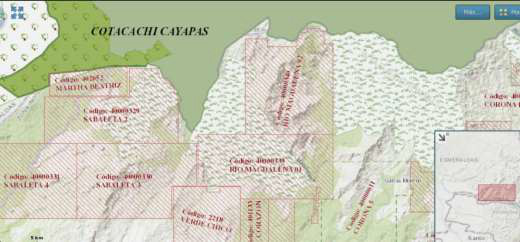
Source: Georeferenced mining cadastre.
17. On November 5, 2018, Jomar José Efren Cevallos Moreno, in his capacity as mayor of Cotacachi canton and Jhesica Liseth Almeida Herrera, the legal representative of the Municipality of Cotacachi, filed an action for injunctive relief against Manuel Humberto Cholango Tipanluisa, in his capacity as Minister of the Environment, and against Carlos Alberto Otero López, General Manager of ENAMI EP. The action for injunctive relief challenged the aforementioned administrative acts,12 specifically the environmental registration and the environmental management plan, because, according to the petitioners, they would have affected the rights of nature by allowing mining activity within the Los Cedros Protected Forest. The petitioners also alleged that neither the constitutional requirements for an environmental consultation, nor those related to the consultation of indigenous peoples and communities, were observed.
18. According to Article 24 of Ministerial Agreement 061, dated April 7, 2015, of the then existing Ministry of Environment and in force at the time, the environmental registration was defined as the environmental permit granted by the corresponding Environmental Authority with jurisdiction over the matter, through the Unified System of Environmental Management (SUIA), and which is mandatory for projects, works or activities considered to be of low environmental impact and risk. For projects with a higher environmental risk or impact, the regulations required an environmental license.
19. On November 13, 2018, the judge of the Multijurisdictional Judicial Chamber of Cotacachi rejected the action, holding that no constitutional rights were violated and that, in accordance with Article 40 of the LOGJCC, “this is a strictly administrative matter, and would be better suited for analysis by judges competent in that subject matter.”
20. The representatives of the GAD of Cotacachi filed an appeal against the ruling of the lower court. On June 19, 2019, the Multijurisdictional Chamber of the Provincial Court of Justice of Imbabura accepted in part the action for injunctive relief, and found there to be a violation of the right to participation as contemplated in Article 61, paragraph 4 of the Constitution. As part of the relief granted in the decision, the challenged portion of the administrative act was held to be no longer in force,13 and the Court ordered the respondents to publish the Court’s decision on their websites, as well as to offer public apologies to the communities that inhabit the area impacted by the project.
21. On August 6, 2019, ENAMI EP — and on August 7 of the same month and year, the MAAE (former Ministry of Environment) and the Autonomous Decentralized Municipal Government of Santa Ana de Cotacachifile — filed an extraordinary action for protection against the court order of June 19, 2019, issued by the Multijurisdictional Chamber of the Provincial Court of Justice of Imbabura. The extraordinary action for protection filed by ENAMI EP alleging the violation of the right of legal certainty, the right to the impartial administration of justice, the right to counsel, and the right to an explanation of legal reasoning, was received on February 7, 2020.14 The claims filed by the then-Ministry of Environment and the GAD of Cotacachi were deemed inadmissible.
III. Constitutional analysis
22. In this appellate decision, the Constitutional Court will divide its analysis as follows: (A) The rights of nature, (B) The right to water and a healthy environment, and (C) Environmental consultation.
A. The rights of nature
23. In the case under review, the GAD explicitly argued the violation of the rights of nature or Pachamama, on whose behalf it appeared. Specifically, in its complaint it cites Article 73 of the Constitution regarding the application of precautionary measures and the restriction of activities that may lead to the extinction of species, the destruction of ecosystems, or the permanent alteration of natural cycles.
24. The respondents asserted that the alleged violation of the rights of nature has not occurred because there is no environmental damage, given that the activity of the mining companies in Los Cedros is currently in its initial exploration phase.
25. According to Article 10 of the Constitution, nature is the subject of those rights that the Constitution recognizes. Among these rights, the Court highlights in the present case two of those included in Article 71 of the Constitution:
i) The right to have its existence fully respected. ii) The right to maintain and regenerate its cycles, structure, functions and evolutionary processes.
26. In order to resolve the underlying case, the Court considers it indispensable to analyze the rights of existence held by the animal and plant species of Los Cedros, as well as the right of this ecosystem to maintain its cycles, structure, functions and evolutionary process.
27. In order to carry out this analysis it is appropriate first to examine the rights of nature as constitutional values and principles, then examine the normative force and scope of these rights, so that the intent of the precautionary principle, enshrined in Article 73 of the Constitution, may be considered as relate to the rights of nature, specifically in relation to the existence of the ecosystem of the Los Cedros Protected Forest, in conformance with the allegations set forth by the petitioner.
28. In its preamble, the Ecuadorian Constitution celebrates nature or Pachamama, of which we are a part and which is vital for our existence. Accordingly, the conception of nature developed by the Constitution in Article 71 includes human beings as an inseparable part of the same, and of the life that it reproduces and forms in its bosom.
29. This constituent declaration of the Ecuadorian people, weaving an intercultural convergence of the knowledge of indigenous peoples and modern Western science, draws upon the universal archetype of the mother and thus recalls the essential relationship between human beings and nature.
30. In highlighting this relationship, the Constitution, in its preamble, emphasizes that Nature, Pachamama, “is vital for our existence”. Here the Constitution perceives that the very existence of humanity is inevitably tied to that of nature, since it conceives humanity as part of nature. Therefore, the rights of nature necessarily encompass the right of humanity to its existence as a species.
31. This is not a rhetorical lyricism, but rather a transcendent statement and a historical commitment that, according to the preamble of the Constitution, demands “a new form of civic coexistence, in diversity and harmony with nature”.
32. The Court emphasizes that these values form part of the constitutional preamble in which the fundamental values of the Ecuadorian people are summarized, and which are expressed throughout the entirety of the Constitution, including those related to right living - sumak kawsay - and the model of development.
Rights of nature and ecological justice
33. The Court observes that, in the case under review, the Provincial Court of Justice concentrates its analysis on the environmental consultation, while the lower court judge reviewing the action for injunctive relief does not develop an analysis regarding the GAD’s allegation concerning the violation of the rights of nature, but rather rejects the requested precautionary measures, limits himself to affirming that the matter dealt with a matter of mere legality, and finds the action for injunctive relief to be inadmissible.
34. It is of much concern to this Court that the rights of nature, to which the Constitution grants express recognition and guarantees, are not being timely and adequately considered by some judges, public authorities and individuals.
35. The rights of nature, like all the rights established in the Ecuadorian Constitution, have full normative force. They do not constitute mere ideals or rhetorical statements, but rather legal mandates. Thus, in conformance with article 11, paragraph 9, integrally respecting - and ensuring respect for - these rights, along with all the other constitutional rights, is the highest duty of the State. This duty of the State is reiterated by the Constitution in article 277, paragraph 1, upon establishing norms for development.15
36. Along these lines, respect for the rights of nature also includes the duty of every entity with regulatory power to formally and materially adapt said norms to these rights, as well as to all the other constitutional rights, as provided in article 84 of the Constitution. Likewise, in article 84, the Constitution provides that public policies shall be intended to effectuate right living and all rights, including, by extension, the rights of nature.
37. Regarding the duties and responsibilities of citizens in general, Article 83, paragraph 6 of the Constitution expressly includes respect for the rights of nature, the preservation of a healthy environment and the rational, sustainable use of natural resources.
38. The Court notes that the normative character of the Constitution applies not only to the rights of nature, but also to all applicable guarantees and principles of constitutional interpretation. Article 71, second paragraph of the Constitution establishes that “any person, community, people or nationality may demand from the public authority the fulfillment of the rights of nature. In order to apply and interpret these rights, the principles established in the Constitution shall be observed, as applicable”. For an effective protection of nature, the Court highlights among these principles direct application and the pro natura principle.
39. In accordance with Article 11, paragraph 3, the rights and corresponding guarantees that the Constitution recognizes for nature are directly and immediately applicable by, and before, any public servant, administrative or judicial, ex officio or at the request of a party.
40. Regarding the pro natura preference principle, all public servants, in accordance with article 11, paragraph 5 of the Constitution, must apply the norm and interpretation that most favors the effective enforcement of rights and guarantees, including the rights of nature.16 In the event there are several interpretations of the same provision, the in dubio pro natura principle is also relevant, in accordance with article 395, paragraph 4 of the Constitution, whereby when in doubt about the specific scope and exclusive nature of environmental legislation, it should be interpreted in the most favorable to the protection of nature. This Constitutional Court additionally determined that these principles should be applied when interpreting the constitutional provisions themselves, since this is what best aligns with the integrity of the Constitution and most favorably allows for the full exercise of rights, in conformance with Article 427 of the Constitution.
41. Within this framework, judges hearing actions for injunctive relief and requests for precautionary measures for possible violations of the rights of nature are obligated to conduct a careful examination of such allegations and petitions, in the same terms that this Court has established for other constitutional rights. In particular, these petitions and claims cannot be denied, as occurred in this case in the lower court, under the mere assertion that the cases deal with purely administrative matters whose adjudication corresponds to the ordinary justice system.17
Intrinsic value of nature
42. The central idea of the rights of nature is that nature has value in itself and that this should be expressed in the recognition of its own rights, regardless of the utility that nature may have for human beings. Article 71 of the Constitution expresses this in the following terms:
Nature or Pachamama, where life is reproduced and realized, has the right to full respect for its existence and the maintenance and regeneration of its vital cycles, structure, functions and evolutionary processes. (emphasis added)
43. It is a systemic perspective that protects natural processes for their own value. Thus, a river, a forest or other ecosystems are seen as life systems whose existence and biological processes merit the greatest possible legal protection that a Constitution can grant: the recognition of inherent rights to a subject. In the Ecuadorian case, there is a general recognition of rights of nature in the Constitution that — as expressed by the Court in Court Order No. 22-18-IN/21, referring to mangrove rights — can be concretized in specific holders; the specific recognition does not imply that recognition is necessary for protection, but rather helps to configure the protection in a manner appropriate to the specific holder of rights, in this case the Los Cedros Protected Forest.
44. In this regard, it is important to understand the ecological tolerance principle, which holds that natural systems can only function adaptively within an environment whose basic characteristics have not been altered beyond what is optimal for that system. This principle is closely related to the right to the existence and reproduction of cycles, for as an environment is modified, it becomes more and more difficult, and eventually, impossible, for the adaptive behavior of the ecosystem to function. For each particular characteristic of the environment (amount of rain, humidity, solar radiation, etc.) there are limits beyond which organisms can no longer grow, reproduce, and ultimately survive.18 Thus, when the ecological tolerance level is exceeded, it is impossible to exercise the right to reproduce life cycles. A protected forest can withstand an impact within certain limits, but beyond those it will lose its structure and be unable to continue exercising this right to reproduce its life cycles, as established in article 71 of the Constitution.
45. The cloud forest is one of several types of ecosystems in Ecuador, and is the ecosystem found in the Los Cedros Protected Forest. The Organic Environmental Code (hereinafter “COAm”) in its respective glossary defines an ecosystem as “a structural, functional and organizational unit, consisting of organisms and the biotic and abiotic environmental variables of a determined area”. In other words, an ecosystem is a community or group of organisms that live and interact in a given environment.19 This supposes that the ecosystem is defined not only by the interrelationships involved therein, but also by its biotic and abiotic components (sunlight, water, minerals and others).
46. The biotic component of the ecosystem is the species that constitute it. A species is defined as the set of organisms capable of interbreeding and producing fertile offspring, though not with members belonging to other species in a natural state.20 Often, over geological time, individuals that separate from the original population and become isolated from the rest may reach a sufficient degree of differentiation to become a new species.21
47. A diverse ecosystem is considered to be one with a high number of interacting species. Biodiversity acts as a natural insurance for the ecosystem because it allows it to recover from the events that affect it. If there are several species that fulfill a similar function, such as feeding on plants, it is feasible that in the event that one of them decreases in population numbers due to natural catastrophes, the others can make up for this deficiency and the ecosystem will recover its stability.22 Both the species and biodiversity of ecosystems are intrinsically valued in the Ecuadorian Constitution.
48. The intrinsic valorization of nature through the recognition of rights is difficult to understand from a rigidly anthropocentric perspective, which conceives of human beings as the most valuable species, while reducing other species and nature itself to a set of objects or resources for the satisfaction of human needs, especially those of an economic character.
49. This vision of nature as a simple source of resources to be exploited at will has been deeply questioned from various perspectives of the natural and human sciences. The rights of nature represent this questioning in the world of law.
50. The intrinsic valorization of nature implies, therefore, a defined conception of the human being about himself, about nature, and about the relations between the two. According to this conception, the human being should not be the only subject of rights, nor the center of environmental protection. On the contrary, while recognizing specificities and differences, a complementarity is proposed between human beings, other species, and natural systems, given that,they integrate common life systems.
51. In this regard, this Constitutional Court highlights what was stated by the Inter-American Court of Human Rights (IACHR) regarding the objectives of environmental protection as stated in Advisory Opinion 23-17:
The aim is to protect nature and the environment not only because of their connection with a utility for human beings or because of the effects that their degradation could have on other human rights, such as health, life or personal integrity, but also because of their importance for the other living organisms with which the planet is shared, also deserving of protection in themselves.23
52. This is a change in the legal paradigm because historically the law has functioned for the instrumentalization, appropriation and exploitation of nature as a mere natural resource. The rights of nature propose that in order to harmonize relationships with nature, it is the human being who must adequately adapt to natural processes and systems, hence the importance of having scientific knowledge and community knowledge, especially indigenous knowledge due to their relationship with nature regarding such processes and systems.
53. This adaptation must also occur within production processes. Indeed, the Constitution itself recognizes in Article 74 that “individuals, communities, peoples and nationalities shall have the right to benefit from the environment and natural resources that allow them to live well”.
54. In conclusion, the notion of the intrinsic valorization of nature is of particular relevance to the constitutional analysis regarding the rights of nature provided for in the Constitution. Since the petitioners claim in their lawsuit that the mining activity in Los Cedros would cause serious and irreversible damage to the species at risk which are present there and to the ecosystem as a whole, and invokes the precautionary principle to that effect, the Court will examine this constitutional principle.
Precaution and prevention
55. The essential idea of the precautionary principle is that, even in the absence of sufficient scientific evidence, it is better not to assume certain risks when these could result in serious damage, which may be irreversible.
56. In the underlying case, the GAD expressly invoked the precautionary principle contained in Article 73 of the Constitution in its complaint, so as to argue the violation of the rights of nature. This article states:
The State shall apply precautionary and restrictive measures for activities that may lead to the extinction of species, the destruction of ecosystems or the permanent alteration of natural cycles.
57. The respondents and in particular ENAMI EP, however, claim the precautionary principle does not apply in this case, since it already would have been observed precisely upon the granting of the respective environmental registration. Instead, there would be certainty about the environmental impacts of the mining activity and therefore the applicable principle in this case would be the prevention principle.
58. The Court observes that neither the trial judge nor the Provincial Court analyzed the precautionary principle or the prevention principle, even though that this was an express allegation of the GAD relevant to this case.
59. The Court considers it essential to elucidate in this case the scope of the precautionary principle because in its article 73, the Constitution applies the precautionary principle to the risk of species extinction and the destruction of ecosystems, considering both situations as violative of the aforementioned rights of nature, and to the full respect of its existence, maintenance and regeneration. All of these concepts are relevant to the case of Los Cedros.
60. According to Article 396 of the Constitution, the precautionary principle determines that “in case of doubt about the environmental impact of any action or omission, even if there is no scientific evidence of damage, the State shall adopt effective and timely Protected measures”.
61. Article 396 includes generic references to the basic components of the precautionary principle in relation to the rights of nature and to a healthy and ecologically balanced environment. More specifically, article 73 of the Constitution applies this principle to the extinction of species, the destruction of ecosystems, and the permanent alteration of natural cycles.
62. Based on these provisions in environmental legislation and constitutional law,24 this Court develops the following elements of the precautionary principle:
1) The potential risk of serious and irreversible damage to the rights of nature, the right to water, to a healthy environment or to health. In order to apply the precautionary principle, it is not enough that a risk simply exists; it is necessary that this risk refers to serious and irreversible damage. Article 73 illustrates this situation well when referring to the extinction of species, destruction of ecosystems and permanent alteration of natural cycles, since all of these are damages so serious and irreversible that the Constitution has included them in the section on the rights of nature, considering them a violation of the same.
2) Scientific uncertainty about these negative consequences, either because they are still the subject of scientific debate, or because of lack of knowledge, or because of the difficulty of determining such consequences due to the high complexity or numerous variables involved. This is the fundamental characteristic of the precautionary principle, and what differentiates it from the prevention principle. Scientific uncertainty for the purposes of the precautionary principle consists of: lack of scientific certainty, which refers to relatively clear or possible effects of an activity or product, but without adequate evidence to assign probabilities25, or ignorance, which refers to the lack of knowledge both of these probabilities and of some of the possible damages or effects. In contrast, the prevention principle applies only when both the effects and their probabilities are known in advance.26
Examples of application of the precautionary principle include human contact with substances or materials such as lead or asbestos27, about which for decades there was no scientific certainty, but only hypotheses of their negative effects on human health, which if precautionary measures had been adopted in a timely manner would have prevented serious illnesses and numerous deaths. It has also been applied to phenomena such as the depletion of the ozone layer,28 the loss of biodiversity29, climate change30, genetically modified organisms31, or human exposure to electromagnetic radiation32, among many others. Although all or some of the potential harms or negative effects that these produce are known a priori, the specific cause-effect relationships between the activity or product and these harms have not been scientifically established, with established probabilities. This limitation of scientific knowledge may be due to the high complexity of a system or phenomenon. Scientific uncertainty may also be evidenced by unresolved scientific debates or absence or insufficiency of knowledge about these effects.
3) Adoption of timely and effective Protected measures by the State. When there is a risk of serious and irreversible damage, but also a corresponding uncertainty surrounding scientific knowledge, it is precisely due to this uncertainty that the State must not assume the risk and instead take certain measures in a timely and effective manner to avoid these possible negative effects.33 In other words, when there is no scientific certainty about the impact or damage caused by an action or omission to nature, the environment, or human health, the State must adopt effective and timely measures to avoid, reduce, mitigate or cease such effects34. Therefore, the precautionary principle favors, in the face of scientific uncertainty, the plausible hypothesis of the worst case scenario: serious and irreversible damage, even if this occurs in the long term. It should be clarified that the prohibition of a product or process is not the only Protected measure that may be adopted, although sucha prohibition may be justified if the potential harm is very serious and irreversible.
63. The precautionary principle differs from the prevention principle in that the latter is applied when there is scientific certainty about the impact or harm, that is, when both the effects and their probabilities are known in advance. In terms of article 396 of the Constitution, “The State shall adopt appropriate policies and measures to avoid negative environmental impacts, when there is certainty of damage”. In other words, the prevention principle entails the State’s obligation to demand compliance with provisions, norms, procedures and measures aimed primarily at eliminating, avoiding, reducing, mitigating and ceasing the impact.35
64. Consequently, Article 73 of the Constitution, concerning precaution in the fact of the risk of species extinction and destruction or serious disruption of ecosystems, constitutes a principle of application of the rights of nature, which is complemented by Article 396 of the Constitution.
65. Article 73 also establishes a duty of the State by imperatively stating that it “shall apply precautionary and restrictive measures”. This is not a conditional power or option, but a constitutional obligation derived from the intrinsic value that the Constitution places on the existence of species and ecosystems through the rights of nature. In effect, the risk in this case does not necessarily relate to the effects on human beings, although they may be included, but rather to the extinction of species, destruction of ecosystems or permanent alteration of natural cycles or other types of serious or irreversible damage to nature, independently of such effects36.
66. It should be emphasized that according to article 396 of the Constitution, precautionary and restrictive measures must be effective and timely. They are effective insofar as they actually fulfill, in a material and not only formalistic sense, the objective of avoiding the violation of the rights of nature implied by the extinction of species or destruction of ecosystems. They are timely insofar as they are announced and complied with immediately, and applied in time, such that they meet the protection objectives.
67. Application of the precautionary principle by constitutional judges must be determined on a case-by-case basis, taking into account the individual and concrete characteristics of the case, the existence of a risk of serious and irreversible damage, as well as scientific uncertainty. This uncertainty refers to the debate still existing in the scientific community about the harm generated by an activity or product, or to insufficient scientific knowledge on the issue. Therefore, these judges, even if there is no conclusive scientific information, but availing themselves of the available scientific and technical information, should identify and analyze the risk of serious and irreversible damage due to the development of an activity or a product in order to duly substantiate in each case the application or non-application of the precautionary principle.
On the extinction of species and destruction of ecosystems
68. A violation of the right of nature to the full respect for its existence occurs through activities that lead to the extinction of species. This is a violation of such magnitude that it would be equivalent to what genocide means and implies in the field of human rights. Once a species is extinct, the laborious process that has taken nature sometimes millions of years results in an irreparable loss of diversity and knowledge. Article 73 of the Constitution applies the precautionary principle to these cases precisely due to the serious and irreversible nature of harm occasioned by the extinction of species.
69. Likewise, given the systemic relationships that all animal and plant species maintain, the disappearance of one or more of them can lead to the extinction of others, or even the destruction of entire ecosystems or the permanent alteration of natural cycles referred to in the same article 73 of the Constitution. This destruction or alteration could also be generated for reasons other than the extinction of species, but the Court wishes to emphasize here the systemic nature of these phenomena. Furthermore, these violations to the rights of nature may have unsuspected negative effects on human beings, which would also violate other rights, such as the right to water and to a healthy environment, as analyzed below in this opinion.
70. In order to analyze the situation of these rights of nature and the application of the precautionary principle in the case of the Los Cedros Protected Forest, the Court first sets forth a description of this ecosystem based on the scientific information received during the verified evidentiary proceedings of this case, including the endemic, threatened, unique and rare species present in the ecosystem.
Los Cedros is a remnant ecosystem of the northwestern forests of Ecuador
71. Various researchers have pointed out that, in the last fifty years, Ecuador has lost almost all of its vegetative cover. In the year 2000, it was estimated that approximately 96% of the old-growth forest land in the west of the country had been deforested. Much of the remaining 4% has since been lost. Both low altitude forests (below 600 mamsl) and mountain forests, including cloud forests, typical of the foothills, have almost disappeared.37
72. For further context, in 1938, in an area of approximately 70,000 km² of the Ecuadorian coast, about 60,000 km² of forests existed.38 Today, the largest remnants of forest in the region, which together total less than 5,000 km², are only four in number: the Awa Ethnic Reserve (Awa), the Mache Chindul Ecological Reserve, the Chongón Colonche Protected Forest, and the Cotacachi Cayapas National Park. Only two, the Awa Ethnic Reserve and Cotacachi Cayapas National Park, maintain remnant cloud forest protected areas. These forest types, as life zones, have been poorly represented within the National System of Protected Areas.39 Los Cedros, with its 6,400 hectares, is one of the last remnants of western cloud forest that remains relatively unaltered.
Los Cedros is an ecosystem at the confluence of two regions of high diversity: the tropical Andes and the Chocó Bioregion
73. Two high biodiversity zones converge in Los Cedros: the Tropical Andes Bioregion and the Chocó Bioregion.40 Biological diversity is a measure of the genetic richness (wealth of genetic information) of a given life zone. The higher the number of species that inhabit a place, the greater its biodiversity.41
74. The Andes in Ecuador are biodiverse because in addition to being in the world’s equatorial zone, which is home to tropical rainforests such as the Amazon, they are mountains of more than 4000 meters. These two characteristics are exceptional and only occur in the north, in Colombia and Venezuela, and in the south, in some areas of Bolivia and Peru, and in the northernmost regions of Argentina and Chile42.
75. The Chocó Bioregion extends from eastern Panama along the Pacific coast of Colombia and the Ecuadorian coastline to border the dry forests of southern Ecuador. Its extremely high levels of precipitation and humidity (3,000 to 11,000 mm per year)43, its tropical condition, its unique geological history and its isolation (being separated from the Amazon basin by the barrier of the Andes mountains) have made the Chocó one of the 34 most diverse places in the world as it gathers 3% of the total number of plant species on the planet, that is some 11,000 species in less than 0.2 of the earth’s surface.44
76. Biodiversity also includes the concept of endemism. A species is endemic when it is only found in a certain geographical area (province, region, country or continent) due to the presence of natural barriers (rivers, mountains, canyons, oceans, etc.) that prevent populations of that species from interbreeding or reproducing with other populations of the same species. By limiting the crossing of genetic information over long periods of time, the endemic species becomes so differentiated that it is no longer possible for it to interbreed with the original species. This is the case of island species such as Galapagos or Hawaii, which originally descended from continental species but are now endemic.
77. Scientific studies indicate that the Chocó is also a center of endemism. There, approximately 2,750 plants are endemic.45
Los Cedros is an ecosystem with endemic species.
78. Los Cedros is not accessible by road and is one of the most remote forests in the northwest. It is this inaccessibility that has kept the Los Cedros Protected Forest almost intact, but it has also meant that it has been less scientifically46 explored than other remnants of forest in the region, such as the Mashpi and Maquipucuna reserves.
79. Many plants in this forest are local endemics with small distribution47 ranges. This means that due to a special combination of microclimate barriers and/or rugged relief within the forest, populations of a given species are less able to cross the barrier and reproduce with other similar populations of the same species. Over time, said population becomes increasingly isolated and in turn differentiates from its original population until it finally becomes a new species limited to areas as small as, for example, the western side of a ravine, the top of a hill, or the edges of a seasonally flooded area and is not in any other part of that same forest, thus becoming a local endemic. This makes them particularly vulnerable to disturbances such as earthquakes, floods and changes in land use48.
80. This seems to be the case within the orchid group49, about which verified information has been documented, and a record of 236 species identified. According to the catalog of the Los Cedros Reserve, there are twelve endemic species in this forest.50 Of these welve species, nine have been confirmed as endemic by studies carried out by specialists in the taxonomy of this group of plants. These are: Brachionidium ingramii, Dracula morleyii, Dracula pubescens, Lepanthes morleyii, Platystele gaileana, Platystele cedriendsis, Platystele rhinocera, Porroglossum lorenae, Trisetella dalstroemii.51
81. Studies are needed to determine an approximate total number of endemic species by taxon (family, genus, etc.) in Los Cedros. However, when considering that 27% of the total number of plants in Ecuador are endemic,52 and that this forest is part of the Chocó where approximately 25% of plant species are endemic,53 it is reasonable to infer high levels of endemism in the organisms that inhabit the vegetative cover.
Los Cedros is an ecosystem with a high number of endangered species
82. Extinction is a biological process that leads to the disappearance of species. A species is considered extinct when its last specimen dies. Extinction is certain when there is no longer any individual capable of reproducing and giving rise to a new generation. A species can also become functionally extinct, that is, a very small fraction of its members survive but are unable to reproduce due to factors such as health problems, age, great geographic distance between their remaining populations, lack of individuals of both sexes, and other reasons.54
83. A species may also become locally extinct. In this case, the species in question ceases to exist in a given area but continues to exist elsewhere. This phenomenon is also known as extirpation. An example of a local extinction or extirpation in Ecuador is that of the tawny-throated dotterel (Oreopholus ruficollis), a bird that once inhabited the southwestern Santa Elena Peninsula but is now currently considered extinct in the country, although it still inhabits areas from Peru to Argentina.55 As a result of industrial development and human population growth, it has been seen that local extinctions of a given species can lead to total extinction of the species.56
84. Because of the number of relationships that a species establishes with other species in the ecosystem, its extinction can lead to what is known as an extinction chain. In this case, the disappearance of a single species can cause extinctions both up and down the food chain of which it is a part.57
85. The International Union for Conservation of Nature (IUCN)58 has established several categories that assess the probability that a known species will disappear. These are, from greatest to least risk of extinction: i) EX, extinct species, ii) EW, extinct in the wild, iii) CR, critically endangered, iv) EN, endangered, v) VU, vulnerable, vi) NT, near threatened, vii) LC, least concern for this species.
86. According to the IUCN, there are two species of mammals at maximum risk of extinction in Los Cedros, level CR. These two species are the jaguar (Panthera onca) and the brown-headed spider monkey (Ateles fusciceps fusciceps).
87. With respect to the jaguar, studies in 201359 have shown that the species has been practically extirpated from the lowland tropical forests of the northwestern part of the country due to habitat loss and the need for large territories for breeding.60 Its presence has only been recorded in Cotacachi Cayapas61 National Park, and in Los Cedros, less than five kilometers from the Mandariacu River.62
88. The case of the brown-headed spider monkey is similar. Only two populations have been recorded in the northwestern part of the country. One within the Awa Ethnic Reserve and the other within the Cotacachi Cayapas National Park.63
89. In addition, Los Cedros protects a considerable extension of the south face of the Toisán mountain range where, due to its inaccessibility, it is likely that populations of threatened birds can take refuge and thrive. Among these birds, Quito’s flagship species, the black-breasted puffleg (Eriocnemis nigrivestris) is critically endangered on both the IUCN list and Ecuador’s64 red list of birds. The original habitat of this bird included the montane forests that extended to the northwest of Pichincha, Esmeraldas and Imbabura. Having disappeared, and with very few records of it, this bird was thought to have been extirpated from its habitat but in 2008 a small population (48-108 individuals) was rediscovered at Cayapachupa in the Toisán mountain range on the border between Esmeraldas and Imbabura65.
90. Other notable mammals in varying degrees of threat that have been reported in Los Cedros include the spectacled bear Tremarctos ornatus (VU), two species of felines: the margay Leopardus wiedii (NT) and the oncilla Leopardus tigrinus (VU), and two other primate species, the white-faced capuchin Cebus capucinus (VU) and the mantled howler monkey Alouatta paliatta (EN).66
91. The category of birds consists of 309 species recorded at Los Cedros, of which 26 face varying degrees of threat.67 Of particular importance are the iconic long-wattled umbrella bird Cephalopterus penduliger, the banded ground cuckoo Neomorphus radiolosus and the baudo guan Penelope ortoni. The first two are in the vulnerable category (VU) and the third in the threatened category (EN).68 These three birds can still be seen within Los Cedros.69
92. In 2005, the non-governmental organization Birdlife International declared the Los Cedros Protected Forest an “Important Bird Area” (IBA).70
93. These forests also host several species of threatened migratory birds that depend on sufficient available forest habitat to arrive after their long journeys to escape winter in Canada and the United States, such as the cerulean warbler Setophaga cerulean (IUCN category VU) and the olive-sided flycatcher Contopus cooperi (IUCN category Near Threatened - NT).71
94. The category of toads is very important because worldwide their species are suffering a significant decline due to the influence of global warming on their populations. In Los Cedros, almost all species are threatened and are only found within Los Cedros and in nearby local cloud forests (Mashpi, Maquipucuna). There are three Critically Endangered (CR) species: the longnose stubfoot toad Atelopus longirostris, the confusing rocket frog Ectopoglossus confusus and the Quito rocket frog Hyloxalus jacobuspetersi.72
95. Reptiles and bats still need to be systematically evaluated in terms of their threat categories and to confirm the species present in the forest, especially bats, given that little is known about them. 73
96. The threatened plants include two species of orchids, Dracula alcithoe and Masdevallia ventricularia, both of which are in the IUCN74 EN category, as well as nine additional species, all endemic to Ecuador and in the IUCN EN category, five of which are tree species, three of which are herbaceous, and one fern.75
97. The microorganisms studied at Los Cedros are mainly fungi that decompose organic matter, including four species that are listed in a recent IUCN initiative to identify species of this group that may disappear. These four species of fungi are: Lamelloporus americanus, Hygrocybe aphylla, Tamnomyces chocoensis, and Callistodermatium aurantium. All of these have been collected in Los Cedros.76
Los Cedros is an ecosystem with unique and rare species
98. In 2018, a comparative study was published examining species occurrence in the few remaining remnants of northwestern montane cloud forest, such as the Mashpi and Maquipucuna Reserves, Los Cedros and the Intag Valley. Of the four localities studied, only in Los Cedros were 157 species identified as unique, that is to say they were not found in any of the other study sites. Of these, 106 are orchids, 33 are birds, 7 are mammals, 7 are reptiles and 4 are amphibians.77
99. Advances in technology have also allowed the use of camera traps to study wildlife. Thanks to this and other novel remote viewing systems at Los Cedros several rarely observed animal species have been recorded, including: the Mountain Lion (Puma concolor), the jaguarundi (Herpailurus yagouaroundi), the very rare northern nakedtailed armadillo (Cabassous centralis), the nine-banded armadillo (Dasypus novemcinctus), the little red brocket (Mazama rufina), the lowland paca (Cuniculus paca), the agouti (Dasyprocta punctata), and the rare western dwarf squirrel (Microsciurus mimulus).78 Several of these animals are nocturnal and due to the difficulties inherent to their study, the status of their populations has not been evaluated or updated in the cloud forest remnants of the northwest.
Los Cedros is an ecosystem with a rich and unknown genetic heritage
100. The gene pool or genetic heritage of an ecosystem can be defined as the totality of genes present in each and every one of the organisms that inhabit it. In recent years several new species have been discovered in Los Cedros. The following can be mentioned:
101. In 2015, a frog was discovered and named Pristimantis mutabilis. This amphibian has a high capacity to modify the texture of its skin as it can change its appearance from smooth to granular in a few minutes.79 Also, in this group and in the same year, biomolecular techniques were used to identify two new species of toads (Pristimantis cedros and P. pahuma), which were originally believed to be a single species. This study concluded that it is very likely that there are many more species of this type that are referred to as cryptic species and that therefore the increase in biodiversity and the conservation status of these species needs to be evaluated.80
102. Other new species exist within the group of begonias81 and the Sabiaceae family (Meliosma gracilis)82 that would have ornamental and medicinal applications. Among the Solanaceae, in Los Cedros, a species of Cuatresia has been discovered: C. physalana, which could have agricultural and/or pharmaceutical value due to its relationship with potatoes and tomatoes, since it is known that members of this genus have antimalarial compounds in their cells.83
103. In the plant group, orchids have made contributions such as the discovery of two new species of the Platystele genus: P. cedriensis and P. decouxii.84 In Los Cedros it has been proven that in addition to contributing new species, each orchid species can be a center of biodiversity in itself, expanding the richness of the gene pool of the area. This happens because orchids are highly specialized organisms that establish multiple and complex ecological relationships with other organisms in their microecosystem such as the pollinators that visit them. One study found that more than 60 unknown species of fruit flies pollinate a single species of orchid (Dracula lafleurii)85. These new fly species are related to Drosophila melanogaster, a model fruit fly, which has contributed immensely to the knowledge and development of molecular genetics and neurobiology.86
104. Another important potential is found in the decomposer fungi species of Los Cedros. These organisms, with their ability to transform substances into their simplest components, are currently being used in the field of bioremediation. Some of these organisms are being used to process oil spills, decomposition of plastic substances, and other pollutants87. In Los Cedros several studies have been carried out in this field and some 300 genera belonging to 81 fungal families have been collected, among which there are undescribed species whose ecology is unknown”.88 This figure supposes a very high biodiversity in terms of gene pool.
105. Additionally, the trichoptera or caddisflies, a group of aquatic insects that populate the waters of forest ecosystems, must be mentioned. They are usually collected as larvae in streams to determine the state of health of the ecosystem because they are very sensitive to the presence of foreign substances. A great diversity in this group assumes unpolluted waters. Their usefulness, then, is to be bioindicators, but in addition, their larvae make a type of silk fiber with which they form a waterproof cocoon that protects them during their metamorphosis to the adult stage. Due to current biotechnology, genes taken from organisms such as spiders have led to the development of fibers with exceptional flexibility, strength and light weight.89 In Los Cedros, after three nights of collection, 40 species were found, of which more than a third, roughly 15, are likely new to science.90 Considering that trichoptera is only one of the 11 macroinvertebrate groups in the region91, the potential number of new species at Los Cedros is high.
Los Cedros is a buffer zone that protects the Cotacachi Cayapas National Park from the “edge effect”
106. In the area where Los Cedros has been deforested to make way for crops, pastures or human settlements, an ecological condition called the “edge effect” is experienced. This term is used to refer to the boundaries created between a natural environment and one artificially generated by humans. The edge of the forest that is exposed by logging begins to dry out, both because it no longer maintains the equilibrium of humidity that previously existed, and due to the entry of more sunlight. This makes forests more susceptible to fires and to the invasion of alien species that compete with native species and can displace them.92
107. Additionally, since the border is closer to roads and thoroughfares, it is more likely that logging will continue and the agricultural frontier will advance, slowly but progressively diminishing the vegetative cover.
108. Los Cedros provides protection for the western edge of Cotacachi-Cayapas National Park. Long before it was declared a Protected forest in 1994, the forest has served as an area that received the brunt of the harmful effects of illegal logging on its perimeter, hereby allowing the western zone of Cotacachi-Cayapas National Park to be preserved.
109. In fact, within Los Cedros there are three areas of illegal encroachment. They were detected in 2005 by the forest’s administration and communicated to the entities in charge of the forest’s control.93 In addition to being a buffer zone for the national park, Los Cedros is a barrier to land invasion into the park as well.
Los Cedros is an ecosystem that is a corridor for biodiversity
110. Species present in the forest such as birds and mammals, insects and others require mobility to fulfill their basic functions such as reproduction and foraging. Plants and fungi, in turn, require territory to disperse and expand their range. As human actions diminish the areas they previously inhabited, it has become necessary to establish areas called biodiversity corridors, that is, protected areas that are at least large enough for animal and plant populations to move through them and maintain ecological viability.
111. Los Cedros is a corridor that connects with the Awá Ethnic Reserve to the northwest, and with the Mashpi and Maquipucuna reserves to the southwest. In addition, the link between Los Cedros and the Cotacachi Cayapas National Park is essential for the ecological functioning of western corridors such as the Andean Bear Corridor, the Chocó Corridor, and the recently proposed Northwestern Biosphere Reserve.94
5.1 Precautionary Principle and the Los Cedros Protected Forest
112. Once the biodiversity present in the Los Cedros Protected Forest has been described, it is necessary to analyze whether or not the constitutional precautionary principle is applicable in the underlying case, taking into account the allegation of the GAD. The Court considers that, taking as a basis the relevant constitutional and legal provisions previously mentioned, the precautionary principle implies the identification of at least the following elements:
i) The potential risk of serious or irreversible damage that a product or the development of an activity may have on the rights of nature, the right to water, the right to a healthy environment, and the right to health.
ii) Scientific uncertainty about these negative consequences, either because they are still the subject of scientific debate, due to lack of knowledge, or because of the difficulty of determining such consequences due to the high complexity or numerous variables involved.
iii) The adoption of effective and timely Protected measures by the State. Faced with the risk of serious and irreversible damage for which we have no scientific certainty, measures should be adopted that best protect the rights of nature, water, a healthy environment and health.
113. Additionally, an environmental consultation is a participatory mechanism that can contribute in certain cases to the application of the precautionary principle. For example, the adoption of effective Protected measures may arise from the consultation, or the consultation may help to identify risks. This aspect will be reviewed in greater detail below when analyzing the environmental consultation.
114. The Court also clarifies and emphasizes that the application of the precautionary principle must always be carried out in a reasonable and proportional manner, that is to say, only when the effective concurrence of the aforementioned elements is effectively established, and under a careful and motivated analysis of each individual case, considering its specificities and concrete characteristics.
115. The Court now proceeds to examine the risk of serious and irreversible damage, the scientific uncertainty, and the adoption of effective and timely measures to determine whether the application of the constitutional precautionary principle to the species and biodiversity existing in Los Cedros is appropriate. It is important to note that the scientific information presented here deals exclusively with the biodiversity and hydraulic importance of Los Cedros, but not with the effects that mining activity would have on this Protected forest. There are no technical studies on the latter issue, which contributes to the element of scientific uncertainty inherent in the precautionary principle, as will be discussed below.
5.1.1. The risk of serious and irreversible damage that a product or the development of an activity may have on the rights of nature, the right to water, to a healthy environment or to health
116. The GAD, upon invoking articles 71 and 73 of the Constitution, has asserted that the extractive activity of metallic mining in Los Cedros violates nature's right to an integral existence by causing the extinction of species. Likewise, mining activity in Los Cedros would violate nature’s right to maintain and regenerate its vital cycles, structure, functions, and evolutionary processes. This right is violated by destroying the ecosystem or causing permanent alteration of the natural cycles of this forest.
117. On the other hand, the respondents claim that mining activity in this Protected forest can be carried out adequately because it would be possible to avoid, reduce, mitigate, and cease the environmental impact of mining activity by complying with the norms and measures established by the State. The following table shows the 178 species known to inhabit Los Cedros that are at high risk of extinction as of March 2018.
Table 1 Species at Risk of Extinction in Los Cedros
| Group | (CR) | (EN) | (VU) | (NT) |
| Orchidsᵃ | 0 | 2 | 57 | 12 |
| Birds | 0 | 4 | 9 | 13 |
| Mammalsᵇ | 2 | 2 | 9 | 4 |
| Reptiles | 0 | 1 | 3 | 8 |
| Amphibians | 0 | 6 | 4 | 5 |
| Other plantsᶜ | 0 | 9 | 17 | 11 |
| TOTAL | 2 | 24 | 99 | 53 |
CR=critically endangered; EN=threatened; VU=vulnerable; NT=near threatened.
ᵃUnderestimated. It is probable that there are 200 more species. (Bird Life International 2017. Important bird and biodiversity area Factsheet: Bosque Protector Los Cedros).
ᵇBats have not yet been studied at Los Cedros. ᶜUnderestimated, the anticipated number of plants is over 2000 species, since the reserve has never been catalogued. (Table Adapted from data presented in Table No. 1 of Roy. et. al, 2018 p 7)
118. Based on this picture and the biological information presented above, the Court observes a high level of risk of irreversible damage, due to the great complexity of the ecosystem, the fragility in which this forest is found and the threat under which several of its plant and animal species run the risk of extinction, and the consequent destruction of the ecosystem or permanent alteration of its natural cycles.
119. As described in detail above based on scientific sources, Los Cedros is a remnant of Ecuador’s northwestern forests where two regions of high biodiversity — the tropical Andes and the Chocó region — converge; it includes endemic, threatened, unique and rare species. Additionally, this forest is linked to the Cotacachi-Cayapas National Park and, as will be detailed below, it is also of great hydraulic importance.
120. As noted, the GAD in its complaint and in its appeal highlighted the presence of numerous endemic threatened and endangered animal and plant species in Los Cedros. On the other hand, as detailed earlier in this judgment, the higher the number of species in an ecosystem, the greater its biodiversity, and the greater its own capacity to maintain and regenerate itself. Consequently, the extinction of species in Los Cedros would diminish biodiversity, and therefore, the capacity of this ecosystem to regenerate its vital cycles, structure, functions and evolutionary processes. For example, the disappearance of a single species can cause extinctions both up and down the food chain of which it is a part, thus altering the ecosystem as a whole. Thus, biodiversity is a relevant constitutional condition in the review of the present case.
121. In addition, as noted above, Los Cedros Protected Forest serves as a buffer zone for the Cotacachi-Cayapas National Park, with which it borders, and fulfills other functions of Protected forests,95 particularly those related to the conservation of ecosystems and their biodiversity; the preservation of watersheds; and its status as an area of interest for scientific, environmental and forestry research.
122. Another important function of Protected forests, which is also the case of the Los Cedros cloud forest, is to contribute to the conservation of fragile ecosystems, understood as areas with unique characteristics or resources that are highly susceptible to any human intervention.
123. The Court considers that because of all these characteristics and functions of the Los Cedros forest, described based on scientific sources throughout this opinion, this forest has special importance for the conservation of biodiversity. Thus, it is evident that there are serious risks of violations to the cycles, structure, functions and evolutionary processes of Los Cedros, and therefore of the rights of nature, which are embodied and exercised in this Protected forest as a holder of the same.
124. The Court observes that the extinction of species in the Los Cedros Protected Forest necessarily leads to the destruction of this ecosystem and the permanent alteration of its natural cycles, incurring in turn the irreversible damages referred to in Article 73 of the Constitution. In sum, the Court considers plausible the hypothesis that the mining activity would generate these damages, which constitute a clear violation of the rights of nature and specifically to the existence of its species and ecosystems, as well as to the regeneration of its cycles, structure, functions and evolutionary processes.
5.1.2. Scientific uncertainty regarding these negative consequences, whether due to being the subject of ongoing scientific debate, lack of knowledge, or the difficulty of determining said consequences given the high complexity or numerous variables involved
125. Scientific uncertainty is a generally accepted component of the precautionary principle. Such uncertainty not only implies the lack of data or models to assess a risk, but may also derive from the impossibility of determining the probabilities or identifying the effects of a given activity due to the high complexity of the system being analyzed.96
126. In the case of Los Cedros, as mentioned above, while important information about its high biodiversity has been documented, much of its biological richness is still unknown. Nevertheless, scientific uncertainty stems precisely from the lack of specific information about the effects — including over the medium- and long-term — that metallic mining would have on this fragile and biodiverse ecosystem, with numerous species at risk of extinction and its corresponding complexity. This ecosystem is also an important water source and a buffer zone for the Cotacachi Cayapas National Park.
127. The Court identifies obstacles of an objective nature to the determination of the effects of metallic mining in Los Cedros for the following reasons: 1) the fragility, biodiversity, and endemism of the ecosystem, and, generally speaking, a level of biodiversity and complexity that implies such a high number of variables and relationships that it is impossible to study adequately the probabilities of the environmental impact of metallic mining in the forest. This results in a lack of scientific certainty. 2) the lack of knowledge regarding the ecosystem’s genetic heritage, as discussed above, which makes it impossible to clearly determine the possible effects of mining activity. This lack of information gives rise to the element of ignorance. 3) The function of Los Cedros as a critical buffer zone with respect to the Cotacachi-Cayapas National Park, of which there is also no knowledge about the possible negative effects that could extend beyond the Protected forest to a reserve zone where the Constitution prohibits metallic mining activities, according to Article 407 of the Constitution. This generates, another set of unknown effects that also contribute, in this case, to the element of ignorance inherent to the precautionary principle.
128. In the event that these studies were sufficient to evaluate the environmental impact, they should be carried out in the initial exploration phase considering the aforementioned characteristics of Los Cedros, and the corresponding legal requirements97.
129. Indeed, it should be recalled that according to Article 86.3 of the Constitution, when examining questions of standing, such as in the underlying case, “The grounds alleged by the claimant shall be presumed to be true when the requested public entity does not prove otherwise or does not provide information.”
130. The Court observes that — assuming it is possible to determine the effects of metallic mining in Los Cedros — the respondents have not provided this Court with any specific, substantiated scientific evidence regarding the impacts the mining activity would have on the rights of nature, demonstrating that said activity will not generate irreversible harm to the Los Cedros Protected Forest, such as the extinction of species and destruction of the ecosystem.
131. Nor is the mere issuance of an environmental registration — which does not describe, consider, or evaluate in a sufficient technical manner the complex biodiversity of this Protected forest — admissible to supplant the constitutional obligations of the State to comply with the precautionary principle and the consequent protection of the rights of nature, particularly those protecting the existence of species at high risk of extinction, or those preventing the destruction or alteration of fragile ecosystems such as the one existing in Los Cedros. Environmental registration of fragile ecosystems such as Los Cedros must also fulfill a precautionary function, and, therefore, should always be preceded by studies of assessment or environmental risk that account for the biodiversity of the respective ecosystem.
132. In previous cases discussing the rerouting of waterways, this Court has stated that the mere granting of a permit or license does not replace the obligation to conduct technical and independent environmental studies that guarantee the rights of nature: “the authorities responsible for issuing these permits must be guarantors of the rights of nature and access to water. Therefore, they must exercise strict compliance control with constitutional, legal and regulatory requirements, and anticipate the liability that could be occassioned by issuing authorizations that give rise to violations of constitutional rights upon not having adopted the necessary provisions”.98
133. This obligation of public authorities to guarantee the rights of nature when issuing environmental permits is evident and indispensable when referring to fragile ecosystems such as Los Cedros, since these are, “areas with unique characteristics or singular resources that are highly susceptible to any intervention of an anthropic nature, which produce a profound alteration in their structure and composition”.99
134. Based on this reality, although initial exploratory mining is defined as having a low environmental impact, the Court cannot fail to observe that said impact is much greater when such activities take place in fragile ecosystems, for which reason the Constitution itself and the law develop specific regulations.
135. Along these lines, the Court observes that, since the Los Cedros cloud forest is a fragile ecosystem with endangered species, it is subject to the specific regulations that the State is obliged to promulgate for its conservation, management, sustainable use, restoration, and delimitations, as provided in Article 406 of the Constitution.
136. In fact, the very same environmental registration certificate granted for initial exploration within Los Cedros cites in its fourth provision of article 19 the Environmental Management Law, in effect at the date of issuance of the environmental registration, and which establishes: “Public, private or mixed public and private works, and public or private investment projects that may cause environmental impacts, shall be qualified prior to their execution by the decentralized control agencies, in accordance with the Central Environmental Management System, whose guiding principle shall be precautionary.” (emphasis added)
137. Therefore, the environmental registration in this case must not be limited to a mere automated procedure100, as the one that was conducted. It is observed in the environmental registration that this matter was reduced to the entry of data into a computer system and the automatic issuance of said registration, without verifying that there was an analysis by the environmental authority on the rights of nature as pertains to the Los Cedros Protected Forest, based on scientific information about its biodiversity.
138. Articles 73 and 396 of the Constitution, as well as the law itself, obligated the environmental authority to consider, and if necessary apply, the precautionary principle to protect the rights of this forest, where there are threatened species in a fragile ecosystem of hydraulic importance and which is necessary for the conservation of the Cotacachi-Cayapas National Park. As has been said, in applying this principle, the environmental authority should also consider the burden of proof, which falls on those proposing the activity that could risk causing serious and irreversible harm to species and ecosystems, and therefore the rights of nature, the right to water, and the right to a healthy and balanced environment.
139. The Court reiterates that the inadequate protection of a buffer zone101 such as the Los Cedros Protected Forest affects not only this fragile ecosystem but could also cause environmental damage to the Cotacachi-Cayapas National Park with which it is adjacent, and to whose conservation it decisively contributes, according to studies by the Ministry of Environment itself102. This park is one of the areas protected by Article 407 of the Constitution, which prohibits the extraction of non-renewable resources.
140. For this reason, according to Article 59 of the COAm, the management plans for each protected area must include the delimitations, uses, and other characteristics of the buffer zones. The same provision establishes that, “Activities carried out in the buffer zones must contribute to the fulfillment of the objectives of the National Protected Areas System”. Likewise, Article 32 of the Unified Text of Secondary Environmental Legislation, in effect at the time of the events in the underlying case, established that the environmental management plan consisted of various sub-plans for prevention, impact mitigation, contingencies, training, safety, and waste management, amongst others concerns. In this regard, the Environmental Management Plan for the exploration phase103 is deficient, since it is limited to a general enumeration of activities to be carried out by the respondent company, without further analysis adequately addressing the reality of the biodiversity found in the Los Cedros Protected Forest. In effect, this Plan merely transcribes legal norms without carrying out the minimum consideration of the application of these norms that would justify the authorization granted in the underlying matter.
141. This eco-systemic interdependence is one of the reasons why the Court cannot accept the interpretation of the respondents in the sense that Article 407 of the Constitution— which prohibits extractive activities of non-renewable resources in protected areas, urban centers, and in zones declared as intangible — has an exclusive and restrictive character. Although it is clear that in this provision the Constitution expressly prohibits extractive activities in these areas, it does not conclude that such activities are automatically or unconditionally authorized in the rest of the national territory, or that, once the constitutional and legal conditions are verified, such activities cannot be restricted or suspended in different areas, under a case-by-case analysis.
142. In effect, it would not be logical to affirm that the rights of nature, the right to water, and the human right to a healthy and balanced environment are only valid in protected areas and intangible zones. On the contrary, the obligations to protect these rights apply to public authorities throughout the national territory, and must therefore be analyzed in accordance with the Constitution and norms promulgated thereunder when authorizing, restricting or regulating said extractive activities.
143. In short, in the case of Los Cedros, despite being a highly biodiverse fragile ecosystem with numerous endangered species, an area of water sources, and a buffer zone of the Cotacachi-Cayapas National Park, the technical and independent studies that this Court has considered indispensable in its jurisprudence in order to seriously evaluate the biodiversity of this ecosystem and possible violations of the rights of nature were not carried out, assuming they were sufficient, prior to the issuance of the environmental registration.
144. In the same sense, as a development of the constitutional precautionary principle, article 9.7 of the COAm stipulates that it is primarily the state environmental authorities, within their respective scopes of power, who must apply the precautionary principle to avoid, reduce, mitigate or cease irreversible effects on nature.
145. However, the administrative authorities did not consider this constitutional and legal principle when issuing the environmental registration. The Court recalls that according to Article 404 of the Constitution, the management of the country's natural heritage, which includes physical and biological formations of environmental and scientific value such as Los Cedros, requires its protection, conservation, restoration and support. For this purpose, according to the aforementioned article, such management must be subject to the principles and guarantees established in the Constitution and the law.
146. The Court considers that the environmental authority should have examined the biological value and rights of Los Cedros and its species prior to issuing the environmental registration. Based on this and applying the precautionary principle, it should have required the respondents to comply with their obligation to submit information on the impact on the rights of nature that their activity would produce.104 In the Court’s opinion, this would have led the MAE to find that the scientific certainty claimed by the respondents about the nature and scale of the impact or harm of metal mining in this forest does not currently exist. This uncertainty is due to the excessive complexity implicated by the principles of cause and effect as related to the impact that metallic mining activity would have on the biodiversity of this fragile ecosystem, on its endemic animal and plant species at high risk of extinction, and even on the Cotacachi-Cayapas National Park.
147. Consequently, the scientific knowledge presented to this Court on the animal and plant species existing in Los Cedros makes plausible the hypothesis that metallic mining in this forest could have serious and irreversible consequences on these species, the ecosystem as a whole, and the Cotacachi-Cayapas National Park.
148. Absent this scientific certainty, the second element necessary for the application of the precautionary principle is met, which should be considered when issuing an environmental registration.
5.1.3. Adoption of effective and timely Protected measures by the State
149. In order to avoid potential serious and irreversible harm, the precautionary principle requires that the State adopt certain actions, or omits others, aimed precisely at this objective. These actions are also based on constitutional obligations that have been developed by regulations promulgated under the Constitution.
150. In this sense, due to the intrinsic and close relationship between ecosystem conservation and biodiversity, paragraph 2, article 30 of the COAm includes the following amongs the State’s objectives related to biodiversity: “to maintain the structure, composition and functioning of ecosystems, in such a way as to guarantee their resilience and their ability to generate goods and environmental services”.
151. Therefore, in order to effectuate the rights of nature, specifically the conservation of ecosystems, the Ecuadorian Constitution gives great importance to biodiversity and establishes obligations that the State must fulfill for this objective. Starting with Article 395, the Constitution develops a complete section on biodiversity. Further on, Article 400 declares biodiversity conservation as an area of public interest, while Article 408 establishes that biodiversity is inalienable, imprescriptible and unseizable property of the State.
152. The COAm also develops a series of regulations for the conservation of biodiversity and the sustainable use of its components. Article 29 reiterates the constitutional principle that biodiversity constitutes a strategic resource of the State, and that its conservation must be included in national territorial planning and in that of the decentralized autonomous governments.
153. According to article 31 of the COAm, this conservation can also be carried out in situ or ex situ. For in situ protection, which is the case of Los Cedros, Article 35 imposes on natural and legal persons the obligation to “protect all native terrestrial, marine and aquatic wildlife species with special concern for endemic species, those threatened with extinction, migratory species, and those listed in international instruments ratified by the State”.
154. In order to protect biodiversity, the COAm creates special areas for biodiversity conservation. Among the various types of special areas are environmental buffer zones, which include Protected forests.105 Buffer zones adjoin protected areas and their function is to contribute to their conservation and integration.106
155. This Court observes that in the specific case of Los Cedros there are State administrative acts, described in the factual section of this opinion, which would allow mining activity in this Protected forest. In the underlying case, the granting of the environmental registration by the MAAE is especially relevant, although there are other administrative acts both prior and subsequent to said registration leading to the same result, such as the granting of the mining concessions in Los Cedros and the requirements for obtaining said registration. In addition, ENAMI EP and Cornerstone carried out exploration activities in their initial phase. In support of their position, the respondents argue that the environmental registration and other administrative authorizations for mining activity in the Los Cedros Forest were granted after following all the procedures and complying with all the requirements established in the environmental and mining legislation and in their respective regulations.
156. In this regard, the GAD alleges in its complaint that, “the Ministry of Environment did not take into consideration that the concessions “Magdalena 01” and “Magdalena 02” are largely within the “LOS CEDROS” Protected Forest. For this reason, since the concessions overlap or intersect a protected area, they directly and seriously affect the biodiversity that inhabits this area”.
157. In paragraph a. of its complaint, the GAD requests the judge “declare without effect” the resolutions of the Ministry of Environment through which the environmental registration was granted within the framework of the various mining concessions. Among the constitutional articles that the GAD considers violated, the GAD expressly refers to articles 73 and 396, relating to the precautionary principle and biodiversity.
158. As a result of these actions by public authorities, the companies ENAMI EP and Cornerstone, the former being public and the latter private, commenced the initial phase of mining exploration activities in Los Cedros. The GAD of Cotacachi conducted an in situ inspection, the report of which describes the opening of trails, construction of paths, clear-cutting of trees, and opening of spaces for temporary camps, exceeding the lengths and other delimits and conditions of the Environmental Management Plan, as well as, according to the report, ignoring the presence and impact on the local fauna and flora, such as the spectacled bear, a species listed as endangered.107
159. These conclusions coincide with the technical report of the MAAE, which upon a complaint from Mr. Josef DeCoux also conducted an onsite inspection. This official report also concludes that, upon exceeding the maximum limit of 1.5 meters, “vegetative cover removal activities were carried out for the opening of a trail of approximately 1.5 kilometers in length, where the width in some cases is geater than 1.5 meters, thereby evidencing the clearing of approximately 100 meters squared. The clearing of vegetation affects several native species of trees encountered in the area such as virola, guarumo, winter’s bark, and the sancona palm tree, including saplings and mature specimens, as well as some fruit trees in areas of extensive clear-cutting.”108
160. Consequently, ignoring the application of the precautionary principle expressly ordered in the Constitution and in the law for cases such as this one, the environmental authority issued an environmental registration that allowed mining exploration activities in a fragile ecosystem populated by numerous species at high risk of extinction, thereby violating the rights of nature and the precautionary principle itself.
161. Given these considerations, having verified the risk of serious or irreversible harm to nature in the Los Cedros ecosystem and to its endemic species under high risk of extinction, the Court considers it appropriate to apply the precautionary principle and consequently to adopt effective and timely Protected measures. In this sense, said measures should have resulted in refraining from granting the environmental registration for initial mining exploration in Los Cedros, which is related both to other previous and subsequent acts taken by the public authority, as well as to the actions of ENAMI EP and Cornerstone in the initial exploration phase.
162. Since in the original proceeding the petitioners requested not only a declaration of the violation of the rights of nature, but also precautionary measures, the Court determines that contrary to the position taken by the trial court judge, the granting of precautionary measures constitutes- provided that the respective requirements are met- a necessary and appropriate decision related to standing when those filing an action for protection from the violation of the rights of nature raise the precautionary principle in their complaint. Precautionary measures, since their purpose is to avoid or temporarily suspend a harm, may contribute to the effectiveness and timeliness of the final measures adopted within the framework of the precautionary principle, when the merits are resolved, analyzing the serious risks and scientific uncertainty in the case.
163. Without detracting from this relationship between precautionary measures and the precautionary principle, these two concepts should not be confused. Precautionary measures are provisional, they do not resolve on the merits, they have their own legal requirements, and they do not necessarily consider scientific uncertainty. The precautionary principle is based on decisions that are in principle final, having considered the merits of an ecological risk or that of another type, and always requires a measure of scientific uncertainty. When applied within the framework of constitutional guarantees, unlike precautionary measures, the precautionary principle is adopted through an urgent but independent process leading to a final judgment.
164. In conclusion, from the preceding constitutional analysis, this Court finds that the necessary elements are present for the application of the precautionary principle with respect to the rights of nature, and specifically the right to exist and to the reproduction of life cycles, in the case of the species and ecosystem of the Los Cedros Protected Forest, in accordance with articles 73 and 396 of the Constitution. Consequently, in accordance with the application of the precautionary principle, the environmental registration granted within this Protected forest for mining activities must be declared null and void.
B. Right to water and the right to a healthy environment
165. In the action for injunctive relief, the GAD of Cotacachi asserted that the right to a healthy environment and the right to water are affected by the mining concession, stating that, “it is the duty of the State to protect the environment, so as to ensure the conservation and protection of protected areas that are the habitat of many animal and plant species. Conserving biodiversity and ecosystems must be a priority in this case.”
166. The Constitution, in addition to recognizing the rights of nature, also recognizes the right of individuals, communities, peoples and nationalities to a healthy environment and the right to water, rights which are interrelated. In light of these rights, the Court analyzes below the specific case of the Los Cedros Protected Forest.
5.2 The right to water
167. As regards the right to water, the petitioner asserted in its the complaint that, “mining activity requires the use of large amounts of water and, within the environmental impact study of the Magdalena River Mining Concession Project, the study describes water contamination as a Primary Environmental Impact on page 5, paragraph 6”. The petitioner considers the aforesaid environmental impact to be contrary to Article 12 of the Constitution, in which the right to water is recognized.
168. The respondent, ENAMI EP, asserted that in order to obtain the environmental registration, which is an administrative act prior to exploration, it is mandatory to have both the certificate of no-impact on water resources and the water use permit, both of which were issued by the corresponding authority, which at the time was the National Water Secretariat (SENAGUA).109 The respondent argues that by virtue of holding these permits, the authorities observe the precautionary and prevention principles, so as to ensure that this right is not violated.110
169. Water is one of the elements essential to ensuring life. Upon considering its importance, and taking into account the global context, both international instruments and the Ecuadorian Constitution have consecrated water as a right in itself.
170. The Ecuadorian Constitution recognizes the right to water as part of the right to right living and the right to a dignified life111. Article 12 enshrines it as follows:
The human right to water is fundamental and inalienable. Water constitutes national strategic patrimony for the public use, being inalienable, imprescriptible, unseizable and essential for life.
171. This Court has observed in previous decisions that the right “to water is recognized both as a right and as a strategic resource112, without prejudice to the rights that the Constitution itself recognizes for nature”.113 This right that articulates human rights and the rights of nature, since its condition is an essential element, thereby converting it into a necessary aspect for the existence of all living beings on the planet and the sustainability of ecosystems. Hence, a specific constitutional recognition is appropriate.
172. Water has also been recognized as a human right through the development of international instruments, both within the United Nations System and the Inter-American Human Rights System. Within the former, the United Nations General Assembly recognized that, “the right to safe drinking water and sanitation is a human right essential to the full enjoyment of life and all human rights.” 114
173. For its part, the Committee on Economic, Social and Cultural Rights (“ESCR Committee”), in interpreting Articles 11 and 12 of the International Covenant on Economic, Social and Cultural Rights, stated that:
The human right to water is the right of everyone to sufficient, safe, acceptable, accessible and affordable water for personal and domestic uses. An adequate supply of safe water is necessary to prevent death from dehydration, to reduce the risk of water-related diseases, and to meet drinking, cooking, personal and domestic hygiene needs.115
174. In the same sense, the United Nations Rapporteur on the human right to water established that: “as relates to the human right to safe drinking water and sanitation, everyone, without discrimination, has the right to sufficient, safe, acceptable, accessible and affordable water for personal and domestic uses and to access, both physical and economic, in all spheres of life, to sanitation that is safe, hygienic, secure and acceptable, and which provides privacy and ensures dignity”.116
175. In the Inter-American Human Rights System, the Inter-American Court of Human Rights has stated that the human right to water is protected by the article 26 of the American Convention on Human Rights117, and has also recognized that this right is derived from the norms of the OAS Charter insofar as they allow for the derivation of the rights to a healthy environment, the right to health, the right to adequate food and the right to participation in cultural life.118
176. This Court, in previous decisions119, has considered as part of the right to water the elements developed by the ESCR Committee:120
1. Availability: continuous and sufficient supply of water for personal and domestic uses (drinking, sanitation, food preparation and hygiene), as well as additional water resources for health, climate and working conditions.
2. Quality: safe water, free of microorganisms or chemical or radioactive substances, with color, odor and taste acceptable for use.
3. Accessibility: water and its facilities should be accessible to all without discrimination, comprising the following overlapping dimensions:
i. Physical accessibility: sufficient physical extension of water, facilities, and services to all sectors of the population and locations.
ii. Economic accessibility: the costs of supplying water must be affordable and must not compromise or jeopardize the exercise of other rights.
iii. Non-discrimination: water, its facilities and services must be accessible to all in-fact and in-law, especially to the most vulnerable and marginalized sectors of the population, without any discrimination whatsoever.
iv. Access to information: the right to request, receive and disseminate information on water issues is established.
177. In addition to the parameters contemplated by international instruments, the Constitution determines specific duties for the State to ensure the exercise of the right to water. Among these duties is “guaranteeing without discrimination (...) water for its inhabitants”121. This obligation translates, amongst other respects, into the public services122 that the different levels of government must guarantee123, access for peasant farmers to water124, the adequate management of irrigation water125 and its rational126 use with an ecosystemic approach.127
178. The Constitution also sets forth parameters for water management, including that it shall be exclusively public or communal, 128 prohibits its privatization,129 and considers water as part of the strategic sectors.130
179. This Court has ruled on the constitutional obligations of the State in relation to water access as a public service, identifying “the obligation to generate the best possible conditions for people to have access to water under equal conditions. In this sense, it must establish measures to ensure, without discrimination, the supply of clean, sufficient, safe, acceptable, accessible and affordable water for personal and domestic use in quantity, quality, continuity and coverage”.131
180. Hence, there is a close relationship between the right to water and the management of the water resources linked to the Los Cedros Protected Forest, given that it would impact human life, as well as the ecosystem. Article 411 of the Constitution, in relation to the management of ecological flows linked to the cycles of nature, establishes:
The State shall guarantee the conservation, recovery and integral management of water resources, drainage basins and environmental flows associated with the hydrological cycle. Any activity that may affect the quality and quantity of water, and the balance of ecosystems, especially sources of water and recharge zones, shall be regulated. The sustainability of ecosystems and human consumption will be a priority in the use and utilization of water. (emphasis added)
181. According to the normative framework that recognizes the right to water, human consumption and the sustainability of ecosystems are two aspects that the Constitution protects and considers as priorities for the use of water. The Court will analyze these aspects below in the underlying matter.
5.2.1 Water in the Los Cedros Protected Forest
182. In order to analyze the right to water in relation to human consumption and the ecosystem of the Los Cedros Protected Forest, it is first necessary to review information on the hydrographic features of this region.
183. According to the submitted evidence, the western part of the Toisán mountain range feeds the drainage of the micro-watersheds that are part of the area of influence of the Los Cedros Protected Forest.132 The Toisán mountain range is considered an extension of the Chocó Bioregion and is also a branch of the northwestern part of the Andes. It belongs to the area of Intag, Cotacachi, in the province of Imbabura133, and is bordered to the east and north by the Cotacachi Cayapas National Park, which is part of Ecuador's system of protected areas.
184. Because they are cloud forests, the forests of the Toisán mountain range recycle water over an area much larger than the area covered by the canopy of their trees. They do this due to the presence of plants known as epiphytes. These are plants that grow exclusively on the branches and trunks of the trees, well above the ground. These epiphytes act as collector panels for droplets of moisture from fog. With their long, smooth leaves like those of orchids or in the form of buds like those of bromeliads and puyas (pineapple-like plants and mosses), they trap the water that drips off, forming a slow but steady runoff that either feeds the forest floor or is held within the forest canopy, increasing relative humidity. This is the reason why cloud forests contribute to capturing an additional 75% of water through the continuous condensation of clouds.134
185. In this fashion, the cloud forest can maintain a reliable flow of water downstream, even during dry periods. This contributes to mitigating the increasingly pressing impacts of global warming.135
186. It should be noted that the forests of the Toisán mountain range is so important in the socio-environmental dynamics of this region that, in April 2019, a Municipal Ordinance was issued by which the GAD of Cotacachi delimited and created the Intag-Toisán Municipal Conservation and Sustainable Use Area. This area has the specific objective of “maintaining the natural hydrological dynamics of the micro-watersheds and protecting surface and groundwater bodies, as well as the integrated and comprehensive management of water resources by micro-watersheds or microwatershed systems with an ecosystemic approach.”136
187. In the westernmost part of the Toisán mountain range and running from north to south sits a small massif called the La Plata mountain range. The southernmost area of this massif includes the Los Cedros Protected Forest. The reserve is located on the ascending slopes of the La Plata mountain range, which includes steep river valleys and high crags. This rugged relief contributes to a continuous drainage of water that forms an intricate network of small streams and creeks. As they flow down the slopes due to gravity, these streams widen to give birth to the headwaters of the micro-watersheds.137
188. Within the boundaries of the Los Cedros Protected Forest there are three important micro-watersheds: the Manduriacus Grande River, the Verde River, and the Mandariacus Chico River.138 The headwaters of the Mandariacus Grande micro-watershed are the northernmost within Los Cedros. The headwaters of the Río Verde and the Mandariacus Chico are consolidated to the south in a lower area, due to drainage from the streams generated within Los Cedros.139
189. It is also important to consider the relationship of the Los Cedros Protected Forest with the Magdalena River micro-watershed, which originates in the upper parts of Brillasol, in the foothills of the Toisán mountain range. With an area of almost 13,500 hectares, this micro-watershed is the largest in the vicinity of the Los Cedros Protected Forest. It is located on its eastern flank. It is an important micro-watershed because, due to its large extension of 14.67 km², it feeds an altitudinal range between 2,700 and 600 mamsl. This means that, as the riverbed flows downhill, various species can be cultivated, from potatoes to subtropical fruit trees, at the different altitudinal levels through which it passes. This micro-watershed provides water to communities settled along its banks (see Table 3).140
190. Therefore, any impact on the slopes of the Protected Forest in the area where these tributaries feed into the Magdalena micro-watershed, whether due to deforestation, land removal or acid contamination, will have repercussions on the quantity and quality of the water in that micro-watershed. The following table illustrates the size of the microwatersheds in the area of influence of the Los Cedros Protected Forest, including the headwaters of the rivers inside and outside this Protected Forest.
Table 2. Micro-watersheds in the Los Cedros Area of Influence
| Name of the micro-watershed | Area in hectares (ha) | Headwaters in relation to Los Cedros |
| Magdalena | 13.557,34 | Outside |
| Mandariacus Grande | 10.330,00 | Within |
| Verde | 3.587,00 | Within |
| Mandariacus Chico | 1.722,00 | Within |
| TOTAL | 29.196,34 |
Prepared based on Senagua 2009, ECOPAR 2018141
191. The headwaters of these four micro-watersheds are located within the middle and upper parts of the westernmost portion of the Toisán mountain range where, mainly due to the absence of roads and the steepness of the terrain, the forests are in a good state of conservation, which in turn determines the amount and flow of runoff. As can be seen in the table above, there are approximately 30,000 hectares of large and small streams that provide water to this area of influence of the the Los Cedros Protected Forest.
192. According to the information referred to in previous paragraphs, the Río Magdalena 01 mining concession overlaps practically the entire lower third of the Los Cedros Protected Forest, encompassing the headwaters of the Rio Verde and Mandariacus Chico micro-watersheds and the middle flow of the Mandariacus Grande river. The Río Magdalena 02 concession is located at the headwaters of the Magdalena River microwatershed and encompasses the upper and middle third of the Los Cedros Protected Forest.142
Water for human consumption
193. The residents of the Magdalena Alto community expressed to this Court: “we have made our living from cattle ranching and from agriculture, we have drunk pure water, clean water that comes from the Los Cedros forest reserve. (...) We are defending nature, the right to life, which is water. More than 12 communities would be affected if the forest were allowed to be interfered with. (...) There are few people here who are in favor of mining, only the workers of the mining company”.143
194. The following story stands out from the community members’ comments: “I have been raised here for more than fifty years, when I was a child here, there was water at every step, today there are only rivers in the larger streams, and if the water that comes from the Los Cedros reserve is not defended now, what is going to happen tomorrow? The most affected are going to be those in the lowlands; we are the ones who should be most concerned about the water.”144
195. Likewise, in the efforts made by ENAMI EP to approach the Brillasol community, the residents expressed their concern that mining activities “affect the bodies of water that supply water to the communities”.145
196. According to a study on Los Cedros and its area of influence, published in 2015 by ECOLEX as a result of a consultancy for the National Forestry Directorate and the Natural Heritage Secretariat of the Ministry of Environment that sought to determine the feasibility of expanding the Protected Forest, as well as to develop its management plan, it was established that the aforementioned forest:
is bordered on the southwest, south, southeast and west by several communities settled in the Manduriacos Valley, which are directly influenced by the presence of the Protected Forest because this is where they obtain their main water supply146. (emphasis added)
197. In fact, nine communities are situated around the Los Cedros Protected Forest, with a population of approximately 3000 people. The micro-watershed from which they draw their water supply and their individual populations are detailed below.
Table 3. Los Cedros micro-watersheds and population within the area of influence
| MICROWATERSHED | COMMUNITY | # Families | No. of inhabitants | Water by pipe or stream |
| Magdalena River | Brillasol | 60 | 300 | Yes |
| Magdalena River | Magdalena Alto | 40 | 200 | Yes |
| Magdalena River | Sn José Magdalena | 105 | 525 | Yes |
| Mandariacus Grande River | Santa Rosa de los Mandariacus | 40 | 200 | Yes |
| Mandariacus Grande River | Cielo Verde | 180 | 900 | Yes |
| Mandariacus Chico River | El Paraíso | 45 | 225 | Yes |
| Mandariacus Chico River | El Corazón | 62 | 310 | Yes |
| Verde River | Pueblo Unido | ---- | ---- | Yes |
| Verde River | Green River | 63 | 315 | Yes |
| TOTAL | 0 | 595 | 2975 |
Prepared based on ECOLEX-MAE 2015. Table1. Number of families of the Mandariacus Valley and Table 3. Services and Infrastructure of the Communities.147
198. In rural areas, water intakes are considered infrastructure works, executed by the authority in charge, whose characteristics and size depend on the quantity and flow of water required by the community. The collection of surface water such as rivers, lakes or reservoirs can be done by gravity or by pumping. In the first case, the catchment sites are located in lower areas, sometimes far from the source in order to take advantage of the unevenness of the terrain, but this does not mean that the flow at the catchment or intake point can escape events that affect the flow at the headwaters or source of the river.148
199. Regarding water for human consumption, the GAD-Cotacachi's Drinking Water and Sewerage Department, in Report No. GADMSAC-IAC-NG-01 of the “Water Sources for Human Consumption in the Area of Influence of the Los Cedros Protected Forest” Project establishes three water catchment sites for the communities of El Corazón and Magdalena Alto: Quebrada del Nacimiento del Río Verde Chico, Quebrada de los Monos, and Quebrada Río Negro. These points are located between the elevations of between 1020 to 1180 mamsl and benefit 800 people. The report states that:
The coordinates of the abovementioned intakes are outside the delimited area of the Los Cedros Protected Forest; however, the waters that drain superficially toward these waterways, that is, the micro-watershed, are in the area of the Los Cedros Protected Forest and are affected by any impact upstream of the intake points.
200. In addition, there is a water intake149 for the communities of Cielo Verde and Santa Rosa de los Mandariacus, which receive water from the Mandariacus Grande River. In total, approximately 3,000 people receive water for human consumption from these three intake sites.
Water for the population's subsistence economic activities
201. The ECOLEX study identified that the main sources of livelihood for most of these communities are agriculture (34%) and livestock (30%), activities for which water availability is fundamental. Products intended for external sale and products intended for domestic consumption in the area are separate and distinct.150
202. As a result, a wide range of edible species are cultivated in the Mandariacus Valley. This productivity is closely linked to the diverse altitudes through which the rivers flow in the area of influence of the Los Cedros forest.
203. With respect to livestock, the ECOLEX study states: “they tend several species of animals, mainly beef cattle and dairy cows. These animals are destined for breeding and subsequent sale, although occasionally this resource is used for internal consumption.”151
204. Both the sale of agricultural products and the trade of animals and milk are negotiated by the community members with intermediaries who transport them to Otavalo, Ibarra or Quito, thus contributing to the food supply in the provinces of Imbabura and Pichincha.
205. By virtue of the above information, the Court observes that the agricultural and livestock activities to which the inhabitants of these communities are dedicated depend on the conservation of water resources, which are linked to the ecosystem of the Los Cedros Protected Forest. In this sense, water also constitutes a fundamental resource for the economic subsistence of these communities.
Community water reserves
206. The GAD of Cotacachi, in response to article 12 of the Organic Law of Water Resources, which since 2001 establishes the responsibility of the decentralized autonomous governments to ensure the sustainable management, protection and conservation of water sources, has supported the creation of community water reserves. In the Aguagrun, Chalguayacu and Mandariacus Chico (Paraíso-Mandariacus) microwatersheds that are fed by the upper slopes of the Toisán mountain range, eight water reserves have been established with an area of 103.3 hectares whose administration and care is in the hands of the closest communities. According to the same source, between 2001 and 2010 more than 40 water reserves have been created in the Intag-Mandariacus Zone in the García Moreno parish.152
207. In conclusion, the above information shows the existence of water resources linked to the Los Cedros Protected Forest, which are used for human consumption, to sustain economic activities such as agriculture and cattle ranching, and also for community water reserves. In addition, there is a complex water system that includes the Los Cedros Protected Forest, which is closely related to the Cotacachi-Cayapas National Park. In this fashion, water is an element that makes possible the exercise of the right to exist as held by nature, and permits the reproduction of nature’s cycles.
Water and the sustainability of the Los Cedros Protected Forest ecosystem
208. As seen in previous paragraphs, Article 411 of the Constitution establishes two priorities for water use: human consumption and ecosystem sustainability. of the ecosystems. The first element was reviewed in the previous section; the Court shall now turn to reviewing the second element, that is, water as an element of the sustainability of the Los Cedros forest ecosystem.
209. In accordance with Article 411, Article 318 of the Constitution establishes a priority for the use of water, stating that “[t]he State, through the unified water authority, shall be directly responsible for the planning and management of water resources to be used for human consumption, irrigation to ensure food sovereignty, ecological flow, and productive activities, in this order of priority.” (emphasis added) The content of these articles complements and obligates the State to protect water, establishing priorities for its usage in accordance with the purpose of achieving a harmonious relationship with nature, as determined by the Constitution. Thus, the state authority, in this case the Ministry of Environment, Water and Ecological Transition, is obligated to plan and manage said resource in compliance with this priority.153
210. In this sense, water is a necessary element to ensure the integral respect for the existence, maintenance and regeneration of the vital cycles of nature, in accordance with the rights recognized in Article 71 of the Constitution. In this line, the Organic Law of Water Resources, Uses, and Management of Water (LORHUA), within the section on the rights of nature expressly states that:
Nature or Pacha Mama has the right to the conservation of water with its properties as an essential support for all forms of life. In the conservation of water, nature has the right to: (a) The protection of its sources, intake areas, regulation, recharge, upwelling and natural waterways, in particular, snow-capped mountains, glaciers, paramos, wetlands and mangroves; (b) The maintenance of the ecological flow as a guarantee of the reservation of ecosystems and biodiversity; c) The preservation of the natural dynamics of the integral water cycle or hydrological cycle; d) The protection of watersheds and ecosystems from all contamination; and, e) The restoration and recovery of ecosystems as a result of the imbalances produced by water contamination and soil erosion.154
211. Under the Ecuadorian constitutional framework, the right to water is not only recognized with a view to guaranteeing the health and life of human beings, but also to guaranteeing the rights of nature, and therefore, with the limitations contemplated in the Constitution, nature also has the right to the conservation of water that makes its existence possible under the terms set forth in the Constitution and as indicated in the article of the aforementioned Law.
212. This makes it necessary to consider also the integrality and complexity of ecosystems in regulations, public policies, and management of activities that may impact the exercise of these rights. From this perspective, it is reasonable to consider that an action that affects water will, in turn, impact ecosystems and the environment of communities. Therefore, the precautionary principle is applicable to the right to water is mandatory for all authorities that have to take decisions related to this right.155
213. In this sense, a complex system such as the Los Cedros cloud forest provides itself with the substances it needs to generate its components and persist as such. It does this through a permanent recycling of water and elements such as carbon, nitrogen, and phosphorus, amongst others. This, by virtue of the characteristic of sustainability, that is, a “system persisting in a state of its own for as long as it naturally can”156, allows for the system’s possibility of continuing to exist and conserving its essential characteristics. It shall now be explained how in the hydrological cycle, in the carbon cycle, and in the food chain, water is critical for this type of forest.
214. Regarding water recycling or the hydrological cycle in forests such as Los Cedros, it is important to understand that this cycle occurs when the leaves transpire and release water vapor into the atmosphere. This vapor condenses as it cools and falls as rain. This is why the tropical areas of the Earth that are home to large masses of vegetation, such as the Amazon, are also the wettest. In steep, sloping areas, such as the foothills of the Andes, forests with their roots also play an important role in retaining the soil and regulating the rate at which rainwater flows down the mountains, preventing erosion and landslides.157
215. Another process that must be taken into account in forests and which is closely related to the water or hydrological cycle is the carbon cycle. As is well known, all living beings are made up of carbon. To guarantee the permanent supply of this element, the leaves of the canopy of the Protected Forest act as if they were solar panels that take the sun's energy, carbon dioxide from the air and water, and convert it into new leaves and stems, which, as indicated, maintain the humidity that when cooled produces rain.
216. In addition to the carbon and water cycles, the food web that takes place within the Los Cedros Protected Forest ecosystem is a key process in its functioning. This network is made up of a series of links that guarantee that the living beings of an ecosystem have the food they require. Simply put - as indicated above, plants transform the sun's energy into new vegetation. This vegetation is consumed by organisms called herbivores such as ruminants (cows, goats, sheep, etc.), and these ruminants in turn are eaten by carnivorous animals. Once plants and animals die, their bodies are decomposed by microorganisms that return their elements to the soil where plants absorb them and restart the cycle. Therefore, if vegetation disappears due to human activity, the water cycle, the carbon cycle and the ecosystem’s food chain will be seriously affected or could disappear.
217. Based on the above, it can be concluded that the water that emerges from the complex water system to which the Los Cedros Protected Forest is linked is an essential element for the sustainability of its ecosystem and must be protected in accordance with the constitutional and legal norms that have been reviewed in this section.
5.2.2 The right to water and the precautionary principle
218. Following these constitutional provisions, this Court, when analyzing the claim of unconstitutionality of rules of the Environmental Regulation of Mining Activities that allowed the diversion of rivers, held that, “the regulations that refer to the issuance of authorizations or permits must require that these are issued on the basis of technical and independent studies and analyses that ensure that the authorization will not lead to the extinction of species, the destruction of ecosystems and the permanent alteration of natural cycles.”158 This Court added that, “such authorizations or permits must guarantee, in each specific case, the application of the principles of precaution and prevention. In particular, in each individual case, it must be evaluated, with technical and scientific information, whether or not the precautionary principle is applicable and, if the authorization or permit is appropriate, the principle of prevention must be guaranteed”159 (emphasis added).
219. Under these considerations, once it has been observed that, in the underlying matter, the water in the region is used for human consumption, agricultural activities in neighboring areas, and that it has a substantial value for the ecosystem of the Los Cedros Protected Forest, it is necessary to analyze whether the actions of the MAAE and the Secretariat of Water met the constitutional parameters, particularly in relation to the parameters of the precautionary principle: i) the risk of serious or irreversible damage, ii) scientific uncertainty, and iii) adoption of Protected measures.
220. Regarding (i) risk of serious or irreversible harm, based on the scientific information submitted in the underlying case, it is evident that there is a reasonable probability that mining activity in the Los Cedros Protected Forest will cause a disruption in the life cycles of this ecosystem that exceeds its resilience capacity, that is, its ability to absorb the impact it receives at a given rate.
221. Based on the known impacts caused by mining, it is possible to hypothesize that the clearing of vegetative cover in areas such as those required for mining would progressively cause a drop in the levels of evaporation and vegetative renewal in the Los Cedros Protected Forest. This could affect, in the first instance, two of its natural cycles: the hydrological cycle and the carbon cycle. When the leaves of the trees and epiphytic plants disappear, the amount of water vapor generated by them would decrease, reducing the amount of condensed water in the atmosphere, the local relative humidity, and likely affecting the amount of rainfall in the medium- or long-term.160
223. Regarding (ii) scientific uncertainty, it is noted that SENAGUA, which at that time was the entity in charge of water management, issued two resolutions corresponding to the Magdalena 01 and Magdalena 02 mining concessions, in which it was decided “to grant the no-impact certificate on water resources for the initial exploration stage”.161 These certifications were issued prior to environmental registration.
224. Nor has it been confirmed that the authorities who issued the environmental registration possessed scientific information that ruled out with certitude effects on human consumption and the ecosystem of the Los Cedros Protected Forest. On the contrary, in ENAMI EP’s environmental registration, among the main environmental impacts the expression “water contamination”162 is mentioned generally, without further explanation. The environmental management plan does not contain developed and technical information on water protection.
225. These administrative actions show that the authorities did not conduct an analysis of the precautionary principle based on scientific information or studies regarding water and the mining activity to be carried out in the area. They limited themselves to formally verifying ENAMI EP’s compliance with the requirements, and in the case of SENAGUA, this was limited only to the exploration phase. On the contrary, there is an inconsistency because the environmental registration expressly states that the effects of the intervention would be water contamination, while the permit granted by the water authority states that there would be no impact.
226. No-Impact certifications must be granted prior to any phase of mining activity (Art. 26 of the Mining Law and Art. 398 of the Constitution). If a mining right is granted without this certificate, based on a technical study, a legal expectation would be created regarding an activity that may not be possible to carry out, since it is incompatible with guaranteeing the right to water and the rights of nature.
227. The information provided by the MAAE does not show the existence of scientific or technical studies upon which a detailed assessment regarding water is made, nor an analysis that considers the applicability of the constitutional principle of precaution in the face of an activity characterized by its environmental impact, such as mining.
228. Nor has said entity introduced evidence into this case that disproves that mining activity will not cause violations in the availability, accessibility, and quality of the right to water. In this way, the lack of information constitutes scientific uncertainty in relation to the activity to be carried out.
229. Regarding element iii), it was necessary to adopt timely and effective measures to protect the right to water, that is, the authority in charge should have acted with a view to protecting this right, both due to the impact on the population and on the ecosystem of the Los Cedros Protected Forest. In this sense, if there was no certain information, the permit could not proceed.
230. Thus, after reviewing the actions of the water authority, it is not evident that the decisions adopted have been formulated under the constitutional parameters reviewed, since these require greater rigor in the control of activities that may affect the rights of nature and alter the harmonious relationship of human activities with the environment, in this case in relation to water as an element that gives rise to life.
231. Therefore, the water use permit granted does not contain reasoned and scientifically based arguments that comply with the application of the precautionary principle in relation to the right to water.
232. Thus, based on the information in the case file, this Court observes that the water authority did not fulfill its role of carrying out water management based on the parameters indicated, since one of its prior obligations was to have accurate information on the water and the characteristics of the ecosystem, in order to adopt the necessary measures for its protection. On the contrary, the MAAE’s argument focuses on pointing out that this ecosystem is not formally part of any of the protected areas where extractive activities are prohibited.
233. However, the scientific information on water resources that has been reviewed during the introduction of evidence of this case shows the obligation of the MAAE to adopt measures for the protection of water, and by failing to do in a timely manner, it failed to comply with the constitutional principle of precaution. Consequently, the GAD of Cotacachi should have resorted to judicial mechanisms to seek the protection of the rights of nature and water.
234. Also of note is that in the judgment under review there is no analysis of the right to water or its relationship with the precautionary principle. This is an essential aspect that judges, within the framework of environmental justice, should analyze and, by virtue of such analysis, adopt the pertinent protection measures.
235. Thus, this Court, based on the information reviewed and which has been summarized in previous paragraphs, has observed that there are reasonable grounds that show that the mining activity could seriously affect the exercise of the right to water of the populations neighboring the Los Cedros Protected Forest, as well as the ecosystem. In this scenario, the precautionary principle was not observed by the MAAE, nor by SENAGUA. Consequently, this Agency concludes that this principle applied to the right to water has been violated and considers that mining activity should not be carried out in the Los Cedros Protected Forest.
5.3 The right to a healthy environment
236. In the complaint, the petitioners made reference to the right to a healthy environment as part of the rights for which the action for injunctive relief was proposed. While the petitioners do not develop arguments in relation to this right other than citing Article 14 of the Constitution, this Court considers it pertinent to rule on this right, based on the facts of the specific case.
237. The arguments of the respondent entities in relation to this right are no different from those put forward with respect to the rights of nature. In this sense, they state that this right has not been violated since the Ministry of the Environment granted ENAMI EP the permit corresponding to the initial exploration phase and, therefore, the legal and constitutional requirements were met. In addition, the Los Cedros Protected Forest is not a protected area, intangible zone or urban center, and therefore mining activity would not be prohibited.
238. These arguments have been analyzed in the sections dealing with the rights of nature and the right to water, in which it was concluded that the authorities in charge did not observe the precautionary principle applicable to these rights in order to adopt effective measures to protect water and the ecosystem of the Los Cedros Protected Forest. In addition, the Court observed that even though this Protected Forest is not part of the protected areas, the elements that make up its ecosystem give it characteristics that, by virtue of the rights of nature and the right to water, do not allow for the occurrence of impact activities such as mining extraction.
239. Consequently, considering that these aspects have already been analyzed previously in this opinion, the Court deems it necessary to develop criteria on the right to a healthy environment and its relationship with the rights of nature. The Constitution recognizes and guarantees people, both individually and collectively, this right. Thus, Article 66, paragraph 27 recognizes, “[t]he right to live in a healthy, ecologically balanced environment, free of contamination and in harmony with nature.” At the same time, as part of the right of right living in a collective sense, Article 14 of the Constitution states, “[t]he right of the population to live in a healthy and ecologically balanced environment, which guarantees sustainability and good living, sumak kawsay, is recognized.”
240. The constitutional right to a healthy environment is recognized for each particular person, but at the same time from a collective perspective, encompassing the population as a whole. This collective viewpoint also provides for the ownership of this right to be recognized for populations in relation to the environment to which they are linked, be they communities, towns, cities or other jurisdictions.
241. The Constitution contemplates as part of this right having an ecologically balanced environment, as this supposes the interaction of the beings inhabiting the environment in a way that does not provoke or endanger the existence of other beings or the elements required for their life. The human being who develops in a particular environment as a species is part of the natural cycles, and may take actions that affect the desired equilibrium of the environment.
242. Human rights and the rights of nature converge within the right to a healthy environment. In essence, the necessary interrelation and complementarity between these rights becomes evident without losing their autonomy, since the preservation of the natural environment allows human beings to exercise other rights. As indicated in previous paragraphs, the right to a healthy environment is not only a function of human beings, but also includes the elements of nature as such.163
243. This biocentric conception of the right to a healthy and ecologically balanced environment does not eliminate the ownership that human beings have with respect to this right, nor does it ignore the effects they may suffer in relation to other human rights as a result of environmental damage. What the Constitution does in its article 14 is to reconceptualize the health, balance and sustainability of the environment, understanding, correctly, the human being to be part of the same, and nature as intrinsically valuable, regardless of its utility.
244. In this sense, the rights of individuals, peoples and communities are seriously compromised when the rights of nature have been affected in an arbitrary, disproportionate and unreasonable manner. Thus, for example, high levels of air, water and soil pollution, erosion, droughts or other anthropogenic impacts on nature, inevitably affect the exercise of the right to health, life, personal well-being, the right to water, food, and other economic, social, and cultural rights and, in general, to the different dimensions of human life.
245. For this reason, the Constitution expressly adds as part of this right the right to a pollution-free environment, since pollution is one of the forms of human intervention in the environment that accelerates its degradation and makes it uninhabitable both for humans and other living beings. This constitutional parameter is in line with international instruments developed to mitigate the effects of pollution, such as the United Nations Convention on Climate Change and the Kyoto Protocol, to which Ecuador is a party.
246. Under these considerations and taking into account the scientific information on the Los Cedros Protected Forest, it is reasonable to conclude that this ecosystem is interrelated and makes possible the preservation of a healthy environment for the surrounding communities, understood both from the individual and from the collective dimension of the right to a healthy environment.
247. Therefore, all human activities, including those of a productive nature that involve the direct use of natural resources, are obligated to observe the provisions of the Constitution and international instruments on the matter. This also entails the obligation of state bodies to generate environmental regulations and public policies that regulate these activities respecting the constitutional parameters for the protection of the environment and the rights of nature.
248. In the underlying matter, it is necessary to consider the constitutional norms that expressly refer to forests. Thus, within the section referring to ecosystems and natural heritage, the Constitution provides in Article 406:
The State shall regulate the conservation, management and sustainable use, recovery, and access rights of fragile and threatened ecosystems; among others, páramos, wetlands, cloud forests, dry and humid tropical forests and mangroves, marine and coastal-marine ecosystems (emphasis added).
249. In accordance with the aforementioned article, in the section on the biosphere, urban ecology and alternative energies, the Constitution in article 414 obligates the State to take “measures for the conservation of forests and vegetation, and to protect at-risk populations.” This constitutional norm seeks to protect nature and the population against the different ways in which the environment is currently threatened globally, such as through deforestation or climate change, in such a way that activities like mining can only be carried out by rigorously observing Protected measures that follow constitutional principles.
250. Likewise, the Constitution requires the protection and preservation of these ecosystems considered as fragile, including forests. Although there is no express constitutional restriction on carrying out certain types of activities in these ecosystems, it does not exclude the possibility that when particular characteristics are identified, as in the case of the Los Cedros Protected Forest, these ecosystems require a higher degree of protection and the strengthening of public policies for their conservation, management, sustainable use, and the promotion of a harmonious relationship between the population and the ecosystem.
251. This requires that the governing entity in environmental matters, in this case the MAAE, fully assumes its role of preserving ecosystems, and promoting harmonious relations between human activities and the environment. To this end, it must have accurate scientific information on the real characteristics, elements and conditions of ecosystems, in order to adopt the necessary measures for their protection.
252. In the case under analysis, the Court observed that the MAAE does not have such information on the Los Cedros forest and, as seen in the previous sections of this judgment, neither has it developed a public policy for management in accordance with the characteristics of this ecosystem. This serious shortcoming resulted in the issuance of the environmental registration without the necessary precautions, affecting the right to a healthy environment.
C. Environmental consultation in the Los Cedros case
253. Next, the Court will examine the charge related to an alleged lack of environmental consultation prior to the granting of the environmental registration and whether this violated constitutional rights in the case under review.
254. Both in its action for injunctive relief and in its appeal, the GAD of Cotacachi stated that “no prior consultation was carried out with the population of the affected area, nor with the communes” [referring to the environmental consultation established in Article 398 of the Constitution].164 The respondents, on the other hand, stated that the processes of citizen participation established in the Constitution and the law were complied with.
255. The lower court decision did not analyze the consultation, while the decision issued on June 19, 2019 by the Multijurisdictional Chamber of the Provincial Court of Justice of Imbabura (hereinafter, “Provincial Court”) examined this charge, establishing the differences between the consultations established in Article 398 of the Constitution and the environmental consultation provided for in Article 398 of the same.
256. Following the in situ site visit, the judges of the Provincial Court found “that in the communes: San Roque, Chontal Alto, San Miguel de Chontal, Brilla Sol, Magdalena Alto, San José de Magdalena, El Paraíso, El Corazón, Pueblo Unido, Río Verde, Cielo Verde, Santa Rosa de los Manduriacos (…) there are no communes, communities, or indigenous peoples”, so they concluded that what was applicable to the case was the environmental consultation of article 398 of the Constitution.
257. The Provincial Court emphasized the importance of the consultations established in the Constitution, examined the evidence provided,165 and concluded that the respondent entities violated the right to be consulted.
258. Consequently, the Provincial Court concluded that the activities carried out by ENAMI EP and Cornerstone did not comply with “the constitutional legal mandates” and declared as violated the right to be consulted, particularly with regard to environmental consultation.
259. The MAAE, ENAMI EP and Cornerstone pointed out that the appellate court made a serious error by confusing environmental consultation, popular consultation and other types of consultation required for the implementation of extractive activities of non-renewable natural resources. They also argued that it was not appropriate to carry out the environmental consultation in the initial exploration phase.
260. With this background, the Court finds sufficient grounds to examine the charge related to an alleged failure to carry out the environmental consultation, considering the following elements: i) the right to participate in environmental matters, ii) the environmental consultation in accordance with constitutional standards and iii) whether or not in the specific case an environmental consultation was carried out in accordance with the terms set forth in the Constitution.
5.4 The right to participate in environmental matters
261. The Constitution establishes citizen participation in matters of public interest as a right in itself (art. 61 CRE), as a constitutional guarantee of other rights (art. 85 CRE), an environmental principle (art. 296 CRE), and an objective that conditions the development of the constitutional framework (art. 276 CRE). This right is also included and developed in constitutional law.166
262. Article 395, paragraph 3 of the Constitution obligates the State to guarantee “the active and permanent participation of affected persons, communities, peoples and nationalities in the planning, execution and control of any activity that generates environmental impacts”.167
263. In Opinion No. 22-18-IN/21, this Court stated that “participation is active when it enables the democratic deliberation of the citizenry, that is, when spaces are generated in which different points of view are involved and environmental public policies are created and executed within the framework of a debate that includes the voices of the citizens. The active participation referred to in the Constitution is not, therefore, a participation without debate or one that passively accepts the position of the State or companies”.168
264. That participation should be permanent means that participatory processes are not exhausted in mere sporadic and occasional gatherings, carried out after public entities adopt decisions that may affect the environment. On the contrary, it is the obligation of the State to ensure participation “from the early stages of the decision-making process and to inform the public about these opportunities for participation” (emphasis added).169
265. In short, the Constitution and international instruments position the citizenry as the protagonist of the decision-making process that may affect the environment. In addition, they consider active and permanent participation as a fundamental element of public environmental management and, in general, of the democratic system. From this right to participate derives the obligation of the Ecuadorian State to guarantee the active and permanent participation of the people in public decision making that may affect the environment.
5.5 Consultations in the Constitution
266. The right to participate in matters of public interest is directly related to the right to be consulted.170 In order to actualize the enjoyment and exercise of both rights, the Constitution establishes different types of consultation that may deal with environmental matters. Although these consultations share certain characteristics, each has its own nature, scope, and effects.
267. Article 57 of the Constitution, for example, establishes two types of consultations. In both cases, these consultations refer to the rights of the communes, communities, peoples and nationalities. The first consultation, contained in paragraph 7 of the referenced article, is the prior, free and informed consultation on plans and programs for prospecting, exploitation and commercialization of non-renewable resources “that are found in the lands of said communities and that may affect them environmentally, socially or culturally”. In addition, Article 57, paragraph 17, establishes pre-legislative consultation, which applies to legislative and administrative measures “that may affect collective rights”. These consultations have been developed by the Constitutional Court, among others, as follows in Opinions No. 20-12-IN/20, 3-15-IA/20 and 22-18-IN/21 and are operative in cases involving indigenous communities.
268. Another type of consultation, included in article 104 of the Constitution, is the popular consultation. This consultation is a mechanism of direct democracy that can be initiated by the President of the Republic, the decentralized autonomous governments and the citizens. In this consultation, the citizenry pronounces itself in favor or against a plebiscite or referendum initiative, in an electoral process with local or national scope. The Court has developed standards for this type of consultation in matters of extraction of non-renewable natural resources in Opinions No. 9-19-CP/19, 10-19-CP/20, 6-20-CP/20, 1- 21-CP/21, amongst others.
269. Article 398 of the Constitution establishes environmental consultation, which operates against any state decision or authorization that may affect the environment. The Court has developed some standards of this consultation in Opinion No. 22-18-IN/21. This consultation will be analyzed in detail in the following section.
270. These different types of consultation coexist in the Constitution as specific expressions of the general right to be consulted. In other words, the Constitution enshrines a generic right to be consulted that involves multiple mechanisms for citizen participation, but from which specific rights are also derived, such as consultations with indigenous peoples and nationalities established in Article 57, or the environmental consultation of Article 398. The Court pointed out that both environmental consultation (Article 398 CRE) and free, prior and informed consultation (Article 57.7 CRE) “seek to involve their holders in the decision-making processes and in the decisions regarding projects that have an impact on the territory or the environment, respectively. For this reason, it is important for both rights, each with its particular characteristics, to have constant, unimpeded access to information on projects, social participation in decision-making, consultation and the application of standards that may favor the exercise of rights”.171
271. In the underlying case, the Court notes that it is not appropriate to analyze the popular consultation (art. 104 CRE), as the Multijurisdictional Chamber of the Provincial Court erroneously did, nor the consultations established in article 57 of the Constitution, since the allegation of the GAD of Cotacachi refers to article 398 of the Constitution and not to the violation of collective rights.
272. As pointed out by MAAE, ENAMI EP and Cornerstone, the appellate court confused the types of consultation, imposing requirements of the popular consultation, established in article 104 of the Constitution and regulated in the Democratic Code as pertains to environmental consultation. Therefore, the Court will develop the constitutional standards for the environmental consultation and will determine if they were complied with in this case.
5.6 Environmental consultation in the Constitution
273. Article 398 of the Constitution establishes environmental consultation in the following terms:
Any decision or state authorization that may affect the environment must be consulted with the community, which shall be informed in a broad and timely manner. The consulting entity shall be the State. The law shall regulate prior consultation, citizen participation, deadlines, the subject consulted and the criteria for evaluating and objecting to the activity subject to consultation. The State shall evaluate the opinion of the community according to the criteria established in the law and international human rights instruments. If the aforementioned consultation process results in a majority opposition from the respective community, the decision regarding implementation of the project will be adopted by a resolution duly enacted by the corresponding higher administrative authority in accordance with the law.
274. The holder of the right to environmental consultation or consulted entity: Article 398 establishes the collective ownership of environmental consultation, expressly referring to “the community”. The ownership of this right corresponds to the community or communities, regardless of their ethnicity, whose environment may be affected by any state decision or authorization.
275. In order for a community, whether rural or urban, to be subject to environmental consultation, it is not necessary for it to have a property title, nor state recognition by means of any registration. It is only required that the decision or state authorization, as stated in the Constitution, “may affect the environment” of such community.
276. This shows another connection between participation, environmental consultation and the precautionary principle, because when faced with the doubt of a possible environmental impact, the State has the obligation to consult the potentially affected community.
277. Article 398 of the Constitution also states that “the law shall regulate (...) the subject consulted”. Article 82 of the Organic Law of Citizen Participation (LOPC) reiterates what is established in the Constitution, while article 184 of the COAm provides that “the Competent Environmental Authority shall inform the population that could be directly affected about the possible realization of projects, works or activities, as well as the possible expected socio-environmental impacts and the relevance of the actions to be taken...”.172 In Opinion No. 22-18-IN/21, this Court declared that:
Article 184 of the Organic Environmental Code does not apply or replace the right to prior, free and informed consultation of the communes, communities, indigenous peoples and nationalities; it will be constitutional provided that its purpose and content is interpreted and complemented by the constitutional norm that establishes the right to environmental consultation, the jurisprudence of the Court on applicable prior consultation, the rules of the Escazú Agreement and with the provisions of this judgment, which determine the elements necessary to guarantee this right”.
278. In other areas, such as the right to water, Article 68 of the Organic Law on Water Resources, Uses and Management of Water states that, “the Unified Water Authority, through the watershed councils, shall consult in a prior, free, informed and obligatory manner and within a reasonable period of time with the users’ organizations on all relevant matters related to the integrated management of water resources that may affect them in accordance with this Law and its Regulations”. When extractive activities have the potential to affect water bodies, environmental consultation must also deal with water issues.
279. The Court also notes that this secondary regulation does not specifically refer to the development of environmental consultation, established in article 398 of the Constitution, but rather to various mechanisms of citizen participation, such as hearings, information workshops, informative meetings, assemblies, and dissemination through web pages, amongst others.173 By itself, the execution of one or several of these mechanisms does not constitute or guarantee environmental consultation in the terms mandated by the Constitution.
280. The Court considers that the subject of the environmental consultation must always be determined in a broad and representative manner, so as not to limit the participation of the communities potentially affected by state decisions or authorizations in environmental matters. Any person who has not been considered in the environmental consultation and who reasonably considers that the measure affects him/her should be included. The analysis of this direct impact should not be strict or rigorous. When the consulted subject is the indigenous communities, the consultation established in Article 57.7 of the Constitution must be carried out.
281. The obligor or consulting party: It is the Constitution itself, in Article 398, which expressly states: “the consulting party shall be the State”.
282. As stated in Opinion No. 22-18-IN/21, the obligation of the State to carry out environmental consultation is a responsibility that cannot be delegated to private natural or legal persons or international organizations. This responds to the fact that, in order to guarantee the active and permanent participation of the community, the environmental consultation must be carried out in the most objective and impartial manner possible. As anticipated, this participation must include and take into account the criteria even of those who oppose the decision or state authorization.
283. In the area of mining activities, the non-delegable nature of environmental consultation is ratified by the Mining Law, which in Article 87 establishes: “the State is responsible for executing the processes of participation and social consultation through the corresponding public institutions in accordance with constitutional principles and current regulations. This responsibility cannot be delegated to any private entity” (emphasis added).174
284. In order to guarantee the objectivity and impartiality of the participatory process, the Court considers that public companies cannot carry out the environmental consultation on their own, since in the corresponding projects they are interested parties of the decisions or state authorizations being sought. The Court emphasizes that Article 87 of he Mining Law establishes: “every mining concessionaire must respect the right of the people to have access to the processes of information, participation and consultation in the environmental management of mining activities”.
285. Likewise, the Court considers that the environmental consultation should be carried out with the accompaniment and supervision of the Ombudsman’s Office as the competent entity for the protection and safeguarding of rights175, which will act in accordance with the provisions of Resolution No. 21-DPE-DD-2019 of February 20, 2019.176 The environmental consultation should include the participation of public authorities of the autonomous decentralized provincial governments177, as well as those of the cantons178 and parishes179, depending on the possible environmental impact accompanying the decision or state authorization.180
286. It is worth noting that Article 184 of the Organic Environmental Code establishes that “environmental facilitators will be involved in social participation processes and will be evaluated, qualified and registered in the Unified Environmental Information System”. These facilitators are independent professionals, with no dependent relationship upon a public or private institution, and which the MAAE recognizes as qualified and registered for the coordination of the processes of social and citizen participation.181 The Court also highlights that, in Opinion No. 22-18-IN/21, it declared the conditional constitutionality of Article 184 of the COAm, stating the following: “the challenged norm will be constitutional as long as it is interpreted and complemented with the provisions of this judgment, the jurisprudence on prior consultation as applicable, the constitutional norm that establishes the right to environmental consultation and with the norms of the Escazú Agreement, which establish the necessary elements to guarantee this right”.
287. Without prejudice to the fact that environmental facilitators may act as collaborators in the process of carrying out the environmental consultation, in no way may they be delegated the essential activities of planning and execution of the same, as this contravenes the provisions of article 398 of the Constitution and the regulatory and administrative provisions cited above. The environmental facilitators should not take the place of the State as the consulting entity.
288. Finally, it should be noted that in the area of mining activity, Article 87 of the Mining Law provides that “for any consultation process, the Ministry of Finance will provide the respective budget through the sectoral ministry”.
Characteristics of the environmental consultation
289. The environmental consultation must broadly inform the community. In order for the environmental consultation to be broadly informative as provided for in article 398 of the Constitution, the Information provided by the State to the affected community or communities must be accessible, clear, objective and complete, in such a way that said communities may fully understand the scope and implications of the State decision or authorization being sought prior to its adoption.
290. In order for environmental information to be accessible, the State must eliminate barriers of any kind that prevent the community from knowing information regarding the State’s decision or authorization that may affect the environment. Access to environmental information in the possession, control or custody of the State is a right in itself.182 The right to access environmental information must be guided by the principle of maximum publicity and includes: “a) requesting and receiving information from the corresponding authorities without the need to mention any special interest or justify the reasons for the request; b) being promptly informed as to whether the requested information is in the possession of the corresponding authority receiving the request; and c) being informed of the right to challenge and appeal the non-delivery of information and of the requirements to exercise this right”.183
291. In Opinion No. 22-18-IN/21, this Court has stated that “access to public information and citizen participation are necessary to effectuate the right to live in a healthy environment, and make possible environmental justice”. In addition, this body pointed out that the Constitution and constitutional law establish the “duty of the State to provide access to information on policies or projects that may have an environmental impact on the community” and added that “the State must provide information to the entity to be consulted, to the citizens who would suffer the possible environmental impacts that the contemplated project may produce”. The Court has also held that the provision of environmental information must comply with the principle of maximum disclosure, in order to “generate and disclose the information necessary to make informed decisions on environmental impact”.
292. The right of access to environmental information obligates the State to inform the consulted community through appropriate means, including written, electronic or oral means.
293. Clarity implies that the information presented to the community should be understandable and formulated in language that is neither technical nor obscure. If necessary, it should be translated when dealing with communities where Spanish is not the majority language.
294. Information is objective when its content is formulated in value-neutral language and is not emotionally charged. That is, when it is not suggestive and does not seek to manipulate or vitiate the consent of the consulted entity.
295. Complete environmental information, according to article 7, paragraph 6 of the Escazú Agreement, includes elements such as:
the type or nature of the environmental decision in question and, where appropriate, in non-technical language; the authority responsible for the decision-making process and other authorities and institutions involved; the procedure envisaged for public participation, including the starting and ending dates, the mechanisms envisaged for such participation, and, where appropriate, the places and dates of consultation or public hearings; and the public authorities involved that may be required to provide further information on the environmental decision in question, and the procedures for requesting the information.
296. The State’s obligation to carry out a broadly informed environmental consultation is not limited to the duty to provide access to information, but must also ensure that the community is aware of the possible risks, including environmental and health risks, so that it can give its opinion on any decision or State authorization that may affect the environment.
297. The State, through its corresponding authorities, must ensure that the consulted community is informed of at least the following aspects: the nature, size, pace, reversibility and scope of any State decision or authorization; the reason for and purpose of the decision or authorization; the duration of the authorized project or activity; the location of the areas to be affected; a preliminary assessment of the likely environmental impacts, including potential risks; the personnel likely to be involved in the implementation of the decision or authorization; and the technical and legal procedures that the decision or authorization may entail.
298. In Opinion No. 22-18-IN/21, the Court stated that “the Escazú Agreement, which complements what is recognized in the Constitution, establishes: a. The objective of “guaranteeing the full and effective implementation of the rights of access to environmental information, public participation in environmental decision-making processes and access to justice in environmental matters... contributing to the protection of the right of every person, of present and future generations, to live in a healthy environment and to sustainable development.” b. The obligation to ensure the right of public participation in environmental decision-making processes (including authorizations to be issued), in reasonable times, for which it shall implement “open and inclusive participation in decision-making processes...” c. The obligation for public participation processes to be effective, understandable and timely; that prior to decision-making, the right of public participation must include “the opportunity to submit comments by appropriate and available means, in accordance with the circumstances of the process”; that the decision adopted, its reasoning and the ways in which the observations were processed of those who participated; that the information provided on environmental impacts must contain the minimum information established in the Agreement; that the process must be adapted to the social, economic, cultural, geographic and gender characteristics of the public”.
299. The environmental consultation must inform the community in a timely manner. In accordance with Article 398 of the Constitution, environmental consultation is a “prior consultation” to the State decision or authorization. Article 7, paragraph 4 of the Escazú Agreement obligates the State to adopt measures to ensure participation “from the initial stages of the decision-making process, so that public comments are duly considered” (emphasis added). Paragraph 5 of the same article establishes that public participation procedures must include “reasonable time frames that allow sufficient time to inform the public and for the public to participate effectively”.
300. As the Court has pointed out in Opinion No. 22-18-IN/21, insofar as applicable, environmental consultation “must incorporate the elements of the right to prior consultation with indigenous peoples, such as being prior in nature and good faith”.
301. Prior environmental consultation is not limited to the fact that it is carried out prior to the decision or authorization, but that the community is given sufficient time to access the information, consider it together, and debate it internally before issuing a pronouncement.
302. Therefore, it is the obligation of the corresponding public entities to carry out the environmental consultation as soon as possible and before adopting the decision or issuing the state authorization that may affect the environment, allowing the community to deliberate.184
On the timeliness of environmental consultation with respect to mining activities
303. The Court has indicated that mining activities are “a highly complex matter” because of their different processes and phases, amongst other reasons185. Regarding the phases of mining activities, Article 27 of the Mining Law recognizes the following phases: (i) prospecting, (ii) exploration, (iii) exploitation, (iv) beneficiation, (v) smelting, (vi) refining, (vii) commercialization and (viii) mine closure.186 The Court has observed that, in the cases of medium and large scale mining: “these are activities that are carried out in sequential order, and only in this way can the objectives pursued in developing this activity be achieved. So, in general, it is not possible to carry out exploitation without having previously developed prospecting and exploration activities; and in turn, it is not possible to reach the commercialization phase if the exploitation phase has not been previously carried out".187
304. Both the Mining Law188 and the Environmental Regulations for Mining Activities (RAAM) establish, among other requirements, the obtaining of an environmental registration for the initial exploration phase189 and an environmental license for the exploitation phase.190 According to article 426 of the Organic Environmental Regulatory Code, the environmental registration is an environmental administrative authorization for low-impact projects, works or activities, while the environmental license operates for medium and high-impact activities.191
305. Article 89 of the Mining Law, which regulates participation and consultation processes, provides that “citizen participation (...) must be carried out in all phases of the mining activity, within the framework of the procedures and mechanisms established in the Constitution and the law” (emphasis added).192
306. The literal wording of Article 398 of the Constitution provides that environmental consultation must occur prior to “any State decision or authorization that may affect the environment”. In order to guarantee the active and permanent participation on environmental matters guaranteed by the Constitution, the Court considers that, in the case of state authorizations and decisions that may affect the environment and are related to medium and large scale mining activities, such as the case under review, the environmental consultation must take place at least prior to the issuance of the environmental registration and prior to the environmental license.
Other features of an environmental consultation
307. The environmental consultation must be free. The environmental consultation is free, that is, preserving of a state of liberty, if there is no pressure, intimidation, coercion or manipulation of the consulted community, either by public entities or third parties. Efforts in the consultation processes to attempt to direct the community’s decision through inappropriate interference such as monetary incentives, strategies of social division, threats, retaliation or criminalization are unacceptable.
308. The environmental consultation must be carried out in good faith. Another similarity between environmental consultation and other types of consultation is that they must be aimed at reaching agreements with the community, within a framework of dialogue, and transparent, full and equitable participation, thereby enabling mutual trust between the State and the consulted entity.
309. This Court has also stated that the purpose of environmental consultation, “is that of a two-way dialogue prior to making a decision on a policy or project during the implementation of the policy and project (if it was decided on a participatory basis), and during the execution of the same.193 This Court has also indicated that, “the dialogue cannot start with a previously-made decision. If there is a prior decision, then it is not a consultation but the mere fulfillment of a formality that consists of informing, and it would be contrary to the good faith with which this consultation must be developed”.194
310. In the event that the consulted community opposes the State’s decision or authorization, article 398 of the Constitution expressly provides: “If the referenced consultation process results in a majority opposition of the respective community, the decision regarding the execution of the project shall be adopted by a duly enacted resolution of the corresponding higher administrative authority in accordance with the law.” The Court deems it necessary to point out that this decision to execute the project or not may not violate the standards developed in this opinion, and must apply the precautionary or prevention principles, depending on which is applicable.
5.7 Environmental consultation in the underlying matter
311. In the case under review, it is necessary to determine whether, prior to granting the Environmental Registration through Resolution No. 225741, issued by the Ministry of Environment on December 12, 2017 (hereinafter, “Environmental Registration”), the environmental consultation was carried out in the terms referred to in Article 398 of the Constitution.
312. The GAD of Cotacachi, as well as several communities that intervened in the public hearing, pointed out that this consultation did not take place; while the respondents indicated they complied with “community engagement and social participation” processes prior to the issuance of the environmental registration. Therefore, the Court deems it pertinent to review whether this process of “community engagement and social participation”, alleged by the respondents, complied with the parameters of the environmental consultation.
313. Pages 181 to 188 of the procedural case file contain the “Information Meeting Attendance Record” and two photographs, dated October 26, 2017, held in the “El Paraíso” Commune (Imbabura), from 10h00 to 12h30, in which 90 signatures are recorded. According to this document, Douglas Ochoa, for ENAMI EP; Santiago Chamorro, for the Ministry of Mining; Xavier Guerra, for MAAE and Lorena Santacruz, for SENAGUA served as “instructors”. In addition to the inhabitants of the Commune, Mr. Alejandro Herrera, for the company Cornerstone, participated in this meeting. Also present was the political lieutenant of the “García Moreno” parish, María del Carmen Nogales.
314. On pages 189 to 192 of the procedural case file there is an “Information Meeting Attendance Record” and two photographs, dated October 26, 2017, held in “Magdalena Alto”, from 16h00 to 19h00, with 41 signatures. The officials referred to in the previous paragraph participated on behalf of ENAMI EP and the Ministries.
315. In pages 193 to 200 of the procedural case file there is the “Information Meeting Attendance Record”, dated November 16, 2017, held in “Brilla Sol”, in which 90 signatures are recorded.
316. Pages 314 to 316 of the procedural case file contain the “Ayuda Memoria No. 084-CCSUGS-ENAMI-EP-2017”, prepared by Mr. Douglas Ochoa, Social Management Supervisor of ENAMI EP, for “Processes of community engagement for mining activity in the Magdalena mining project”, carried out on October 26, 2017. This document shows that since July 2017, ENAMI EP and the company Cornerstone made approaches with the Parish Council of García Moreno, the governor of Imbabura, and members of the boards of the councils of the communes Brilla Sol, Magdalena Alto and El Paraíso.
317. The same document states that on October 26, 2017, “approximately 120 inhabitants of the communities El Paraíso, Magdalena Alto participated, in which information was provided on the framework agreement signed by ENAMI EP and Cornerstone for the management and administration of the mining project, the role of each company, the scope of initial exploration activities complementing with the exercise of the Authorities in the management of processes linked to environmental (water, natural resources) and administrative aspects in the development of mining activity”.
318. According to the analysis performed by the official of ENAMI EP:
...the Cornerstone S.A. team has been able to familiarize the villagers (...). the leadership of the Paraíso community (...) have expressed their support for the mining project (...) the existence of the protected forest of Los Cedros (...) could mean a broad and extended process of continuous positioning and community engagement (...) this does not mean a limitation for the development of the mining project (...) the Municipality of Cotacachi (...) coerces several inhabitants of the community to oppose the mining activity (...) it is anticipated that the community will continue to be divided between people who are committed to facilitating the mining activity, and a group that will maintain positions opposed to the technical team of the mining companies (...) the president of the community has the support of the community and is committed to promoting actions that will allow the positions of certain members of the community to be extended and generalized....
319. Pages 318 to 320 of the procedural case file contain the “Ayuda Memoria No. 084-CCS- UGS-ENAMI-EP-2017”, prepared by Mr. Douglas Ochoa, Social Management Supervisor of ENAMI EP195, dated November 16, 2017, in the Brilla Sol community, in which the following is stated:
...the main concern raised by the residents is that mining activities are being authorized in areas that include Protected forests such as the Cedros and Chontal, and affect bodies of water that supply the communities (...) these claims were refuted by a detailed explanation of the initial exploration activities (...) the residents expressed their satisfaction with the institutional coordination achieved during the meeting (...) Cornerstone S.A. committed itself to contribute to the maintenance of the road (if necessary)...
320. This Court requested the MAAE report on the completion of the environmental consultation in the case under review. By Memorandum No. MAAE-SCA-2020-0606-M, dated October 23, 2020, signed by Mr. Oscar Zapata Olmedo, Undersecretary of Environmental Quality, said entity stated:
...With regard to prior consultation, the Constitutional Court in Opinion 001-10-SIN-CC, of March 18, 2010, has clearly established the following with respect to Free and Informed Prior Consultation: “Therefore, this Court determines that in the event the State intends to initiate a mining activity in the territories of the indigenous communities, peoples and nationalities of the country, as of the publication of this ruling, the State, through the Ministry of the sector or any other governmental authority, must implement the processes of free and informed prior consultation established in Article 57, paragraph 7 of the Constitution: to that end, it must adapt, by means of a normative act, the provisional rules that this Court will establish hereinafter. It is made clear that the same shall be of mandatory compliance, until the National Assembly issues the law that regulates the right of prior and informed consultation recognized in the Constitution of the Republic.” Therefore, and according to what is established in Ministerial Agreement No. 1040 of May 8, 2008, and Ministerial Agreement No. 103 of October 14, 2015,which indicate that medium and high-impact activities will be those that require a community engagement process, while low-impact activities (Environmental Registration) do not require social processes, THE PROCESS OF SOCIAL PARTICIPATION (sic) WAS NOT PERFORMED (sic). Therefore, this Directorate does not have the relevant files. Additionally, I must point out that, according to sectorial regulations, with the exception of the initial exploration phase, all the others will require (sic) the presentation of an environmental impact study and the corresponding social process (advanced exploration, exploitation and benefit)...
321. In this regard, the Court will determine whether the informative meetings held in the communities “El Paraíso”, “Magdalena Alto” and “Brilla Sol”, by ENAMI EP and Cornerstone S.A., complied with the constitutional standards of environmental consultation.
322. Regarding the subject consulted, the informative meetings did not include all the affected communities. The MAAE has not presented elements confirming that, prior to the granting of the environmental registration, the active and permanent participation of communities such as “Cielo Verde” and “San José”, and even the inhabitants of the “Brilla Sol” Community, which are also part of the area of influence of the Río Magdalena 01 and the Río Magdalena 02 concessions, has been heard and guaranteed. The inhabitants of these communities, as well as the general public, through their comments, indicate they were not consulted. The respondents have not presented elements that allow contradict the allegation made and therefore the violation is presumed.196
323. In relation to the consulting entity, the informative meetings held on October 26 and November 17, 2017, were not primarily planned or carried out by the public entity that issued the Environmental Registration, that is, the then-Ministry of the Environment. These meetings were organized by ENAMI EP and the company Conerstone Ecuador S.A. Both companies are interested parties in the mining activity of the Río Magdalena 01 and 02 concessions, so the objectivity and impartiality of the citizen participation process and the environmental consultation were not guaranteed. This omission on the part of the current MAAE contravened the provisions of Article 398 of the Constitution, Articles 28 and 29 of the then-current Environmental Management Law, and article 87 of the Mining Law, amongst other norms.
324. The Court highlights that Article 12 of Executive Decree No. 1040, alleged by the now MAAE in its memorandum No. MAAE-SCA-2020-0606-M, dated October 23, 2020, expressly established that “in the case of activities or projects that affect the whole or part of the National System of Protected Areas, Protected Forests and Vegetation and State Forest Heritage, the competent authority shall be the Ministry of Environment”. That is to say, the secondary legislation established the competence of said Ministry for the organization, development and application of the environmental consultation.
325. Regarding the obligation to provide ample information, the Court verifies that the documents provided by the respondents do not prove that accessible, clear, complete and objective information on the nature, size, pace, reversibility and scope of the authorization issued through the Environmental Registration was distributed to the public. The information provided by the respondents also does not give an account of the reason and purpose of the environmental registration, the duration of the project or the initial exploration activity authorized, its possible risks, or the probable impacts of this environmental authorization. Therefore, the Court considers that the MAAE did not comply with the obligation to inform in a comprehensive manner, which is expressly provided for in Article 398 of the Constitution.
326. In relation to the obligation to timely report on the Environmental Registration, the MAAE has pointed out that, pursuant to Executive Decree No. 1040 of May 08, 2020 Ministerial Agreement No. 103 of October 14, 2015197, “medium- and high-impact activities will be those that require community engagement, while activities of lowimpact (Environmental Registration) do not require community engagement”. Therefore, the MAAE points out, “THE SOCIAL PARTICIPATION PROCESS (sic) WAS NOT PERFORMED”.
327. The Court considers that this interpretation of the MAAE is unconstitutional and limits the scope of the environmental consultation which, according to Article 398 of the Constitution, operates prior to “any decision or state authorization that may affect the environment” and which according to Article 89 of the Mining Law “must be carried out in all phases of the mining activity”. It should be noted that neither the Constitution nor the law excludes from the scope of application of environmental consultation those activities that generate a low environmental impact, as mistakenly expressed by the MAAE.
328. Furthermore, the interpretation of the MAAE restricts the right to participate in environmental matters “from the early stages of the process of adopting decisions” and “from the initial stages of the decision-making process”, as established in the Escazú Agreement, and from "planning", as established in article 395, paragraph 3 of the Constitution. This aspect shows another connection with the precautionary principle, since participation must take place just before initiating a risky activity on the environment, whose impact is uncertain from a scientific perspective.
329. The Court emphatically warns that secondary environmental and mining legislation should not restrict the content of the right to participate and be consulted on environmental matters, as established in the Constitution. Neither can the interpretation made by the competent authorities. In this sense, it is the obligation of the MAAE to comply with the standards established in the Constitution itself.
330. In summary, the Court considers that the informative meetings held by ENAMI EP and Cornerstone do not imply that an environmental consultation was held in accordance with the standards of the CRE and international instruments.
On the effects of the failure to carry out an environmental consultation
331. As already stated, at the time of the facts in the underlying case, environmental consultation was regulated by the Environmental Management Law (LGA).198
332. Article 28 of the LGA stated that, “every natural or legal person has the right to participate in environmental management, through the mechanisms that, for this purpose, are established in the Regulations, which shall include consultations, public hearings, initiatives, proposals or any form of association between the public and private sectors”. The same article added that “failure to comply with the consultation process referred to in article 88 of the Political Constitution of the Republic shall render the activity in question unenforceable and shall be grounds for nullity of the respective contracts” (emphasis added).
333. Article 28 of the LGA refers to Article 88 of the 1998 Constitution, which stated: “any state decision that may affect the environment must first be based on the criteria of the community, for which purpose the community shall be duly informed. The law will guarantee their participation”. Currently, environmental consultation is established in Article 398 of the Constitution.
344. It follows that environmental consultation, in addition to being a formal requirement, is a substantial mechanism for making public decisions that may affect the environment. Failure to comply with it results in the unenforceability of all those decisions or unconsulted authorizations that may affect the environment.
355. This was already expressed by the former Constitutional Court, in the action for injunctive relief in case No. 679-2003-RA, in which it declared the “definitive suspension” of the challenged acts for not complying with the provisions of Article 28 of the LGA.199
336. From the above, it is clear that the legal consequence for the lack of environmental consultation in the underlying case is the unenforceability and nullity of the environmental registration issued by the MAAE through Resolution No. 225741, dated December 12, 2017.
IV. Conclusions
337. [Conclusion on the Rights of Nature] The rights of nature protect ecosystems and natural processes for their intrinsic value, thus complementing the human right to a healthy and ecologically balanced environment. The rights of nature, like all constitutional rights, are fully justiciable and, consequently, judges are obligated to guarantee them. To this end, they must apply the relevant principles and rules of the Constitution and the law. Regarding the precautionary principle, in order to consider its application in the framework of precautionary measures and protection actions, judges must analyze the following parameters in each specific case considering the specific conditions present: (i) The risk of serious and irreversible harm that a product or the development of an activity may have on the rights of nature, the right to water, the right to a healthy and ecologically balanced environment, or the right to health. (ii) The scientific uncertainty about these negative consequences, either because they are still the subject of scientific debate, or because of lack of knowledge, or because of the difficulty of determining such consequences due to the high complexity or numerous variables involved. (iii) The adoption of effective and timely Protected measures by the State.
338. [Conclusion on the right to water] The right to water is closely related to the right to a healthy environment and to the rights of nature, since it is an element that brings forth life on the planet. The precautionary principle, in accordance with the parameters previously mentioned, is applicable in the framework of the norms, public policies, and judicial decisions that concern the exercise of this right.
339. [Conclusion on the right to a healthy environment] The right to a healthy environment under the Ecuadorian constitutional framework and international instruments not only focuses on ensuring adequate environmental conditions for human life, but also protects the elements that make up nature from a biocentric approach, without losing its place as a human right. This right has an individual and collective dimension and obligates environmental authorities to adopt public policies and regulations that promote and strengthen the harmonious relationship of human activities with the environment in which they are developed.
340. [Conclusion on environmental consultation] The application of environmental consultation shall observe the following parameters: (i) the decision of the consulted entity shall be the broadest and most democratic possible. In the event of doubt about a possible environmental impact, the State must consult the community(ies) potentially affected, (ii) the consultation is a non-delegable obligation of the State and must be carried out with the support of the Ombudsman’s Office and local government authorities, (iii) in the case of mining activities, the environmental consultation must be carried out at a minimum prior to the issuance of the environmental registration and prior to the environmental license, and (b) according to the provisions of article 89 of the Mining Law, prior to “all phases of the mining activity”, (iv) the environmental consultation must comply, in all applicable respects, with the parameters of prior, free and informed consultation, (v) the lack of environmental consultation results in the unenforceability of the State decision or authorization, (vi) an action for injunctive relief is the proper tool to allege and vindicate the violation of the right to be consulted on State decisions or authorizations that may affect the environment.
V. Relief
341. This Court has verified that the Ministry of Environment, Water and Ecological Transition violated the rights of nature that correspond to the Los Cedros Protected Forest and the right to water, as well as the right to be consulted on decisions or authorizations that may affect the environment of the communities settled in the area of influence of the Magdalena 01 and 02 mining projects. Pursuant to article 11, paragraph 9 of the Constitution, any violation of rights has as a consequence the obligation to make full reparation for said violations. Article 18 of the LOGJCC develops this right to relief. 200
342. This Constitutional Court has indicated that full relief by reparation constitutes a constitutional right and a guiding principle that complements and perfects the exercise of rights. The reparation of the damage caused by the violation of a constitutional right requires, whenever possible, full restitution (restitutio in integrum), that is, the reestablishment of the previous condition.201
343. Considering the violations declared, the Court considers that this judgment constitutes in itself a form of reparation.
344. The Court ratifies the decision adopted in the judgment under review issued by the Provincial Court of Justice of Imbabura, accepts the action for injunctive relief proposed by the Municipal Government of Cotacachi and provides the following reparation measures:
a) Activities that threaten the rights of nature must not be carried out within the ecosystem of the Los Cedros Protected Forest, which includes mining and all types of extractive activities.
b) The Court hereby confirms the reparation measure adopted in the judgment issued by the Provincial Court of Justice of Imbabura, whereby the environmental registration and water permits granted for the Magdalena 01 and Magdalena 02 mining concessions referred to in this opinion were annulled.
c) Empresa Nacional Minera EP and allied or associated companies must refrain from carrying out any type of activity in the Los Cedros Protected Forest, remove the infrastructure that has been built in the forest, if any, and reforest the areas that have been affected by such infrastructure or by the opening of trails.
d) The Ministry of Environment, Water and Ecological Transition, in its capacity as lead agency in environmental matters and in coordination with other national authorities and the GAD of Cotacachi must adopt all necessary measures for its preservation and respect for the rights of nature that are granted to the Los Cedros Protected Forest.
e) The Ministry of Environment, Water and Ecological Transition will promote the construction of a participatory plan for the management and care of the Los Cedros Protected Forest. This plan should include the residents of the surrounding communities, the authorities of the Provincial Government of Imbabura, the Cantonal GAD of Cotacachi and the GAD parish governments, scientific researchers and academics who have conducted studies in the Los Cedros Protected Forest. The Ombudsman’s Office will accompany and monitor this process so that the parameters on participation contemplated in this Order and in the Constitution are observed.
f) The management plan for the Los Cedros Protected Forest, referred to in the previous paragraph must include at least: (i) indicators to measure the levels of effectiveness of the measures adopted for the protection of this forest, (ii) measures to prevent and sanction illegal mining within the Los Cedros Protected Forest and other activities that may be harmful to the forest and the inhabitants of the surrounding communities, iii) reforestation of areas that have been affected by infrastructure, iv) promotion of scientific, environmental and forestry research, v) measures for the preservation of water, and vi) promotion of economic activities for the surrounding communities that are in harmony with the rights of nature in accordance with the parameters of this court Order.
345. As guarantees of non-repetition, the Court orders the following measures:
g) The Ministry of Environment, Water and Ecological Transition must fully comply with its role of ensuring respect for the rights of nature and the right to a healthy environment, consequently it must revise the regulatory and administrative regulations corresponding to the issuance of environmental registrations and environmental licenses and the use of water for extractive activities, in order to avoid violations to the rights of nature as in the present case. In the process of regulatory revision, coordination mechanisms should be established between the entities in charge of issuing environmental authorizations and permits and those in charge of regulating non-renewable natural resources, specifically the Ministry of Environment, Water and Ecological Transition and the Ministry of Non-Renewable Natural Resources.
h) The Ministry of Environment, Water and Ecological Transition shall disseminate through its website the content of this ruling and train public servants in charge of issuing environmental permits, including environmental registration and environmental licenses, on the parameters of this decision.
i) All public administrative and judicial authorities that adopt decisions related to nature, a healthy environment, and water must guarantee the rights of nature and environmental principles in the terms contemplated in the Ecuadorian Constitution, adopting the necessary measures for the preservation of fragile ecosystems in special areas, considering their concrete and specific characteristics.
j) The Judiciary Council will disseminate this ruling amongst members of the bar.
k) The Ombudsman’s Office shall conduct on-site visits and issue compliance reports on the restrictions on extractive activities in the Los Cedros Protected Forest. This entity, within the framework of its jurisdiction, effectuates the necessary jurisdictional guarantees, as the case may be.
346. The present opinion and order, which are adopted in an extraordinary manner within the Constitutional Court’s power of review, are independent, subsequent to the judicial decision under review; and prevail over all legal and regulatory authorizations granted to ENAMI EP and its concessionaires.
VI. Decision
347. Wherefore, due to the foregoing, the administration of constitutional justice and by mandate of the Constitution of the Republic of Ecuador, the Plenary of the Constitutional Court resolves:
g) To ratify the ruling adopted on June 19, 2020, by the Multijurisdictional Chamber of the Provincial Court of Justice of Imbabura and to accept the action for injunctive relief proposed by the GAD of Cotacachi.
h) To declare the violation of the rights of nature corresponding to the Los Cedros Protected Forest.
i) To declare the violation of the right to water and the right to a healthy environment of the communities neighboring the Los Cedros Protected Forest.
j) To declare the violation of the right to be consulted on decisions or authorizations that may affect the environment, established in articles 61, paragraph 4, and article 398 of the Constitution, of the aforementioned communities.
k) To ratify the reparation measures adopted in the ruling issued by the Multijurisdictional Chamber of the Provincial Court of Justice of Imbabura on June 19, 2020, whereby the environmental registration and water permits granted for the Magdalena 01 and Magdalena 02 mining concessions referred to in this opinion were rendered null and void.
348. As comprehensive reparation measures in the underlying case the Court hereby orders:
l) Activities that violate the rights of nature must not be carried out within the Los Cedros Protected Forest, such as those declared to be violating rights in the present case.
m) Empresa Nacional Minera EP and allied or associated companies must refrain from carrying out any type of activity in the Los Cedros Protected Forest, must remove all infrastructure that has been built in connection with the Magdalena 01 and Magdalena 02 concessions, if any, and remain within the forest, and reforest the areas that have been affected by such infrastructure and clear-cutting for trails. The costs involved in the reforestation shall be borne by the companies mentioned in this decision.
n) The Ministry of Environment, Water and Ecological Transition, in its capacity as the lead agency in environmental matters and in coordination with other national and local authorities, must adopt all necessary measures for the preservation of, and respect for, the rights of nature to which the Los Cedros Protected Forest is entitled. To this end, experts from academic centers and scientific researchers will participate.
o) The Ministry of Environment, Water and Ecological Transition, in coordination with the Ministry of Non-Renewable Natural Resources and the decentralized autonomous governments, within one year from the approval of this order, shall adapt the regulations corresponding to the issuance of environmental registrations and environmental licenses and the use of water for extractive activities in order to avoid violations to the rights of nature such as those in the present case. At the end of the term, a compliance report will be sent to this Court. In the process of regulatory revision, effective coordination mechanisms must be established between these entities.
p) Within a period of no more than six months from the approval of this judgment, the Ministry of Environment, Water and Ecological Transition shall promote the construction of a participatory plan for the management and care of the Los Cedros Protected Forest in accordance with the provisions of the section on reparations in this judgment. The Ombudsman’s Office will accompany and monitor compliance with this provision. Within 30 days of notification of this judgment, the Ministry of Environment, Water and Ecological Transition and the Ombudsman's Office shall report separately to this Court on the progress of the construction of the plan.
349. As measures of non-repetition the Court hereby orders:
q) The Ministry of Environment, Water and Ecological Transition shall disseminate through its web portal the content of this judgment, within a period of 30 days after the notification thereof, and shall inform this Court of its compliance.
r) Training to public servants of the Ministry of Environment, Water and Ecological Transition in charge of issuing environmental permits including the environmental license and permit based on the parameters of this decision. This training will be carried out jointly with the Ombudsman’s Office, within 90 days after the notification of this decision. The Ombudsman’s Office will report to this Court on compliance with this measure.
s) All public administrative and judicial authorities that adopt decisions related to nature, a healthy environment, and water must guarantee the rights of nature and environmental principles, in the terms contemplated in the Ecuadorian Constitution, adopting the necessary measures for the preservation of fragile ecosystems in special areas, considering their concrete and specific individual characteristics.
t) The Judiciary Council shall disseminate this judgment amongst members of the bar within 30 days after notification of this decision and shall report to this Court on compliance.
u) The Ombudsman’s Office shall conduct at least one quarterly onsite visit per year in order to confirm compliance with the restrictions on extractive activities within the Los Cedros Protected Forest. The first visit shall take place within 30 days of notification of this decision. At the end of the year following the issuance of this Order, a compliance report shall be sent to this Court. This entity, within the framework of its competencies, shall effectuate the necessary jurisdictional guarantees in cases in which the parameters developed in this Opinion and Order are not complied with.
350. The present ruling, which is adopted in an extraordinary manner within the Constitutional Court’s power of review, is independent, subsequent to the judicial decision under review, and must prevail over all legal and regulatory authorizations granted to ENAMI EP and its concessionaires.
For notification, publication, and compliance.
LUIS HERNAN BOLIVAR SALGADO PESANTES
Digitally signed by LUIS HERNAN BOLIVAR SALGADO PESANTES Date: 2021.11.30 10:00:38 -05'00'
Dr. Hernán Salgado Pesantes PRESIDENT OF THE COURT
Certification: I hereby certify that the above ruling, which was approved by the Plenary of the Constitutional Court with seven votes in favor by Constitutional Judges Karla Andrade Quevedo (concurring vote), Ramiro Avila Santamaría, Agustín Grijalva Jiménez, Enrique Herrería Bonnet (concurring vote), Alí Lozada Prado (concurring vote), Daniela Salazar Marín (concurring vote) and Hernán Salgado Pesantes; and, two dissenting votes by Constitutional Judges Carmen Corral Ponce and Teresa Nuques Martínez during the ordinary session of Wednesday, November 10, 2021. So certified.
AIDA SOLEDAD GARCIA BERNI
Digitally signed by AIDA SOLEDAD GARCIA BERNI
Dr. Aída García Berni GENERAL SECRETARY