




Waratah Coal Pty Ltd v Youth Verdict Ltd & Ors (No 6)
[2022] QLC 21
LAND COURT OF QUEENSLAND
| CITATION: | Waratah Coal Pty Ltd v Youth Verdict Ltd & Ors (No 6) [2022] QLC 21 |
| PARTIES: | Waratah Coal Pty Ltd ACN 006 670 300 (applicant) v Youth Verdict Limited, The Bimblebox Alliance Inc., John and Susan Brinnand (active objectors) and Chief Executive, Department of Environment and Science (statutory party) |
| FILE NOs: | MRA050-20 (MLA 70454) EPA051-20 (EPML 00571313) |
| PROCEEDING: | Application for mining lease and objections thereto, objections to environmental authority. |
| DELIVERED ON: | 25 November 2022 |
| DELIVERED AT: | Brisbane |
| HEARD ON: | 26, 27, 28, 29 April 2022, 3, 4, 5, 6, 10, 11, 12, 17, 18, 19, 20, 23, 24, 25, 27, 30, 31 May 2022, 1, 16, 17 June, 28 July 2022. Final written submissions received on 4 November 2022. |
| HEARD AT: | Brisbane Erub (Darnley Island) Poruma (Coconut Island) Gimuy (Cairns) |
| PRESIDENT: | FY Kingham |
| ORDERS: | 1. I recommend to the Honourable the Minister responsible for the Mineral Resources Act 1989 that MLA 70454 be refused. 2. I recommend to the administering authority responsible for the Environmental Protection Act 1994 that EPML 00571313 be refused. 3. I direct the Registrar of the Land Court to provide a copy of these reasons and access to the Land Court e-trial site to the Honourable Minister administering the Mineral Resources Act 1989 and to the administering authority under the Environmental Protection Act 1994. 4. I will hear from the parties as to costs. |
| CATCHWORDS: | ENERGY AND RESOURCES – MINERALS – COURT EXERCISING JURISDICTIONS IN MINING MATTERS – where there are objections to the grant of the mining lease being applied for – where there are objections to the draft environmental authority – where the Court hears the objections together – where the Court makes recommendations to the Minister for the MRA and administering authority for the EPA concerning the mining leases and draft environmental authority. ENERGY AND RESOURCES – MINERALS – COURT EXERCISING JURISDICTION IN MINING MATTERS – where multiple objections considered including noise, air quality, ecology, surface water, ground water, subsidence from underground mining, biodiversity offsets, impact of mining on a nature refuge, climate change impacts, economic benefit, social impact, past performance and many others ENERGY AND RESOURCES – MINERALS – COURT EXERCISING JURISDICTION IN MINING MATTERS – CONDITIONS OF ENVIRONMENTAL APPROVAL – where there is uncertainty about the extent of environmental harm resulting from mining – where there is uncertainty about the ability to offset significant residual impacts – where proposed conditions deferred certain investigations until after the approval is granted – whether the uncertainty affects the decision about whether the application should be approved ENERGY AND RESOURCES – MINERALS – COURT EXERCISING JURISDICTIONS IN MINING MATTERS – JURISDICTION AND POWERS – Environmental Protection Act 1994 (as at 14 April 2013) s 223 – whether the Court can consider the impact of combustion of the mined coal when making an objections decision HUMAN RIGHTS – Human Rights Act 2019 ss 8, 13, 15(2), 16, 24, 25(a), 26(2), 28, 58 – where the Court required to properly consider human rights relevant to its decision – where the meaning of a ‘limit’ to a human right considered – whether there is a sufficient causal connection between the approval of the applications, the combustion of the mined coal and the harm resulting from climate change to constitute a limit – where the meaning of the right to life, the cultural rights of First Nations peoples, the rights of children, the right to property, the right of privacy and home, and the right to equal enjoyment of human rights considered – where the Court considered whether the limit to each of those rights was demonstrably justified Convention on Biological Diversity, opened for signature 5 June 1992, 1760 UNTS 79 (entered into force 29 December 1993) Environmental Offsets Act 2014 (Qld) Environmental Offsets Regulation 2014 (Qld) Environmental Protection Act 1994 (Qld) Human Rights Act 2019 (Qld) Land Court Act 2000 (Qld) Mineral Resources (Common Provisions) Act 2014 (Qld) Mineral Resources Act 1989 (Qld) National Greenhouse and Energy Reporting Act 2007 (Cth) Nature Conservation Act 1992 (Qld) Paris Agreement, opened for signature 22 April 2016, [2016] ATS 24 (entered into force 4 November 2016) State Development and Public Works Organisation Act 1971 (Qld) United Nations Framework Convention on Climate Change, opened for signature 9 June 1992, 1771 UNTS 107 (entered into force 21 March 1994) Vienna Convention on the Law of Treaties, opened for signature 23 May 1969, 1155 UNTS 331 (entered into force 27 January 1980) A & B v Children’s Court of Victoria [2012] VSC 589 Adani Mining Pty Ltd v Land Services of Coast and Country Inc & Ors (2015) 36 QLCR 394; [2014] QLC 48 Anvil Hill Project Watch Association Inc v Minister for the Environment and Water Resources (2007) 97 ALD 398 Budayeva v Russia [2008] II Eur Court HR 267 Bulga Milbradale Progress Association Inc v Minister for Planning & Infrastructure (2013) 194 LGERA 347 Bundesverfassungsgericht [German Constitutional Court] 1 BvR 2656/18, 1 BvR 78/20, 1 BvR 96/20, 1 BvR 288/20, 14 March 2021 Buzzacott v Minister for Sustainability, Environment, Water, Population and Communities (2013) 215 FCR 301 Carstens v Pittwater Council (1999) 111 LGERA 1 Castles v Secretary, Department of Justice (2010) 28 VR 141 Cemino v Canna (2018) 56 VR 480 Certain Children v Minister for Families and Children & Ors (No 2) (2017) 52 VR 441 Certain Children v Minister for Families and Children (2016) 51 VR 473 Coast and Country Association of Queensland Inc v Smith & Ors [2016] QCA 242 Coast and Country Association of Queensland Inc v Smith & Ors [2015] QSC 260 Committee on the Rights of the Child, Views: Communication No. 107/2019, 88th Sess, UN Doc CRC/C/88/D/107/2019 (22 September 2021) (‘Saachi v Germany’) Deés v. Hungary (European Court of Human Rights, Chamber, Application No 2345/06, 9 November 2010) Director of Housing v Sudi [2010] VCAT 328 Director of Public Prosecutions (DPP) v SL (2016) 263 A Crim R 193 E. v United Kingdom (European Court of Human Rights, Chamber, Application no 33218/96, 26 November 2002) Fraser v Attorney-General of Canada [2020] SCC 28 Friends of the Gelorup Corridor Inc v Minister for the Environment and Water [2022] FCA 944 Future Generations v Ministry of the Environment Corte Suprema de Justicia de Colombia [Supreme Court of Justice of Colombia], TC4360-2018, Radicación n. 11001-22-03000-2018-00319-01 (5 April 2018) Giacomelli v. Italy ECtHR (European Court of Human Rights, Chamber, Application No 59909/00, 2 November 2006) Gloucester Resources Ltd v Minister for Planning (2019) 234 LGERA 257 Gray v Minister for Planning (2006) 152 LGERA 258 Grimkovskaya v Ukraine (European Court of Human Rights, Chamber, Application no 38182/03, 21 October 2011) Hancock Coal Pty Ltd v Kelly & Ors (No 4) (2014) 35 QLCR 56; [2014] QLC 12 Hatton and Others v. the United Kingdom (European Court of Human Rights, Grand Chamber, Application No 36022/97, 8 July 2003) Hight Country Conservation Advocates v U.S. Forest Serv 52 F. Supp 3d 1174 (D. Colo. 2014) Hogan v Hinch (2011) 243 CLR 506 Human Rights Committee, Views adopted by the Committee under article 5 (4) of the Optional Protocol, concerning communication No. 3624/2019, 135th Sess, CCPR/C/135/D/3624/2019 (22 September 2022) (‘Billy et al v Australia’) Innes v Electoral Commission of Queensland & Anor (No 2) (2020) 5 QR 623 James v United Kingdom (1986) 8 EHRR 123 Lopez Ostra v Spain, (European Court of Human Rights, Chamber, Application no 16798/90, 9 December 1994) McKinnon v Secretary, Department of Treasury (2006) 228 CLR 243 Minister for Environment v Sharma (2022) 400 ALR 203 Minister for the Environment and Heritage v Queensland Conservation Council Inc (2004) 139 FCR 24 Momcilovic v The Queen (2011) 245 CLR 1 Moreno Gómez v. Spain (European Court of Human Rights, Chamber, Application No 4143/02, 16 November 2004) National Land Services of Coast and Country Inc v Chief Executive, Department of Environment and Heritage (2016) 222 LGERA 122 New Acland Coal Pty Ltd v Smith & Ors (2018) 230 LGERA 88 New Acland Coal v Ashman & Ors and Chief Executive, Department of Environment and Heritage Protection (No 4) [2017] QLC 24 Owen-D’Arcy v Chief Executive, Queensland Corrective Services [2021] QSC 273 Pembroke Olive Downs Pty Ltd v Sunland Cattle Co Pty Ltd & Ors [2020] QLC 27 PJB v Melbourne Health (2011) 39 VR 373 Queensland Conservation Council Inc v Xstrata Coal Queensland Pty Ltd & Ors(2007) 98 ALD 483 Re Application under the Major Crime (Investigative Powers) Act 2004 (2009) 24 VR 415 Sharma v Minister for the Environment (2021) 391 ALR 1 Sinclair v Mining Warden at Maryborough (1975) 132 CLR 473 State of the Netherlands (Ministry of Economic Affairs and Climate Policy) v Urgenda Foundation ECLI:NL:HR:2019:2007, (Supreme Court of the Netherlands, 20 December 2019) State of the Netherlands (Ministry of Infrastructure and the Environment) v Urgenda Foundation, ECLI:NL:GHDHA:2018:2610, (The Hague Court of Appeal of the Netherlands, 9 October 2018) Sun v Minister for Immigration and Border Protection (2016) 243 FCR 220 SZTAL v Minister for Immigration and Border Protection (2017) 262 CLR 362 Telstra Corporation v Hornsby Shire Council (2006) 67 NSWLR 256 Thompson v Minogue [2021] VSCA 358 UPAL v Arco (No 2) [1999] 1 Qd R 445 Waratah Coal Pty Ltd v Youth Verdict Ltd & Ors [2020] QLC 33 WBM v Chief Commissioner of Police (2012) 43 VR 446 WildEarth Guardians v US Bureau of Land Management 870 F 3d 1222 (10th Cir, 2017) Wildlife Preservation Society of Queensland Proserpine/Whitsunday Branch Inc v Minister for the Environment & Heritage (2006) 232 ALR 510 Winn v Director-General of National Parks and Wildlife & Ors (2001) 130 LGERA 508 Xstrata Coal Queensland Pty Ltd & Ors v Friends of the Earth – Brisbane Co-Op Ltd & Ors and Department of Environment and Resource Management (2012) 33 QLCR 79; [2012] QLC 13 |
| APPEARANCES: | P Ambrose QC and D O'Brien KC with J O'Connor, T Jackson and G Yates (instructed by Hall & Wilcox) for the applicant S Holt KC and E Nekvapil SC with K McAuliffe-Lake, K Brown (instructed by the Environmental Defenders Office) for Youth Verdict Ltd and The Bimblebox Alliance Inc J and S Brinnand, active objectors (self-represented) J Horton KC with A Hellewell (instructed by Litigation Unit, Department of Environment and Science) for the statutory party |
TABLE OF CONTENTS
| Executive Summary | [1] |
| The Court’s Function in a Mining Hearing | [49] |
| Project and the objections | [125] |
| Bimblebox Nature Refuge | [150] |
| Offsets | [449] |
| Climate Change | [571] |
| Overview | [571] |
| What causes climate change and what are its impacts? | [586] |
| What contribution will this Project make to global GHG emissions and why is that relevant? | [639] |
| What can climate scenarios and the carbon budget tell us? | [719] |
| What are the climate change implications for the Project? | [781] |
| Conclusions | [1015] |
| Economic and Social Benefits | [1030] |
| Overview | [1030] |
| The financial assessment | [1036] |
| The economic assessment | [1084] |
| Mr Coleman’s evidence | [1253] |
| Social impacts | [1261] |
| Conclusions on economic and social benefits | [1280] |
| Human Rights | [1288] |
| The Climate Change Ground | [1288] |
| The Glen Innes Ground | [1658] |
| Assessment of the application for the mining lease | [1706] |
| Assessment of the application for the environmental authority | [1810] |
| Recommendations | |
| Appendix |
EXECUTIVE SUMMARY
[1] This case is not about whether any new coal mines should be approved. It is about whether this coal mine should be approved on its merits.
[2] Waratah Coal Pty Ltd has applied for a mining lease (ML) and an environmental authority (EA) to allow it to mine thermal coal in the Galilee Basin. Without those approvals, the mine cannot proceed.
[3] The applications were referred to the Court so the evidence and arguments about the Project could be tested through an open and transparent process. It is my function to make recommendations, but not the final decision, on the applications. The Minister for Resources will decide the ML application. The Chief Executive of the Department of Environment and Science will decide the EA application.
[4] The factors I have considered are not determined solely by the parties. The Mineral Resources Act 1989 (MRA) and the Environmental Protection Act 1994 (EPA) prescribe matters that I must consider and weigh in the balance in making my recommendations. They also constrain me from considering some matters that might otherwise seem relevant. The Court has additional obligations under the Human Rights Act 2019 (HRA) to properly consider human rights and not to make a decision that is incompatible with human rights.
[5] In its submissions, Waratah refers to the coal in the area applied for as the ‘Waratah coal’. While I do not take that to be an assertion of ownership, it prompts me to observe that the State is not regulating Waratah’s use or enjoyment of its own private asset. This coal is a public resource, owned by the State, to be exploited, or not, for the public good. There is no default position in favour of or against exploitation.
[6] In the objects of the MRA, the Queensland Government has identified the broader societal benefits of developing the State’s mineral and energy resources, by encouraging and facilitating mining, encouraging environmental responsibility in mining and responsible land care management, and providing for an appropriate financial return to the State.
[7] The EPA also recognises the benefits that appropriate development can bring. Its objective is to:
protect Queensland’s environment while allowing for development that improves the total quality of life, both now and in the future, in a way that maintains the ecological processes on which life depends (ecologically sustainable development).
[8] The two applications are heard together to promote coherence in decision making and efficiency in the process. Ultimately, though, each application must be, and has been, decided by reference to criteria specific to that application.
[9] This has been a lengthy and strongly contested hearing. As the size of my decision attests, I have heard substantial and detailed evidence, including evidence from experts in a multiplicity of disciplines.
[10] The parties did their best to agree on a list of issues for the hearing. Unfortunately, they failed to completely agree, not so much on what the issues were, but how the questions should be framed for me to consider. I have used the list of issues as a point of reference, accepting that some issues fell away during the hearing, and the parties made limited use of the list in their comprehensive written and oral submissions.
[11] More helpful is the list of matters not in dispute, which encompassed important matters and greatly reduced the hearing time.
[12] I have thoroughly considered all the evidence I heard and to which I was referred, as well as the parties’ arguments. Ultimately, I have decided to recommend both applications are refused. I have prepared detailed reasons and this summary provides an overview only.
[13] The Project encompasses both open cut and underground thermal coal mining on several properties north of Alpha in Central Queensland. All but one of those properties has been extensively cleared and are used for grazing purposes. The remaining property, Glen Innes, is a protected area under the Nature Conservation Act 1992 (NCA) known as the Bimblebox Nature Refuge (Bimblebox). It is one of the refuges in private hands that comprise one-third of Queensland’s protected area estate. Bimblebox was established as a refuge by a group of private citizens, committed to conservation and to exploring whether sustainable cattle grazing could co-exist with biodiversity conservation.
[14] These citizens pooled their limited personal savings and secured Commonwealth government funding to purchase the property as part of the national estate. Funding was conditional on the property being declared a refuge under Queensland law, which it was. Both the Commonwealth and Queensland governments assessed the property as worthy of protection because of its ecological values.
[15] Bimblebox is in the Desert Uplands. Its ecology is not unique, but its ecological condition is very high. When Bimblebox was established the Desert Uplands was subject to extensive clearing. The ecosystem on Bimblebox was, and still is, underrepresented in the protected area estate. Bimblebox is surrounded by properties cleared for grazing.
[16] The owners have conservation agreements with both the Commonwealth and Queensland Governments, which they have faithfully observed for almost 22 years. In that time, they have built a community of people who come to Bimblebox for conservation, education, scientific research, recreation, and artistic purposes.
[17] By law, a nature refuge of this sort can be mined. That was the case when it was established.
[18] Waratah proposes to underground mine two-thirds of the refuge. That would cause subsidence across the surface of the land above the mine, resulting in a ridge and swale landscape and extensive surface cracking. The extent of subsidence impacts is not certain. What effect subsidence impacts will have on the ecological values of Bimblebox is not certain. What can or should be done to remediate those impacts is not clear.
[19] The evidence suggests it is likely the Refuge will be lost and the ecological values of Bimblebox seriously and possibly irreversibly damaged. There is no credible plan before the Court to offset such a loss and the evidence causes me to question whether one could be developed and implemented.
[20] The uncertainty about those matters prevents me from assessing what level of harm would be authorised by the EA, whether that harm could be appropriately managed, and whether that would be an acceptable outcome given the object of ecologically sustainable development.
[21] The purpose of the Project is to mine and export thermal coal for combustion to produce electricity. Waratah’s intended market is Southeast Asia, where there is a growing population and demand for electricity. As well as the considerable economic benefits of the mine, including to Waratah and to the State of Queensland, there is a benefit to our neighbours in Southeast Asia in providing a reliable source of energy.
[22] Climate change was a key issue in this hearing. Human-induced climate change is caused by greenhouse gas (GHG) emissions, most importantly carbon dioxide (CO2), which is emitted when thermal coal is combusted. The Paris Agreement, made by the Conference of Parties of the United Nations Framework Convention on Climate Change (UNFCCC), sets a long-term global temperature goal of well below 2°C above the pre-industrial level at 2100, with the ambition of keeping that temperature to 1.5°C above that level.
[23] The evidence is clear that, globally, we are struggling to achieve that goal. The higher the temperature rises the greater the risk that the climate will move into a self-reinforcing cycle with feedback loops, exacerbating the climate changes and limiting our options in response. None of that is in dispute.
[24] What is in dispute is whether I can take into account the emissions from combustion of the coal. Waratah says the Court has no control over the emissions, because approving the applications does not approve the combustion of the coal. That will be a decision made in the countries to which the coal will be exported. The emissions in generating electricity will be the responsibility of those countries and are not relevant to these applications.
[25] However, granting permission to mine the coal cannot be logically separated from the coal being used to generate electricity. The justification for the mine is to export coal for that purpose. As a matter of law, I have decided I can take the emissions into account in applying the principles of ecologically sustainable development (for the EA application) and in considering whether the applications are in the public interest (on both the ML and the EA applications).
[26] This case is about Queensland coal, mined in Queensland, and exported from Queensland to be burnt in power stations to generate electricity. Wherever the coal is burnt the emissions will contribute to environmental harm, including in Queensland.
[27] That raises the question of how to assess the significance of those emissions when this coal is only one source. Waratah says there is no certainty about what will happen with future global emissions and climate change. There are too many uncertainties to predict what will happen. Future global emissions can only be forecast.
[28] However, there is sufficient certainty in the science to understand the relationship between emissions and temperature. This helps in weighing arguments about the significance of the contribution of emissions from combustion of the Project coal to climate change.
[29] There is an almost linear relationship between increases in the atmospheric concentration of GHGs and increases in temperature. This knowledge underpins the use of a carbon budget to understand the possible consequences of different levels of GHG emissions. By taking into account the present accumulation of GHGs in the atmosphere, the remaining carbon budget estimates the maximum further GHG emissions to keep temperatures at the specified level.
[30] The carbon budget is only one tool for assessing the significance of the Project, but it is helpful and informative about the scale of the Project. The remaining global carbon budget to keep the temperature to 1.5°C in 2100 is 320 Gt. At the current rate of global emissions, that will be exhausted in eight years. The remaining carbon budget to keep temperatures to well below 2°C by 2100 is 620 Gt. At the same rate, it will be exhausted in 15.5 years.
[31] Neither calculation takes into account the emissions from combusting the Project coal. The parties agree that will result in 1.58 Gt of CO2 being emitted between 2029 and 2051. In absolute terms, that is a material contribution to the remaining carbon budgets that meet the Paris Agreement goals.
[32] Waratah says approving the mine will make no difference to total emissions, because it will displace other lower quality coal with higher GHG emissions. I reject that submission, as well as its submissions that there will be a beneficial climate outcome if the Project is approved and an adverse climate outcome if it is not. Although the Project coal might displace other supply in its market, that is most likely to be other high rank coal, with similar GHG emissions.
[33] As well as evidence about climate scenarios, Waratah produced scenarios about the market for the Project coal, which, amongst other things, could be used to estimate demand for the Project coal for the projected life of the mine. Relating the climate and the market scenarios provides a picture of what the climate consequences could be if there was sufficient demand for the coal for the mine to be viable.
[34] Viability matters because the economic benefits are only fully realised if the mine is viable. So balancing the benefits and the costs of the mine requires a consistent approach to the scenarios.
[35] It does not mean that approving the applications guarantees a particular temperature outcome, and I have not made my decision on that basis. This Project alone is not the difference between acceptable and unacceptable climate change. But 1.58 Gt of CO2 is a meaningful contribution to the remaining carbon budget to meet the long-term temperature goal of the Paris Agreement. Making the coal available for combustion could limit the options for achieving that goal.
[36] In the end, I have decided that the climate scenario consistent with a viable mine risks unacceptable climate change impacts to Queensland people and property, even taking into account the economic and social benefits of the Project.
[37] The social benefits of the mine are largely regional and are mixed, with residents of Alpha, on balance, experiencing the mine positively and the affected landowners experiencing it negatively.
[38] Waratah’s assessment of the economic benefits at $2.5 b suggests the potential benefits are considerable. They are also uncertain in a market with declining demand for thermal coal. There is a real prospect the mine will not be viable throughout its projected life and that not all the economic benefits will be realised. Further, the costs of climate change to people in Queensland, to which combustion of coal from the Project will contribute, have not been fully accounted for. Nor have the environmental costs of the act of mining on Bimblebox.
[39] In any case, an economic analysis is only part of the consideration and there are many factors I have had to consider that cannot be quantified and are not capable of precise analysis.
[40] One of those is the human rights implications of the Project, both as they relate to Bimblebox and to climate change. This is not a separate approval process, but forms part of my consideration of the applications. I must properly consider the human rights that might be limited by the Project and whether any limit can be demonstrably justified as required by the HRA.
[41] Waratah says the Project would not limit any human rights because the relationship between approving the mine and climate change is too remote, indirect and not specific to this mine. I have explained why I find the connection between the two is sufficient to constitute a limit to human rights.
[42] Under the HRA, an act or decision can limit a human right if the limit is “no more than is justified in a free and democratic society, based on human dignity, equality and freedom”. That test requires the decision maker to balance the purpose and importance of both the limit and the right, taking into account the nature and extent of the limit and whether there are less restrictive alternatives.
[43] This test gives an additional dimension to my function when assessing the public interest on both applications.
[44] I have found that several human rights would be limited by the Project. For the owners of Bimblebox, that is their right to property and to privacy and home. In relation to climate change, I have found that the following rights of certain groups of people in Queensland would be limited: the right to life, the cultural rights of First Nations peoples, the rights of children, the right to property and to privacy and home, and the right to enjoy human rights equally. Doing the best I can to assess the nature and extent of the limit due to the Project, I have decided the limit is not demonstrably justified.
[45] For each right, considered individually, I have decided the importance of preserving the right, given the nature and extent of the limitation, weighs more heavily in the balance than the economic benefits of the mine and the benefit of contributing to energy security for Southeast Asia.
[46] It is not my function to decide whether granting the applications would be unlawful because it is not compatible with human rights. However, in deciding what recommendation to make, I have taken into account my view of the human rights implications as a matter relevant to the public interest for each application.
[47] I have also considered my findings on the other key issues I have mentioned in this summary and other discrete issues raised by the objectors and the relevant statutory criteria. On each application I have weighed all the relevant factors in the balance in reaching my decision.
[48] This is only a summary of key findings that led to my decision to recommend both the applications are refused. The reasons start with an explanation of the Court’s function and a description of the Project and its history of assessment. Then follows a detailed assessment of the relevant evidence and the parties’ arguments using four broad themes: Bimblebox, Climate Change, Economic and Social Benefits, and Human Rights. The reasons conclude with my discrete assessment of each application, having regard to the relevant statutory criteria.
THE COURT’S FUNCTION IN A MINING HEARING
| The MRA | [60] |
| The EPA | [69] |
| The HRA | [77] |
| Interpreting the HRA | [79] |
| How the HRA relates to the Court’s function in a mining objection hearing | [87] |
| Key Principles | [91] |
| Public Interest | [92] |
| Ecologically Sustainable Development | [102] |
| Precautionary Principle | [109] |
| Intergenerational Equity | [116] |
[49] The applications made by Waratah for a ML under the MRA and an EA under the EPA have been referred to this Court because there are objections to both being granted.1
[50] The Court’s function is to hear the ML and EA applications and the objections to them and, considering prescribed criteria, make a recommendation to the ultimate decision maker on each application.2 If practicable, the Court must conduct the hearings together, which it has in this case.3
[51] The Court has procedures to identify the parties who will fully participate in the hearing. They are called active parties. The applicant for an ML or EA, and the Department with responsibility for the EA, the Department of Environment and Science (DES), are active parties in any mining objection hearing. Not all objectors wish to be active parties and the Court’s process allows objectors to choose whether to take on that role. Youth Verdict Ltd (YV), the Bimblebox Alliance Inc (TBA) and John and Susan Brinnand elected to be active parties. Youth Verdict and the Bimblebox Alliance (YV&TBA) were represented by the same lawyers. Mr Brinnand represented himself and his wife. There are 23 current objectors who did not elect to be active in the Court process. Nevertheless, the Court must consider their objections in making its recommendations, and they are referenced at relevant points of this decision.4
[52] For the application for the ML, the Court must make a recommendation to the Minister for Resources that the application be granted or rejected, in whole or in part, or that the application be granted subject to stated conditions.5
[53] For the application for the EA, the Court must make an objections decision directed to the Chief Executive of DES. The Court may recommend the application be granted in the terms of a Draft EA that has been publicly notified; that the application be granted, but on different conditions; or that the application be refused.6
[54] The Court’s recommendations are not the final decisions on the applications, but they affect the rights and interests of the parties in a practical sense.7
[55] The Court’s recommendation on the ML application is a pre-condition to the application proceeding. The Minister must take the Court’s recommendation into account in making the final decision.8
[56] Similarly, the Court’s objections decision on the EA is the trigger for the Chief Executive of DES (or their delegate) to make a final decision on the EA application and the decision maker must have regard to the Court’s objections decision.9
[57] In fulfilling its function for the applications under those two Acts, the Court is acting in an administrative capacity, and must comply with the obligations imposed on public entities by the HRA.10
[58] The objects of the MRA, the EPA, and the HRA guide the Court in interpreting the requirements of and in exercising its powers under those Acts. Key provisions of the Acts introduce principles the Court must have regard to in making its recommendations.
[59] In this section of the reasons, I will consider the objects of the three Acts, the key principles, and some of the legal arguments raised about their interpretation.
The MRA
[60] The MRA encourages and facilitates exploitation of the mineral resources of the State in an environmentally responsible way.
[61] Section 2 states the seven principal objectives of the MRA. The most pertinent for this hearing are to:
| (a) encourage and facilitate…mining of minerals;… | |
| (d) encourage environmental responsibility in…mining;… | |
| (e) ensure an appropriate financial return to the State from mining;… | |
| (g) encourage responsible land care management in … mining. |
[62] One mechanism in the MRA for encouraging both mining and environmental responsibility is to coordinate the processes for publicly advertising and hearing and deciding the applications for the ML and the EA.11
[63] Another mechanism is the prescribed criteria the Court must consider in deciding what recommendation to make:
| 269 Land Court’s recommendation on hearing | |
| 4) The Land Court, when making a recommendation to the Minister that an application for a mining lease be granted in whole or in part, shall take into account and consider whether- |
| (a) the provisions of the Act have been complied with; and | |
| (b) the area of land applied for is mineralised or the other purposes for which the lease is sought are appropriate; and | |
| (c) if the land applied for is mineralised, there will be an acceptable level of development and utilisation of the mineral resources within the area applied for; and | |
| (d) the land and surface area of the land in respect of which the mining lease is sought is of an appropriate size and shape in relation to- |
| (i) the matters mentioned in paragraphs (b) and (c); and | |
| (ii) the type and location of the activities proposed to be carried out under the lease and their likely impact on the surface of the land; and |
| (e) the term sought is appropriate; and | |
| (f) the applicant has the necessary financial and technical capabilities to carry on mining operations under the proposed mining lease; and | |
| (g) the past performance of the applicant has been satisfactory; and | |
| (h) any disadvantage may result to the rights of- |
| (i) holders of existing exploration permits or mineral development licences; or | |
| (ii) existing applicants for exploration permits or mineral development licences; and |
| (i) the operations to be carried on under the authority of the proposed mining lease will confirm with sound land use management; and | |
| (j) there will be any adverse environmental impact caused by those operations and, if so, the extent thereof; and | |
| (k) the public right and interest will be prejudiced; and | |
| (l) any good reason has been shown for a refusal to grant the mining lease; and | |
| (m) taking into consideration the current and prospective uses of that land, the proposed mining operation is an appropriate land use. |
[64] The acceptable level of development criterion (s 269(4)(c)) allows the Court to consider the viability of the mine because that is relevant to whether the resource will be developed and utilised to an acceptable level.12
[65] The sound land use and the environmental impact criteria (s 269(4)(i) and (j)) refer to the operations to be carried on under the authority of the proposed ML. This confines these considerations to mining coal and associated activities within the boundaries of the proposed ML.13
[66] The public interest consideration (s 269(4)(k)) considers the interests of the public, not a mere individual interest.14 However, that criterion is not confined to the authorised activities, as s 269(4)(i) and (j) are. It has been interpreted to involve a discretionary balancing exercise of the widest import confined only so far as the subject matter and the scope and purpose of the statute may enable.15 It allows consideration of what is known as scope 3 emissions of GHG emissions, including combustion of coal extracted under the proposed ML.16
[67] Like the public interest criterion, the any good reason criterion (s 269(4)(l)) contemplates broader considerations, limited only by the structure and objects of the MRA.17
[68] The Court must weigh all the benefits and detriments of a proposal in deciding what recommendation to make.18
The EPA
[69] The object of the EPA is ecologically sustainable development (ESD).
[70] The mechanisms for achieving that objective include promoting environmental responsibility environmental values into management of natural resources and ensuring all reasonable and practicable measures are taken to protect environmental values from all sources of environmental harm (s 4).
[71] For a mining activity, the object of the EPA is achieved by requiring an EA to be granted before any activity authorised by the ML can take place (s 147(1)). The EPA prescribes a staged decision-making process for a mine of the scale that Waratah proposes, which requires environmental impact assessment and, if DES decides the application can proceed, public notification of proposed conditions (the Draft EA), and the opportunity for any person to object to the grant of the EA or to the proposed conditions (Ch 5, Pt 6).
[72] In hearing the EA application and objections, the Court must perform its function under the EPA in the way that best achieves the object of the Act (s 5). This regulates the way in which the Court goes about making its decision, rather than its outcome, by requiring the Court to make its recommendation in a way the Court conceives is the way that best achieves ecologically sustainable development.19
[73] In making the objections decision, the Court must consider a number of matters:
| 223 Matters to be considered for objections decision | |
| In making the objections decision for the application, the Land Court must consider the following- |
| (a) the application documents for the application; | |
| (b) any relevant statutory requirement; | |
| (c) the standard criteria; | |
| (d) to the extent the application relates to mining activities in a wild river area – the wild river declaration for the area; | |
| (e) each current objection; | |
| (f) any suitability report obtained for the application; | |
| (g) the status of any application under the Mineral Resources Act for each relevant mining tenement. |
[74] The standard criteria means –
| (a) the principles of ecologically sustainable development as set out in the ‘National for Ecologically Sustainable Development’; and | |
| (b) any applicable environmental protection policy; and | |
| (c) any applicable Commonwealth, State or local government plans, standards, agreements or requirements; and | |
| (d) any applicable environmental impact study, assessment or report; and | |
| (e) the character, resilience and values of the receiving environment; and | |
| (f) all submissions made by the applicant and submitters; and | |
| (g) the best practice environmental management for activities under any relevant instrument, or proposed instrument, as follows – |
| i. an environmental authority; | |
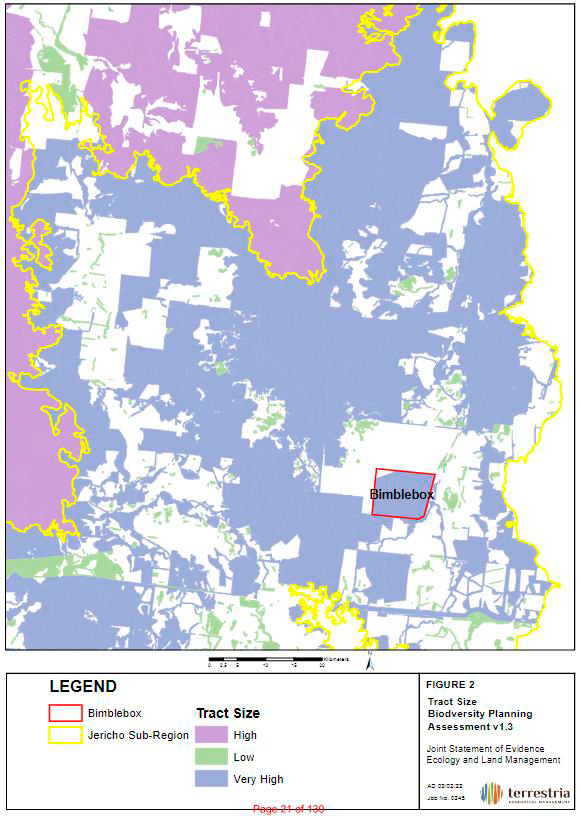
| ii. a transitional environmental program; | |
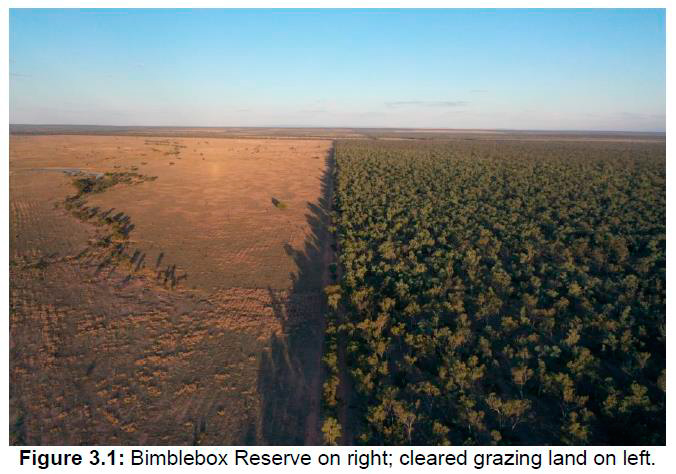
| iii. an environmental protection order; | |
| iv. a disposal permit; | |
| v. a development approval; and |
| (h) the financial implications of the requirements under an instrument, or proposed instrument, mentioned in paragraph (g) as they would relate to the type of activity or industry carried out, or proposed to be carried out, under the instrument; and | |
| (i) the public interest; and | |
| (j) any applicable site management plan; and | |
| (k) any relevant integrated environmental management system or proposed integrated environmental management system; and | |
| (l) any other matter prescribed under a regulation. |
[75] In a mining objections hearing the Court’s consideration of environmental impacts is driven by the framework of the EPA. However, the Court must be careful to observe some jurisdictional limitations in considering environmental factors for both the ML and EA applications. As noted above, when considering any adverse environmental impacts under s 269(4)(j) of the MRA, the consideration is confined to the impacts of mining and associated activities authorised by the ML.
[76] There is a dispute between the active parties about whether the standard criteria, including the public interest criterion, allow the Court to consider scope 3 emissions when making its recommendation on the EA. As that is addressed below at [663]-[718] it is not necessary to say more here.
The HRA
[77] The main objects of the HRA are (s 3):
| (a) to protect and promote human rights; and | |
| (b) to help build a culture in the Queensland public sector that respects and promotes human rights; and | |
| (c) to help promote a dialogue about the nature, meaning and scope of human rights. |
[78] The HRA states the human rights Parliament specifically seeks to protect and promote. One mechanism for achieving the objects of the HRA is to require public entities to act and make decisions in a way compatible with human rights (s 58). Another is to require courts to interpret statutory provisions, to the extent possible that is consistent with their purpose, in a way compatible with human rights (s 48).
Interpreting the HRA
[79] In interpreting the HRA, I understand none of the following propositions is controversial, but it is useful to state them.
[80] All legislation must be construed having regard to its text, context, and purpose, and in a way that best achieves its objects.20
[81] International and foreign law sources with a logical or analogical relevance can assist in interpreting the HRA (s 48). However, courts should pay due regard to the different legal and constitutional settings for those decisions.21
[82] As beneficial legislation, provisions of the HRA which bestow, protect, or enforce rights should be construed as widely as their terms permit.22
[83] Human rights are an expression of underlying values. Those values explain their nature. Human rights should be construed in the broadest possible way before consideration is given to whether they should be limited.23
[84] An act or decision is compatible with human rights if it does not limit a human right or, if it does, the limit is only to the extent that is reasonable and justifiable in a free and democratic society based on human dignity, equality and freedom (ss 8 and 13). The test of compatibility of a limit with a human right is set out in s 13 and is known as the proportionality test.
[85] The context for construing a human right includes the proportionality test. The Victorian Court of Appeal recently considered the role of the cognate provision of the Victorian Charter (s 7) in interpreting rights:24
The context within which each provision conferring a human right must be construed includes s 7(2). However, the existence of s 7(2) does not distort the process of statutory construction by mandating that provisions conferring a human right — with or without internal limitations — be given either an overly narrow or an overly generous interpretation. Each provision must be given the meaning that its text, context and purpose — assisted in appropriate cases by international jurisprudence — require.
[86] I will apply those principles, by construing the rights in the broadest possible way having regard to their text, context and purpose, taking into account s 13, without allowing it to distort the process of interpretation.
How the HRA relates to the Court’s function in a mining objection hearing
[87] The Court is a public entity within the meaning of the HRA when making recommendations on the applications for the ML and EA (s 9).
[88] This means I must fulfill the obligations imposed on a public entity, and it would be unlawful for me either (s 58):
[89] The procedural limb in s 38(1) of the Charter of Human Rights and Responsibilities Act 2006 (Vic) (Victorian Charter) has been held to require the decision maker to:25
| (1) understand in general terms which of the rights of the person affected by the decision may be relevant and whether, and if so how, those rights will be interfered with by the decision; | |
| (2) seriously turn his or her mind to the possible impact of the decision on a person’s human rights and the implications thereof for the affected person; | |
| (3) identify the countervailing interests or obligations; and | |
| (4) balance competing private and public interests as part of the exercise of justification. |
[90] There was a substantial dispute between Waratah and YV&TBA about how to interpret and apply the HRA, specifically, whether the Project could be said to limit a human right because of the combustion of the mined coal. I address that argument later in these reasons at [1298]-[1383]. Waratah also argues it does not bear an onus to demonstrate that any limit to the right is justified. I address that argument at [1412]-[1421].
Key Principles
[91] A number of principles are referred to in these reasons. The following is a brief explanation of their history, meaning and application.
Public Interest
[92] Both the MRA and the EPA require the Court to consider the public interest when deciding what recommendation to make. Although the EPA uses the term ‘public interest’ and the MRA uses the phrase ‘public right and interest’, I consider little turns on the different formulation.
[93] The High Court considered the phrase ‘public right and interest’ in Sinclair v Mining Warden at Maryborough.26 At that time, the mining regulation required the Mining Warden to recommend rejection of an application if they considered the grant would prejudice the public right or interest.
[94] Barwick CJ recognised environmental concerns are matters of general public interest:27
It cannot be doubted, in my opinion, that the matters raised and evidenced by the objector [the effect of mining operations on the environment of Fraser Island] were matters of general public interest.
[95] The Court went on to consider what was required of the Mining Warden in considering the public interest in a mining objection hearing. The principles that can be derived from that decision are:
[96] The term public interest is a broad concept that is incapable of universal application.28 In O'Sullivan v Farrer the High Court described the discretionary nature of the concept:29
Indeed, the expression ‘in the public interest’, when used in a statute, classically imports a discretionary value judgment to be made by reference to undefined factual matters, confined only ‘in so far as the subject matter and the scope and purpose of the statutory enactments may enable ... given reasons to be [pronounced] definitely extraneous to any objects the legislature could have had in view.
[97] What is in the public interest will require consideration of competing arguments about the public interest, or different features or facets of the public interest.30
[98] More recently, the ‘public interest’ was considered by the High Court in Hogan v Hinch. French CJ said:31
Section 42 requires that the court, before making an order under that section, be satisfied that "it is in the public interest to do so". The term "public interest" and its analogues have long informed judicial discretions and evaluative judgments at common law...When used in a statute, the term derives its content from "the subject matter and the scope and purpose" of the enactment in which it appears [72]. The court is not free to apply idiosyncratic notions of public interest.
[99] It is in the public interest, in determining an application under an Act, to give effect to the objects of that Act.32
[100] The HRA requires the Court to interpret all statutory provisions, to the extent possible that is consistent with their purpose, in a way that is compatible with human rights (s 48). This does not create a special rule of interpretation. It forms part of the body of interpretative rules to be applied at the outset, in ascertaining the meaning of a provision.33
[101] However, the protected rights give an additional dimension to the public interest. In Hogan v Hinch,34 Gummow, Hayne, Heydon, Crennan, Kiefel and Bell JJ referred to the cognate requirement when it referenced rights protected under the Victorian Charter in evaluating the public interest criterion for a suppression order, made under the Serious Sex Offenders Monitoring Act 2005 (Vic).35
Ecologically sustainable development
[102] ESD is the object of the EPA. In making its objection decision, the Court must consider the principles of ESD as set out in the ‘National Strategy for Ecologically Sustainable Development’.36
[103] The core objectives of the National Strategy for ESD are:
[104] The guiding principles of the National Strategy for ESD are:
[105] The National Strategy states the guiding principles and core objectives must be considered as a package, with none predominating over the others, requiring a balanced approach taking them all into account in pursuing the goal of ESD. The Court should not view any in isolation or reject an application because it finds a guiding principle is ‘breached’.37
[106] Rather, the principles assist the Court in its evaluative task and informs the decision making process.
[107] While the EPA expressly incorporates the principles of ESD as a prescribed criterion, the MRA does not. Nevertheless, the findings made for the EA application may have relevance for various prescribed criteria under the MRA and, in that indirect way, the principles of ESD may be relevant to the ML application.
[108] Before finishing with the EPA, I will briefly discuss two concepts within the principles of ESD which were the focus of attention in this hearing – the precautionary principle and intergenerational equity.
Precautionary Principle
[109] The precautionary principle was developed internationally and adopted in Australia by the early 1990s. The National Strategy definition, incorporated into the EPA by reference in the definition of standard criteria is:
where there are threats of serious or irreversible environmental damage, lack of full scientific certainty should not be used as a reason for postponing measures to prevent environmental degradation.
[110] The same formulation of the precautionary principle appears in the Protection of the Environment Administration Act 1991 (NSW). In Telstra Corporation v Hornsby Shire Council,38 Preston CJ articulated how it should be implemented, an approach since adopted in this Court.39
[111] Preston CJ identified two preconditions to the application of the principle – a threat of serious or irreversible environmental damage and scientific uncertainty as to the environmental damage.
[112] The threat of serious or irreversible environmental damage must be adequately substantiated by scientific evidence. As to the degree of uncertainty his Honour identified the following factors might be considered:40
| (a) the sufficiency of the evidence that there might be serious or irreversible environmental harm caused by the development programme or project; | |
| (b) the level of uncertainty, including the kind of uncertainty (such as technical, methodological or epistemological uncertainty); and | |
| (c) the potential to reduce uncertainty having regard to what is possible in principle, economically and within a reasonable time frame. |
[113] The principle has a protective function:41
to require the decision-maker to assume that there is, or will be, a serious or irreversible threat of environmental damage and to take this into account, notwithstanding that there is a degree of scientific uncertainty about whether the threat really exists.
[114] Finally, his Honour said the principle embraces the concept of proportionality. Measures taken in applying the principle should not go beyond what is appropriate and necessary to achieve the objectives, recourse should be had to the least onerous measure, and the disadvantages should not be disproportionate to the aims.42
[115] There is a substantial dispute between the parties as to whether the precautionary principle is engaged in this case and, if it does, what would be a proportionate response. That dispute is best dealt with after I have discussed the relevant evidence.
Intergenerational equity
[116] The concept of intergenerational equity also has its origins in international policy and is embedded in one of the core objectives of the National Strategy on ESD “to provide for equity…between generations.”
[117] There has been little judicial consideration in Queensland of the meaning of intergenerational equity, and the definition of standard criteria in the EPA has changed over time. That principle was considered by Bowskill J, as the Chief Justice then was, in New Acland Coal Pty Ltd v Smith. It was not necessary for her Honour to explore the meaning of the principle, because she decided the Member had wrongly applied it.
[118] The guiding principles of the National Strategy for ESD includes this principle, which reflects the core objective of intergenerational equity, amongst other things:
decision making processes should effectively integrate both long and short-term economic, environmental and equity considerations.
[119] In an earlier version of the EPA, the definition of standard criteria referred to the Intergovernmental Agreement on the Environment, adopted in the same year as the National Strategy on ESD, which included this definition of the principle:
| 3.5.2 Intergenerational Equity • The present generation should ensure that the health, diversity and productivity of the environment is maintained or enhanced for the benefit of future generations. |
[120] While this formulation is more specific than the key principle and core objective set out above, it is consistent with the way the principle has been considered in Queensland and other jurisdictions.
[121] In an article which explored the ESD principles, Preston CJ identified three fundamental principles underpinning the concept of inter-generational equity:
1. the conservation of options principle which requires each generation to conserve the natural and cultural diversity in order to ensure that development options are available to future generations; 2. the conservation of quality principle that each generation must maintain the quality of the earth so that it is passed on in no worse condition than it was received; and 3. the conservation of access principle which is that each generation should have a reasonable and equitable right of access to the natural and cultural resources of the earth (references omitted)
[122] Without narrowing the breadth of the core objective of the National Strategy, his Honour’s thoughtful analysis of the different aspects of the concept provides a useful framework for considering the arguments about intergenerational equity in this case.
[123] This principle was applied in assessing the Rocky Hill Coal Project in the case of Gloucester Resources Ltd v Minister for Planning.43 While the following passage identifies factors that are specific to that case, it also assists in understanding how it might apply more generally:44
398. A further social impact, revealed in the other types of social impact discussed earlier, is the distributive injustice or inequity that would result from approval of the Rocky Hill Coal Project. Distributive justice concerns the just distribution of environmental benefits and environmental burdens of economic activity. Distributive justice is promoted by giving substantive rights to members of the community of justice to share in environmental benefits (such as clean air, water and land, a quiet acoustic environment, scenic landscapes and a healthy ecology) and to prevent, mitigate, remediate or be compensated for environmental burdens (such as air, water, land and noise pollution and loss of amenity, scenic landscapes, biological diversity or ecological integrity). Issues of distributive justice not only apply within generations (intra-generational equity) but also extend across generations (inter-generational equity). 399. The principle of intra-generational equity provides that people within the present generation have equal rights to benefit from the exploitation of natural resources as well as from the enjoyment of a clean and healthy environment: Telstra v Hornsby Shire Council at [117]. The principle of inter-generational equity provides that the present generation should ensure that the health, diversity and productivity of the environment are maintained or enhanced for future generations. (references omitted)
[124] With that context about the Court’s function and the objects and principles that must guide it in fulfilling its function, I will outline the mine proposal, how it has evolved during the hearing, and provide an overview of the objections made to the ML and EA applications.
THE PROJECT AND OBJECTIONS
| History of the project | [125] |
| The original and revised mine plan | [134] |
| The objections | [143] |
History of the project
[125] The Project was previously known as the China First Coal Project.45 It was to be developed by China First Pty Ltd, a fully owned subsidiary of Resourcehouse Limited, which in turn, was wholly owned by Mineralogy Pty Ltd. China First had contractual rights with Waratah to develop the project and mine 1.4 b tonnes of coal from the tenements Waratah would apply for.
[126] The Applicant is now Waratah Coal Pty Ltd, a privately owned Australian coal exploration and development company and a wholly owned subsidiary of Mineralogy Pty Ltd.46 The following corporate structure shows the relationship of corporations within this group and, ultimately, the interest of Clive Palmer.47
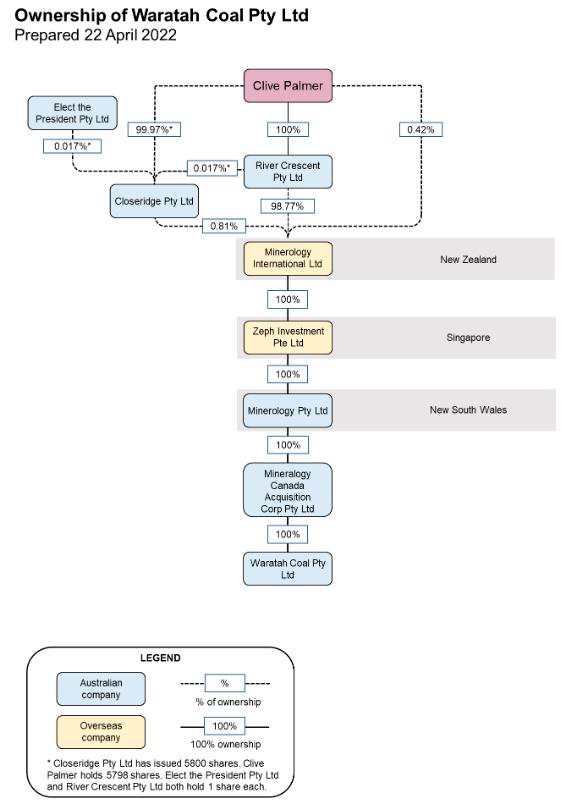
[127] This project has had a long history since exploration commenced 16 years ago.48
[128] It was assessed at both State and Commonwealth levels between 2008 and 2015. Then, after a lapse of four years when nothing appears to have happened with the ML and EA applications, they were publicly notified and then referred to the Court. After they were referred, Waratah made significant changes to the mine plan, as it related to the Bimblebox Nature Refuge. This hearing has proceeded on the revised mine plan.
[129] In summary, the pre-hearing assessment of the original mine plan went through the following steps:
[130] Nothing further happened with the applications for four years.
[131] Then, in December 2019:
[132] The applications were referred to the Land Court on 22 April 2020. Some other approvals are needed before the mine could be fully operational, but they are not before the Court.53
[133] Almost one year later, Waratah notified the Court and the parties that it would revise its mine plan to remove open-cut mining on Bimblebox. In a letter to objectors, Waratah advised it had considered the objections carefully and decided not to proceed with open cut mining on Bimblebox. It said the revised mine plan will significantly reduce the environmental impacts associated with mining on the refuge.54 While that would suggest the change was prompted by the concern expressed for Bimblebox, Mr Harris said it was to “better utilise the economic mineral resources”.55
The original and revised mine plan
[134] The original plan was to create a new mine 30 km north of the township of Alpha in central Queensland to mine 1.4 b tonnes of raw coal. That would have involved mining 20 Mtpa of coal from open-cut operations and 36 Mtpa from underground operations for a total run-of-mine (ROM) coal extraction of 56 Mtpa. Coal would be washed, with an overall product yield of 72%, producing 40 Mtpa of thermal coal.56 The following map shows the original mine plan in 2011.
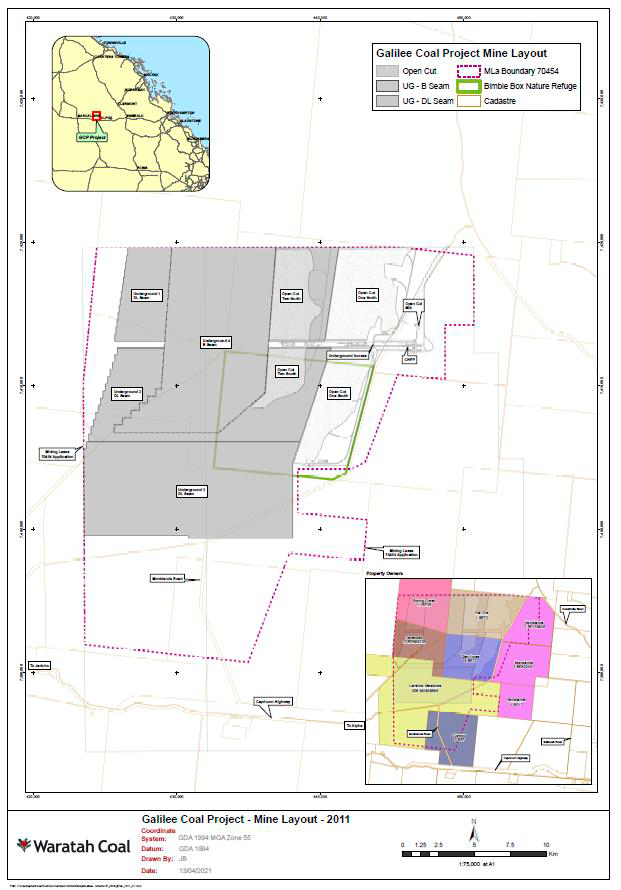
[135] That would have incorporated the following elements:57
[136] The surface mining method was to be a combination of walking draglines for overburden removal in conjunction with truck and shovel fleets for partings removal and coal recovery. An additional overburden removal system utilising large electric rope shovels loading onto overburden conveyors would also be used in conjunction with the draglines.
[137] Underground mining would be undertaken by the longwall method involving seven-kilometre-long blocks with a 400 m wide longwall face.
[138] In its revised EMP, Waratah identifies several changes to that mine plan. The key changes are:58
[139] The following map is the revised mine plan as it stands at the time of hearing.
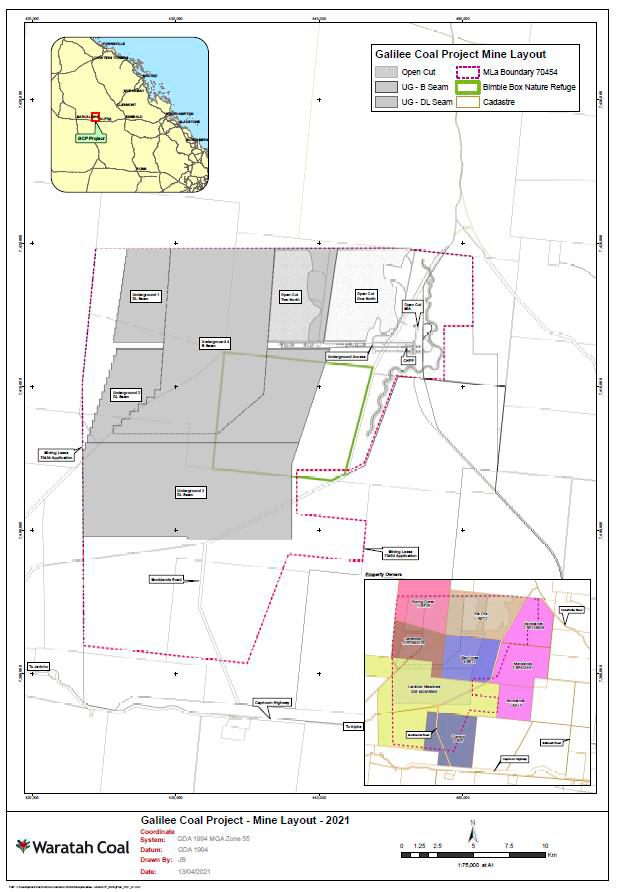
[140] There are seven properties within the proposed ML area.
[141] TBA does not own Glen Innes, the property which is the Bimblebox Nature Refuge. It is aligned with and supports the owners of the Bimblebox Nature Refuge. The lion’s share of the evidence led during the hearing related to the impacts on that refuge. Bimblebox Nature Refuge is underlain by three longwall mines: Underground 4 B Seam and Underground 2 DL Seam and Underground 3 DL Seam.
[142] Other properties that would be affected by mining or mine infrastructure are:60
The objections
[143] During the notification period in 2019-2020, 22 objections were received to the application for the ML and 16 to the application for the EA. Some objections have been withdrawn, leaving 31 current objections.
[144] Of the current objectors, YV&TBA and Mr & Mrs Brinnand elected to be active parties in the hearing, the remaining objectors did not, but the Court must consider their objections in deciding what recommendations to make.
[145] The active parties prepared a List of Issues of Fact and Law.61 Ultimately, it did not define the hearing and submissions. I have used it as a guide, rather than a strict definition of the issues in these reasons. It was not fully settled as an agreed List. However, the List helpfully related the objections to the issues.
[146] As there are two applications, it is necessary to identify which relate to only one or both applications. In the following summary, derived from the List of Issues, I have identified the name of the objector and noted whether the objection relates to either or both applications. Although the active parties’ list does not identify YV&TBA as having raised some issues in their objections, during the hearing Waratah agreed YV&TBA’s objections were couched in sufficiently broad terms to raise all environmental impacts on Bimblebox that were canvassed during the hearing. Waratah confirmed that in its written submissions, and the following summary reflects that agreement.
[147] In summary, the parties agree the objections raise issues about:
[148] Most of those issues are considered under the broad topics of:
[149] Any remaining issues are addressed under relevant criteria that I must consider for either or both applications.
BIMBLEBOX NATURE REFUGE
| Bimblebox Nature Refuge | [150] |
| Ecological values | [153] |
| Conservation management | [194] |
| Green grazing | [199] |
| Other scientific research | [211] |
| Artists’ camp | [213] |
| Summary of values | [217] |
| Potential impacts of mining activities on Bimblebox | [218] |
| Noise and vibration | [223] |
| Dust | [274] |
| Subsidence | [303] |
| Water | [358] |
| Ecological impacts of subsidence or rehabilitation | [385] |
| What are the potential impacts of subsidence? | [390] |
| What would remediation of subsidence mean for the ecology of Bimblebox? | [405] |
| Conclusions on impacts on Bimblebox | [422] |
| Offsets | [449] |
| What law applies to offsets for this mine? | [459] |
| Is Waratah’s Offset Plan adequate? | [472] |
| Should I prefer Dr Cousin over Professor Maron? | [481] |
| Is it possible to devise an adequate Offset Plan? | [505] |
| How could offsets be conditioned if the mine is approved? | [522] |
| Findings on offsets | [562] |
The uniqueness of Bimblebox doesn’t come from its rarity. It’s not the last surviving species of anything, it’s not the last population of any poor creature or plant…It’s an example of something which was once everywhere in the Desert Uplands but increasingly no more and certainly not in a protected form. It’s a unique combination of an extraordinary number of things that are, or were, entirely ordinary.62
Bimblebox Nature Refuge
[150] The name of one of the active parties speaks for itself. The Bimblebox Alliance Inc marshalled extensive expert and lay evidence so I could know what they and others63 value about Bimblebox and what they fear will be lost if the mine proceeds.
[151] John Brinnand feels so strongly about Bimblebox that he made sure I had the perspective of a regular visitor, committed to the place and the people who care for it. Mr Brinnand represented himself, no mean feat in any case. In this lengthy and complex hearing, I appreciated his serious intent and thoughtful and respectful contributions.64
[152] In this section I will discuss the evidence about the values of Bimblebox that the objectors say are at risk from the mine.
Ecological values
[153] Bimblebox, or as it used to be known, ‘Glen Innes,’ is in Jagalingou Country in the Jericho sub-region of the Desert Uplands, a bio-region under threat from broad scale clearing for cattle grazing when the current owners purchased it in 2000 to protect it. A change to legislation and policy arrested the threat. Even so, significant areas of the Jericho sub-region have been cleared (see Figure 1 after [171]).65
[154] Three ecologists gave evidence about Bimblebox’s ecological values: Dr Daniel, Mr Caneris, and Professor Fensham. They prepared a Joint Report that also include contributions by Mr Thompson, a soil and land use rehabilitation expert and all four gave evidence in a concurrent evidence session.66
[155] Dr Daniel, engaged by Waratah to give evidence on vegetation, is the principal ecologist at Terrestria Pty Ltd and advises governments and private organisations about ecological investigations, ecological management planning, and offsetting of impacts.
[156] Mr Caneris, engaged by Waratah to give evidence on fauna, is a certified environmental practitioner with ecology specialisation certification
[157] Mr Thompson, also engaged by Waratah to give evidence on land rehabilitation, has a Bachelor’s degree of Agricultural Science (Soil Science) from the University of Queensland, and is the Director of Land and Resource Assessment and Management, a firm that advises clients on soils, land use and rehabilitation issues. Mr Thompson has decades of experience in his field.
[158] Professor Fensham, engaged by YV&TBA to give evidence on ecology and conservation management, is Associate Professor in Biological Science at the University of Queensland and principal botanist at the Queensland Herbarium. He conducted vegetation research on Bimblebox for more than a decade and visited it again for one day in 2021 to prepare his evidence.
[159] Waratah and YV&TBA made competing submissions about the weight I should place on the ecologists’ evidence.
[160] Dr Daniel and Mr Caneris are well qualified and experienced in their fields. They inspected Bimblebox twice for a total of six days in 2021,67 undertaking broad rapid assessments across the proposed disturbance footprint and surrounding landscape,68 but they did not do ecological surveys. Their opinions were informed by the surveys presented in the EIS and SEIS, although they noted deficiencies in those statements.
[161] Professor Fensham’s long research association with Bimblebox gives me greater confidence in his opinion where it differs from the other experts. While he admires the landowners for their careful management, I have no cause to question the integrity of his evidence or, for that matter, the others.
[162] Waratah objects to certain passages of the Joint Report contributed by Professor Fensham, upon which YV&TBA do not rely. These passages are about the purchase and establishment of the Bimblebox Nature Refuge and there is lay evidence on the topic.69 Waratah also objects to other statements in the report by Professor Fensham about vegetation on the basis that the scientific or intellectual basis for the conclusion was not identified or established.70 I dismiss that objection as Professor Fensham amply demonstrated the basis for his opinions in oral evidence.
[163] What follows is my summary of their evidence, dealing with the few material disagreements that remained by the close of their evidence, largely questions of degree and certainty. It also draws on lay evidence from the owners and others about the flora and fauna recorded on Bimblebox, which Dr Daniel and Mr Caneris considered it in preparing the Joint Report.
[164] Bimblebox is an 8,000 ha area of remnant vegetation, an open woodland characteristic of the Jericho Subregion of the Desert Uplands, comprised by Poplar Box and Silver-leaved Ironbark Woodlands on deeply weathered sandplains.
[165] It is in very good ecological condition. It supports a diverse range of native flora species and provides foraging, roosting, and breeding habitats for a suite of fauna species, including conservation significant species.
[166] To document the biodiversity values of Bimblebox, Patricia Julien, the Secretary and Researcher of the TBA management committee, compiled indices of recordings of fauna and flora on Bimblebox from reports and surveys by scientists and citizen scientists.71 Ms Julien said the flora and fauna recorded in the EIS and SEIS are for species documented within the entire ML area, without demarcating the area comprised by Bimblebox.72 Her indices report that some 383 plant species, 179 bird species, 16 native amphibians and 69 reptile species have been recorded on Bimblebox alone.
[167] Eric Anderson is a bird watcher and has been a regular visitor to Bimblebox over many years.73 In 2003, Mr Anderson established 14 long-term bird monitoring sites, at least one in each paddock to account for the different grazing and burning off methods used on the property. His intention was to use long-term bird surveys as an indicator of ecological health.
[168] Between 2003 and 2019 he undertook seven surveys in a range of seasons and weather conditions using Birds Australia survey methods. He recorded 181 species of birds, and observed an increase in bird species over time, which he attributed to good ground cover.
[169] Mr Caneris said the work done by lay witnesses were long-term observations, but not necessarily done with scientific rigour. He said he has regard for Mr Anderson and the work of his organisation, and the contribution of citizen science work is valuable.74 Mr Caneris made no specific criticism of Mr Anderson’s evidence, and Waratah did not require him for cross-examination. Unless there is a conflict between his evidence and the expert evidence, there is no reason not to give full weight to his observations. I take the same approach to the evidence of other lay witnesses who say what they have observed about Bimblebox.
[170] The ecologists agree that the natural values of the woodlands on Bimblebox, the species composition, and the extant habitats, are not particularly unique or rare. It is botanically diverse despite threatened weed invasions by buffel grass, which dominates most of the region today. The good condition of the lower shrub layers supports ground dwelling fauna and contributes to the property’s resilience to weed invasions. Its biodiversity value lies in the very good condition of the ground and lower shrub layers that support a diverse range of widespread native flora species and a low density of exotic species. It holds valuable habitats for many native fauna species, but none are reliant on these habitats for their persistence in the local landscape. It has old growth trees, many of which are more than 200 years old. Because they grow so slowly, the area is not resilient to the removal of big old trees.
[171] Bimblebox is a large area of remnant vegetation dominated by ecosystems that remain common within the subregion and bioregion - see Figure 1.75
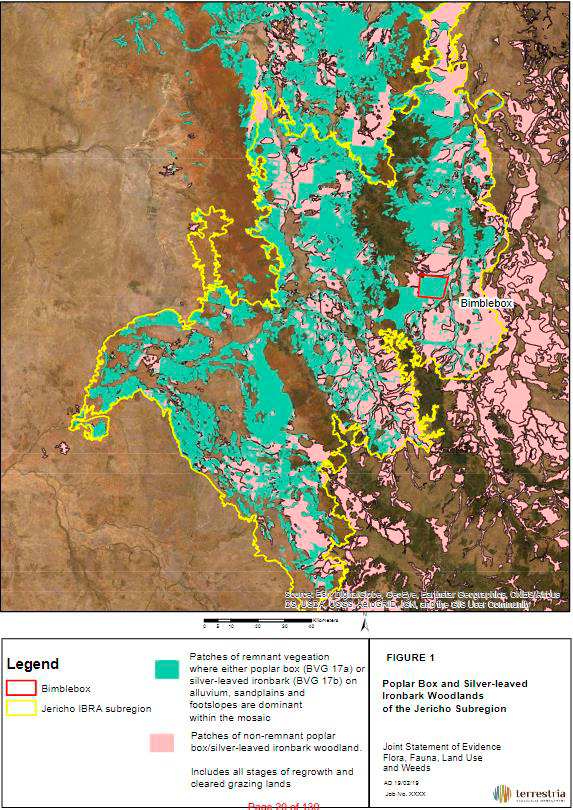
[172] The areas in green, including Bimblebox, are remnant vegetation. The areas in pink show cleared grazing lands and any areas at any stage of regrowth which have not attained the remnant vegetation thresholds of 70% of the pre-cleared canopy height and 50% of the pre-cleared cover. Regardless of those technical thresholds, in this sub-region, most of the pink areas on Figure 1 were cleared recently and have very little regrowth. The experts agreed the distinction in Figure 1 is between cleared and uncleared areas.76 This photo taken on Bimblebox’s northern boundary with Kia Ora illustrates that difference:77
[173] Bimblebox is all but surrounded by cleared areas, primarily maintaining connections to large tracts in the south-west, south and south-east, as well as some riparian corridors in the north-east and south-east.
[174] That much is agreed between Dr Daniel, Mr Caneris and Professor Fensham.
[175] The point at which they disagree is the importance of Bimblebox to biodiversity conservation.78
[176] Professor Fensham described its importance as critical.79 Dr Daniel said Bimblebox provides a useful contribution to biodiversity80 and Mr Caneris said it provides a role by retaining habitats and habitat values for fauna.81
[177] As I understood their evidence, Dr Daniel and Mr Caneris assessed Bimblebox’s role in biodiversity conservation through a regulatory classification of ecosystems and species by their rarity or vulnerability. The Bimblebox ecosystem is common in the bioregion, and it does not support species of flora or fauna that are rare or endangered or dependent upon Bimblebox for their persistence in the local landscape.
[178] This leaves little scope for what YV&TBA describe as keeping the common common.
[179] Professor Fensham took a more wholistic view of the role Bimblebox plays in biodiversity conservation, valuing the combination of its intact natural values, very good ecological condition, its committed conservation managers who have a successful history of sensitive cattle grazing and weed management, and the scientific monitoring framework that demonstrates that success.82
[180] In its submission to the Coordinator-General about Waratah’s EIS, the Department of Environment and Resource Management (the DERM report) included this observation about Bimblebox’s biodiversity values.83
The refuge supports viable populations of a high diversity of native frogs, reptiles, birds and mammals. This includes many woodland bird species known to be in decline. It is also known or potential habitat for several rare and threatened or bioregional priority animal and plant species.
[181] Despite Waratah’s objection to the report, I will have regard to it.84 Although, as Waratah says, the opinions are dated, the same is true of much of the material provided by Waratah in support of its application. That is a matter of weight, not relevance. The opinions were not tested, but Waratah could have asked DES to make the author available for cross-examination.
[182] The DERM report was put to the ecologists. Dr Daniel said he broadly agreed with the findings, although he described the connectivity of Bimblebox to other areas of remnant vegetation as equivocal. He said this did not mean I should not be concerned about it.85 Mr Caneris said the fauna numbers seem extremely high and he would need to check the scientific papers relied upon regarding the density estimates. He also questioned the description of the diversity of native frogs as ‘high’, he would describe it as ‘reflective’.86
[183] With those qualifications, the Department’s submission supports a favourable view of Bimblebox’s importance to biodiversity conservation.
[184] The conflict between the ecologists about the significance of Bimblebox is really a question of degree, and I prefer Professor Fensham’s opinion, which sits comfortably with Bimblebox’s status as a protected area.
[185] Bimblebox is a “Private Protected Area for Nature Conservation purposes” within the National Reserve System established under the Natural Heritage Trust of Australia Act 1997 (Cth). It is also a declared Nature Refuge under the NCA.
[186] Carl Rudd, Kerri Rudd, Ian Herbert, and Catherine Herbert entered into an agreement with the Commonwealth Government for financial assistance under the National Reserve System (the Commonwealth Agreement). In 2000, a company, Populnea Pty Ltd, was established to consolidate funds used to purchase the leasehold interest known as Glen Innes Station. Although they were not parties to the Commonwealth Agreement, other shareholders of Populnea are Ian Hoch, who is the caretaker of Bimblebox, and Paula Cassoni, who is also active in managing the use of the property. The leaseholders of Glen Innes Station are Paola Cassoni, Carl Rudd and Kerri Rudd.
[187] Exhibited to Ms Cassoni’s affidavit was a video about Bimblebox, which Waratah objects to as irrelevant. It also objects to [184] of her affidavit for the same reason. YV&TBA say the commissioning and production of a documentary about Bimblebox that has been seen across Australia is relevant because it has contributed to the cultural and artistic landscape of Queensland. I have viewed the video in that context and dismiss the objection but, to be clear, rely on the specific evidence given by witnesses about the values of Bimblebox.
[188] Under the Commonwealth Agreement, the Commonwealth contributed two-thirds of the purchase price of Bimblebox ($314,600) “for the purpose of establishing a private protected area to protect the significant values of the site”.87 For their part, the landowners agreed to manage the land as a Protected Area in accordance with the IUCN Guidelines and management objectives of the Commonwealth Agreement.
[189] The Commonwealth Agreement identified the following significant features of Bimblebox:
| 1.2 Significant features of the Land |
[190] Bimblebox is also classified as a Nature Refuge, a class of Protected Area under the NCA (s 14). The prescribed management principles for nature refuges are to conserve and provide for controlled use of the area’s significant cultural and natural resources (s 22). An area may be declared a nature refuge by regulation, if the Minister and affected landholders agree about the area to be declared, the management intent for the refuge, and the terms of a conservation agreement between the State and the landholders (the State Agreement) (ss 44, 45).
[191] Bimblebox was gazetted as a nature refuge on 9 May 2003. The regulation identified its significant cultural and natural resources and values as follows:88
| The nature refuge supports- |
| (a) 6 regional ecosystems, including poplar box and silver-leaved ironbark woodland; and | |
| (b) a large area of intact habitat in a landscape that has been subjected to widespread clearing; and | |
| (c) a diverse range of herbaceous species. |
[192] The State Agreement described the values of Bimblebox:89
The Land is significant because 96% of its original vegetation is still intact, is in excellent condition, and has high biodiversity values. The Land consists primarily of poplar box and silver-leaved ironbark woodlands (Regional Ecosystems 10.3.27, 10.3.28, 10.5.5 and 10.5.12), which are currently the focus of extensive clearing in the bioregion. Both eucalypt woodlands support a wide variety of grasses and fauna species. The Land also contains small areas of moreton bay ash, coolibah, bloodwood, brigalow, blackbutt and heath (Regional Ecosystems 10.3.12 and 10.3.3). The conservation agreement will ensure that management and use of the Land sustains these flora and fauna values in perpetuity.
[193] Under both schemes then, Bimblebox’s ecological values are recognised and their preservation supported. The implications of the mine for its status under both schemes was raised by YV&TBA and other objectors.90
Conservation management
[194] Under both the Commonwealth and State schemes, the owner of Bimblebox has conservation management responsibilities, which include:91
[195] Bimblebox is surrounded by cleared country and requires active, ongoing management to retain its natural values. Professor Fensham said the committed conservation work of the managers of Bimblebox contributed to its critical role in biodiversity conservation.
[196] Mr Hoch has been primarily responsible for the on-ground management at Bimblebox since it was purchased in 2000.92 The long-term management plan for Bimblebox is to maintain and enhance the nature refuge’s biodiversity. He aims to retain a sample of native plants across various soil types on Bimblebox to ensure the longevity of a viable seed bank. He says this is difficult, because: “only half of the full catalogue of plants on Bimblebox are visible at any one time, and yet we [manage] also for the other half which are dormant”.93
[197] Maintaining floral biodiversity on Bimblebox requires continuing intensive management, to prevent the invasion of exotic or introduced species. Mr Rudd said their first priority after buying the property was to get rid of introduced species such as buffel grass and seca stylo.94 Buffel grass covers most of the neighbouring properties and must be intensively managed to prevent it from taking over Bimblebox. Although buffel grass has not been eliminated from the property, Mr Hoch and others have completely eradicated Rubber Vine (Cryptostegia grandiflora), Parkinsonia (Parkinsonia aculeate), Coffee senna (Senna occidentalis) and Mimosa (Acacia farnesiana).95
[198] The management of Bimblebox is orientated around “climate friendly and ecologically sound and sustainable principles”.96 Management strategies change according to the seasons, and Mr Hoch and others have had to learn and adapt to the changing environment. One vegetation management strategy involves the use of fire and burning off. Another is green grazing.
Green grazing
[199] Mr Hoch said stock are managed in accordance with the effects of methane emissions, carbon sequestration and fixation to ameliorate the impacts of climate change.97 Ms Cassoni says the green grazing on Bimblebox helps manage the spread of buffel grass, and supports their conservation efforts, both economically and ecologically.98
[200] Green grazing, or ‘sustainable land grazing’ was defined by the experts as grazing that is sustainable in three areas:99
[201] There was a difference of opinion between the ecologists and Mr Thompson, Waratah’s land rehabilitation expert, about whether the green grazing on Bimblebox was sustainable.
[202] Mr Thompson was ‘concerned’ low intensity grazing would not “be able to sustain ongoing management and maintenance of capital works which are currently in need of substantial maintenance and repair”.100
[203] However, green grazing has been practiced on Bimblebox since the property was purchased in 2000. It relates to the management objectives of the Commonwealth and State Agreements under which grazing is used as a tool for conservation, to demonstrate the compatibility between agriculture and conservation, and to provide income for the upkeep of the Nature Refuge.101
[204] Mr Thompson’s emphasis on infrastructure upkeep is relevant, but the owners have demonstrated they can maintain this practice long-term.
[205] Professor Fensham and Dr Daniel both addressed green grazing from an ecological perspective. Dr Daniel said the priority is conservation of the ecology and its ecosystem services, so grazing doesn’t significantly impact those values. He distinguished this from just stopping land erosion and maintaining enough grass for the cows to eat.102
[206] None of the experts knew of any green grazing trials on a nature refuge with the same goals. More often, cattle are grazed in conservation parks or national parks to evaluate pasture management, cattle impacts or sustainable land management.103
[207] Professor Fensham says green grazing is a powerful tool for conservation management. While there can be negative effects where there is intense activity around areas such as water points, Bimblebox stocking rates are relatively low and grazing pressure is applied evenly in time and space.104
[208] Without the grazing, Professor Fensham believes the currently stable incursions of buffel grass and seca stylo would become more “dominant and abundant”. Accepting, as Mr Thompson said, that grass seeds can be spread by cattle,105 Professor Fensham said careful cattle grazing can help control both the spread and seeding of the grass.106 There was no contest that current management had been effective in managing buffel grass.
[209] The cattle also serve as a method of managing ground fuel, preventing fire and herbage composition.107
[210] The DERM Report explained the value of the green grazing trial:108
An important management objective of Bimblebox NR was to establish relevant research and monitoring that would evaluate and demonstrate opportunities for integrating cattle production with nature conservation. In 2003, the Queensland Herbarium received funding from Land & Water Australia to commence an integrated long-term experiment to assess the effects of combinations of fire and grazing on pasture composition, botanical diversity and woody plant dynamics. These trials are now 8 years old, have spanned both dry and wet periods and are beginning to generate deep insights into the dynamics and resilience of the woodlands. The findings of the study have relevance to 20 M ha of similar woodland, most of which is managed for pastoralism. This study will answer questions such as: • What is the impact of fire and grazing on botanical diversity? • To what extent do fire and grazing impact on the regeneration cycle (germination, growth mortality) of the tree species that make up the woodland? • How can fire and grazing be used to make woodlands more resilient to invasion by exotic grasses? These results will have profound implications not only for the pastoral industry that rely on the woodland ecosystem, but also for developing industries such as mining which must also engage in regional planning, responsible conservation management and restoration of degraded habitats.
Other scientific research
[211] Although research activity has declined since interest was shown in the coal beneath Bimblebox around 2008, Ms Cassoni gave evidence about other research relating to, and occurring on, Bimblebox:109
[212] That research has produced publicly accessible data which forms part of Queensland’s knowledge about land management and biodiversity.
Artists’ camp
[213] Bimblebox also has an important cultural and educational dimension. Jill Sampson is a visual artist and the project coordinator of the Bimblebox Art Project, which she started in 2012. Ms Sampson gave evidence about the artistic projects associated with Bimblebox.110 Bimblebox hosts an artists’ camp, located in the top northwest section of Bimblebox, just below Heath Paddock. The artists’ camp infrastructure includes camping areas, shower and toilet facilities, a kitchen, and connected potable water.
[214] The purpose of the artists camp is to document what might be lost if the mine proceeds (at that time to open cut mining), to raise awareness, spread information and ideas and to highlight the risk to ‘protected environments’ posed by coal mining.
[215] The first camp was held in September 2012 and then annually until 2018. It has not run since due to drought conditions and the impacts of COVID-19. Expressions of interest are now open for a future camp. Ms Sampson says nearly 200 people have responded.
[216] The artists form part of the community that centres around Bimblebox but their creative endeavours have reached far beyond it. The first exhibition to emanate from the camp, Bimblebox: art – science – nature, toured Australia for three years and was attended by over 45,500 people. The second exhibition, Bimblebox 153 Birds, has had 12,105 visitors over six exhibitions.
Summary of values
[217] Bimblebox plays a critical role in biodiversity conservation. Its ecological value is recognised under commonwealth and state conservation regimes. The owners have carefully managed Bimblebox to eradicate or control invasive species. The long-term grazing trials and other research provide a valuable contribution to our knowledge base for developing sustainable land management. It has nurtured a creative community which has successfully exhibited both the productivity of the camps and the importance of places like Bimblebox.
Potential impacts of mining activities on Bimblebox
[218] Waratah’s revised mine plan has two open cut pits and a mine infrastructure area to the north of Bimblebox, with double seam underground mining on Bimblebox and underground mines to its north, west and south.
[219] Waratah led evidence from experts about the key environmental impacts the mine may cause and how they might be avoided, mitigated, or rehabilitated. In this section, I address those matters as they relate to Bimblebox. Waratah says the impacts on Bimblebox can be appropriately managed, mitigated or offset.
[220] A common thread in the expert evidence is uncertainty about the extent of the impacts or how they may be mitigated. YV&TBA say this uncertainty is so great the Court can have no confidence they could be appropriately managed.
[221] Waratah says some uncertainty is to be expected with a project of this nature and as the mine proceeds, there will be further definition of what is required to adequately manage impacts.
[222] Another issue was how the mine would affect the legal status of this area as a nature refuge. The legal status has implications for the conditions proposed in the Draft EA. YV&TBA say mining is so inconsistent with Bimblebox’s environmental values that, necessarily, this property cannot be maintained as a nature refuge if the mine is approved. Waratah’s position about the refuge was ambiguous and at times, inconsistent. With that, I turn to deal with the environmental impacts about which I received expert evidence.
Noise and vibration
[223] The mine would substantially change the acoustic environment in its vicinity. Several objectors say the noise and vibration impacts are unacceptable, both as a matter of amenity and because of ecological impacts.111 Waratah says noise and vibration impacts can be mitigated or managed to an acceptable level through the EA. It had proposed less restrictive limits than in the Draft EA, but no longer does so.112
[224] Noise and vibration impacts would result from mine construction, stripping and stockpiling cover material from open cut areas, drilling and blasting, and ongoing mining operations. The sources of operational noise include:113
[225] The noise expert engaged by Waratah for the hearing was Shane Elkin, the sole expert witness on this topic. Mr Elkin holds a Bachelor of Engineering (Mechanical) and is an acoustic consultant with expertise in mining noise and vibration assessment as well as transportation and environmental assessment and control. Mr Elkin prepared two expert reports, as well as a Noise and Vibration Impact Assessment and gave oral evidence during the hearing.114
[226] Mr Elkin said the noise modelling undertaken for the EIS and SEIS underestimated the noise impacts.115 In any case, the revised mine plan changed the situation for Bimblebox and required a reassessment of what the impacts would be without open cut mining.
[227] The Environmental Protection (Noise) Policy 2019 (EPP Noise) provides the regulatory context to resolve these issues. It identifies those environmental values of the acoustic environment that the Queensland government seeks to enhance or protect:
| 6 Environmental values | |
| The environmental values to be enhanced or protected under this policy are– |
| (a) the qualities of the acoustic environment that are conducive to protecting the health and biodiversity of ecosystems; and | |
| (b) the qualities of the acoustic environment that are conducive to human health and wellbeing, including by ensuring a suitable acoustic environment for individuals to do any of the following – |
| i. sleep; | |
| ii. study or learn; | |
| iii. be involved in recreation, including relaxation and conversation; and |
| (c) the qualities of the acoustic environment that are conducive to protecting the amenity of the community. |
[228] Those environmental values are present in the mine’s vicinity now.
[229] Mr Hoch, Ms Cassoni, Mr Rudd, and Ms Sampson each gave evidence about the peaceful and very quiet environment and how much that is valued by visitors, including birders and artists.116 Ms Sampson exhibited recordings by the sound artist Boyd, who told her how wonderful Bimblebox was for audio recording because of the absence of human sounds and activity.117
[230] The assessment by Mr Elkin supports the experience of those who care for and visit Bimblebox. He described the background noise levels as typical for a rural environment with “natural noise sources, such as birds, light wind in trees and insects, and intermittent contributions from nearby farm sources (farm animals and machinery)”.118 Road traffic noise is not a prominent feature, and no other mines or industrial sites cause audible noise at the monitoring locations.
[231] He undertook baseline noise monitoring at six locations which he chose as representative of the most potentially exposed sensitive receptors.
[232] The concept of sensitive receptors comes from the EPP (Noise). To enhance or protect the environmental values, the EPP (Noise) states an Acoustic Quality Objective (AQO) for each type of sensitive receptor and the environmental value to be enhanced or protected.119
[233] To establish the baseline at the sensitive receptors, Mr Elkin recorded the Rating Background Level (RBL), a widely accepted method for defining background noise levels for noise assessments in Queensland120. This records the lowest background noise level at each location during daytime, evening, and night periods.
[234] Across the six locations, Mr Elkin recorded RBLs of between 22 dBA and 26 dBA during the day, 19 dBA to 24 dBA during the evening, and 18 dBA to 20 dBA at night. Those RBLs are all less than the ‘deemed background noise level’ used by DES as the starting point when formulating maximum noise levels for EA conditions for mines.121
[235] Having assessed the current acoustic environment, Mr Elkin predicted noise and vibration impacts at 24 sensitive receptors, all of which appear to be residences.122 Six of those are within the ML area. Eight are 3 km to 5.5 km from the boundary. The remaining 10 are further away, where Mr Elkin expected negligible impacts, but included for completeness.
[236] Mr Elkin modelled predicted noise and vibration at all 24 sensitive receptors using four representative operational mining scenarios, chosen to capture the key stages of mining.
[237] Scenarios 2 and 3 represent the loudest scenarios given the proximity of the mining operations to the sensitive receptors at those stages. He summarised his predictions for night-time (10pm to 7am) noise because it is the most sensitive period, with the lowest noise limits and has the most adverse weather effects from an acoustic perspective.
[238] The assessment considered both noise criteria and blast criteria of the Draft EA. He also undertook a cumulative noise assessment, including those from other mines, and concluded they will not exceed the limit in Table D1 of the Draft EA.
[239] Mr Elkin concluded the air blast overpressure levels and ground vibration levels at the residence on Bimblebox will comply with the Draft EA limits,123 but the noise levels will not comply with all requirements.
[240] The Draft EA sets the following night-time noise criteria:124

[241] The first criterion assesses continuous noise (LAeq), the second relates to the maximum noise experienced (LA1). Both are assessed over a 15-minute period.
[242] Mr Elkin concluded operational mining noise levels at night would exceed the Draft EA limits at the residence on Bimblebox.
[243] For continuous noise, the 33 dBA LAeq would be exceeded during adverse noise propagation weather conditions - by 1 dBA for scenario 1 and by 2 dBA for scenarios 2 and 3.
[244] For maximum noise, the maximum noise EA limit of 40 dBA LA1 would be exceeded by 2 dBA for scenario 1 and 3 dBA for scenarios 2 and 3.
[245] The Draft EA criteria allow for a significant increase in the noise that will be experienced on Bimblebox, compared with current levels.
[246] Mr Elkin downplayed the significance of the predicted exceedances, describing the difference of 1 to 2 dBA as “negligible because…[it]…is imperceptible to the human ear; therefore there would be no perceptible difference in effect”. He described the predicted exceedance of 3 dBA for the LA1 level (maximum sound) in a worst-case scenario as “just noticeable”.125
[247] Mr Elkin said there is a level of uncertainty of plus or minus 1 to 2 dB in modelled predictions, assuming reasonable inputs. The predicted exceedances may not occur at all, or they may be greater, and more than just noticeable. He accepted a change from a background level of 18 dB to 20 dB to a level of 33 dB feels like more than twice as loud.
[248] It may be possible for Waratah to use mitigation measures to prevent noise levels at Bimblebox that exceed the Draft EA levels. Mr Elkin identified several in his report. The first two recommendations are resumption of the property (by which I assume he means purchase) or relocation of the property to a location exposed to noise levels below the final EA conditions.
[249] He also recommended use of silencers on mobile plant, parts of the conveyor system and the CHPP, and either managing the plant, or not doing surface mining during adverse weather conditions.
[250] Except for the impacts at the Kia Ora and Monklands homesteads, Mr Elkin considered noise impacts could be adequately managed using reasonable and feasible mitigation measures.126 That assumed the Draft EA noise levels only applied to the residence at Bimblebox, not to the whole refuge.
[251] I find it is possible Waratah could meet the Draft EA conditions at the residence on Bimblebox, even if only by not undertaking surface mining under adverse weather conditions at night. However, there is a substantial contest about the noise levels for Bimblebox as a whole. This arises from two factors: Bimblebox’s status as a nature refuge and the lack of a quantified noise level for the AQO concerned with protected areas.
[252] The EPP (Noise) identifies a ‘protected area’ as a sensitive receptor. The AQO for a protected area is “the level of noise that preserves the amenity of the existing area or place”. The environmental value to be protected by that AQO is the “health and biodiversity of ecosystems”.127
[253] Although the link is not express, it makes sense to interpret the phrase ‘protected area’ consistently with that definition in the NCA, as DES has done in its Draft EA.128 The consequence for this case is that the Draft EA noise limits apply across Bimblebox, not just at the residence.
[254] Mr Elkin did not know this until he gave evidence. Nor did he know about the artists’ camp.129
[255] Although he had monitored only one location on Bimblebox, he monitored another homestead, Monklands, which is close to the north-eastern corner of Bimblebox and the closest monitoring point to the artists’ camp.
[256] Mr Elkin’s predictions about impacts there allow me to infer the potential impacts in the northern portion of Bimblebox, closest to the open cut pits and the mining infrastructure area. Mr Elkin predicted significant noise exceedances for both neutral and adverse weather conditions at Monklands, as well as exceedances of vibration and air blast overpressure levels.130
[257] When shown his noise contour maps with an overlay of the Bimblebox boundaries,131 Mr Elkin agreed there would be significant variation in the impacts across Bimblebox, depending on location on the refuge. In the northern and eastern part of Bimblebox, the noise predictions are substantially greater than at the residence.132
[258] Mr Elkin’s predictions call into question whether Waratah could comply with the noise, vibration and air blast overpressure limits applied across Bimblebox, even with reasonable and feasible mitigation measures.
[259] Waratah submits the Draft EA should be amended to exclude ‘a protected area’ from the definition of sensitive place for the noise conditions. This would have two consequences. First, noise levels for human health, wellbeing and sleep would not apply to people camping at the artists’ camp or elsewhere on Bimblebox. Second, there would be no objective standard against which the impact of noise on the health and diversity of the ecosystem could be judged.
[260] The first concern might be addressed by Waratah’s commitment to take the necessary steps to comply with the EPP (Noise) such that noise impacts from the mine preserves the amenity of Bimblebox, as a nature refuge, to the extent possible.133 This includes using noise management during construction and investigating techniques to attenuate noise from crushers and modify proposed earthworks where required and enable design planning noise levels to be met.
[261] Another option for dealing with the impact of noise on campers, is to monitor noise at the artists’ camp and apply the Draft EA noise levels there. As that was not canvassed during the hearing, I would not recommend that as a condition. Instead, if I was going to recommend the EA is granted, I would recommend the Chief Executive consider specifically including the artists’ camp as a sensitive receptor for the purpose of the noise conditions of the Draft EA.
[262] I would also recommend, as Mr Elkin did, that at the commencement of mining activities anywhere on the mining lease, there should be thorough noise monitoring to confirm what mitigation measures are required to meet the final EA conditions.
[263] This could mitigate amenity impacts for people camping in the areas most likely to be affected, but says nothing about ecosystem health, a concern raised by several objectors in addition to YV&TBA.134
[264] While the EPP (Noise) identifies the environmental value for a protected area, the AQO does not provide a numeric measure. There is no formula for this AQO in the Model Mining Conditions. This is hardly surprising. If we are to preserve the amenity of an area to protect the health and biodiversity of its ecosystem, we must have a sound understanding of that ecosystem, something lacking in this case.
[265] Mr Elkin did not propose a numeric standard.
[266] He confined his consideration of the impact of noise on ecosystem health and biodiversity to four species identified in the Draft EA - ornamental snakes, squatter pigeons, yakka skinks and koalas.135
[267] Mr Elkin said there was little scientific literature he could draw on beyond research dealing with extreme impacts like temporary or permanent hearing loss and reactive behaviours like alarm and flight response.136 He did not assess noise impacts on the values of the protected area itself, but said he did his best to firm up an appropriate criterion for particular species.
[268] Mr Elkin said:137
I have undertaken a review of potential noise impact on four native animals that are listed under State Significant Biodiversity Values. My findings are: • Ornamental Snake - no form of temporary hearing damage (i.e. temporary threshold shift), and therefore no other forms of injury/mortality, is predicted for snakes as a result of mining noise from this project. • Squatter Pidgeon - squatter pigeons within BNR would not be adversely impacted by mine noise. • Yakka Skink - Yakka Skink within BNR would not be adversely impacted by mine noise. • Koala – I was not able to draw any conclusions In relation to blasting, I am not aware of any studies that have been conducted in relation to blasting impacts on koalas, snakes or lizards/skinks. In relation to blasting impacts on birds, predicted blast noise levels from the project are well below the levels that relate to bird hearing damage, hatching failure, injury or mortality. However, in the northern parts of the BNR, there may be alarm or flight responses from birds to blasts unless the noise level is below 110 dBL. I defer to Mr Adrian Caneris as the fauna expert for the findings in relation to mine impacts on all four species discussed above.
[269] Mr Caneris inspected the site but did not do a fauna survey, relying on the EIS and SEIS in giving his evidence. Further, he gave no specific evidence on the impacts of noise from a mine operating all year, around the clock, on fauna or on the health and biodiversity of Bimblebox as an ecosystem.
[270] Waratah submits the noise limit for a sensitive place should not apply to both residences and to Bimblebox generally. It may make sense to have different levels for human and ecosystem health, but there is insufficient evidence for the Court to be able to recommend appropriate levels in this case.
[271] Waratah says it will apply to degazette the refuge if it cannot comply with the noise level DES applies across Bimblebox.138 That would make the mine compliant but destroy the value provided by Bimblebox’s status as a protected area. If degazettal of the refuge is the price for the mine to proceed, I would recommend against the necessary approvals.
[272] Given the state of the evidence, I cannot make any finding about what noise and vibration levels would be appropriate to protect the health and biodiversity of the Bimblebox ecosystem.
[273] That uncertainty weighs in the balance against the mine proceeding.
Dust
[274] The objectors raised concerns about the extent and nature of the air quality impacts from the proposed mine, and the cumulative impacts from other sources, on flora and fauna; on Bimblebox and any other ecologically significant area; on sensitive receptors; and on crops and pasture grasses for cattle on surrounding properties.139
[275] Simon Welchman was Waratah’s nominated expert for air quality and the only expert witness for this topic. Mr Welchman holds a Bachelor of Engineering (Environment) and is an air quality expert with experience in the private sector and for the government regulator. He assesses the environmental and community impacts of air pollutants, including from mining projects.140 Mr Welchman prepared an Air Quality Assessment and two expert reports, as well as giving oral evidence in the hearing.141
[276] Air quality impacts include nuisance caused by offensive odours. Mr Welchman said separation distances from residences will adequately manage nuisance associated with odour. I am satisfied the risk of odour impacts on people is adequately dealt with by the Draft EA, which prohibits nuisance from odour at any sensitive place.
[277] Mr Hoch’s evidence about existing air quality was unchallenged. He said that visitors to Bimblebox are ecstatic about:142
[H]ow clean is this air; how blue the sky, and at night jam packed with stars scattered asunder like shattered glass, not a pin prick between them…It’s the pristine atmosphere that is rare and unusual, and with this mining proposal that is what is endangered. I believe this is as worthy of protection as the wildlife.
[278] The Environmental Protection (Air) Policy 2019 seeks to enhance or protect the qualities of the air environment that are conducive to (s 6):
| (a) protecting the health and biodiversity of ecosystems | |
| (b) human health and wellbeing | |
| (c) protecting the aesthetics of the environment | |
| (d) protecting agricultural use of the environment |
[279] The primary concern with air quality associated with a mine of this nature is the impact of dust on those environmental values. This is reflected in that matters raised by the objectors.
[280] The EPP (Air) sets Air Quality Objectives (AQOs) to be achieved or maintained by the policy.143 To enhance or protect the environmental value of air quality conducive to human health and wellbeing, the AQOs include three indicators for dust:
[281] The key dust-generating activities are mine construction, open cut mining (pit preparation, blasting and drilling, excavation, handling), hauling coal and overburden, dumping of waste material, coal handling at the CHPP, and wind erosion from open cut pits and waste dumps. Three sources would contribute about 74% of the PM10 emissions: draglines, hauling overburden and coal, and wind erosion.
[282] The revisions to the Draft EA proposed by DES adopt the AQOs for TSP, PM10 and PM2.5 (24 hour), as well as adopting the dust deposition rate of the Model Mining Conditions (120 mg/m2/day averaged over 1 month).
[283] Mr Welchman modelled compliance at the residence for dust deposition and TSP, and predicts non-compliance with the PM10 limit of 50 (with a prediction of 84.6) and, marginally, for the PM2.5 limit of 25 (with a prediction of 26).145
[284] A significant difficulty with Mr Welchman’s opinion on compliance is that he only assessed that at the residence. Like Mr Elkin, he did not appreciate the Refuge itself is a sensitive place under the definition used in the Draft EA.
[285] Mr Welchman’s air quality contour maps show exceedances for nearly all the Refuge for both PM10 and PM2.5 on a maximum 24-hour average in adverse conditions.146
[286] YV&TBA say that, for PM10, the prediction of 98.5 at Monklands and, for PM2.5, the prediction of 140.1 at Kia Ora, provide a better guide about impacts in the north of the Refuge than do the levels predicted for the residence at Bimblebox, given the shape of the air quality contours and the location of the relevant activities.
[287] Another concern is the ability to enforce an EA condition which requires DES to determine whether any exceedances are caused by mining activities, in the absence of background levels.
[288] In its revised EMP, Waratah uses background dust levels for a predominantly rural environment, but it is not clear whether those levels distinguish between a cleared landscape and a forested area like Bimblebox. Mr Welchman did not do a background assessment of air quality, relying on the EIS and SEIS to ensure his data maintained consistency with the original reports. In oral evidence, he said he thought Waratah’s proposed background dust levels were high for a rural area.147
[289] Without a proper assessment of the existing background levels, the Court cannot know what compliance with proposed limits would mean for those using Bimblebox.
[290] Although Mr Welchman said his predictions were worst case scenarios because he assessed adverse conditions, his predictions assume standard mitigation measures, such as using water or dust suppressants, reducing vehicle speed during haulage and enclosing the conveyor, will be used.148 Further, he agreed there was a level of uncertainty in the model of somewhere between 10% and 40%.149
[291] The Revised Draft EA picks up on Mr Welchman’s recommendation that Waratah be required to develop and implement a Reactive Air Quality Management Plan. Beyond continuous monitoring and ensuring the standard mitigation measures are being effectively undertaken, Mr Welchman said the options were to shift activities or location or stop the relevant activity.150
[292] As a matter of practicality, YV&TBA question how compliance can be achieved in such close proximity to the mine infrastructure area and an open cut pit. The levels Mr Welchman predicted for Kia Ora and Monklands suggest non-compliance at that point would be regular and comprehensive across the northern parts of Bimblebox.
[293] The Revised Draft EA proposes an air quality monitoring point along the northern boundary of Bimblebox.151 Waratah does not oppose this as a way of supporting measures to monitor or mitigate air quality impacts but does not accept that it is necessary.
[294] The proposed EA limits, which relate to human health and wellbeing, do not explain the degree of change to the current air quality. Nor do they address other environmental values the EPP (Air) seeks to protect and enhance.
[295] The EPP (Air) provides no numeric dust measures for some environmental values that are relevant to Bimblebox.
[296] For the environmental value of the health and biodiversity of the ecosystem, there is the same problem as for noise. To set limits to protect that value requires an understanding of the potentially affected ecology, something lacking in this case.
[297] There is limited information available on threshold concentrations and deposition rates for fauna and ecologically sensitive environments.152 I place little weight on Mr Welchman’s assertion that odour is not an issue for flora and fauna. He cites no basis for his opinion and his expertise to express that opinion is not apparent. As for dust deposition rates, the studies he referenced do not appear to address the specific vegetation types on Bimblebox, and there is no information on native fauna.
[298] There is a similar difficulty with protecting agricultural values. Mr Welchman has referenced some studies which suggest cattle are not deterred or detrimentally affected by dust deposition on their fodder below the proposed EA limit. Assuming they are appropriate, then, to protect both human health and agricultural values, Mr Welchman’s evidence supports the Draft EA limits applying across Bimblebox, as DES proposes.
[299] The lack of specificity in the EPP (Air) about the means to protect ecological and agricultural values does not mean no limits should be imposed. The EPP (Air) does not restrict the scope of the matters the Court must consider under the EP Act or what it may recommend about the EA.
[300] As with noise, given the state of the evidence, I cannot make any finding about what dust levels would be appropriate to protect the ecological and agricultural values of Bimblebox.
[301] Waratah submits DES should amend the definition of sensitive place in the Draft EA so it applies only to the residence. In its Revised Draft EA, DES did not do so. In any case, were that change made, this would not deal with the impacts on people using the artists’ camp, and there would be no measure for protecting ecological and agricultural values.
[302] If the mine were to proceed, DES proposes to apply the dust conditions across Bimblebox. If the price of compliance is degazetting Bimblebox as a nature refuge, this weighs in the balance against approval.
Subsidence
[303] Waratah proposes four underground mines that would affect five properties - Spring Creek, Cavendish, Lambton Meadows, Kia Ora, and Bimblebox. Underground mines 1, 2 and 3 would mine coal in the DL and DU seams on those properties. Each of those properties would also be affected to some extent by underground mine 4, which would mine coal in the shallower B seam, which lies above the DL and DU seams. Although it is named the fourth mine, the B seam is shallower and must be mined before mining the seam below.
[304] The map below illustrates the revised mine plan.153 Waratah objects to this map to the extent that is supports an opinion by the subsidence experts about the dependence of trees and vegetation on a water table. For reasons given later, impacts on the quantity of groundwater are beyond the jurisdiction of the Court. However, Waratah’s objection does not appear to relate to the accuracy of Figure 4.7.1 in relation to the mine areas, which it clearly based on the map in Waratah’s revised EMP appearing at [139] above.
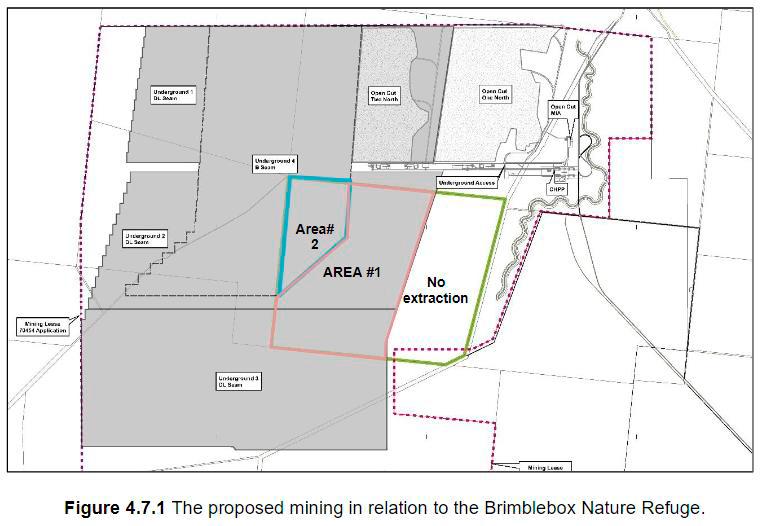
[305] For Bimblebox, double seam underground mining would occur in the north-western corner (underground mines 2 and 4 in Area 2) with single seam mining in the centre of Bimblebox (underground mines 2 and 3 in Area 1). There will be no mining in the eastern side of Bimblebox.
[306] Objections by YV&TBA and Sharov & Sosnina concern the nature, extent and consequences of subsidence on Bimblebox, and challenge the accuracy of the estimates of this damage in the EIS and SEIS.
[307] I was assisted by two experts who gave evidence about the potential subsidence impacts from the proposed underground mining. Dr Seedsman, engaged by Waratah, holds a Bachelor of Science, Geology; Master of Science, Sedimentology; and a PhD in Civil Engineering. He is a principal consultant at Byrnes Geotechnical Pty Ltd and provides specialist geotechnical advice to mining companies from operations to board level.
[308] Dr Pells, engaged by YV&TBA, holds a Bachelor of Science, Engineering; Masters of Science, Engineering; Diploma Imperial College, Soil Mechanics; and DSc, Engineering. Dr Pells works as a consultant and specialises in earth and tailings dams, hydrogeology, foundations, stabilisation and tunnels and mining rock mechanics.
[309] Dr Seedsman and Dr Pells both prepared individual reports and two Joint Reports and gave oral evidence in a concurrent evidence session over two days.154
[310] Their explanation of Waratah’s proposed longwall mines is assisted by this illustration.155
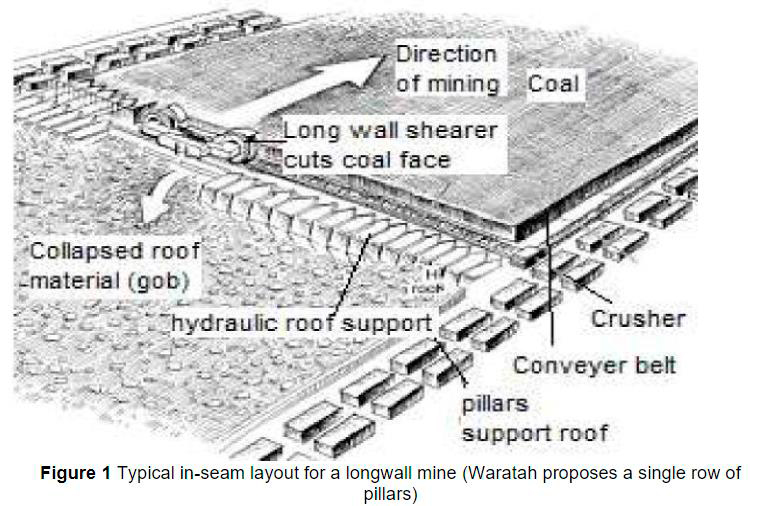
[311] The proposed mine would use a longwall machine to progressively slice a 1 m thick web of coal, ranging in height from 2 m to 4 m, along a 470 m wide face. With a 5 m wide roadway on each side of the face, the total width of the extracted void would be 480 m.
[312] The longwalls would be about 7 km long. When a longwall is fully extracted, the process is repeated in an adjacent long wall.
[313] Between the longwalls there are interconnected roadways used to transport coal by conveyors, to move machinery, and to provide ventilation and worker safety. They are known as chain pillars.
[314] As the longwall progresses, the rock above the extracted seam collapses into the void, or caving zone. This collapsed rock is known as goaf. The ground above the extracted seam moves down onto the goaf. The ground comes down in layers, but there will be some fracturing as it moves. The movement reports to the surface as settlement and some sideways movement, all of which is called subsidence. Because the goaf is blocky, the settled surface is not uniform. Settlement also occurs about the chain pillars, due to compression of the ground above and below the pillars. The deformation of the surface from subsidence occurs shortly after extraction, although there can be some later settlement.
[315] The experts discussed the following changes that may be caused to the surface of Bimblebox by subsidence: settlement, differential settlement, steps between different areas, surface cracking, and tilt. Dr Seedsman and Dr Pells agree the EIS and SEIS understates the potential subsidence damage from the mine, but they were wary of being held to firm estimates of what the damage would be.
[316] Dr Seedsman was asked to review the predictions made in the EIS and SEIS, not to make his own. Because of their different experience and expertise, Dr Pells deferred to Dr Seedsman on his calculations of possible settlement. Dr Seedsman said there was insufficient data to enable him to undertake predictive modelling that could be used for design. His calculations employed geometric principles. Although there is information about the geology of the Galilee Basin,156 there is no experience of underground mining in that Basin from which they could confidently model subsidence.
[317] Settlement of the surface – This is the lowering of the surface of the land. For the damage to be trivial, surface subsidence should not exceed 300 mm. Once settlement exceeds 0.3 m, there is a step change in the damage and what needs to be done in response.
[318] The experts estimated subsidence could be between 2 m and 4 m,157 compared with the estimate in the Longwall Mining Subsidence Report in the SEIS, in the order of 1.1 m to 2.8 m.158
[319] The magnitude of settlement depends on the thickness of the coal extracted and the width of the extraction face relative to the depth of mining. Once an extraction face exceeds 350 m the extra width has limited consequence. The shallower the seam, the greater the degree of settlement. In those areas where there is mining in both seams, the potential for land subsidence is greater.
[320] There appears to be one key factor that explains the difference between the experts’ estimates and those made in the Longwall Mining Subsidence Report in the SEIS. The SEIS estimate used the empirical subsidence predictive method, which assesses maximum subsidence using the factor of 60% of the thickness of the coal extracted.
[321] That method was developed in the 1970s for the NSW coalfields, using historical data from NSW mines. Longwall mining methods have since evolved and extraction widths have increased from 200 m – 250 m to the 480 m proposed by Waratah.
[322] Given there has been no underground mining in the Galilee basin, there is no alternative to using the empirical subsidence predictive method. However, in applying it, the assessment must consider how the mine geometry and the overburden conditions compare with those in the database.159
[323] The EIS and SEIS drew on a dataset from the Newcastle Coalfields, which has different geology to the Galilee basin. Dr Pells said the data must be used with some circumspection until it is tested by experience in the Galilee. Both he and Dr Seedsman thought this meant the factor of 60% was on the low side.
[324] In their estimate for their Joint Report, Dr Seedsman used a value of 70%. That is not derived directly from any dataset. It is the value he applied after considering the historical data from coalfields in NSW, and the compressive strength of the massive sandstone beds in those areas, with the geology in the Galilee Basin. Dr Seedsman considered 70% would encompass most outcomes on the information available.
[325] Dr Seedsman also considered the mine geometry when drawing on the NSW data. Mine geometry is either subcritical or supercritical: Subcritical if there are narrow panels mined at greater depth, which results in negligible surface subsidence; supercritical if wider panels are mined at shallower depths, which results in fracturing and caving that does report to the surface. Once the panel width is greater than 200 m, the most important factor is the depth of overburden. Given the double seam mining and the depth of the B seam on Bimblebox, this is an important factor.
[326] Differential settlement, channelisation and ponding – Because the longwalls are extracted and the chain pillars are not, the settlement above the two is not uniform. The difference between the settlement above the longwalls and the chain pillars is known as differential settlement. The differential settlement between the ground above the longwalls and above the chain pillars, creates a ridge and swale effect on the surface. This may not be perceived by eye until there is a rainfall event. Then ponding in the subsided longwall panels may be evident. It is less noticeable in a hilly landscape, where the water can get away and ponding is less likely to occur because of the grade of the land. However, Bimblebox has a very gentle grade in a flat landscape and channelisation along the subsided long wall panels will affect movement of surface water, with potential to affect the ecology of the refuge.
[327] In the Joint Report, the experts said the differential settlement would be less than predicted in the EIS and SEIS predictions of more than 1 m for a single seam and more than 2.5 m for double seam mining.160
[328] The Joint Report includes the following Figures.161
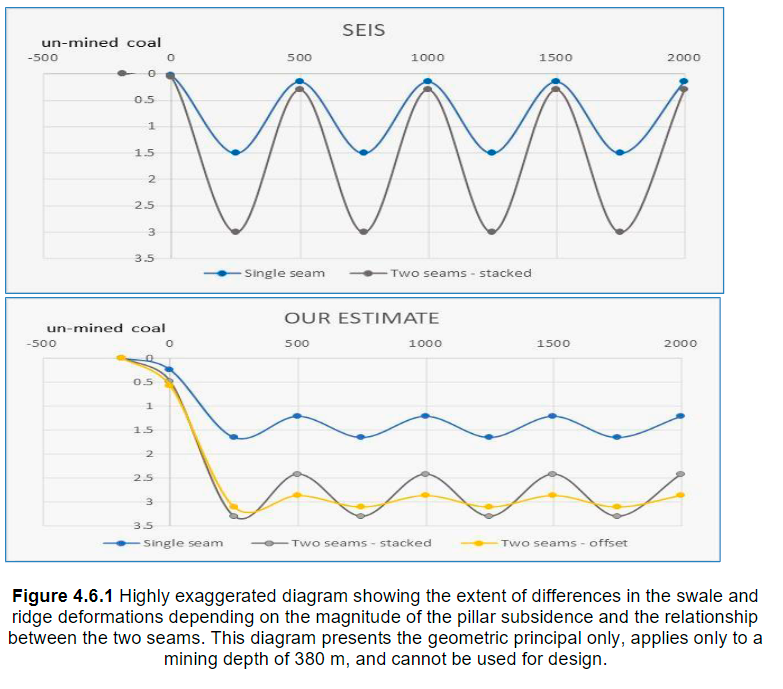
[329] The top illustration plots the SEIS estimate for differential subsidence for single seam and two seams – stacked. The bottom illustration, entitled “Our estimate”, has three lines: single seam, two seams – stacked, two seams – offset. Although it is in a Joint Report, Dr Seedsman prepared the figure and Dr Pells deferred to him on this evidence.
[330] Dr Seedsman intended this figure to illustrate the difference that offsetting two seam mining could have on the ridge and swale topography. Despite its title, he did not intend to make a prediction about the subsidence above the chain pillar or the differential subsidence. He applied a geometric principle in arriving at the plot points.
[331] Most importantly, it does not calculate mining at the depth it will occur on Bimblebox.
[332] Depth of cover is the critical factor for differential subsidence. The less cover, the less compression on the chain pillar and the less the area above the pillar will subside. The effect of this is to increase the difference between subsidence above the unmined chain pillars and the mined longwall panels. The shallower the mining, the greater the differential subsidence.
[333] While the graph illustrates differential subsidence when mining at a depth of cover of 380 m, that is deeper than the cover material for mining on Bimblebox, in some areas, considerably so.
[334] The B seam at underground mine 4 (Area 2) has cover of between 80 m or 90 m and 160 m. The DL seam at underground 3 (lower portion of Area 1) has between 120 m and 250 m. The DL seam at underground 2 (Area 2 and upper portion of Area 1) has between 120 m and 140 m.162
[335] Dr Seedsman’s purpose in including Figure 4.6.1 was to illustrate a possible reduction in differential settlement by offsetting the double seam from the centre line to the longwall centre line. In his figure, the bottom graph shows the difference in the yellow line. Offsetting would leave chain pillars above the middle of the goaf in the mined pillar below. His diagram illustrated the possible difference it might make in the ridge and swale effect. The figure is not for design use. Dr Seedsman did not have the necessary information for that purpose. The diagram merely illustrates the geometric principle: “So it’s sort of identifying an opportunity for the mine, but that really as far as it should go at this stage”.163
[336] Dr Pells and Dr Seedsman agreed there are probably dozens of alternatives that might alleviate surface damage by changing the length of the longwall face, the orientation, and the size of the chain pillars. Offsetting a double seam was only one possible consideration. While offsetting might reduce the differential subsidence, it would not affect the total subsidence of the longwall panels, which would be the same.164
[337] Figure 4.6.1 cannot be used as a prediction of differential settlement for the mine. Dr Seedsman did some further calculations during the hearing.165 This resulted in a calculation of differential subsidence in Area 2 of between 1.6 m and 2.2 m, compared with the differential of 0.8 m illustrated in Figure 4.6.1. He was reluctant to take the matter further during oral evidence and said he would need time to provide a calculation of differential settlement across the different underground mines on Bimblebox. I was not provided with any further calculations on the point. It is a matter for Waratah what evidence it chooses to lead in support of its application. However, I am still uncertain about what impact offsetting the double seams would have.
[338] In the end, I have an estimate of differential subsidence in the EIS and SEIS which Dr Seedsman and Dr Pells agree is an overestimate and Dr Seedsman’s illustration of how that might be affected by offsetting. I have no actual estimate of the differential subsidence of the revised mine plan.
[339] There is a further difficulty with the state of this evidence. Other experts, such as Dr Vitale who advised on surface water, assumed Dr Seedsman’s Figure 4.6.1 is an estimate they could use in giving their opinion.
[340] Dr Seedsman’s further calculations suggest differential subsidence in Area 2 might be of a similar magnitude to the SEIS estimate, albeit arrived at in very different ways. That leaves this important question in a state of considerable uncertainty.
[341] Settlement steps across Bimblebox – Another aspect to the land deformation that would be important for Bimblebox is the variable settlement outcomes across the refuge. In the eastern portion, there will be no mining at all. In Area 1, only the D seam will be mined. In Area 2, both the D and B seams will be mined. This will result in stepped subsidence across the landscape from east to west, with two distinct drops, the first from the no mining area to Area 1, the second, a further drop from Area 1 to Area 2.
[342] The steps will reverse the natural gradient of the earth. Currently, the land slopes gently west to east, the steps would have the ground levels lowering over two steps moving in the opposite direction, from east to west. The experts agreed this reversal cannot be remedied.166 YV&TBA say this difference in the levels will compound the harm caused by differential settlement and channelisation and ponding.
[343] Tilt – The experts estimate tilts in Area 1 of between 0.7° and between 1.4° and 2.8° depending on the depth of the seam.167 For Area 2, the experts estimate a tilt of 7°.168 These tilts, which will go against the natural flow of the land, would put Waratah in non-compliance with the requirement of proposed condition Table F1 in the Draft EA. When asked how Waratah would respond to this evidence, senior counsel said there is only one answer to it, and that is the condition must be changed.169
[344] If the only means for dealing with an impact of this nature is to accept it, that weighs in the balance against approval.
[345] Cracking – The experts agree it is very difficult to predict the width of tensile cracking. Dr Seedsman said this is a direct result of developing a model to predict subsidence more generally. The SEIS significantly understates the scale and distribution of cracking of strata, and open cracks at the surface. The experts said stepped near-vertical cracks and shears will be ubiquitous from the extracted seam level to the surface over the whole area of the underground mine. At the surface this will exhibit as open tension cracks that may extend downward for many tens of metres. These cracks will run along the ridges in the ridge and swale landscape.
[346] Considering the surface geology which is dominated by unconsolidated sands, silts and clay, they anticipate surface cracks of between 20 mm (at a mine depth of 400 m) to 150 mm (at a mine depth of 100 m). Where there is double seam mining at shallower depths, they anticipated cracking of up to 300 mm wide, and compression humps of 100 mm in height are possible.170 Cracks of that magnitude present a risk to both humans and animals as a trip hazard.
[347] There is a high probability that surface and near surface cracking will cause physical damage to buildings, sheds and concrete water tanks, roads, dams, and bores, cased or non-cased. It could also facilitate surface water flow to the underground, with possible change to groundwater quality.171
[348] Waratah says the changes caused by subsidence will be imperceptible. That is an oversimplification of the experts’ evidence about the visibility of the ridge and swale topography to the naked eye in the absence of rain. Waratah accepts there will be cracks, and if they are unsafe, they will need remediation, and that there will be topographical changes to the surface and possibly a need to cordon off the surface area that will be undergoing subsidence. It has no solution to the stepped change in the landscape. Its answer to tilt is to change the condition.
[349] Dr Seedsman and Dr Pells agreed the Draft EA should be amended to include the following:172
[350] DES has responded to that evidence by proposing further conditions regarding a predictive subsidence model.173 Those conditions would strengthen the Draft EA. But that does not inform me, now, about the likely impacts of the mining or the extent to which they might be able to be mitigated or avoided by a change to the mine plan. The implications for the viability of the mine are also unknown.
[351] Waratah says there will be sufficient data available before the mining begins under Bimblebox, to allow accuracy in predicting the impacts and adaptive mitigation measures, but that is not consistent with Dr Seedsman’s evidence.
[352] Dr Seedsman said the model cannot be developed without starting to mine. As mining progresses and assumptions in the model are verified or varied, the miner will have confidence in predicting the impacts, but they cannot build the model without actively mining.174
[353] Waratah says the detail of subsidence may be uncertain in a new basin but that does not mean no new basin can ever be open to mining. It submits I should have regard to the mine sequencing which, it says, shows that by the time underground mining commences beneath Bimblebox, there will be sufficient data to accurately predict the likely impacts of subsidence. However, Waratah has not referred me to any evidence from Dr Seedsman to support that, and it seems the proposition was not put to the experts. I cannot assume it is correct.
[354] In any case, the conditions do not contain quantitative measures, except for tilt, and the experts say this cannot be complied with.
[355] In the Joint Report Dr Pells noted the lack of compliance limits in the Draft EA. In oral evidence, Dr Seedsman agreed the regulator should decide what the limits should be and then the predictive model and the miner’s response to that determines compliance with the conditions, rather than predictions defining what harm is authorised.175 Dr Pells said:176
My concern – and I may be misunderstanding, but to me, my concern with the DA is not predicting what is likely to happen but what is allowed to happen … and it’s really as simple as that. It’s no more complicated than that.
[356] Dr Seedsman repeatedly emphasised the need for there to be agreed limits that the model works to.
[357] The failure to specify subsidence limits means there is no certainty about what impacts will be authorised. Uncertainty assumes greater significance when the area proposed to be mined is protected for biodiversity conservation. The level of uncertainty about the degree and extent of subsidence on Bimblebox weighs in the balance against approval.
Water
[358] The proposed mine could affect the quality, quantity, and flow regimes of both ground and surface water, with consequential ecological, agricultural, and social impacts. Each of these issues were raised in the objections to the mine, but the Land Court does not have jurisdiction to consider them all.
[359] At Waratah’s instigation, and with the active parties’ consent, I made the following declaration:177
any objections…about the effects of taking or interfering with groundwater on natural ecosystems or the physical integrity of watercourses, lakes, springs, or aquifers…are beyond the jurisdiction of the Land Court.
[360] That declaration is consistent with the finding by Bowskill J in New Acland Coal Pty Ltd v Smith.178 Her Honour found the grant of a mining lease did not authorise the holder of the mining lease to interfere with groundwater. The holder of a mining lease still needed a permit under the Water Act 2000. The effects of interfering with groundwater would be considered by the decision maker under that Act.
[361] Her Honour’s reasoning and findings were not disturbed on appeal (Oakey Coal Action Alliance Inc v New Acland Coal Pty Ltd & Ors).179 Justice Sofronoff, then President of the Court of Appeal, observed as a matter of practicality the grant of the mining lease cannot impinge on groundwater and the issue is irrelevant if a further approval is required.
[362] In 2016, amendments were introduced to both the MRA and the Water Act to confer rights to remedy the difficulties and inefficiencies involved in examining the miner’s activities under different Acts. However, it is common ground Waratah is in the same position as was New Acland Coal, given the date its applications were made.
[363] The active parties agreed Waratah cannot impact on groundwater levels within groundwater aquifers without an approval under the Water Act.180
[364] That has consequences for the matters I can consider and the evidence and submissions I can receive in exercising the Court’s functions in this hearing. Waratah led four reports from Dr Noel Merrick, all of which they agreed I should not consider. I have disregarded them, and any objections which address those matters in the declaration.181
[365] The active parties also agreed to strike out any evidence from the subsidence experts that dealt with depressurisation caused by groundwater impacts. Fortunately, Dr Seedsman and Dr Pells agreed the issue of depressurisation did not affect their opinions about subsidence as they had sufficient geological information on which to base their opinions.182
[366] The parties do not agree, though, that the Court must disregard all evidence about groundwater quality impacts.
Groundwater
[367] The objections raise questions about the extent and nature of the groundwater quality impacts on any relevant aquitards and aquifers, and on flora and fauna within Bimblebox or any other ecologically significant areas. They also question the appropriateness of the Draft EA conditions, and whether any impacts on groundwater quality are unacceptable.
[368] Waratah relies on the uncontested Statement of Evidence of Mr Hair, a geologist and hydrologist with extensive relevant experience.183 Although YV&TBA did not require Mr Hair for cross-examination, they argue I can make little use of his evidence. They say Mr Hair’s conclusion the mine would not impact groundwater quality should be disregarded. It is based on the specific altered flow regime and drawdown predicted by Dr Merrick.184 As they could not test that evidence from Dr Merrick, I should not accept any conclusions drawn from that evidence.
[369] I am not persuaded the evidence needs to be so starkly demarcated. The effect under consideration is the potential contamination of groundwater outside the ML area, not the quantity of groundwater or groundwater levels. That does not fall within the scope of the declaration I made by consent or extend the hearing beyond its jurisdictional limit. I am satisfied I can receive evidence that groundwater quality is unlikely to be affected because the effect of dewatering the mine will be to change the direction of groundwater flow, such that contact with contaminants would not flow west from the excavation.
[370] Further, YV&TBA say I should reject Mr Hair’s conclusion there will be no impacts to flora and fauna on Bimblebox arising from groundwater impacts. That is based on studies in the EIS and SEIS which did not identify any groundwater dependent ecosystems, and which found the vegetation communities are shallow rooted and not reliant on the deep groundwater table.185 Those studies used State vegetation mapping which Dr Daniel said “is too broad scale for accurate measurement”.186
[371] Further, Mr Hair was not provided with the uncontested evidence of Ms Julien. Her indices of recordings of fauna and flora on Bimblebox include 31 wetland indicator species.187
[372] That evidence falls squarely within the declaration. It relates to the effect of drawdown of groundwater on ecosystems which depend on the groundwater. Accordingly, I will exclude the evidence of Mr Hair on this topic.
[373] Finally, while Mr Hair considers the Draft EA conditions which defer baseline monitoring of groundwater quality to post approval are appropriate, YV&TBA argue the lack of the baseline demonstrates the uncertainty about possible impacts.
[374] YV&TBA frankly concede this is not a decisive issue, but say it reinforces the overall lack of certainty about the potential impacts of the mine on Bimblebox.
[375] I accept that. However, that issue will be considered if Waratah applies for an approval under the Water Act. I do not consider it a material consideration on these applications.
Surface Water
[376] Turning to surface water, Waratah relies on the evidence of Dr Andrew Vitale, a civil engineer with extensive experience in designing flood mitigation measures for large infrastructure projects, including mines. His company did the surface water assessments for the SEIS in 2011. He was personally involved in that report. Dr Vitale prepared an expert report and gave oral evidence at the hearing.188
[377] Although the revised mine plan did not change the plans for underground mining on Bimblebox, the passage of 10 years since the EIS and SEIS provided an opportunity to address data limitations in the original studies, and there was good reason to update dated information. Dr Vitale was not instructed to undertake that exercise.189
[378] The open cut pits on other properties have the potential to affect surface water quality, quantity, flow volumes and duration on Bimblebox. However, the focus during the hearing was on the impact of subsidence on surface water flows on Bimblebox.
[379] Without considering the meteorological data since 2012, the EIS and SEIS work on surface water flows, hydrology, and flooding and drainage could not be updated. Any predictions in the earlier reports are dated. Further, the topographical data used in those studies is coarse, publicly available data and does not capture the shape of drainage features on the land. There is no hydrological modelling for the revised mine plan and no geomorphological assessment of the potential downstream impacts.190 The SEIS 50-year flood overlays do not model for any impacts for the eastern part of Bimblebox.191
[380] The degree and direction of tilt, the stepped nature of settlement, and the degree of differential settlement over the underground longwall panels will alter surface water flows. The uncertainty about subsidence (see [303] to [357]) has obvious implications for any predictions Dr Vitale might make.
[381] The impact of greatest concern to YV&TBA, from a surface water perspective, was the differential settlement. Although the degree of differential settlement is uncertain, some differential settlement above the longwall panels is certain. This will result in channelisation along subsided longwall panels above the underground mine. This is represented in Figure A4 below, which overlays the proposed longwall panels over the landscape. The red outline shows the boundaries of Bimblebox.192
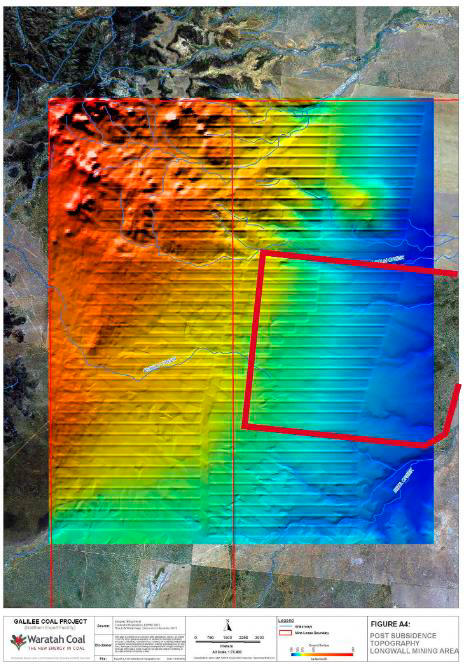
[382] Channelisation will affect surface water flows across Bimblebox in general. It will also alter the course of its major drainage feature, Pebbly Creek. This is an ephemeral creek that meanders in a south-easterly direction to enter Bimblebox and then join Beta Creek, to the east. The impact of underground mining is that Pebbly Creek will become part of a channelised subsided longwall panel and, unless remediated, it will no longer pass to the eastern third of Bimblebox at all.193
[383] Dr Vitale identified the following potential impacts from changes to surface water processes:194
[384] Although Dr Vitale described these and other surface water impacts as “potential”, that seemed to relate to the extent of subsidence, on which he deferred to the subsidence experts, which would determine whether rehabilitation would be required. This is important because rehabilitation to deal with surface water impacts could have significant ecological consequences.
Ecological impacts of subsidence or rehabilitation
[385] While there may be other impacts on fauna caused, for example, by noise, the predominant issue for both vegetation and fauna would be subsidence. YV&TBA are particularly concerned about subsidence impacts on the ecology of Bimblebox and the further damage that might be caused in attempting to remediate the damage.
[386] Before getting into this topic, I must deal with some arguments about evidence about rehabilitation.
[387] Rehabilitation necessarily involves a multidisciplinary approach, but Waratah sought to draw bright lines between experts on this issue. Waratah was the only party to nominate an expert on land rehabilitation, Mr William Thompson. It objects to evidence given by Dr Pells in the Joint Report. I overruled that objection during the hearing, but Waratah seemed to maintain the objection in its written submissions. To avoid doubt about this, I dismiss their objection to Dr Pells’ evidence for the reasons already given.195
[388] Unusually, Waratah also submits I should give little weight to some aspects of the evidence of one of their own witnesses, Dr Vitale, the expert they nominated on surface water issues. I am not persuaded I should give less weight to relevant evidence given by Dr Vitale within his area of expertise experience, particularly about what he expects would need to be done to remedy the channelisation and to restore the natural flow of Pebbly Creek.
[389] I now turn to the ecological consequences of subsidence and rehabilitation.
What are the potential impacts of subsidence?
[390] The ecology of Bimblebox will be changed by mining, whether the subsidence is remediated or not.
[391] Dr Daniel, Mr Thompson, and Professor Fensham each would have preferred more work done to predict damage to enable them to assess the potential impacts.
[392] Dr Daniel and Mr Thompson recommended an EA condition requiring a project scale regional ecosystem, soils, and land use map. Dr Daniel said this is what was expected in the environmental assessment process and some of the uncertainties affecting the ecologists’ evidence would have been addressed if that had been done.196
[393] Professor Fensham said surface drainage is a critical feature that determines the ecosystems that occur at Bimblebox. Its surface topology is extremely flat with poorly defined drainage channels flowing west to east. Disruption to surface flows will change the water conditions of different areas, with implications for their suitability for existing vegetation, whether trees or grasses.
[394] Dr Daniel expected subsidence damage would cause the death of some canopy trees, the short-term loss of some shrub and ground layer species, a change in the dominant native species where there is increased surface ponding, and because of exposure of bare soil, invasion of buffel grass with a loss in the ecological condition of Bimblebox.
[395] Mr Thompson questioned how the likely extent of ponding in the channels could be assessed without decent soil mapping. There are different soil types on Bimblebox, some deep and freely draining, others with higher clay contents that impede drainage. He estimated 70% of the soils on Bimblebox are more freely draining soils. Correlating vegetation to the soils, Professor Fensham thought the more freely drained soils covered the areas to be underground mined. This was yet another area of uncertainty.
[396] There was some speculation that the soil profile would allow the cracks to self-heal. Mr Thompson said, depending on how amenable to self-heal the soil characteristics are, allowing them to self-heal may be the best option. The absence of reliable data about the soil qualities of the areas that will be affected by mining compounds the uncertainty about ecological impacts.
[397] Dr Daniel and Professor Fensham identified an impact of surface cracking would be root tearing, particularly for canopy trees. The damage to or loss of canopy trees would take decades to recover to pre-mining levels and, in some circumstances, may lead to irreversible changes to the floristic makeup of Bimblebox’s ecosystems.
[398] A point of disagreement was what would happen after the death of the trees. Dr Daniel said Bimblebox would transition to an ecosystem that would also be typical of the landscape. So, if it were the silver-leaved ironbark that died because of poor drainage, Poplar Box, also now present on Bimblebox, would probably colonise that area.197
[399] While Professor Fensham agreed with Dr Daniel that changes would lead to other native communities being established in those areas, because nature has a way of filling a vacuum, he did not agree that it will be Poplar Box.198 Whether the new ecosystem would be dominated by Poplar Box or not, it would be different to the current ecosystem.
[400] Without management, Dr Daniel said there would be an invasion of buffel grass. The subsidence impacts will create areas of bare earth and will significantly increase the amount of weed management required to keep buffel grass invasion to current levels.
[401] Mr Caneris said subsidence damage would have habitat impacts because of loss of vegetation, including habitat trees. Dr Daniel also predicted there would also be fauna impacts from the transition to a different native vegetation community type. Mr Caneris said this would provide advantageous conditions for amphibians, and increased access to water would advantage some species, including feral species such as pigs and foxes.
[402] There are implications for scientific research of vegetation and habitat changes. The experts agree the scientific research done on Bimblebox was valuable. Waratah submits no research has been undertaken for more than 10 years. However, bird monitoring has occurred on established sites in 2005, 2011, 2012, 2015 and 2019.
[403] Waratah says it would be possible to repeat the experiments in another location and there will be an opportunity for other, important scientific research associated with subsidence impacts to be undertaken on Bimblebox.
[404] However, Dr Daniels and Mr Caneris believe it would take more than 20 years to repeat what has been done on Bimblebox.199 As for research on subsidence impacts, Dr Daniel agreed this would mean that “Bimblebox becomes the experiment for next time”.200
What would remediation of subsidence mean for the ecology of Bimblebox?
[405] Dr Daniel and Mr Caneris look to an adaptive subsidence management plan to mitigate and manage effects on native vegetation where possible and to offset any residual impacts.
[406] As well as requiring a plan of that nature, Schedule F of the Draft EA contains conditions about the post-mining landform that require Waratah to address topographical changes:
[407] As already observed at [343], the subsidence experts expect the post-mining slope to well exceed 1° in areas of double seam mining (at 7°) and when mined at shallow depths for single seam mining (e.g. at 100 m, a tilt of 2.8°). That cannot be remediated without major earthworks.201
[408] Further, this tilt will go against the current slope of the land, because of the stepping down from the unmined area in the east, to the single seam mine and then the double seam mine going west. The reversal of the natural gradient of the earth cannot be remedied.202
[409] The channels would be kilometres long, and metres or several metres deep, depending on the degree of differential subsidence.
[410] Dr Vitale said that reinstating the natural drainage path of Pebbly Creek, which would be captured by the channels, would require earthworks across a path in the order of 15 m to 20 m wide to accommodate a 5 m base for the creek and sloping sides to maintain stability.
[411] Earthworks to remediate the subsided longwall panels would be of the same nature, at a lesser scale, using heavy equipment and major removal of vegetation.
[412] As for tension cracks, they would be expected along the long edge of each longwall panel in the ridge of the ridge and swale topography. If they do not self-heal, Dr Vitale said they would be rehabilitated by ripping, using a metal tool pulled through the ground. There is no way to do this without removing the vegetation.
[413] The Draft EA requires progressive rehabilitation, raising the prospect of ongoing disturbance of vegetation for heavy machinery to access areas under rehabilitation, as well as the substantial earthworks to remediate subsidence damage.
[414] Dr Daniel, Mr Caneris, Mr Thompson, and Professor Fensham were all concerned about the invasion of buffel grass. It is likely to proliferate because of the mine and is a key threat to the ecosystem. Mr Hoch’s vigilance and hand pulling of buffel grass has been effective in dealing with incipient outbreaks.
[415] Dr Daniel and Professor Fensham regarded a weed management plan for the whole ML area as a necessary condition of approval. Mr Thompson was critical of the absence of a weed management plan with a decent baseline. He said any plan would need to be sophisticated and as soon as a machine was put through the land, there would need to be immediate follow up. A buffer area might assist, but that would not be enough because of the way buffel seed spreads.
[416] Professor Fensham believed it would be impossible for a weed management plan to prevent the spread of buffel. The area disturbed by subsidence damage over the longwall panels is so great that he thinks the whole place would be infected with buffel grass. The mines to the east of the Desert Uplands are seas of buffel grass and broadscale control of buffel grass is not possible where ground is disturbed around the mine.203
[417] Waratah objects to this evidence for various reasons. I overrule the objection. Professor Fensham’s evidence was responsive to questions put to the experts in the concurrent evidence session. It was within his area of expertise. It did not imply, as Waratah said, that the company would not comply with an environmental condition, rather, Professor Fensham clearly thought the condition would be ineffective.
[418] However, against that evidence, I take into account what Mr Thompson said. In his experience with mine rehabilitation in Queensland, buffel grass is often used as a pioneer species for rehabilitation areas, because it is so competitive. That might explain the seas of buffel grass that Professor Fensham referred to.
[419] Nevertheless, Mr Thompson shared Professor Fensham’s concern. He said he had seen some control of buffel grass in hard rock mines, but the grass was not as highly competitive in those environments as in this one.204
[420] The experts agreed with the suggestion by senior counsel for YV&TBA that, from an ecological perspective, rehabilitation of subsidence damage might make matters worse. That is, the cure might be worse than the disease.
[421] That does not mean the disease is acceptable.
Conclusions on impacts on Bimblebox
[422] Waratah says subsidence is not inevitable because Mr Harris said it would look at minimising disturbance using alternate underground mining methods.205 Mr Harris’ evidence about this is so vague as to be meaningless. It does not identify the alternative method. It provides no basis for greater certainty about the ecological impacts of the underground mining. An alternative method has not been considered by the many experts called to give evidence on the topic.
[423] During the subsidence experts’ oral evidence, the suggestion was made by counsel for Waratah that a different mining method, such as bord and pillar might be used, with less significant impacts. However, this would present another substantial change to the mine plan which has not been assessed and on which the expert witnesses were unable to provide meaningful evidence. This was the response of Waratah’s own subsidence expert to the proposition:206
DR SEEDSMAN: Yes, but they’d probably go out of business straightaway. I mean, there’s an infinite number of ways that I can mine coal. However, we’re in the Galilee Basin. We’re mining thermal coal. There is a limit to the mining systems that we can adopt. Now, in an ideal situation, it is possible that they could make money doing a board and pillar operation, but it’s well outside the brief, and, once again, we couldn’t make any calls, including the one about board and pillar, unless we have these predictive models that I’m talking about.
[424] Waratah says the evidence supports a ‘wait and see’ approach to rehabilitation. Certainly, none of the ecologists or land rehabilitation experts recommended broad scale use of heavy earth moving equipment.
[425] Because of the uncertainty about the degree of subsidence damage, there is similar uncertainty about the flora and fauna impacts of the proposed mine.
[426] Waratah says the uncertainty can be managed through conditions which they say, as a matter of practice, should only require costly, detailed plans to be done when there is some certainty about securing a mining lease. Where its expert witnesses have recommended further investigation into an impact, Waratah says the EA should be amended to include conditions requiring that to occur.
[427] YV&TBA say addressing the uncertainty by conditioning the Project is inappropriate. In this case there is insufficient knowledge of the nature of the harm that the EA would authorise. Conditioning further investigation does not remedy this, instead it defers the assessment of environmental harm until post-approval.
[428] Although the extent of the impacts is uncertain, the nature of the impacts is not.
[429] It would be possible to adopt a less intrusive approach to rehabilitation than would be required to restore the pre-mining topography and surface water features. For example, it may not be necessary to use heavy earth moving equipment to deal with cracking or to allow water to escape from the channels above the longwall panels.
[430] But that has ecological consequences. The tilt of the land, the change in direction of the slope, the stepped changes in topography, and the change to the natural flow of Pebbly Creek cannot be addressed without substantial earth works. Those changes will alter the ecology of the refuge.
[431] This does not mean any species will become locally extinct or that there will be significant impact on endangered or vulnerable species or their habitats. However, this is a large intact natural woodland with very high ecological values, listed as a refuge to protect those very values.
[432] Dr Daniels said Bimblebox’s ecological values, post-subsidence, may never be as good as they currently are.
[433] Bimblebox’s status as a nature refuge is at risk if the mine proceeds.
[434] Under the NCA, a nature refuge must be managed in accordance with the management principles prescribed by the Act and the declared management intent, and the State Agreement (s 15). The State Agreement must be consistent with those management principles (s 45(3)). It binds the landholder, their successors, and any other person with an interest in the land in the nature refuge (s 51). That would include Waratah if it is granted a mining lease.207 The refuge must then be managed according to the declared management intent, including, “to conserve the area’s significant cultural and nature resources” (s 22) and the Conservation Agreement (s 15(1)(b)(iv)).
[435] The Conservation Agreement prohibits:208
[436] The proposed activities cannot comply with those requirements.
[437] Mr Harris says Waratah intends either to purchase Bimblebox or to work with the owners to maintain the status of Bimblebox as a nature refuge, through the progressive rehabilitation plan, in consultation with the current owners and DES.209
[438] The prospect of Waratah purchasing Bimblebox is low. Ms Cassoni expressed no interest in that happening. In any case, it cannot be disposed of without the consent of the Commonwealth because of the Commonwealth Funding Agreement.210
[439] Whether Waratah purchases it or not, the ecologists agree Bimblebox would lose its very good ecological values if the mine proceeds. Dr Daniel and Professor Fensham assumed approval of the mine would result in the loss of its status as a nature refuge. Dr Daniel doubted the high ecological values of Bimblebox could be retained, even under a subsidence management program involving management of impacts to the natural ecosystem, weed management and remediation effort.211 Mr Caneris also considered the key environmental values of Bimblebox would not be maintained or enhanced if the mine were approved, and it would lose its status as a refuge.212
[440] As DES submits, the gazettal of Bimblebox should be considered in the context of the objects of the NCA, relevantly, that nature conservation is to be achieved by “an integrated and comprehensive strategy for the whole of the State” (s 5). ‘Conservation’ is the protection and maintenance of nature while allowing for its ecologically sustainable use (s 9). ‘Nature’ includes all aspects of it. ‘Ecologically sustainable use’ is the use of the area within its capacity to sustain natural processes while, in relation to protected areas:
[441] Bimblebox is to be managed in accordance with the “declared management intent, and the conservation agreement” and with the following management principles (s 15(1) and 22):
[442] Its gazettal did not exclude the possibility of a mining lease being granted over Bimblebox. But DES submits I should only recommend approval if strongly persuaded I ought to do so for good reason. I accept that, as a matter of discretion, rather than one of onus or precondition. There is a public interest in maintaining the protection of this large intact natural woodland. While the vegetation types on Bimblebox are common across the Desert Uplands, they are poorly represented within the reserve system.213
[443] The risk of the loss of Bimblebox as a nature refuge is both real and likely if the mine proceeds.
[444] The ecological impacts of changes to the topography and surface water flows due to subsidence, and the further ecological damage that would be caused by attempts to rehabilitate those changes, make it improbable that the owners could comply with the declared management intent for the refuge – to conserve the area’s significant cultural and natural resources.
[445] Despite Mr Harris’s evidence that Waratah would try to maintain Bimblebox as a nature refuge, during the hearing Waratah proposed degazettal as the way to deal with air and noise conditions if they are interpreted to apply across the property because of its status as a refuge.
[446] Mr Brinnand submits that if the mine proceeds, Bimblebox has no future as a nature refuge.214
[447] Waratah submits that Bimblebox is replaceable and any evidence which relies upon the endeavours or value of the current management (such as that given by the ecology experts) should be given limited weight. They submit that there is no reason why the terms of the Conservation Agreement could not be replicated for a proposed offset site.
[448] That assumes an appropriate offset can be secured, an issue strongly in dispute.
Offsets
[449] The expert evidence about offsets was given by Dr Jarrad Cousin and Professor Martine Maron. They provided two reports, one prepared after they had given oral evidence in a concurrent evidence session.215
[450] Dr Cousin has 20 years’ experience in scientific research and environmental practice and specialises in fauna ecology, particularly avifaunal. For the last seven years, he has focussed on the design, delivery and monitoring of biodiversity and carbon offsets for mining, infrastructure and development projects. He has worked on every stage of offset management plans, from design to ongoing monitoring and compliance assessment, and conducted extensive field-based assessments relating to biodiversity offsets in Queensland.
[451] Professor Maron is a scientist and academic who leads collaborative research efforts in partnership with government and non-government organisations to improve environmental policy and its outcomes for biodiversity. The work of her research group in the School of Earth and Environmental Sciences at the University of Queensland has a focus on biodiversity net gain/no net loss policy. This group has a particular interest in the design and consequences of biodiversity offsetting and conservation and restoration of Australia’s woodlands and woodland bird assemblages.
[452] Professor Maron has worked extensively with Australian state and federal government agencies over the last 10 years to support development of biodiversity offset policy and improve its implementation. For the last 10 to 15 years, she has had a particular interest in the intersection between what policy says and what it achieves on the ground to understand how to improve policy outcomes. She is a member of the Queensland Government’s Offsets Project Management Committee, the group that advises DES on how to spend the funds that it receives as financial settlement offsets under the current policy. She is also a member of a multisector reference group that is part of the ongoing review of the Queensland offsets framework.
[453] Waratah says offsets are the answer to any unavoidable impacts that remain after mining. It maintains its commitment to provide offsets for all former open cut areas to ensure that additional subsidence areas will have offsets provided for them, “whether there are impacts or not”.
[454] Biodiversity offsets are the last step in the mitigation hierarchy when assessing projects that have biodiversity impacts. If impacts cannot be avoided, or minimised and rehabilitated, offsets counterbalance this to achieve a no net loss. An effective offset delivers a benefit or gain for the affected biodiversity features that is at least as large as the impact is and which lasts at least as long as the impact does.
[455] The offset experts said the reason for the strong emphasis on avoidance and minimisation, rather than offsets, is that adequate offsets are very challenging to achieve, and some impacts cannot feasibly be offset.
[456] The legislation governing environmental offsets has changed since Waratah made its application. The offset experts say the Offset Plan prepared by Waratah for the Coordinator-General is inadequate when assessed against current requirements. The experts differ on whether it is possible to devise an adequate plan, and Waratah says I should prefer the evidence of the expert it nominated, Dr Cousin, who said it was possible.
[457] Waratah and DES suggest different ways offsets might be conditioned if the mine is approved, but this involves considerable uncertainty about what offsets would be required and whether they could be achieved. It defers the assessment of offset proposals to after the EA is granted. YV&TBA says to recommend the EA be approved on that basis would abdicate the Court’s function about that application.
[458] The evidence and submissions raise these questions:
What law applies to offsets for this mine?
[459] The current offsets regime in Queensland is comprised of the Environmental Offsets Act 2014 (Offsets Act), the Environmental Offsets Regulation 2014 (Offsets Regulation) and the Queensland Environmental Offsets Policy (Offsets Policy). The main purpose of the Offsets Act is to counterbalance the significant residual impacts of activities on prescribed environmental matters by environmental offsets (s 3(1)).
[460] The Offsets Act commenced in 2014, after Waratah had lodged its applications. At that time, offsets for a mining activity were governed by the EPA s 210, which conferred on DES the power to impose an offsets condition in the Draft EA, which it did.
[461] The 2013 EPA continues to apply to an application made but not decided when the Offsets Act commenced and, if the EA is granted, the EPA, not the Offsets Act, will apply to the EA (s 95(2)).
[462] In preparing their Joint Report, the experts assumed the Offsets Act applied and assessed Waratah’s Offset Plan against the Offsets Policy (version 1.9), then the current version under that Act.
[463] The Offsets Act does allow for the Offsets Policy to be considered for an undecided application, but only if the applicant requests or agrees to that (s 95A). During the hearing, Waratah agreed to DES considering the Offsets Policy version 1.9 (or later) when deciding the EA application.
[464] Although the Offsets Policy has been updated since the experts prepared their Joint Report, DES says there is no material difference and I can refer, as the experts did, to version 1.9.
[465] The Offsets Policy is a tool to support administrative decision makers to formulate a condition requiring an offset when one is required for a prescribed activity that has a significant residual impact on a prescribed environmental matter. These are defined terms under the Offsets Act.
[466] A mining activity regulated under an EA is a prescribed activity because it is authorised under the EPA under which an offset condition may be imposed (EPA s 9).
[467] A nature refuge is a prescribed environmental matter because it is a matter of state environmental significance (MSES).216 MSES were previously called State Significant Biodiversity Values, the term used in the condition in the Draft EA. In this case, as well as the nature refuge itself, the MSES include of concern and riparian vegetation, connectivity, koala habitat, wetland protection areas and significant wetlands. Offsets for habitat for five vulnerable species (the ornamental snake, squatter pigeon, black-throated finch, yakka skink and red goshawk) are conditioned by the Commonwealth Government under the EPBC Act. This Court has no jurisdiction for the Commonwealth approval.
[468] There will be a significant residual impact within the meaning of the Offsets Act if mining causes a direct or indirect adverse impact which is significant and likely to remain despite on-site mitigation measures (s 8(1)). Less onerous requirements apply for some types of impacts within protected areas, but this does not apply to a nature refuge (s 8(2), (5)).
[469] Because Waratah has agreed to DES applying the Offsets Policy to this EA, its Offset Plan stands to be assessed against current requirements. The difficulty with doing that is it assumes a total loss of ecological value on Bimblebox due to open cut mining.
[470] Given the revised mine plan, DES says it remains to be decided whether there would be a significant residual impact. Waratah has not provided sufficient information for that to be assessed.
[471] Waratah says I must first consider the extent to which its mitigation measures would ameliorate the direct or indirect adverse impacts. It is only if significant adverse impacts are likely to remain that an offsets condition may be imposed. That submission does not sit well with its commitment to provide offsets for the entire area, regardless of impacts.
Is Waratah’s Offset Plan adequate?
[472] Waratah’s Offset Plan was prepared in 2014 and reflected the requirements of the imposed condition, the Offset Policy, and the conditions of its approval under the Commonwealth EPBC Act. It identified the potential impacts of the mine plan as it then was. That involved open cut mining on Bimblebox, which would have resulted in the destruction of much of the surface area of the nature refuge.
[473] The Offset Plan identified two properties in the Desert Uplands and Brigalow Belt Bioregions that Waratah said had the potential to meet 100% of the requirements of both Commonwealth and State requirements.
[474] The offset experts said there is inadequate information provided to support the contention that either or both properties could provide an adequate offset for the loss of Bimblebox and its associated values, or that they meet the object or purpose of offsetting in general.217
[475] Waratah says this relates only to parts of the proposal, not the whole, without explaining what this means. I cannot accept that submission. The experts said the Offset Plan lacks robust and reliable information and inappropriately and incorrectly estimates the benefits. The regional ecosystem mapping used in the Offset Plan needed to be ground-truthed at an appropriate scale to adequately assess impacts. Further ecological equivalence assessment for the proposed offset properties was required. The methodology used in the assessment of offset requirements lacked sufficient detail to accurately assess habitat quality.
[476] Even assuming the information used to assess offset requirements is broadly correct, they agreed the offsets are based on calculations that appear to have misrepresented critical inputs in the methodology which would have resulted in overestimation of the offset benefits.
[477] Those observations go to the basis of the Offset Plan as a whole.
[478] As DES identified in its submissions, the key concerns were:
[479] Since there is no disagreement between the experts, there is little purpose in further exploring their reasons for having those concerns. They are explained in detail in their Joint Report, including by reference to calculation tools that assist in evaluating an offset proposal. Waratah has not referred me to any oral evidence that qualified their joint opinion.
[480] However, the experts did not agree on an important question: whether they thought it possible that an adequate offset plan could be devised. Ultimately, I consider their disagreement was a question of degree, with Dr Cousin saying it was possible, while Professor Maron said she did not know if it was.
Should I prefer Dr Cousin over Professor Maron?
[481] Waratah says I should prefer the evidence of Dr Cousin and objected to some evidence of Professor Maron. Those arguments are best dealt with before I explore their difference of opinion.
[482] Waratah says Professor Maron’s career has been primarily academic, focussed predominantly on policy design, rather than implementation.
[483] That misrepresents Professor Maron’s experience.
[484] Although she no longer does as much field work as she would like to do, Professor Maron has had significant field work experience.218 Her research work is very outcome focussed, looking at implementation not just design. She has used the results of research into biodiversity offsets to develop tools to support decision makers in implementing policy.219
[485] I reject Waratah’s submission I should prefer Dr Cousin’s evidence to Professor Maron’s on the few matters on which they disagree. Professor Maron’s experience is no less relevant than Dr Cousin’s.
[486] Professor Maron has a detailed understanding of the requirements under state and federal legislation and policy on this topic.220 Dr Cousin acknowledged she is a leader in the architecture of the offset frameworks.221
[487] While Dr Cousin has considerable on-the-ground experience of developing and working with offset plans for specific projects, Professor Maron’s research provides a valuable system-wide perspective of the effectiveness of offsets in achieving the objective of biodiversity conservation. That is relevant because of Waratah’s assurance I need not recommend refusal of the applications because, assuming there is a total loss of Bimblebox’s ecological values, that loss can be offset.
[488] Waratah makes two other submissions about Professor Maron’s evidence that I will deal with here.
[489] First, it objects to any evidence from Professor Maron about the ecological values of Bimblebox because she was not the expert nominated by YV&TBA to advise on that topic and, Waratah says, she expressed different views to those expressed in the ecologists’ Joint Report.
[490] Although Waratah gave pinpoint references to passages of the Joint Report and Professor Maron’s oral evidence, it is not clear what evidence is objected to because of the single expert rule and what is objected to because it is inconsistent with the ecologists’ evidence, or both.
[491] Given the voluminous written and oral evidence, if there is a serious inconsistency Waratah should articulate that rather than leaving it to me to work out if there is any substance to its complaint.
[492] In its written submissions Waratah relies on paragraph [75] of the offsets experts’ report as the most obvious example, without identifying the inconsistency, which I confess is not obvious to me. In that paragraph, Professor Maron appeared to be attempting to summarise what she understood to be the effect of the reports provided to her, including the ecology and land rehabilitation Joint Report.
[493] As appears from my earlier discussion of ecological values and impacts, I have looked to the nominated ecologists for evidence on those topics, not to the evidence of Professor Maron. However, it is unrealistic to expect that an ecologist nominated to advise on offsets would not draw on their own expertise in forming their opinion about the adequacy of offsets or the possibility of devising an effective biodiversity offset for the loss of the ecological values of Bimblebox.
[494] I assume that Dr Cousin, who is also an ecologist, would have done the same thing, and his evidence suggests he did. He undertook a site inspection on Bimblebox, viewing the refuge from the northern, western and eastern boundaries. He conducted broad assessments identifying vegetation communities, general habitat condition, disturbances, and fauna habitat values.
[495] Professor Maron inspected Bimblebox over three days in October 2020, travelling most vehicle tracks and observing and assessing its floristics and its habitat structure, including the condition of the ground layer and other relevant habitat values for fauna.
[496] Both Professor Maron and Dr Cousin would necessarily have drawn on their ecological expertise to form their views. If not, what was the purpose of their site inspections? They were instructed to have regard to the ecology and land use Joint Report, not to restrict themselves to that source of information. The experts said they had considered their own independent observations of Bimblebox and the proposed offset properties as well as the material provided in their brief.222
[497] Having inspected the properties and considered the reports provided to them, the experts agreed the Offset Plan provided to the Coordinator-General was inadequate.
[498] As I understand their evidence, their difference of opinion about whether it would be possible to devise an adequate biodiversity offset does not depend on a difference of opinion about the ecological values of Bimblebox.
[499] In those circumstances, I overrule the objection.
[500] Second, Waratah submits Professor Maron’s evidence is unreliable because it is coloured by her view that the offsets framework in Queensland does not work.
[501] When asked whether offsets in Queensland under the Offsets Act work to achieve their objective, Professor Maron answered “No”. She said that was the clear outcome from the offsets review feedback as well. However, Professor Maron said she did not intend to imply that no offsets work. Individual offsets can work. Her answer to counsel’s question was about offsets in general.
[502] Her reservation about the effectiveness of the offsets framework is based on her research into the intersection between what policy aims for and what policy achieves. That is empirical research. Her opinion is not some ideological stance that might justify her evidence being discounted.
[503] Professor Maron did not rule out the possibility of a suitable offset plan being devised. She said she did not know if it was possible but thought it would be very challenging.223
[504] I reject Waratah’s submission I should discount Professor Maron’s evidence because of her opinion about the efficacy of the offsets framework in Queensland.
Is it possible to devise an adequate Offset Plan?
[505] There are two aspects to this issue because YV&TBA question whether it is possible either as a matter of law, or fact, to devise an adequate offset.
[506] The question they raise about legality relates to the loss of Bimblebox’s legal status as a nature refuge. They say this is a loss that, legally, cannot be offset. The Offsets Policy requires offsets to achieve a conservation outcome that counterbalances the significant residual impact for which the offset was required ([1.3(3)]). Under the Offsets Act, to achieve the conservation outcome the offset must be selected, designed and managed to maintain the viability of the matter (s 11). If the matter is Bimblebox as a nature refuge, that matter will cease to exist if the nature refuge is degazetted. There can be no counterbalance.
[507] Although I see the logic in the argument, it requires abstract reasoning without grounding in the text of the Offsets Act. In the absence of an expressed intention that the loss of a protected area’s status cannot be offset, the provisions that do address protected areas do not support that interpretation.
[508] For example, in the definition of significant residual impact, the Offsets Act draws a distinction between impacts on a protected area, as a prescribed environmental matter, and impacts on a prescribed environmental matter (such as an endangered species) that occurs in a protected area. Some types of impacts on a protected area (other than a nature refuge) are deemed to be significant without that being established, including a reduction in the natural or cultural values of all or part of the protected area. Given the careful distinction between the impacts on and in a protected area, if it had been intended that the loss of legal status could not be offset, that could easily have been stated.
[509] As I interpret the Offsets Act, it is possible to devise an offset where the effect of the impact is that a nature refuge loses its legal status as a protected area.
[510] I will now turn to the evidence from the offset experts about whether they think it is possible, as a matter of fact, to devise an adequate Offset Plan to counterbalance residual impacts on Bimblebox.
[511] They agree that to effectively counterbalance the residual impacts, the offset must deliver a benefit or gain for the same biodiversity features or matters that are impacted. This must be at least as large as the loss from the impact and last as long as the impact’s duration.
[512] Dr Cousin said there are likely areas within the Desert Uplands bioregion with similar native flora and fauna communities and associated habitat values to those contained within Bimblebox. They would have to be protected and appropriately managed to achieve the offset objective. His opinion was based on the ecologists’ report, not his own assessment of alternative properties. He said any assertion of appropriateness would need to be confirmed after detailed assessments of vegetation mapping, fauna habitat values and habitat quality assessments, which are the deficiencies they identified in Waratah’s Offset Plan.
[513] Professor Maron did not know if it would be possible to devise and implement appropriate biodiversity offsets for the mine. It would require a very large area of very high condition old-growth vegetation, with limited buffel grass incursion, and enough potential to improve the condition of the site for each of the affected species for which offsets are required. She said there needed to be more targeted searches and expert input about affected species and ecological communities to assess whether it is possible.
[514] Professor Maron also drew attention to the large old hollow trees on Bimblebox which she said are essentially irreplaceable, due to their great age.224 When asked whether they could be offset by existing hollow trees on offset land, she explained that is not a gain to compensate the loss on Bimblebox. The hollow trees already exist. The net position is still a loss. She said the importance of the hollow trees depends on how integral they are to the matter to be offset.225 Dr Cousin agreed the hollow trees may be irreplaceable but said it seemed there are no hollow-dependent species on Bimblebox that will be impacted. However, he did not think that undermines the importance of hollows.226
[515] The difference between the experts about the possibility of devising an effective offset is one of degree. They appear to agree about what is required, and the need for substantial work to assess both Bimblebox and the ecological equivalence of the proposed offsets.
[516] The experts were not asked to identify any additional properties that might be suitable as offsets. Waratah identified seven possible offset properties in its EIS in 2013, which it narrowed to four, before it settled on the two identified in the Offset Plan, one of which has since changed hands. I understand Waratah’s concern that flagging a property it intends to buy for offset land might cause the price to rise. But failure to identify properties that could be assessed for equivalence leaves its offsets proposal little more than a theoretical possibility.
[517] The experts agreed there is a general challenge for biodiversity offsets to find landholders willing to enter into offset agreements. They discussed the possibility of a shortfall in offset property being met by a financial contribution. Professor Maron’s role on the Queensland Offsets Project Management Committee puts her in a strong position to advise about this.
[518] Waratah objects to some evidence from Professor Maron about discussion with landholders about offset agreements and guidance she has been preparing for the Department of Agriculture, Water and the Environment (DAWE) about how to minimise the risk that offsets may not be able to be provided.227 I dismiss the objection. The guidance she has prepared for DAWE is relevant, whether or not it has been adopted by DAWE. It is based on her practical experience and knowledge and, in the general terms that she has referred to her discussions with landholders, they provide the basis for her opinion that there are challenges in securing offsets.
[519] Professor Maron said there is a lot of accrued offset liability in the Queensland Offsets Scheme, which represents money paid for values impacted for which an offset has not yet been found.228 Dr Cousin seconded Professor Maron’s opinion that there is a high risk that an offset benefit represented by a financial settlement would not be realised for Bimblebox given the need to find a benefit large enough to counterbalance the loss. The funds are often considered grossly insufficient to achieve the intended, required conservation gain. This moves the requirement for delivery to a future time, with no certainty that delivery is possible.229
[520] Neither expert says it is not possible to devise an adequate offset for Bimblebox. They agree on what needs to be done to properly assess an offset proposal. They are both concerned about the risk that an offset will not be achieved if suitable properties have not been secured and conditions are met by financial contribution.
[521] Against that evidence, I turn to the parties’ submissions about how offsets might be conditioned, the experts’ opinions about that, and the legal arguments about whether it is a proper exercise of power.
How could offsets be conditioned if the mine is approved?
[522] The Draft EA contains a condition imposed by the Coordinator-General under the s 54(b) of the SDPWOA. It must be included in the EA (EPA s 205(2)). The Coordinator-General’s imposed condition prevails over other conditions of the EA, to the extent of any inconsistency (SDPWOA s 54E).
[523] In this case, the Coordinator-General’s imposed condition about offsets is:
| Condition 1. Offset plan | |
| The Coordinator-General is to have jurisdiction for this condition. |
| (a) Waratah must prepare and lodge an offset plan with the Coordinator-General that must include: |
| (i) ecological equivalent assessments of the impacted project sites and proposed offset sites to address impacts to State significant biodiversity values | |
| (ii) an offset site of at least the size of the BNR and of at least equivalent conservation value that is suitable for declaration as a nature refuge under the NC Act | |
| (iii) details of offset requirements required by the Commonwealth to address MNES | |
| (iv) proposed offsets to address significant residual impacts that are not covered by Commonwealth requirements. |
| (b) The offset plan must be lodged with the Coordinator-General no later than 60 days after a Commonwealth decision on offsets to address MNES. |
[524] Waratah submits the imposed condition is adequate and the true issue revealed by the evidence is Coordinator-General’s approval of Waratah’s Offset Plan. It proposes to withdraw the current plan and lodge a new plan with the Coordinator-General which takes the Court’s reasoning into account.
[525] One difficulty with that proposal is that, to comply with the imposed condition, Waratah’s Offset Plan need not meet the requirements of the current Offsets Policy. The policy does not limit the functions or powers of the Coordinator-General under the SDPWOA ([3]). An obvious point of conflict between the condition and the Offsets Policy is the size of the offset required. The condition requires an offset of 1:1, the Offsets Policy requires an offset of 5:1 offset for a nature refuge.
[526] Waratah submits I should not recommend the EA application is refused if I consider the imposed condition is inadequate. I could make a recommendation conditional upon Waratah making a change application to the Coordinator-General to vary the condition.
[527] The Coordinator-General has the power to amend its condition (SDPWOA s 54Z). I accept I could make a recommendation on that basis.
[528] DES formulated alternative offsets conditions to assist me should I choose that course. Ms Bennink, the Chief Executive’s delegate for making the decision on the EA said the alternative offset conditions are suggested in response to the evidence. She has formed a view about whether the conditions should be imposed. She will await my recommendation, as required, before making the decision on the EA application.
[529] DES says this condition fixes a problem with the imposed condition, which it says refers only to impacts on Bimblebox. I agree with Waratah that the imposed condition can be interpreted to include impacts outside Bimblebox, but it would be better for that to be clarified. The ecologists said areas of Lambton Meadows, a property to the south-east of Bimblebox within the ML area, were in “very good ecological condition, with large mature canopy trees, well developed shrub and ground layers with floristic diversities similar to Bimblebox”.230 Any Offset Plan should consider those areas as well.
[530] The imposed condition expressly gives jurisdiction for the offsets condition to the Coordinator-General, not DES. Waratah says the Offset Plan submitted to the Coordinator-General would take into account my recommendation, made with the benefit of DES submissions. But DES’ submissions are based on the current Offset Plan, which the experts say is wanting and which Waratah says it will withdraw. However, I am confident the Coordinator-General would involve DES in assessing any new plan.
[531] Both Waratah and DES propose a staged approach to identifying and delivering offsets. The Coordinator-General has not been party to the hearing or heard the offset experts give their evidence. Generally, DES is the agency with oversight of the implementation of an EA. If I was to recommend the grant of the applications, it would be on the basis of DES’ alternative offset conditions. However, I am not convinced the alternative offset conditions proposed by DES is a sufficient basis to recommend the EA be approved.
[532] The experts provided their opinion on the alternative offset conditions in their supplementary Joint Report.
[533] They agree there is a high risk that any offsets resulting from these conditions will be inadequate and/or delayed. The conditions delay consideration of impacts on prescribed matters, and the likely feasibility and availability of offsets to counterbalance them, to post-approval. Professor Maron said that, in effect, the conditions allow all decisions about offsets and their appropriateness to be made after the EA is granted.
[534] The experts advised that, prior to the EA being issued, Waratah be required to prepare an Impact Assessment Report, that addresses the deficiencies they identified in their first Joint Report, and an updated Offset Plan using current Offset Policy and assessment methodology. Professor Maron further recommended the EA, if issued, include explicit requirements to demonstrate performance in implementing the offsets and ensuring offset properties are secured and on-site habitat management is implemented prior to the impacts occurring.
[535] Waratah says the experts’ recommendations could be taken up in the amended Offset Plan they propose to lodge with the Coordinator-General. But that would defer work that the experts say should be done before the decision is made on the EA application until after the EA has been granted.
[536] YV&TBA submit this defers the entire process of assessing the impact site and identifying and securing suitable offsets post-approval, which would be beyond the Court’s power.
[537] This argument rests on a principle, often referred to as the principle of finality, applied by the NSW Court of Appeal in Mison v Randwick Municipal Council.231
[538] Before exploring how the principle of finality might relate to the question of offsets, I should deal with a submission by Waratah that the principle does not apply to the Court’s exercise of power under the EPA for a mine.
[539] Waratah says the finality principle was agitated and dismissed by Douglas J in Coast and Country Association of Queensland Inc v Smith & Ors.232 That case can be distinguished on the facts. The argument about finality arose because the recommendation to grant the application was conditional on the applicant securing approval under the Water Act. Douglas J rejected the argument that the Member’s recommendations lacked finality, and were therefore invalid, because they depended on a further process of approval. He said:
Here, where the decision of the Land Court is merely a recommendation linked to further necessary statutory approvals under the Water Act, should the mine proceed, it does not have the effect of involving the decision maker in deferring matters for later decision by itself.
[540] In this case, the recommendation relates to the EA itself, not to a separate statutory approval process.
[541] The finality principle was considered by the NSW Court of Appeal in Winn v Director-General of National Parks and Wildlife & Ors.233 Stein JA considered Mison as authority for the proposition that an approval is not a consent to an application if it is subject to a condition which has the effect either of significantly altering the development, or of leaving open the possibility that the development carried out in accordance with the condition would be significantly different to that applied for.
[542] His Honour identified two rationales for the principle. One is the diminishing of participation rights of objectors heard at the time of consent. The other is to ensure the decision to grant consent is not undermined by later changes that may result in a development taking place that has not been assessed or which may have important environmental effects that have not been assessed.
[543] The cases of Winn and Mison related to the ancillary power to impose conditions on consent under the Environmental Planning and Assessment Act 1979 (NSW).
[544] The same principle has been considered in interpreting the equivalent power under the EPBC Act in two cases relied upon by YV&TBA. Waratah seeks to distinguish these two cases on the basis that they deal with a Ministerial decision, not with a Court exercising judicial power. As is well-established, this Court is fulfilling an administrative function on these applications, not exercising judicial power.
[545] In Buzzacott v Minister for Sustainability, Environment, Water, Population and Communities,234 the Full Federal Court, constituted by Gilmour, Foster and Barker JJ, said in a joint decision, that conditions may raise questions as to whether the approval power has been truly exercised because the activity defined by the conditions, or the application of the conditions is different to the activity for which approval is sought.235
[546] Whether a conditional approval is valid is an exercise in statutory construction, and a condition will not necessarily be invalid because it retains some ongoing flexibility in implementing the approved activity or delegates some authority about implementation to another person or agency.236
[547] It is not uncommon for an EA to include conditions that allow for some post-approval flexibility about when information is provided and the detail to which the activity is prescribed in advance. That is unavoidable if adopting an adaptive management approach which allows the regulator, as well as the miner, to respond to changing conditions and information.
[548] However, using Stein JA’s formulation, the conditions could result in a development taking place which may have important environmental effects that have not been assessed.
[549] YV&TBA say the observations of Colvin J in Friends of the Gelorup Corridor Inc v Minister for the Environment and Water provide some analogous assistance.237 As Waratah submits, that decision interpreted specific provisions of the EPBC Act in the context of the assessment and approval scheme provided for by Act as a whole. It is not a binding authority for a condition imposed pursuant to the EPA. Nevertheless, I find Colvin J’s reasoning is helpful in articulating the principle.
[550] Colvin J said it was not open to the Minister to defer any evaluation as to whether to approve the activity or to formulate the content of the conditions to the stage when compliance with the conditions is determined. To demonstrate that the terms of an approval would have had that effect, he said:238
[I]t would be necessary to show that the Minister remained in a state of uncertainty as to whether plans which met the conditions would be a sufficient basis for the grant of the Approval and was waiting to see the terms of the plans before reaching that view or was deferring part of all of the approval decision until that later point in time.
[551] In that case, he decided the conditions were not of that nature.
[552] Here, I am left in a state of uncertainty about whether an offset plan would be a sufficient basis for recommending the grant of the EA application. The same can be said of the suggestion that subsidence impacts are dealt with by requiring a predictive model to be developed after the EA is granted.
[553] One function of an EA is to authorise environmental harm that would otherwise be unlawful under the EPA (Ch 8, Pt 3). Chapter 5 of the EPA contains a detailed, staged and differentiated process, depending on the scale of the proposed activities, requiring relevant information and public consultation on a Draft EA containing what DES considers necessary or desirable conditions in achieving the object of the EPA.
[554] As DES submits, Waratah has not provided sufficient information about the potential impacts to prescribed environmental matters to allow it to assess and determine the impacts and the significance of those impacts post onsite mitigation measures.
[555] There is merit in YV&TBA’s argument that I am being asked to recommend an EA that does not authorise significant residual impacts over a large portion of the mining lease area until an Offset Plan is produced and accepted.
[556] The legal argument about the validity of such a condition cannot be answered in a factual vacuum. The alternative offset conditions might well be appropriate if the application material gave sufficient confidence that Waratah could produce an acceptable Offset Plan.
[557] That is not the case here.
[558] The offset experts advised that significant further work in the pre-approval assessment process is required.
[559] Waratah objects to their agreed evidence that without further information being available to decision-makers, “it is not possible for them to consider the approval of the project in the light of the likely environmental outcomes or to know whether and to what extent the mitigation hierarchy has been implemented.”239 It also objects to two passages that are attributed to Professor Maron on the same topic.240 It says the experts are not decision makers and it is irrelevant what they think a decision maker needs or would consider relevant. I dismiss that objection. This is evidence from experts on the topic about what a decision maker would need to properly assess a proposed offset against the policy.
[560] DES, a decision maker on such matters, submits “it cannot be known now that the Offset Plan will ever be adequate, and the evidence gives cause to believe it may never be”.241
[561] In those circumstances, were I to recommend the EA is granted subject to a post-approval process for offsets, I would be recommending approval of an activity that might have important environmental effects that have not been assessed.
Findings on offsets
[562] The evidence has left me in a state of considerable uncertainty about the impacts of the mine on Bimblebox. This started with the inadequate assessment of Bimblebox’s ecology. The deficiency in that assessment has been compounded through related and consequential information gaps - about the extent of subsidence, about what subsidence would mean for MSES, about what could or should be done to avoid, minimise or remediate subsidence, about what residual impacts there might be on MSES, about whether they would be significant, and about the prospects of securing an adequate offset for any significant residual impacts.
[563] My recommendation may not require the finality in expression that the EA itself requires.242 Ultimately it will be for the delegate for the Chief Executive to consider whether granting an EA subject to the alternative offset condition is a valid exercise of power. However, the prospect of invalidity influences what recommendation I make about conditions of the EA.
[564] Assuming the condition were valid, if it works as I understand DES intends, Waratah will have no certainty from the EA that it will be able to mine on Bimblebox, or any other area subject to an offset requirement. That is also unsatisfactory.
[565] Given the high risk the experts spoke of, the unsatisfactory uncertainty about what is approved and what will be offset, and the possible invalidity of the condition, I would not recommend the alternative offset conditions.
[566] Nor am I satisfied with the imposed condition. It leaves jurisdiction with the Coordinator-General, who has not been a party to these proceedings and does not have general responsibility for the enforcement of conditions of an EA. Further, the imposed condition can be satisfied without meeting current requirements of the Offsets Policy.
[567] The fact that Waratah has not demonstrated the likelihood (as opposed to the possibility) that residual impacts can be offset is not fatal to the EA application. However, it means I do not know the scale and extent of the residual environmental impacts that would be authorised by the EA, and whether they could be offset.
[568] As DES submits, I am entitled to form a view that this weighs against approval.
[569] Also relevant in that balancing exercise are the limitations of a biodiversity offset, which does not deal with cultural and spiritual values associated with a place and its history. An offset cannot counterbalance the 22 years the owners of Bimblebox have invested in their custodianship of the nature refuge in compliance with their agreements with the Commonwealth and State governments. Further, some biodiversity values cannot be replaced within reasonable time frames, such as the loss of large old trees.
[570] This concludes my examination of the issues raised about the impacts on Bimblebox. In the next section of the reasons, I will deal with another highly contested issue: the climate change implications of the Project.
CLIMATE CHANGE
| Overview | [571] |
| What causes climate change and what are its impacts? | [586] |
| What are the causes of climate change? | [594] |
| What are the impacts of climate change? | [609] |
| What contribution will this Project make to global GHG emissions and why is that relevant? | [639] |
| Why are GHG emissions classified by scope? | [652] |
| Can the Court consider scope 3 GHG emissions in making its recommendation? | [663] |
| Does international and national policy prevent consideration of scope 3 emissions? | [668] |
| Does the EPA prevent the Court from considering scope 3 emissions? | [697] |
| What can climate scenarios and the carbon budget tell us? | [719] |
| What can climate scenarios tell us? | [722] |
| What are the IPCC Shared Socioeconomic Pathways? | [726] |
| Which scenarios did the climate change experts use? | [744] |
| What use is a carbon budget | [757] |
| What are the climate change implications of the Project? | [781] |
| Will there be demand for the Project coal for the life of the mine? | [798] |
| What is the market for the Project coal? | [808] |
| Which scenarios project demand for thermal coal? | [818] |
| What factors influence demand for thermal coal? | [862] |
| How will climate change policy affect demand for thermal coal? | [865] |
| How will competition from renewable energy sources affect demand for thermal coal? | [882] |
| How will the use of carbon capture and storage technologies affect demand for thermal coal? | [905] |
| Conclusions on demand projections | [922] |
| What does the Project mean for the climate scenarios? | [926] |
| Will combustion emissions matter? | [955] |
| What coal would the Project coal displace or be substituted by? | [956] |
| Will there be perfect substitution? | [973] |
| What difference will it make for GHG emissions? | [1006] |
| Conclusions | [1015] |
Humans have firmly got our hands on the temperature knob of the world by our CO2 emissions and every tonne of emissions counts.243
Overview
[571] Objections based on the climate change implications of the proposed mine lie at the heart of both environmental and human rights objections in this case. YV&TBA say approving the mine is not consistent with the principles of ecologically sustainable development, particularly the precautionary principle and intergenerational equity, and is not compatible with a range of human rights, including those of children, vulnerable people and communities, and First Nations peoples.
[572] They say combustion of coal that Waratah proposes to extract and sell is not consistent with the goal of the Paris Agreement to limit the increase in global temperature above pre-industrial levels to well below 2°C while pursuing efforts to limit it to 1.5°C. Waratah says a recommendation to approve the mine is not contrary to the Paris Agreement. As I understand their objection, YV&TBA are not saying Waratah must establish that the mine ‘complies with’ the objective of the Paris Agreement. The issue is better framed as a question of consistency or consonance.
[573] The climate change experts agreed:244
A project can be consistent and ‘meet’ the requirements of Australia's NDCs and the obligations of the Paris agreement while being contrary to the intent of both. From the perspective of climate change and reduction of global impacts, it is the intent of the Paris Agreement that matters.245
[574] Waratah accepts climate change is occurring and agrees physical impacts have already occurred and will continue to occur and intensify as average global surface temperature rises. It accepts combustion of the Project coal will contribute to climate change.
[575] However, Waratah submits the Court cannot consider the emissions caused by the combustion of the Project coal when deciding what to recommend about the EA, and they have little relevance to the ML, because responsibility for the combustion emissions rests with the country in which the coal is burnt.
[576] Waratah submits the mine’s contribution to GHG emissions is of little consequence in the context of national and global emissions. The coal extracted under the Project has the potential to displace other sources of supply. If the mine does not proceed, Waratah says there may be an adverse environmental outcome, because lower quality coal with higher GHG emissions will be burnt. Conversely, if the mine does proceed, Waratah says the environmental outcome will be no worse and likely better, because it will displace lower quality coal in the market. Further, the public interest is not prejudiced by the mine because of the Project’s economic benefits.
[577] The parties’ submissions raise myriad issues about climate change, coal markets and the consequences of the mine proceeding. They also raise legal questions about the extent to which the Court can consider the impacts of the combustion of the Project coal.
[578] The evidence about climate change was given by Dr Bethany Warren (engaged by Waratah) and Professor John Church (engaged by YV&TBA). They agreed on all matters except for a minor disagreement about the uptake of Carbon Capture and Storage technology (CCS).
[579] The evidence about the market for the Project’s coal and factors that might affect demand for it was given by Mr Paul Manley (engaged by Waratah) and Ms Rachel Wilson (engaged by YV&TBA). Although they agreed on many aspects about the market for the Project coal, they did not agree about the market impact of dynamic influences on demand or whether the Project coal would be substituted by existing supply if the mine is not approved.
[580] Both the climate change experts and the market experts considered a range of scenarios about climate outcomes and market outlooks to assist the Court to understand the potential implications of the mine being approved. These scenarios, with one important exception, do not purport to make predictions about what will happen in the future. They were offered by the experts to assist the Court to understand the competing arguments about the possible climate implications of the mine.
[581] As well as the evidence of the climate change experts and market experts, there is relevant evidence from two other experts called by YV&TBA on this topic.
[582] Professor Bambrick gave evidence about the health impacts of climate change. She is a bioanthropologist and environment epidemiologist with 19 years of post-doctoral academic research, specialising in the health impacts of climate change. Professor Bambrick was an Adjunct Professor with the Faculty of Health at the Queensland University of Technology and has recently taken up position of Director of the National Centre for Epidemiology and Population Health at the Australian National University.
[583] Mr Coleman gave evidence about the costs of climate change from an actuarial perspective. He is a qualified actuary and a Fellow of the Institute of Actuaries of Australia. He also has several other degrees and qualifications including a Master of Business Administration and an Honorary Degree in Business from Macquarie University. Mr Coleman is currently the Chair of the Macquarie University Centre for the Health Economy and has previously held roles with a range of Australian and international organisations with operating in the risk, health and finance spheres.
[584] I will explore the multifarious issues raised by the parties’ submissions by addressing the following questions:
[585] The conclusions I reach about these matters will influence the conclusions I reach about two other important matters, which I deal with elsewhere; the economic assessment of the mine (see [1030]-[1287]) and the human rights implications of the mine (see [1288]-[1705]).
What causes climate change and what are its impacts?
[586] Dr Warren and Professor Church produced a Joint Report prepared with the input of another expert engaged by YV&TBA, the esteemed climate scientist Emeritus Professor Will Steffen.
[587] Professor Steffen’s research has an emphasis on incorporation of human processes in Earth System modelling and analysis, and on sustainability and climate change. He is a member of the External Advisory Panel on Building Climate and Economic Resilience in the Transition to a Low-Carbon Economy and a Climate Councillor with the Climate Council of Australia. He has held positions domestically and internationally and has given numerous briefings on climate change, Earth System science and the Anthropocene to the Australian Government, European countries and the European Union. Professor Steffen’s expertise also lies across the science-policy interface, and he has previously contributed to the Intergovernmental Panel on Climate Change (IPCC).
[588] The IPCC is the United Nations body for assessing the science related to climate change. It has 3 working groups which contribute to IPCC assessments. WGI examines the physical science underpinning past, present and future climate change. WGII assesses the impacts, adaptation and vulnerabilities related to climate change. WGIII focuses on climate change mitigation, assessing methods for reducing GHG emissions, and removing GHGs from the atmosphere.
[589] Professor Steffen was unable to continue in his role as expert witness in this case. Waratah and YV&TBA agreed there was no need to limit the use the Court made of the Joint Report. All matters of substance were agreed between the three contributors. Dr Warren and Professor Church agreed with and adopted any aspects of the report that were contributed by Professor Steffen.246 I take the agreed opinion in their first Joint Report, then, as the evidence of Dr Warren and Professor Church.
[590] As well as preparing a Joint Report, Dr Warren and Professor Church prepared a Supplementary Report at my request, and they gave evidence in a concurrent evidence session during the hearing.247
[591] Dr Warren has been a practicing air quality and greenhouse gas consultant for over thirteen years in Australia. She has conducted extensive work in all aspects of air toxics and GHG emissions estimation, forecast modelling, regulatory reporting and guidance, emissions management and environmental auditing. Dr Warren has also worked in the mining industry, conducting emission inventories to inform fuel quality standards and annual regulatory reporting.
[592] Professor Church’s expertise lies primarily in the role of the ocean in climate change, particularly anthropogenic climate change, and in understanding global and regional sea-level rise. Professor Church is currently a Professor at the Climate Change Research Centre of the University of New South Wales. He has led several programs into oceanography and processes related to Antarctica and has travelled to the United Kingdom as a visiting research scientist. Dr Church was also a co-convening lead author of the Chapter on Sea Level in the IPCC Third and Fifth Assessment Reports and has been awarded a plethora of prizes, including an AO in the Australia Day Honours 2022.
[593] While Dr Warren and Professor Church have quite different expertise and each deferred to the other for some aspects of their written reports, there was little material disagreement and their evidence, in the most part, stood unchallenged. During the hearing, at my request, they prepared a Supplementary Joint Report in which they agreed on all but limited matters.
What are the causes of climate change?
[594] The parties agree that, since the industrial revolution, human activity has caused the emission into the atmosphere of GHGs which have caused climate change impacts.
[595] The climate change experts referred to the Earth System to explain their evidence about the causes and impacts of climate change. The Earth System is defined as the suite of interlinked physical, chemical, biological and human processes that cycle (transport and transform) materials and energy in complex, dynamic ways within the system. It is illustrated by this conceptual systems dynamics model:248
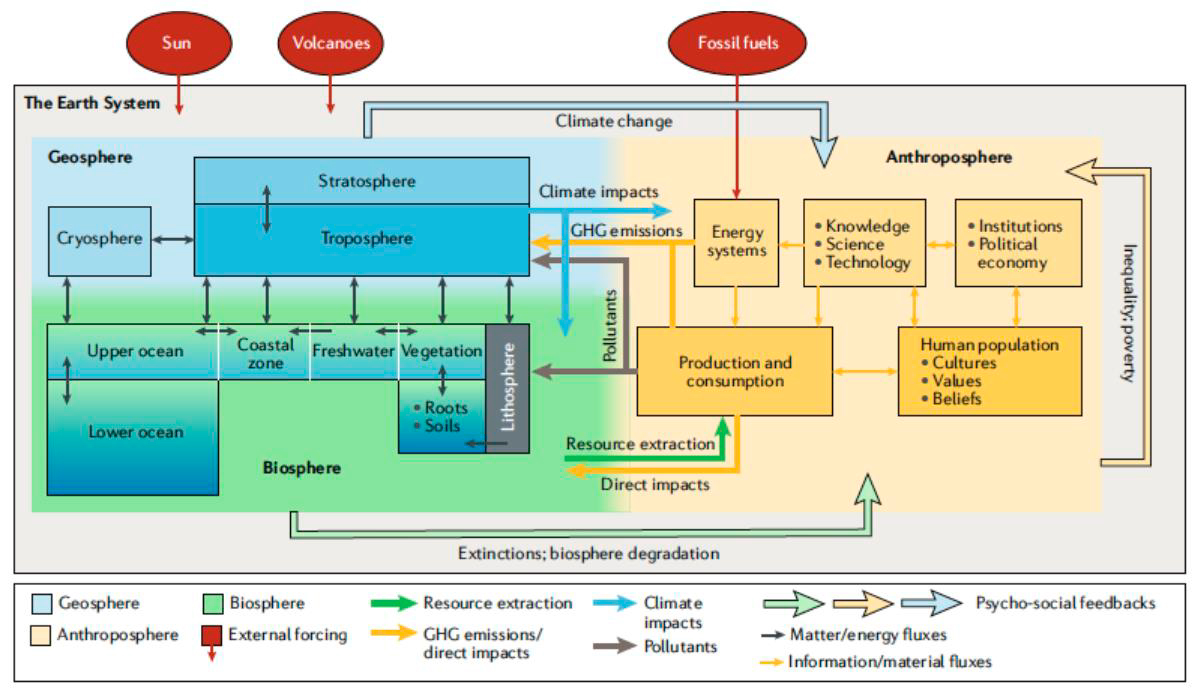
[596] Using the Earth System, the Court is part of the anthroposphere as an institution within a decision making framework that can determine whether or not an activity that will emit GHGs can proceed.
[597] The following are a few examples of the many individual processes that interact to form the Earth System, our ‘life support system’ in which the biosphere plays a vital role in the stable functioning of the planet as a whole:
[598] GHGs absorb outgoing infrared (long wave) radiation (heat) from the Earth’s surface and re-emit it in all directions. Some re-emitted heat remains in the lower atmosphere. The effect of re-emitted heat is measured as radiative forcing. When the measure of radiative forcing is positive, it warms the Earth’s lower atmosphere, increasing the global average surface temperature.
[599] As a fraction of overall human-driven warming, the most important GHG is CO2. CO2 emissions are primarily a function of human activities such as fossil fuel combustion and land use changes. Total GHG emissions are expressed in carbon dioxide equivalents (CO2-e).
[600] Atmospheric CO2 acts as the ‘thermal regulator’ of the Earth System, and is an integral component of the planet’s carbon cycle. About 44% of CO2 emissions remain in the atmosphere, accumulating from year to year. The remainder is absorbed by land vegetation and the ocean. Plants absorb CO2 from the atmosphere to power their growth and emit CO2 back to the atmosphere as part of their metabolism. Geophysical processes, such as the dissolution and release of CO2 to and from the ocean also play a crucial role in the planetary metabolism.
[601] The Figure below illustrates the global carbon cycle:249
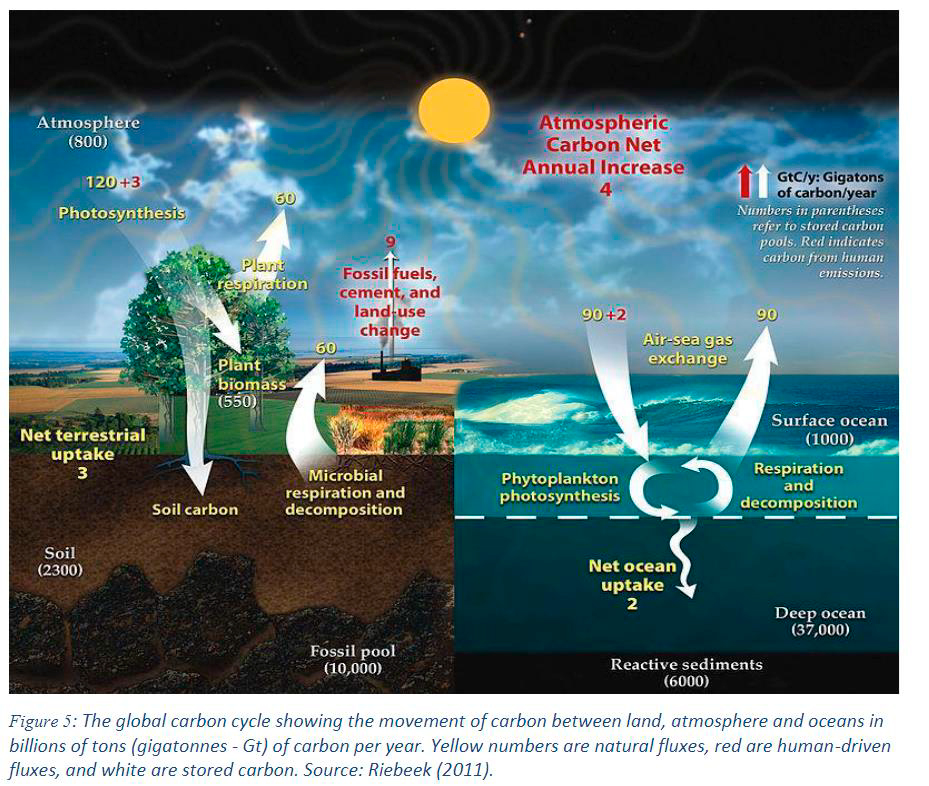
[602] There is a near-linear correlation between the cumulative emissions of CO2 and the rise in global average surface temperature using a pre-industrial baseline.
[603] The pre-industrial baseline for global average surface temperature is the 1850-1950 average. By 2020, the global average surface temperature had increased by 1.2°C or, if the 2011-2020 average is used, by 1.09°C.
[604] The pre-industrial baseline for atmospheric CO2 concentration is taken at 1750, which was about 278 ppm. By 2020, the atmospheric concentration of CO2 had increased to 412.5 ppm.
[605] The combustion of coal accounts for about 30% of the rise in both temperature and atmospheric CO2 concentration.
[606] The rate of growth in both global average surface temperature and atmospheric concentration of CO2 has been increasing. The long-term trend from 1960 to date is one of accelerating temperature increases.
[607] Atmospheric concentration of CO2-e will stabilise when the addition of GHGs to the atmosphere by human activities is matched by their removal from the atmosphere by natural processes and human drawdown. That is when net-zero CO2-e emissions is achieved.
[608] Reaching net-zero will not lead to an immediate stabilisation of temperature, which depends on the scale and pace of emission reductions. There could be a significant lag between the two. Under lower emission scenarios the increase in atmospheric CO2 concentrations would slow visibly after five to ten years, and the slowing of global surface warming would be detectable after 20 to 30 years. Under higher emission scenarios the lag could be centuries. However long it takes, the stabilisation temperature is directly proportional to the CO2 concentrations at the time we reach net-zero emissions.
What are the impacts of climate change?
[609] The climate change experts agree human induced climate change has caused changes to the planet’s atmosphere, oceans are heating at an increasing rate, polar ice is melting, extreme weather events are becoming more extreme, sea levels are rising, and ecosystems and species are being degraded or lost.
[610] But this case is not about the current impacts of climate change, it is about the future.
[611] The parties agree that if human beings continue to emit GHGs, then these will accrete in the atmosphere with GHGs already present there, causing increasingly adverse impacts to the health, life, and way of life, of human beings, individually, in communities and as a species, and of other species and ecosystems, and other components of the environment.
[612] They agree the environmental impacts will include:
[613] They agree the impacts on the health, life, way of life and property of human beings, will include:
[614] The parties agree climate change impacts are not experienced in the same way everywhere. Professor Church and Dr Warren summed up the future impacts in Australia from climate change:
[615] In Queensland, there have been more heatwaves, a long-term increase in extreme fire weather, increased likelihood and severity of heavy rainfall, mass coral bleaching of the Great Barrier Reef, increased ocean acidity, sea level rises along coast and islands, and worsening drought conditions.
[616] Mr Coleman said Queensland will bear a “very heavily disproportionate cost of climate change compared to the rest of Australia” because of its unique topography and climate, in particular from cyclones and heatwaves. More than two-thirds of all residential properties exposed to climate change risk in Australia are in Queensland.250
[617] Queensland is also home to the Great Barrier Reef. WG II of the IPCC considered impacts on coral reef systems in its sixth assessment report (AR6). The report observed the GBR is the world’s largest and most extensive coral reef system, making it a globally outstanding and significant entity. Nearly the entire ecosystem was inscribed as World Heritage in 1981. It is a cornerstone of traditions and culture for over 70 geographically and culturally diverse Traditional Owner groups spanning the length of the GBR. It is already severely impacted by climate change, particularly ocean warming, through increasingly frequent and severe coral bleaching. Over 90% of the Reef has now been affected by bleaching and the northern and middle sections of the Reef are now highly degraded.251
[618] It also says that “while there is no risk category beyond very high, risks obviously get worse with further global warming, and the risk for coral reefs is already very high”.252
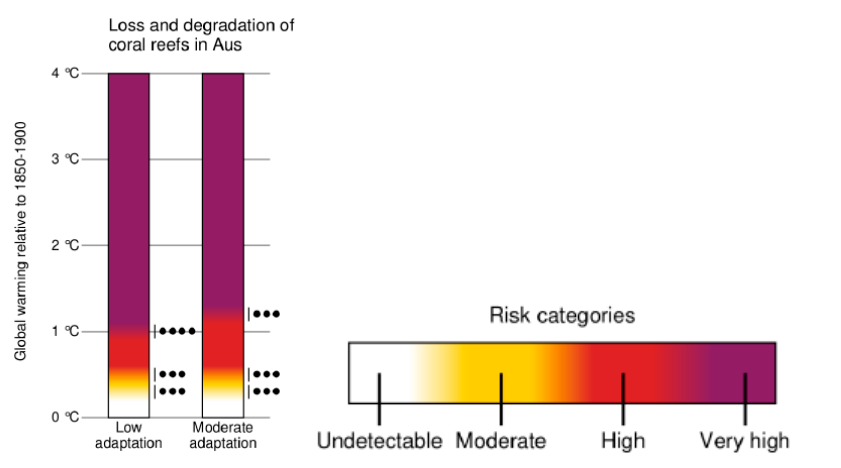
[619] The parties agree that, as GHGs continue to accrete in the atmosphere, Queensland will become less capable of supporting human or other life and will be able to do so in a decreasing number of geographical areas and locations.253
[620] Professor Bambrick prepared an expert report and gave oral evidence during the hearing.254 She says that death and illness related to extreme heat exposure is a primary impact of climate change. She relied on the climate experts’ evidence that heatwaves in Queensland have been more frequent, longer, hotter and starting earlier since the 1940s. Mr Coleman says the pace and scale of change has and continues to escalate. Because of this, heat-related deaths in Queensland will increase by thousands before 2100.
[621] Professor Bambrick says that high temperatures and extreme heat in Queensland contribute to morbidity and mortality, which increases when maximum daily temperatures reach approximately 30℃. Professor Bambrick and Mr Coleman both observed that this temperature is comparatively worse in Queensland as it is coupled with higher humidity. Humidity causes greater thermal stress on human bodies at lower temperatures because sweating becomes less effective at cooling, leading to overheating (hyperthermia), heatstroke and possibly death. Temperatures over 35°C, combined with humidity of 70%-80% are considered dangerous or extremely dangerous and potentially unliveable.
[622] The minimum night-time temperature is also relevant, as a failure to cool overnight means heat stress accumulates. Numbers of hot nights have increased across Queensland in recent decades.
[623] Although heat-related mortality represents the extreme end of the scale, measurable ill-health occurs at lower temperatures and among more people.255 Extreme heat also affects services and infrastructure protecting public health due to, for example, high demand and failed infrastructure and services.
[624] Sea level rises are also experienced differently in different places. Torres Strait Islanders are disproportionately vulnerable to climate change impacts. The IPCC AR6 predicts global sea level rises of 4.4 mm/year if GHG emissions are low and 12.2 mm/year if GHG emissions remain high. The climate change experts say in the Torres Strait, this equates to 4 mm/year and 11.3 mm/year respectively. They read the statements by Kapua, Florence and Lala Gutchen, three of the First Nations witnesses who gave evidence in this hearing. They live on the island of Erub (Darnley Island) in the Torres Strait. The climate experts said the concerns those witnesses expressed are consistent with the expected impact of rising sea levels and climate change.
[625] The climate change experts say rising sea levels will result in a ‘dramatic’ increase in the frequency of extreme coastal flooding events with one-in-100 year events occurring several times per year in 2100. This will result in additional coastal erosion, compounded by changes in winds and waves, posing an existential threat to Torres Strait Islanders who have lived on their Country for tens of thousands of years. The climate experts say these conditions could lead to the loss of islands.
[626] Further, the rate of sea-level rise in northern Australia in the last 30 years has been higher than the global average and higher than that in the rest of the country.
[627] Further, climate change impacts are not experienced in the same way by all people.
[628] Waratah accepts the adverse impacts described above will disproportionately affect:
[629] Professor Bambrick explained children are on average more at risk because they are more vulnerable to thermal stress, which will have impacts on their health in addition to their learning and work. Further, the more the climate changes the worse the adverse impacts will be on children’s health and wellbeing in the future, as children will have to live longer with the impacts.
[630] She also said the health vulnerability of First Nations peoples to climate change impacts is greater because of higher rates of underlying chronic conditions, socioeconomic disadvantage, more dangerous jobs, and reduced access to cool spaces and health services. Their mental health may also suffer through disruption to traditional knowledge and cultural practices which depend on connection to country and development for future generations.
[631] Further, the parties agree that climate change impacts will adversely affect First Nations Aboriginal and Torres Strait Islander peoples in specific ways, including by causing:
[632] Professor Bambrick described the loss of cultural practices in the Torres Strait due to rising sea levels as a tertiary impact of climate change. She says tertiary impacts will constitute the greater burden to human health.
[633] Finally, the parties agree that, eventually, the continued emission of GHGs into the atmosphere will destroy the health, life, and way of life, of many human beings and human communities; cause or contribute to the widespread extinction of many nonhuman species and ecosystems; and destroy the ecosystems and environments on which human and other life depends.
[634] This description of the impacts of climate change is, necessarily, at a high level of generality. Waratah submits it is impossible to attribute any particular harm to emissions related to the Project. This is true. But it does not provide a complete answer to the objectors’ concerns.
[635] Climate change is multidimensional, simultaneously both global and local in both cause and effect. Additionally, in a causal sense it is impossible to identify a particular impact to the emissions from an individual project. As the proximate cause of increased temperature is the accumulation of GHGs in the atmosphere, an assessment of a project’s impact on climate change can only ever be considered in terms of contribution.
[636] This concept is not new to environmental law. It is embedded in the EPA in the definition of environmental harm.
| 14 Environmental harm | |
| (1) Environmental harm is any adverse effect, or potential adverse effect (whether temporary or permanent and of whatever magnitude, duration or frequency) on an environmental value, and includes environmental nuisance. | |
| (2) Environmental harm may be caused by an activity— |
| (a) whether the harm is a direct or indirect result of the activity; or | |
| (b) whether the harm results from the activity alone or from the combined effects of the activity and other activities or factors. |
[637] On the agreed facts, the Project will contribute to climate change. The dispute on this aspect of the case is about the significance of the contribution and what bearing that should have on the outcome of the applications.
[638] The first step in that analysis is to understand the scale of GHG emissions related to the Project.
What contribution will this Project make to global GHG emissions and why is that relevant?
[639] Waratah relies on Dr Warren’s estimate of the GHG emissions associated with the Project. Her expertise to undertake that exercise was not challenged. She estimated the GHG emissions associated with the mine using the system of classification of emissions by scopes 1, 2 and 3, consistent with the Greenhouse Gas Protocol and the Australian National Greenhouse Gas and Energy Reporting requirements.
[640] Scope 1 emissions are direct emissions from sources owned or controlled by the company. Scope 2 emissions are indirect or upstream emissions which arise from the generation of purchased electricity consumed by the company. Scope 3 emissions are all other indirect emissions, which occur in sources not owned or controlled by the company. For this Project, that would include emissions caused during the transport and combustion of the Project coal.
[641] The climate change Joint Report contains a helpful figure that illustrates this.256
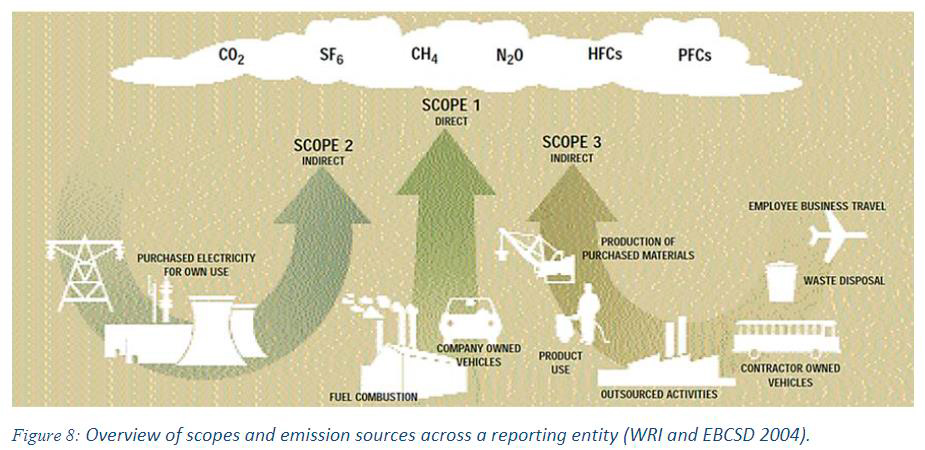
[642] The estimate of scope 1 emissions over the life of the mine was 36,512,194 t of CO2-e. This represents emissions from combustion of diesel in mining equipment and transport in light vehicles, fugitive methane emissions from both open cut and underground mining, the combustion of blasting explosives, and land clearing.
[643] The estimate of scope 2 emissions over the life of the mine was 21,017,880 t of CO2-e. That could be an overestimate because it uses the 2020 grid electricity emission factor. That factor will decrease as the grid power generation sources move away from fossil fuels.
[644] The estimate of 2,205,415,086 t of CO2-e of scope 3 emissions overwhelms scopes 1 and 2 combined. The parties have since agreed on another estimate for the combustion emissions from the Project coal, which I will refer to shortly.
[645] Waratah says it is committed to reducing scope 1 and 2 emissions and for scope 3 emissions will preference customers and power generators that have resolved to reach net-zero emissions or implement abatement technologies.257 Whether that is a realistic prospect or would make a meaningful difference is questionable given the evidence of the market experts about the extent to which coal is traded through long term coal contracts and the barriers to the uptake of CCS technology.
[646] YV&TBA focussed on the scope 3 emissions attributable to the combustion of the Project coal for good reasons.
[647] Dr Warren’s estimate of scope 3 emissions was limited to the transportation and combustion of the coal. It seems the transport option she used is one Waratah no longer proposes (via rail to Abbot Point). More importantly, emissions from combustion of coal represents 97.9% of the total scope 3 estimate.
[648] Dr Warren’s estimate of the emissions from combustion was 2,159,666,995 t CO2-e.258
[649] That is based on Waratah’s initial proposal. The revised mine plan proposes to extract 761,828 Mt of saleable coal, which the parties agree would result in combustion emissions of 1.58 Gt CO2-e. That is the figure I have taken into account when considering combustion emissions.
[650] Waratah agrees that if the mine is approved the thermal coal in the mining lease will be extracted and burned, thereby emitting greenhouse gas (mostly CO2) into the atmosphere.
[651] Nevertheless, it argues scope 3 emissions (almost all of which are combustion emissions) either cannot or need not be considered for various reasons, depending on whether the Court is considering the application for the ML or the EA and when it is addressing the human rights implications of its recommendations. Before canvassing those arguments, it is helpful to understand the purpose of the scope classification and how it is used domestically and internationally.
Why are GHG emissions classified by scope?
[652] Australia’s international reporting obligations are defined by territory not scope.
[653] In 1992, parties to the UNFCCC259 stated their objective to stabilize GHG concentrations in the atmosphere at a level that would prevent dangerous anthropogenic interference with the climate system (art 2).
[654] In 1997, the parties to the Kyoto Protocol required certain developed countries to establish a national system for estimating anthropogenic GHG emissions by sources and removals by sinks using a methodology accepted by the IPCC (art 5). The IPCC published guidelines in 2006, which were updated at the 24th Conference of Parties (COP24) of the UNFCCC (the Katowice Guidelines).260
[655] The Paris Agreement261 introduced the concept of Nationally Determined Contributions (NDCs) – self-determined high-level commitments by member States to reduce emissions. Countries are required to account for their NDCs applying the guidelines adopted by the COP to avoid, amongst other things, double counting.262
[656] The way the Katowice Guidelines avoid double counting of emissions is through the concept of national territory, not scope. National inventories include GHG emissions and removals taking place within the national territory and offshore areas over which the country has jurisdiction.
[657] To compile a national inventory to report on its emissions, a country must gather information about GHG emissions in its territory. One source of information is corporations undertaking activities that cause emissions.
[658] In 2004, the World Resources Institute and the World Business Council for Sustainable Development developed a protocol using the scope classification.263 Dr Warren explained the scope classification was primarily meant for industries or cities to understand their carbon footprint.
[659] To serve that end, the scope classification uses organisational and operational boundaries rather than physical boundaries. The Australian Government employs this scope classification in imposing reporting obligations on corporations under the National Greenhouse and Energy Reporting Framework.264 Companies that meet certain thresholds must register and provide reports on their emission of GHGs, defined as scope 1 and 2 emissions.265
[660] A Commonwealth House of Representatives Standing Committee examined a proposal to expand reporting responsibilities to include scope 3 emissions.266 It recommended against it, for reasons that include:
[661] The concern about double counting drives the boundaries for both reporting systems, using different concepts.
[662] At the national level, the concern is to avoid reporting emissions in a way that would inflate the national account. At the international level, the concern is to avoid more than one country reporting the same emissions, hence the territorial boundary. The climate scientists agreed “[u]sing the GHG scope emissions framework, most simply, a country would want to only quantify scope 1 emissions from all individual sources to be used for developing their NDCs. This would minimise any double or triple counting of a country’s emissions”.267
Can the Court consider scope 3 GHG emissions in making its recommendations?
[663] That issue emerged in several ways in this hearing.
[664] For the application for the ML, Waratah accepts scope 3 emissions are relevant to considering whether it is in the public interest to grant the mining lease but says it has limited significance:
[665] When the Court is considering the human rights implications of the recommendations for either the ML or the EA, Waratah says scope 3 emissions are not relevant. Neither recommendation authorises combustion of coal. The Court could not find any human rights will be limited, because there is not a sufficient causal link between the recommendations and the combustion. I deal with that argument when considering the human rights aspects of the decision at [1298]-[1383].
[666] For the application for the EA, Waratah says the Court cannot consider scope 3 emissions because the Court is confined to assessing the physical activities that will take place on the mining lease area that are authorised under the MRA – the winning and extracting of coal.
[667] In this section of the reasons, I will deal with Waratah’s submissions about international and national policy and whether the Court can have regard to scope 3 emissions when considering the EA application.
Does international and national policy prevent consideration of scope 3 emissions?
[668] Waratah does not dispute that GHG emissions contribute to the global phenomenon of climate change, which does not respect territorial, organisational, or operational boundaries. Whether they are classified as scope 1, 2 or 3, and wherever they occur, they have impacts here and elsewhere.
[669] However, it submits I should follow the approach taken in previous cases of leaving the consideration of the impact of scope 3 emissions as a matter of policy to be dealt with by governments through international and national commitments.
[670] Waratah refers to the conclusions of MacDonald P and Smith M in previous cases of Xstrata and Adani, and Hancock and New Acland.268 In each of those cases, on the evidence, the Court found the public right and interest would not be prejudiced by the grant of the ML because of the scope 3 emissions associated with the mines. But those were factual conclusions based on evidence about the market for coal considering propositions about substitution and displacement of the coal and what that would mean for emissions. Likewise, I deal with those arguments on the evidence in this case (see [955]-[1014]).
[671] In Hancock, Smith M said:269
Clearly the possibility of dire consequences from climate change is a matter which falls to be addressed by the international community and the Federal Government.
[672] When that case was decided, the Paris Agreement had not been reached. Member Smith, respectfully, may have had good cause on the evidence to accept the international reporting framework would achieve the objectives of the global community about climate change. The Paris Agreement has been in force now for almost six years. The evidence in this case is that the current NDCs are inadequate to achieve the global temperature goal.
[673] This is an administrative process. It is not a question of putting policy to one side. The Court is tasked to advise the ultimate decision maker what decision it should make, including with regard to the policy context. To do so does not mean, as Waratah submits, that the Court would be considering what public or government policy should or should not be. That is not the effect of having regard to scope 3 emissions from the mine.
[674] Waratah submits that taking into account scope 3 emissions would subvert international and national policy frameworks, which place responsibility for emissions with the country in which the coal is combusted. But that conflates a measure (NDCs and a reporting framework) with the goal it is designed to promote (the long term temperature goal). That is not a proper approach to interpreting that agreement.
[675] The Vienna Convention on the Law of Treaties 1969 provides:270
[a] treaty must be interpreted in good faith and in accordance with the ordinary meaning of the words of the treaty in their context and in the light of the treaty’s object and purpose.
[676] The aim of the Paris Agreement is “to strengthen the global response to the threat of climate change in the context of sustainable development and efforts to eradicate poverty”, including by its temperature goal (art 2(1)).
[677] To achieve the aim of the Paris Agreement, the signatories also state as an aim “to reach global peaking of greenhouse gas emissions as soon as possible” (art 4(1)).
[678] Other means identified in the Paris Agreement for achieving the aim are “increasing the ability to adapt to the adverse impacts of climate change, fostering climate resilience and low greenhouse gas emissions development, in a manner that does not threaten food production” (art 2(1)).
[679] The NDCs provide a mechanism to support one measure directed to achieving that aim – by tracking emissions at their source. That does not mean the NDCs determine the extent of a countries’ responsibilities under the Paris Agreement. Nor do NDCs represent the totality of either the Commonwealth or Queensland Governments’ policy response to the global threat of climate change.
[680] The Paris Agreement also includes commitments by developed countries to provide support in finance, technology development and transfer, and capacity building (arts 9, 10, 11). The parties to the Paris Agreement recognise this support will allow for higher ambition in developing countries (art 4).
[681] Further, the Paris Agreement is a resolution of the Conference of Parties of the UNFCCC. Its objective in art 2 is to achieve stabilisation of GHG concentrations in the atmosphere at a level that would prevent dangerous anthropogenic interference with the climate system. That is the ultimate goal that international and national policy seeks to achieve.
[682] Looking at Queensland policy, in the Queensland Climate Transition Strategy, the Queensland Government stated it is in the process of re-joining the Under2 Coalition, which brings together over 270 governments representing 1.75 b people and 50% of the global economy.271 The Government signed the Under2 MOU in 2017, but its membership was invalidated due to requirements under a Federal Foreign Arrangements scheme. The Government is now in the process of re-joining the coalition.
[683] The Under2 coalition is a coalition of subnational governments seeking to address climate change. The MOU is not legally binding. By joining the coalition, members demonstrate a clear and lasting commitment to reduce emissions in the decades to come.272
[684] As well as pursing an international goal of net-zero emissions by 2050, the parties commit to limit global warming to no more than 1.5°C and to support international activities and declarations to respond to climate change, including the Paris Agreement.
[685] Although the government has not yet re-joined the coalition, its commitment to do so is unambiguous. In those circumstances, I give substantial weight to the policy intent expressed in the Under2 MOU.273 In making the recommendations, as far as possible, I should act in consonance with that intent.274
[686] It goes without saying that the Commonwealth and Queensland emission targets are not affected by combustion emissions in another country. Nevertheless, the history of increasing ambition in those targets demonstrates a strengthening political acceptance of the urgent need to reduce global emissions. That is consistent with the higher-level objectives of reaching global peaking of GHG emissions as soon as possible and fostering low GHG emissions developments. Those objectives are relevant considerations when the Queensland government makes decisions with global consequences that could promote or constrain those objectives.
[687] That does not mean that no new coal mines can or will be approved. This is a hearing about one application, not whether that policy should be adopted. It is clear that current federal and Queensland policy contemplates an ongoing role for Australia as an exporter of thermal coal, albeit in the context of declining demand.
[688] At the Commonwealth level, Australia’s Long Term Reduction Plan notes:275
The long-term prospects for Australia’s coal and gas sectors will depend on the preferences of our customers and the pace of international action…Coal production will remain flat or decline slightly, by around 6% over the same period. [to 2050] There will be ongoing demand for both commodities, especially in emerging markets in the Asia-Pacific and Indo Pacific. Given our proximity to these markets, our strong reputation as a supplier of energy exports and the high quality of our fossil fuel commodities, Australia is well placed to meet this demand.
[689] Recently, the Queensland government issued the Queensland Resources Industry Development Plan (QRIDP). It recognises that in the declining global market for thermal coal, pockets of further growth in fast-developing countries in Indo-Pacific region can present opportunities for Queensland’s high quality thermal coal.
[690] The QRIDP also states:276
The coal projects in Queensland will continue to be supported as long as they stack up economically, environmentally, and socially.
[691] In this case, the Court must consider this application on its merits. It is tasked with considering whether this particular Project stacks up economically, environmentally, and socially. In making its recommendations, the Court is acting in an administrative capacity. Unless constrained by the relevant Acts from doing so, it must make its decision with regard to the policy framework that applies to the ultimate decision maker.
[692] Waratah submits the current Australian and Queensland policy frameworks do not promote restricting private development as a means for Australia to meet its commitments under the Paris Agreement.
[693] In one sense it is right to describe the mine as a private development because it is a private corporation that proposes it. However, in another sense that description is misleading.
[694] This coal is a public asset. It is owned by the State. It is for the State to decide whether to develop it. If the State to decides not to do so, this is not a constraint on a private development right. In a case such as this, where the ownership of the resource rests with the State, there is no private right to develop it. The effect of granting the ML application would be to transfer ownership from the State to the holder of the ML, converting the State’s interest into a right to royalties (MRA s 310).
[695] It does not subvert international, national and state policy on either climate change or resource development for the Queensland government to take into account the effect of scope 3 (including combustion) emissions when making a decision on this Project.
[696] I will now turn to Waratah’s legal argument about the EPA.
Does the EPA prevent the Court from considering scope 3 emissions?
[697] In this regard, Waratah relies on the reasoning of MacDonald P, in Xstrata Coal Queensland v Friends of the Earth & Ors.277 In that case, her Honour considered provisions of the EPA that were unchanged in the 2013 EPA, which is the version that applies in this case.
[698] The Land Court’s function is to make a recommendation about an application for an EA issued for mining activities (EPA s 222). One of the factors the Court must consider is the standard criteria, which incorporate the principles of ecologically sustainable development (s 223(c)).
[699] In Xstrata, MacDonald P interpreted that provision narrowly. In making its recommendation, MacDonald P said the Court is limited to considering the activities that can be authorised by the EA. The EA authorises harm caused by mining activities. Mining activities are activities authorised under the MRA to take place on land to which the ML relates. Transporting and burning the coal is not authorised by the ML. They are not the subject of the EA application. Therefore, MacDonald P concluded, the Court can only consider the physical activities of winning and extracting the coal that could be authorised under the ML, and cannot consider scope 3 emissions.278
[700] It seems no argument was made about scope 2 emissions in that case. They too are not authorised by either the EA or the ML, being indirect emissions caused by the generation of electricity to supply the power needs of the mine. An activity that takes place outside the ML area. Presumably, the same logic would apply to those emissions. But that is a distraction.
[701] President MacDonald’s reasoning was adopted in subsequent cases in the Land Court, notably, Hancock.279 That recommendation was subject to judicial review in the Supreme Court of Queensland and then appeal to the Court of Appeal in Coast and Country Association of Queensland.280 An application for special leave to appeal to the High Court was dismissed.
[702] Waratah submits the Court of Appeal in Coast and Country Association of Queensland “ultimately determined that it is not within the Land Court’s jurisdiction to have regard to scope 3 emissions under the provisions of the EPA or the MRA other than the public interest criterion”.281
[703] I do not accept that construction.
[704] The relevant ground of appeal was ground 1:282
[that the member had erred] in construing the [EP Act] as allowing the Land Court, when considering whether or not to recommend the grant of an environmental authority for the Alpha Coal Mine, to give zero weight to the environmental harm caused by the…greenhouse gas emissions produced in transporting and burning the coal obtained as a result of that coal mine, on the basis of the Land Court’s finding of harm caused by other mining activities not being those of the Alpha Coal Mine.
[705] In New Acland, Bowskill J examined the decision of the Court of Appeal and expressed the view (albeit obiter) that Fraser JA, with whom Morrison JA agreed, did not express a concluded view on that interpretation of the EPA.283 Respectfully, I agree.
[706] Ground 1 was dismissed because the relevant provisions of the EPA (ss 3, 5, 223) did not require the Land Court to give any particular weight to emissions, and, on the evidence before him, Smith M was entitled to make the factual finding that global emissions would not be increased by the mine proceeding.284
[707] That reading of the majority’s reasoning is consistent with the way it was put by senior counsel for Hancock in resisting an application for special leave to appeal to the High Court. That appears to have been accepted by Kiefel CJ and Keane J who refused the application because the matter was not a suitable vehicle to resolve the issues the applicant sought to agitate.285
[708] Returning to the Court of Appeal decision, in Coast and Country Association of Queensland, in separate reasons the then President of the Court of Appeal, McMurdo P, articulated strong reasons for interpreting s 223(c) more broadly than MacDonald P had in Xstrata:286
MacDonald P’s reasons in Xstrata Coal Queensland Pty Ltd & Ors v Friends of the Earth – Brisbane Co-op Ltd & Ors express a construction of s 223(c) that is certainly open. But I am persuaded the better view is that, the Land Court, in considering objections for an environmental authority for mining activities under the Environmental Protection Act, must consider scope 3 emissions. The Environmental Protection Act provides a significantly different legislative scheme to that under the Mineral Resources Act. Unlike in the latter act, the very broadly defined object of the Environmental Protection Act and its equally broad definitions of environment, environmental value and environmental harm are consistent with a desire to protect Queensland’s environment from development, including mining development, which would cause harmful global greenhouse gas emissions. The Land Court in determining the objections was obliged to consider “standard criteria” which incorporate the National Strategy’s Core Objectives and Guiding Principles. The terms of these Objectives and Principles are consistent with a concern about harmful global greenhouse gas emissions which would not enhance individual and community well-being and welfare by following a path of economic development that safeguards the welfare of future generations”; would not “provide for equity within and between generations”; could damage “biological diversity” and “essential ecological processes and life support systems”; or could raise “threats of serious or irreversible environmental damage.” Section 223(a) and (f) are specifically limited by the words “for the application” and the terms of s 223(d) and (g) are also limiting. In the absence of any such limiting words in s 223(c), and in light of the broadly expressed object and definitions to which I have referred, I can see no warrant to construe s 223(c) narrowly so as to limit it to a consideration of the standard criteria directly relevant to an activity authorised under the Mineral Resources Act to take place on land to which the relevant mining tenement relates.
[709] The Land Court must perform its function in a way that best achieves the object of the EPA (s 5). Its recommendation informs the ultimate decision maker, who is subject to the same obligation.
[710] The interpretation of s 223(c) should be guided by the object of the EPA. It provides more than context. There is a clear and direct link between the object and the first of the standard criteria - “(a) the principles of ecologically sustainable development as set out in the ‘National Strategy for Ecologically Sustainable Development’”.287
[711] McMurdo P’s interpretation of the effect of including the principles of ESD in the standard criteria is consistent with the jurisprudence in NSW and in other jurisdictions on this point. I respectfully adopt, without reproducing, the survey of case law by Preston CJ in Gloucester Resources.288
[712] The definition of environmental harm provides harm caused by an activity may be the indirect result of the activity and may result from the combined effects of the activity and other activities or factors (EPA s 14(2)). The environmental harm to which emissions related to this Project will contribute will be experienced in the Queensland environment that the EPA seeks to protect.
[713] In that statutory context, as DES submits, the permission to extract the coal cannot logically be separated from burning it, that being the whole point of the exercise. If the mine proceeds, the mined coal will be burned emitting GHG emissions and contributing to climate change which will be experienced in Queensland.
[714] The concept of scope 1, 2 and 3 emissions is not recognised in either the EPA or the MRA. The history of amendments to the EPA and MRA demonstrates an intention to promote legislative coherence, at least in relation to the process for hearing and deciding the applications under the two Acts. One of the standard criteria under s 223(c) is the public interest,289 a term which, when used in s 269(4)(k) of the MRA, has been interpreted as sufficiently broad to allow consideration of scope 3 emissions.
[715] The same distinction that has been drawn between different considerations in s 269(4) of the MRA should apply to the interpretation of s 223. It would be an anomalous outcome for the public interest criterion under the EPA to be interpreted more narrowly than it is under the MRA.
[716] In the absence of a clear intention to limit the scope of broadly stated criteria, such as the statutory criteria, including the public interest, respectfully, I prefer the reasoning of McMurdo P in interpreting s 223(c).
[717] I find the impact of scope 3 emissions is a relevant factor when considering what recommendation to make on the EA application.
[718] With that clarified, I return to the evidence of the climate change experts about future climate impacts, having regard to the totality of the emissions associated with the mine.
What can climate scenarios and the carbon budget tell us?
[719] Although there is no disagreement about the nature and scale of future climate change impacts, there is a critical dispute about the significance of the mine’s contribution to future impacts and the relevance of that to the applications.
[720] Waratah refers in its submissions to the percentage the GHG emissions represent to annual Australian or global emissions. Assessments on an annual basis are unhelpful in understanding the contribution of emissions associated with the Project, over its life, to the atmospheric concentration of CO2. In any case, the climate scientists stated the remaining carbon budget for keeping temperatures to 1.5°C in 2100 will be exhausted in 8 years at the current rate of emission, and to keep temperatures to well below 2°C by 2100 will be exhausted in 15.5 years.
[721] The Court heard evidence about scenarios that may assist the Court in understanding that contribution. They include climate scenarios used by the climate change experts derived from reports of the IPCC. Other scenarios considered in this section were developed by the International Energy Agency (IEA) and Wood Mackenzie (WM), an energy research and consultancy company which employs one of the market experts, Mr Manley. The IEA and WM models are discussed later (see [818]-[861]). Here I consider the climate scenarios used by the climate change experts, how they were derived, the temperature outcomes for those scenarios, and how the concept of a carbon budget relates to the scenarios.
What can climate scenarios tell us?
[722] The parties asked the climate change experts to consider the implications of some indicative temperature points when the increase in temperature difference stabilises. The experts chose three scenarios, which I examine below.
[723] They said how quickly future climate change impacts are experienced, and how severe those changes are, will be driven for the next several decades by further human induced GHG emissions. In the longer term (centuries) this will be driven by both human emissions and feedbacks in the climate system. A feedback occurs when the climate impacts become self-reinforcing and create a risk of reaching a tipping point. A tipping point is a threshold where a tiny change could push the system into a new state.
[724] The common approach to assessing future effects is to use quantitative projections by Earth System models, based on mathematical descriptions of the major features of the Earth System and their interactions. The models are driven by projected human-induced GHG emissions, land-use change and natural drivers such as changes in solar radiation. The model outputs provide insights into the risks faced by humanity, usually by reference to changes in global average surface temperature.
[725] To understand the scenarios chosen by the climate change experts, it is necessary to canvass some background about climate change scenarios developed by the IPCC, from which the experts derived their scenarios.
What are the IPCC Shared Socioeconomic Pathways?
[726] Scenarios and modelling methods are pillars in the IPCC WGIII Assessment Reports. WGIII defines a scenario as:290
an integrated description of a possible future of the human–environment system, and could be a qualitative narrative, quantitative projection, or both. Scenarios typically capture interactions and processes driving changes in key driving forces such as population, GDP, technology, lifestyles, and policy, and the consequences on energy use, land use, and emissions. Scenarios are not predictions or forecasts.
[727] In its contribution to AR6, WGIII sought to address knowledge gaps about modelling and to improve the transparency of model assumptions and enhance the communication of scenario results.
[728] It collected 3131 scenarios developed by other researchers and institutions. 1686 of those passed the vetting process in which the WGIII assessed the scenarios for their representation of historical trends and to ensure their key indicators of emissions and energy sector generation were within reasonable ranges from/for the baseline period.
[729] Amongst the scenarios that survived vetting are the scenarios to which the climate change experts referred in developing their 3 scenarios.
[730] They are called Shared Socioeconomic Pathways (SSPs). WGIII describes SSPs as part of a new framework the climate change research community has adopted to facilitate the integrated analysis of future climate impacts vulnerabilities, adaptation, and mitigation.
[731] The purpose of the SSPs is to ask and answer questions about the implications of policy and social decisions. The IPCC attempts to be policy neutral, presenting the choices and the implications of those choices.
[732] So, if the goal is to limit global warming to 1.5°C, the relevant scenario will present the required actions. There are 5 groups of SSPs categorised by the nature of the pathway ranging from strong mitigation scenarios that are cost effective to rapid growth with no climate policy:
SSP1 – a focus on sustainability SSP2 – a middle of the road approach SSP3 – regional rivalry SSP4 – inequality SSP5 – rapid growth
[733] The SSPs are numbered by that category (the first number) and by approximate radiative forcing, the measure of how GHG emissions contribute to warming expressed in watts per square metre, in 2100 (the second number).291
[734] To illustrate, the best possible outcome, and the most challenging SSP to achieve, is SSP1-1.9. The pathway is an SSP 1, meaning the category of response to climate change is a focus on sustainability. Its radiative forcing is 1.9, which results in the global average surface temperature stabilising in 2100 at 1.4°C.
[735] The WGIII analysed the vetted scenarios in several ways: by warming levels, for feasibility, and by reference to mitigation pathways - gradual strengthening of current policies, extensive use of net negative emissions, renewables, low demand, and shifting pathways.
[736] Vetting for feasibility needs to be distinguished from vetting for probability.
[737] The first aspect of feasibility relates to the models’ ability to solve the scenario with the included constraints. That is about the internal functioning of the model itself. The second aspect is evaluating feasibility against real world benchmarks such as political constraints and technology availability. This results in a scenario being defined on a scale of plausible to unprecedented.
[738] The feasibility assessment identifies where things are more or less feasible to assist governments to understand where they need to put their resources to overcome feasibility issues. This is a question of technical feasibility. At a very high level, it asks the question “is this scenario possible?”. It is not an assessment of whether a government will take a particular path. Taking climate policy as one variable in the scenarios, neither the IPCC nor the climate change experts assessed the probability of a country acting in a certain way.292
[739] That said, it is a qualitative scale to be used to understand aspects of mitigation methods. It identifies barriers and enablers of the use and implementation of mitigation methods. Those relevant to coal consumption are CCS and the phasing out of fossil fuels.
[740] For CCS, the biggest enablers are the desire of government and industry to use them, the economic benefits of implementation and the benefits to air quality and land use. The biggest barriers are the complexity of the mitigation method, the cost to implement by 2030 and potential water and geophysical impacts.
[741] For the phase out of fossil fuels, the biggest enabler is political acceptance, maturity of alternative technologies, and benefits to geophysical resources, air quality, water quality and biodiversity. The biggest barriers are public acceptance, legal and administrative costs, and the physical potential for implementation.
[742] The climate change experts note some criticisms of the types of models used by the scenarios assessed in WGIII. Many of those criticisms are reviewed and considered in the WGIII feasibility analysis. The methods and data underpinning the IPCC assessments are publicly accessible and backed by peer-reviewed scientific literature.
[743] I now turn to the climate change experts’ 3 scenarios, which they relate back to the SSPs.
What scenarios did the climate change experts use?
[744] Climate scenario 1 is the best possible or near best possible outcome because it would stabilise global average surface temperature in 2100 at below 2°C above pre-industrial temperatures. It is consistent with the goal of the Paris Agreement and can be equated to 2 SSPs: SSP1-1.9 and SSP1-2.6.
[745] SSP1-1.9 relates to an increase in temperature of 1.4°C, SSP1-2.6 to an increase of 1.8°C. Both SSPs are challenging to achieve, SSP1-1.9 exceptionally so. SSP1-1.9 would see temperature overshoot 1.5°C in 2050 before decreasing in the second half of the century with a large drawdown of CO2.
[746] Both SSPs will require drawdown of CO2 from the atmosphere. This means that, globally, we will need to draw down more CO2 from the atmosphere than we emit. Drawdown may occur through natural means such as reforestation and by industrial means such as CCS or other technologies (not yet developed).
[747] Climate scenario 2 would result in global average surface temperature stabilising in 2100 at or very close to 3°C above pre-industrial levels. It does not achieve the goal of the Paris Agreement. This scenario can be equated to SSP2-4.5, meaning it is a middle of the road pathway, or moderate action pathway, resulting in radiative forcing of 4.5. This scenario reflects the policy settings of national governments in 2021, which the IPCC estimated would result in temperature increases of between 2.7°C and 3.1°C above pre-industrial temperatures.
[748] Climate scenario 3 is the worst possible outcome and can be equated to SSP5-8.5. The pathway is an SSP 5, which means it is a pathway of rapid growth, resulting in radiative forcing of 8.5, and a 4°C increase in temperature late this century, continuing to rise into the 22nd century and beyond. This is not a business-as-usual projection, and is only useful as a high-end, high-risk scenario.
[749] That means climate scenarios 1 and 2 are better reference points for the Court. Climate scenario 1 is consistent with the aim of the Paris Agreement. Climate scenario 2 is not.
[750] Further, the climate change experts caution that it may not be possible to stabilise the Earth System under climate scenario 2 at 3°C above pre-industrial levels. An increase in temperature of that nature may activate tipping points when feedback processes become self-reinforcing, initiating a tipping cascade. There is a very low probability of that occurring at a temperature increase in the range of 1.5-1.7°C, but the probability rises at an increasing rate after that. See Figure 16.15 below.293
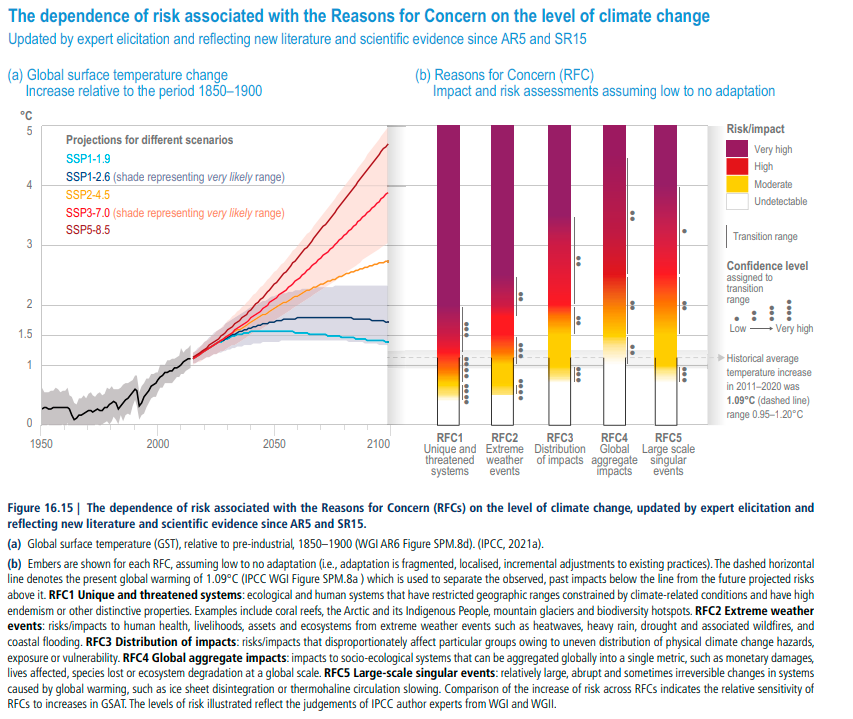
[751] The feedback processes include climate change-driven degradation of large biomes such as the Amazon rainforest and the boreal forests in Canada and Siberia; melting of polar ice such as the Arctic sea-ice over the north pole; enhanced melting of permafrost; and changes in ocean and atmospheric circulation, such as a weakening of the Atlantic Ocean thermohaline circulation.
[752] Several of these processes operate over many centuries, potentially leading to a drift of the Earth System towards the hotter conditions of the SSP5-8.5 trajectory.
[753] As well as physical tipping points, the IPCC uses the concept of social tipping points, to describe the destabilization of human societies at multiple scales, resulting from the impacts of climate change and the societal context in which that occurs. One type of social tipping point is when intangible elements that ensure the survival of individuals and communities are eroded or removed. An example the WGII used to illustrate this is the Millennium Drought in Australia which led to higher rates of male suicide, especially among farmers.294
[754] Professor Bambrick said the direct impacts of fatalities and injury caused by climate change are the tip of the iceberg. Tertiary, broader impacts such as displacement, conflict and famine are likely to deliver the greatest burden to human health.
[755] The climate scenarios are not probabilistic determinations about the future. Professor Church explained this was not a matter of climate science. They could not predict what decisions governments will make in the future.
[756] However, as well as assisting us to understand the likely effects at different temperature levels, the scenarios are helpful in guiding decisions by governments about policies or activities with climate change implications. They do this partly through the use of a carbon budget.
What use is a carbon budget?
[757] Although there is a complex relationship between atmospheric CO2 concentrations, global temperature increases, and CO2 emissions, the climate change experts agree a cumulative carbon budget provides a means to manage that complexity. A cumulative carbon budget estimates the cumulative CO2 emissions that can be allowed if the world is to achieve a desired global temperature goal.295
[758] The IPCC definition of a carbon budget is:296
…the maximum amount of cumulative net global anthropogenic CO2 emissions that would result in limiting global warming to a given level with a given probability, taking into account the effect of other anthropogenic climate forcers. This is referred to as the Total Carbon Budget when expressed starting from the pre-industrial period, and as the Remaining Carbon Budget when expressed from a recent specified date.
[759] The carbon budget rests on the observation that the increase in the global average surface temperature from 1850 to present scales nearly linearly with cumulative CO2 emissions as this figure, which charts historic emissions and temperature from 1850 to 2019, demonstrates:297
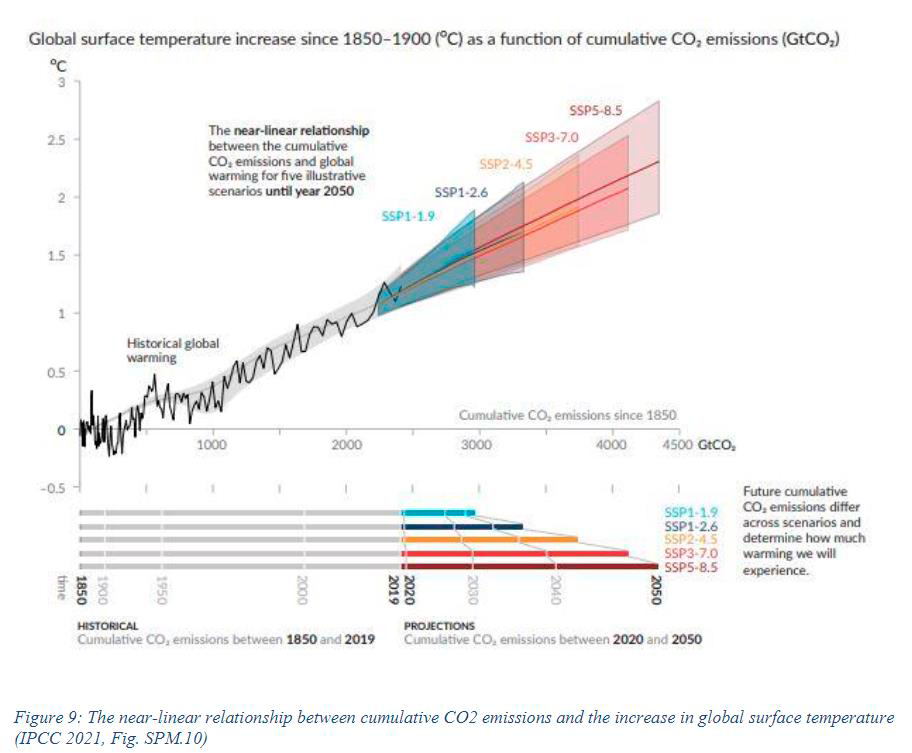
[760] That figure also projects future emissions and predicts climate outcomes across the SSPs on which the climate scenarios are based.
[761] The AR6 WGI report estimates historical CO2 emissions and remaining carbon budgets calculated from the beginning of 2020.298
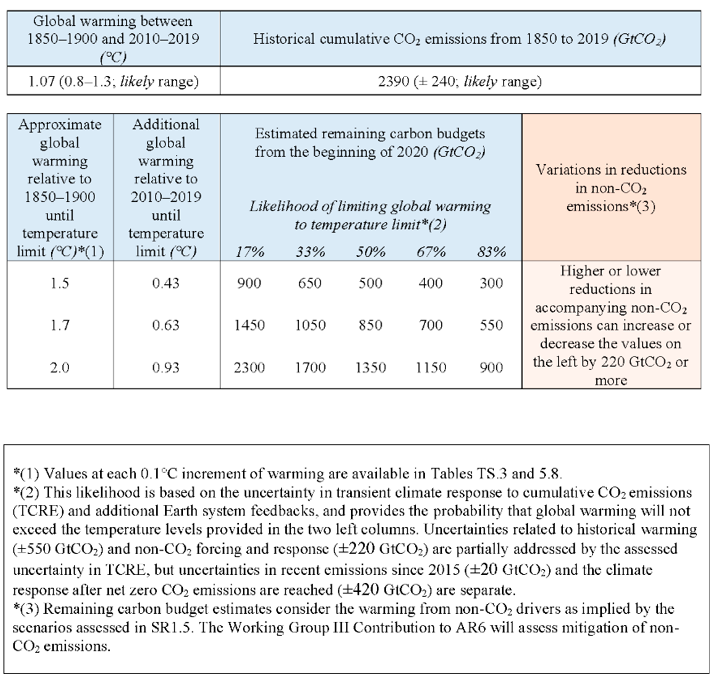
[762] The table shows the remaining carbon budget for different temperatures using five different probabilities for limiting climate change to that temperature.
[763] This records the carbon budget as at the beginning of 2020. In their supplementary Joint Report, the climate change experts said the best estimate of the remaining carbon budget from 2022 is similar, but adjusted for the emission of 80 Gt CO2-e over the last two years.
[764] Waratah says that, if the Court is going to have regard to a carbon budget, it should use a remaining carbon budget of 1350 Gt CO2-e as a reference point, presumably adjusted to take account of emissions over the last two years.
[765] Waratah’s choice of remaining carbon budget (which is for SSP2-4.5) equates to warming of between 2°C in the mid-term (2041-2060) and 2.7°C in the long term (2081-2100).299 That well exceeds the goal of the Paris Agreement. At the Conference of Parties to the UNFCCC held in Scotland in 2021 (COP26), the parties expressed “alarm and utmost concern that human activities have caused around 1.1°C of warming to date, that impacts are already being felt in every region, and that carbon budgets consistent with achieving the Paris Agreement temperature goal are now small and being rapidly depleted”.300
[766] Further, the budget Waratah has chosen is for a 50% probability of limiting warming to that temperature outcome. Whatever the temperature goal, it is prudent to choose a budget that delivers a greater than 50% probability of meeting the goal as a reference point, such as 67%.
[767] The SSPs that meet the goal of the Paris Agreement of keeping temperature well below 2°C with the aim of limiting it to 1.5°C are SSP1-1.9 (1.4°C) and SSP1-2.6 (1.7°C). Assuming a 67% probability of keeping the temperature to the target, and accounting for the 80 Gt CO2-e emitted in the last two years’ emissions, the remaining carbon budget for SSP1-1.9 is 320 Gt CO2-e and for SSP1-2.7 is 620 Gt CO2-e.
[768] The climate change experts described the carbon budget as the most robust way to determine the changes in human activity required to meet the aims of the Paris Agreement. Professor Church said that, as science has evolved, the carbon budget encapsulates a lot of the knowledge from the climate models and is the most appropriate way forward now.301
[769] Waratah cautions against adopting a narrow carbon budget analysis, an argument it says finds support in the judgment of Preston CJ of the Land and Environment Court in the Gloucester Resources.302
[770] In the passages Waratah relies upon, his Honour considered an opinion expressed by an expert witness that to remain within the carbon budget, most fossil fuel reserves will need to remain in the ground unburned, on the basis that existing and approved projects could continue and would emit at the rate estimated.
[771] The Chief Judge said he preferred to evaluate the specific fossil fuel development considering its GHG emissions, their contribution to climate change and its consequences, as well as its other impacts. His Honour did not reject consideration of a carbon budget, just the suggestion that the question should be approached in a general way, rather than with specific reference to the project. It is clear Preston CJ considered the carbon budget helpful in assessing the particular project before the Court.
[772] His Honour explained a project’s GHG emissions may be significant in absolute or relative terms. In absolute terms, a project may be a sufficiently large source of GHG emissions that refusing the application may make a meaningful contribution to achieving the long-term temperature goal. Refusing larger developments prevents greater increases in GHG emissions than refusing smaller ones. In relative terms, smaller projects with similar GHG emissions may have different environmental, social and economic impacts, favouring the project with the lesser impacts.
[773] In Gloucester Resources, Preston CJ based his decision primarily on the significant and unacceptable planning, visual and social impacts of the proposed mine, which he found could not be satisfactorily mitigated.
[774] The Rocky Hill mine before the Court in Gloucester Resources was a much smaller mine than Waratah proposes. The estimate of scope 3 emissions for Rocky Hill was approximately 36 Mt CO2-e, less than 25% of the estimate for this mine. Nevertheless, his Honour found preventing a new source of what he described as “a meaningful amount GHG emissions” was an additional reason to refuse that application.303
[775] The climate change experts say the remaining carbon budgets for meeting a 1.5°C goal (320 Gt CO2-e) and a 1.7°C goal (620 Gt CO2-e) with a 67% probability, equate to about 8 and 15.5 years of emissions respectively, at an emission rate of about 40 Gt CO2 per year. Using the Chief Judge’s measure, preventing 1.58 Gt CO2-e being emitted in that context is, in absolute terms, a meaningful contribution to achieving the long-term temperature goal.
[776] The climate change experts agree the carbon budget is not the only factor to consider in assessing the climate change implications of a development.
[777] In oral evidence, counsel for Waratah challenged their agreement that the carbon budget is a robust methodology. The climate change experts accepted a carbon budget is not referred to in the Paris Agreement or the UNFCCC. They agreed the budget is not determined by the sustainable development goals or the concept of common but differentiated responsibilities. It does not address how to use the budget and does not differentiate between emissions from more and less efficient sources or the methods of taking up CCS or renewables. Nor does it consider matters such as energy security, infrastructure availability, cost, and energy demand.
[778] However, Professor Church contested the proposition that it would be more robust to consider those factors without reference to the carbon budget. He said you would need to consider those other things as well as the temperature implications of exceeding the carbon budget. Dr Warren agreed with that.304
[779] I accept the climate change experts’ opinion on this point. The carbon budget is one of many factors that I have considered in arriving at my recommendations.
[780] I will now move to the arguments about the climate change implications of the Project taking combustion emissions into account.
What are the climate change implications of the Project?
[781] Waratah opened its case this way:305
…the whole of the evidence will show that [the Project coal] will replace the coal its target customers currently use, resulting in less coal being burned for the same energy produced and therefore fewer greenhouse gas emissions…there will be no increase in adverse climate change effect if [the Project coal] enters the market.
[782] Disentangling Waratah’s submissions on this topic is challenging because it makes its case about climate change in different ways at different times.
[783] As best I can discern, Waratah makes these assertions at various points in its submissions:
| 1. The market for coal is demand-driven and, regardless of what the demand is, the demand for and the consumption of coal in the target market will be the same, whether the mine proceeds or not. | |
| 2. Because the same amount of coal will be burned, there will be no difference to climate change (no net impact). | |
| 3. Because of the relative quality of the Project coal and the existing supply of coal in the target market: |
| o There will be a beneficial environmental outcome if the mine is approved because the Project coal will displace lower quality coal resulting in fewer GHG emissions in meeting the demand (beneficial outcome). | |
| o There will be an adverse environmental outcome if the mine is not approved because lower quality coal will substitute for the Project coal resulting in more GHG emissions to meet the demand (adverse outcome). |
[784] Whether looking at displacement or substitution, the pre-conditions to a finding that approving the mine will produce no net impact or a beneficial outcome (or, conversely that refusing the mine will cause an adverse outcome) are:
[785] The perfect substitution proposition, and the arguments about the GHG consequences of the proposition, have been developed through a series of cases in the Land Court.
[786] In Xstrata, Hancock and Adani306 the perfect substitution proposition was said to support a finding that there would be no net impact if the mine were approved. In New Acland, that was modified to include the proposition that I understand Waratah to make here – that there will be a beneficial outcome if the mine is approved and an adverse outcome if it is not.
[787] YV&TBA say any level of substitution is irrelevant under the EP Act because the Court’s statutory task is to consider the environmental harm if the mine is approved, not the harm caused if it is not.307
[788] There is merit in that submission, which calls up the reasoning of Preston CJ in Gloucester Resources:308
There is also a logical flaw in the market substitution assumption. If a development will cause an environmental impact that is found to be unacceptable, the environmental impact does not become acceptable because a hypothetical and uncertain alternative development might also cause the same unacceptable environmental impact. The environmental impact remains unacceptable regardless of where it is caused. The potential for a hypothetical but uncertain alternative development to cause the same unacceptable environmental impact is not a reason to approve a definite development that will certainly cause the unacceptable environmental impacts. In this case, the potential that if the Project were not to be approved and therefore not cause the unacceptable GHG emissions and climate change impacts, some other coalmine would do so, is not a reason for approving the Project and its unacceptable GHG emissions and climate change impacts… (references omitted)
[789] The same view was taken by Beach J in Minister for Environment v Sharma.309 His Honour said the party challenging the Minister’s decision was not required to establish a counterfactual regarding what would happen to global CO2 emissions if the extension to the Project were not approved.
[790] YV&TBA accept it is arguable that the ratio of the judgment in the Court of Appeal in Coast and Country Association of Queensland means substitution is a relevant matter under the EPA. As they have not pressed the point, and I have not had the benefit of full argument on the matter, I will not take that matter further.
[791] Waratah submits I am bound to follow binding authorities about substitution. The only case that could bind me is the judicial review of the Land Court’s decision in Hancock and the subsequent appeal to the Court of Appeal in Coast and Country Association of Queensland.310
[792] On judicial review, Douglas J in Coast and Country Association of Queensland accepted Smith M’s finding about substitution was open on the evidence.311 On appeal, the Court of Appeal found no error in Douglas J’s conclusion on that point.312 That is, it is a factual not a legal question.
[793] Nevertheless, there is a vast difference between accepting the relevance of the possibility of perfect substitution and assuming it would occur. Perfect substitution is not self-evident.
[794] The US Court of Appeals in WildEarth Guardians v US Bureau of Land Management described the perfect substitution assumption as “irrational (i.e. contrary to basic supply and demand principles)” and found:313
it was an abuse of discretion [by the Bureau of Land Management] to rely on an economic assumption, which contradicted basic economic principles, as the basis for distinguishing between the no action alternative and the preferred alternative.
[795] In Hight Country Conservation Advocates v U.S. Forest Serv the Court said:314
The production of coal in the North Fork exemption will increase the supply of cheap, low-sulfur coal. At some point this additional supply will impact the demand for coal relative to other fuel sources, and coal that otherwise would have been left in the ground will be burned. This reasonably foreseeable effect must be analyzed, even if the precise extent of the effect is less certain.
[796] Whether there will be perfect substitution, and what that would mean for GHG emissions, must be assessed on the evidence. Relevant factors will be the market for the project coal, the existing and likely supply in the market, the factors that will influence supply and consumption of thermal coal, as well as demand, and the relative qualities of the Project coal and any coal it might displace or be substituted for.
[797] Against that background, I will consider the evidence of the market experts and the climate change experts on the following questions:
Will there be demand for the project coal for the life of the mine?
[798] The coal and energy market expert experts are Mr Manley and Ms Wilson. Mr Manley has a Bachelor of Science in Geology and Earth Sciences. He is the Director, Metals and Mining Consulting with Wood Mackenzie, a position he has held since 2014. He has worked in the coal industry for 25 years as a geologist, cartographer, market researcher and adviser on coal quality, coal technology, coal supply and purchasing, coal markets and price forecasting, project analysis and financing, and due diligence. He has extensive experience in coal market analysis, including forecasting, in the seaborne thermal coal market.
[799] Ms Wilson has 19 years’ experience as an economist with expertise in energy system analysis and modelling. She is a Principal Associate with Synapse Energy Economics. She provides expert analysis on a wide range of issues relating to the electricity and natural gas sectors including integrated resource planning, clean air policies, emissions from electricity generation, electricity system dispatch, and environmental compliance technologies, strategies, and costs. She uses models to analyse utility service territories and regional energy markets.
[800] Mr Manley and Ms Wilson prepared a Joint Report and gave evidence over two days in a concurrent evidence session.315 Mr Manley also produced two further documents during the course of the hearing.316
[801] Waratah makes a submission about the weight I should place on Ms Wilson’s evidence. While accepting she is an expert in her field, Waratah says her experience is primarily grounded in computer modelling and has limited bearing on the issues in dispute between the parties.
[802] I do not agree.
[803] Ms Wilson’s qualifications and experience are directly relevant to a key driver for demand in the target market, the demand for electricity generation and how that demand might be met by energy sources, including coal. Mr Manley is more familiar with the export market for thermal coal, but not necessarily with electricity sector analysis, an important factor in analysing demand.
[804] In addressing the questions asked of them by the parties, both experts referenced scenarios which projected, amongst other things, future demand for thermal coal. These modelled scenarios sat at the heart of their disputes. Their opinions were informed, if not determined, by them.
[805] As Waratah acknowledges, Ms Wilson has expertise in computer modelling. Mr Manley has no qualifications or expertise in modelling. He has only worked with energy system models for coal, while Ms Wilson has worked with models for other sources of energy. In his role, Mr Manley is responsible to ensure the model is accurate and both the inputs and outputs are sensical. However, if there are technical questions about models or scenarios he would rely on people with that technical expertise. During his evidence it became clear he relied on the WM analysts for some key inputs to the scenarios he presented.
[806] Ms Wilson understands how models are constructed and operate, and how to validate their results. She has worked with more than one energy system model.
[807] Ultimately, there was limited disagreement between the market experts about the models. There were substantial disagreements on other aspects of their evidence, and I explain my reasons for accepting one over another where that arises. However, I have not started, as Waratah submits I should, with an assumption that Ms Wilson’s evidence is to be discounted because of the nature of her experience.
What is the market for the Project coal?
[808] Waratah identified a domestic and an export market for the coal.
[809] The proposed domestic consumer is Waratah’s 1,400 MW Galilee Power Plant, which, if approved and constructed, will be located contiguous to the mine. Its status is uncertain.
[810] Ms Wilson said it is unlikely to be constructed because new coal power generation is no longer a competitive resource in Australia. Mr Manley appeared to agree. He said Australia is moving away from coal-fired electricity generation, but the coal slated for domestic use could be exported. The amount identified by Waratah for domestic consumption is a small fraction of the expected annual production of the mine and Waratah placed no emphasis on the domestic market or the prospects of the Galilee Power Plant being approved. If the power plant is not approved, all the coal will be exported.
[811] The real contest, then, is about demand in the export market for the Project coal.
[812] The proposed export market is the Pacific seaborne thermal coal market. In that market, Indonesia and Australia are the largest suppliers. Japan, South Korea, and Taiwan have traditionally been the principal importers, but there has been recent growth from the developing economies of China, India, and Southeast Asia.
[813] Waratah argues there will continue to be sufficient demand for the Project coal until 2051 in the seaborne thermal coal market. YV&TBA say that is not certain, and that if there is demand for thermal coal at the level Waratah projects, that is inconsistent with the objective of the Paris Agreement and the climate change consequences are unacceptable.
[814] There is no onus on Waratah to positively establish there will be demand for the coal throughout the life of the mine.317 However, the level of demand is relevant to the viability of the mine. Viability is relevant to the level of utilisation of the resource and to the public interest in the economic benefits of the mine (considered at [1030]-[1287]).
[815] Demand is also relevant to the climate change consequences of the mine proceeding, because it identifies the possible climate outcomes in a world in which there is sufficient demand for the Project coal for the mine to be viable.
[816] If I am to take into account the economic benefits of producing coal for combustion on an assumption about the level of demand, then I must also take into account the climate and other consequences of combustion at that same level of demand.
[817] That does not mean I could reach a reliable conclusion about the level of demand, the level of combustion, and the consequence for climate. There are simply too many variables, and the time frame over which they must be considered (at least 28 years) is too long for that to be done. It simply means that if an assumption about demand is made to support a favourable case on economic benefit, the same assumption should be made about environmental and other costs in weighing those factors in the balance.
Which scenarios project demand for thermal coal?
[818] The scenarios that deal with demand for coal are different to the IPCC SSPs discussed by the climate change experts.
[819] The market experts referred to scenarios developed by both WM and the IEA. Those scenarios are run using models, essentially computerised algorithms. Mr Manley agreed with Ms Wilson’s description of model types.
[820] She said the WM model, like ones she uses in her work with Synapse, is a deterministic model. It has fixed variables which, taken together, produce an optimal solution based on the algorithm. This contrasts with the integrated assessment models used by the IPCC which capture the interactions between all the variables in trying to solve the array of policy solutions that will arrive at a specific temperature target. Ms Wilson said the input assumptions are the most important component of a model because you want to model forecasts that you believe are reasonable and likely to occur, given other assumptions in your model and the policy outcome you are trying to achieve.
[821] WM uses scenarios in advising clients on market conditions, drawing on its proprietary database. The inputs for its scenarios are not publicly available, although many key assumptions, at least for one of the scenarios, are explained in Mr Manley’s contribution to the Joint Report. The WM model and its scenarios have not been assessed or vetted by the IPCC WGIII. As I have already noted, Mr Manley cannot speak to its design and relies on technical experts and researchers in relation to the model and at least some of the inputs to the scenarios.
[822] In the Joint Report, Ms Wilson agreed with certain results reported by Mr Manley using the WM model. In oral evidence, she said this agreement assumed Mr Manley’s calculations were correct. She could not verify this before settling the Joint Report because she did not have access to the WM model or the data used to inform it. For example, she could not backcheck the model using historical data to see if the model comes up with a result that is consistent with what is known. Nor could she run any sensitivity analyses by changing an input to see if the model responds as expected.
[823] The three WM scenarios explored in this case are the WM ETO (Energy Transition Outlook)318 and two WM AET (Advanced Energy Transition) scenarios: AET 2 and AET 1.5. These are scenarios developed by WM to advise their clients.
[824] The WM ETO is a proprietary report that is commercially available. It reflects WM’s wholistic analysis of energy demand, supply, investment across multiple scenarios, emerging decarbonisation technologies and key energy policies around the world. It is regularly updated.
[825] Waratah relies on Mr Manley’s analysis of the proposed mine using the WM ETO, which he described as ‘the base case’, as providing the best evidence of what is likely to happen out to 2051 in the market, including its projection of demand for the Project coal. YV&TBA say this is just a scenario, which is no more likely than another, and is not consistent with achieving the goal of the Paris Agreement.
[826] Mr Manley’s analysis of the Project used the WM ETO as at October 2021, entitled ‘Walking a tightrope to a net zero future’. Wherever I refer to the WM ETO in these reasons, I am referring to that analysis unless I specify otherwise. This is important because during the hearing Mr Manley agreed there was an update to the ETO in April this year, which revised downwards the demand for thermal coal in the seaborne market.319
[827] The IEA scenarios are long-term scenarios developed by the International Energy Agency using the World Energy Model, a large-scale simulation model designed to replicate energy markets. This model has been used by the IEA since 1993 as the principal tool for generating detailed projections for scenarios presented in its World Energy Outlook.320
[828] In its World Energy Outlook 2021 (WEO), the IEA used four scenarios in the lead up to COP26 to illustrate the choices that face the world’s decision makers. The scenarios presented in that outlook are the NZE (Net-Zero Emissions), SDS (Sustainable Development Scenario), STEPS (Stated Policies Scenario) and APS (Announced Pledges Scenario).
[829] The assumptions and variables in the IEA scenarios were not proved in evidence. However, the IPCC has assessed and vetted the IEA NZE scenario. As I understand the evidence, the IPCC has not vetted the WM scenarios.
[830] There are some important differences in the parameters for the WM and IEA scenarios that affect their demand projections.
[831] One parameter is the scope for the projection. The primary scope for the IEA analysis is the global energy sector, although some of the scenarios do include a regional analysis. The information published by the IEA does not make it possible to disaggregate the data by country.321 Further, although there is some reference to domestic supply and imports in the narrative, the demand projections in the IEA’s WEO do not distinguish between thermal coal demand for a region such as the Asia Pacific, and how much of that might be traded on the seaborne market.
[832] This makes it difficult to equate IEA demand projections with those in the WM scenarios, which do specify demand in the seaborne thermal coal market.
[833] It seems logical the IEA demand projections will be higher than the WM projections. The seaborne supply is used to make up shortfalls between demand and domestic supply.322 In the WM ETO scenario, Mr Manley identified India as the most likely market for high rank coal, with an estimated demand of 115.8 Mt in 2050. Coal India has offered substantial qualities of coal at e-auction to push more domestic supply, but some factors limit uptake and domestic coal producers face several issues in increasing supply. China is in the next band of demand at 68 Mt. China is expected to remain the largest seaborne thermal coal buyer until 2029 and its policy on importing Australian coal remains a key uncertainty for its demand.
[834] Another parameter is whether demand is projected in terms of different coal qualities. Mr Manley’s base case analysis using the WM ETO does this, showing the level of demand for high rank coal within the seaborne thermal coal market. The IEA scenarios do not do this. The market experts agree the quality of coal could affect the rate of decline in demand, with demand for high rank coal falling more slowly than for lesser quality coal. This is relevant to Waratah’s substitution argument.
[835] The way in which the demand projection is arrived at for a scenario is another point of distinction. This arises from the purpose of the model and scenario. The demand projection could be the result of the model working to solve to a goal, or it could be the result of assumptions about fixed variables that could affect demand.
[836] The two IEA scenarios which chart a path to a temperature or emission outcome - the NZE scenario and the SDS – are examples of scenarios driven by the goal. Mr Manley described this type of projection as a hindcast.
[837] The IEA NZE scenario shows a narrow but achievable pathway for the global energy sector to achieve net-zero CO2 emissions by 2050, with advanced economies reaching net-zero in advance of others. It also meets key energy-related UN Sustainable Development Goals (SDGs), by achieving universal energy access by 2050.323
[838] The IEA SDS is a ‘well below 2°C’ pathway and represents a gateway to achieving the outcomes targeted by the Paris Agreement. It also assumes all energy-related Sustainable Development Goals (SDGs) are met and advanced economies reach net-zero before other countries.324
[839] Those features of these two IEA Scenarios are worth noting because of Waratah’s submission that a narrow carbon budget analysis fails to account for common but differentiated responsibilities and SDGs about energy access. Shortly before the Paris Agreement was reached, the General Assembly of the United Nations adopted a resolution which announced 17 SDGs. These include to increase substantially the share of renewable energy in the global energy mix and enhance international cooperation to facilitate access to renewable energy.325 Those SDGs are taken up in a number of commitments in the Paris Agreement.326
[840] The temperature or emission goal is reached under the IEA NZE and SDS pathways, without sacrificing the SDGs, and recognising the different needs and capacities of developing countries. Because this is accounted for by the IEA in its projections for these two scenarios, they provide the bridge between the carbon budget and those broader considerations the climate change experts agreed I should bear in mind. The difference between the two scenarios is, at least in part, explained by the assumptions about the acceleration of climate related policy which are set out in the WEO 2021.327
[841] There are two more examples of demand projections that are the result of temperature goals, although their purpose is not to chart a pathway to achieve the goal, but to attempt to forecast the implications for seaborne thermal coal demand should the commitment for either 2°C or 1.5°C be achieved.328 These are the WM AET 2 and AET 1.5 scenarios. It is not clear to me whether they also account for the energy-related SDGs and the differentiated responsibilities and capacities of developing countries.
[842] The remaining two IEA scenarios – STEPS and APS - are examples of scenarios in which the demand projections have resulted from assumptions about fixed variables, primarily the climate policies and announcements made by governments. They both assume a country will do what they say. They differ in the levels of policy development they consider.
[843] STEPS provides a conservative benchmark for the future because it does not assume that governments will reach all announced goals. It looks only at existing policies and those under development. APS takes account of all the climate commitments made by governments, including NDCs, and longer-term net-zero targets and assumes they will be met in full and on time.
[844] The final scenario, and the one on which Waratah primarily relies, is the WM ETO. Waratah says this uses real world information. I do not accept that is a point of distinction from IEA scenarios.
[845] The WM ETO is like STEPS and APS because the demand projection results from assumptions about policies. Unlike the IEA scenarios, the WM ETO does not assume existing policies and those in development will be implemented (as does STEPS) or that the announced pledges will be met in full and on time (as does APS).
[846] Mr Manley was not able to be specific about the assumptions in the WM ETO on this topic. He described it as a mixture of STEPS and APS. Presumably, somewhere between the two. The WM analysts examine the stated policies and take a view of what different countries say they will do. They develop an internal consensus around which announced policies may come to fruition.329 The best I can make of Mr Manley’s evidence about this is that it assumes existing policies will be implemented and some, but not all, policies under development and climate announcements will be met, and perhaps not on time.
[847] The WM ETO is unique in the scenarios put before the Court in another crucial way. This is the only scenario that any party asserts can predict what will happen with coal demand over time.
[848] Waratah says this is the best prediction of future demand.
[849] In fact, it is the only prediction.
[850] That does not mean I should act on it.
[851] To accept the demand projected using the WM ETO model as a reliable prediction calls for a high degree of confidence in the ability of the WM analysts to make accurate predictions. The history of WM’s projections tells against that.
[852] During the hearing, Mr Manley was referred to WM’s latest half-year thermal coal outlook.330 He agreed it would account for what had occurred at or because of COP26, held in Glasgow in late 2021. But he could not tell me what the implications of that revised outlook was for his analysis of the Project. He offered to revise his report using the latest version of the model. It is a matter for Waratah to decide what evidence it will lead in support of its applications, and it did not seek to lead further evidence from Mr Manley about this.
[853] YV&TBA objects to Mr Manley giving evidence about likelihood of the WM ETO being realised. It is not necessary to rule on the objection because Mr Manley did not hold to that evidence in the hearing. He was careful to say that, at the time it was written, he considered the WM ETO presented in the Joint Report was the most likely view of the market. He did not say that was his opinion now.331
[854] In any case, WM has consistently downgraded its projections of seaborne thermal coal demand over time, giving little confidence about the reliability of predictions based on those projections.
[855] Innumerable variables, including the decisions made about this mine, have the capacity to affect what will happen in the market. I find the WM ETO is just another scenario and is not a reliable prediction of what will occur through to 2051.
[856] Before concluding with scenarios, I will identify what demand they project.
[857] For the WM ETO, Mr Manley projected demand for thermal coal in the seaborne market in 2050 of 608 Mt. That was based on the most recent WM ETO when the Joint Report was prepared. In April 2022, WM published a revised thermal coal outlook which reduced that demand projection to 512 Mt. During the hearing, Waratah and YV&TBA used the lower figure as the relevant projection assuming the WM ETO. The projections on the earlier WM ETO are, 246 Mt for WM AET2 and 169 Mt for WM AET 1.5.332 Those projections would be affected by the WM revised thermal coal outlook as well, although it is not clear how.
[858] The latest IEA projections provided to me for coal demand in the Asia Pacific in 2050 are 3,375 Mtce for STEPS, 2,191 Mtce for APS, 1,014 Mtce for SDS. There are no demand projections in the IEA NZE.333 There are two difficulties in comparing these demand scenarios. First, they are expressed differently. The WM scenarios use coal volume in Mt. The IEA scenarios use a measure of energy. Further, as I have already observed, the IEA coal demand projections are not directly comparable to those of the WM as they do not descend to the detail of the seaborne thermal coal market.
[859] Later in these reasons I consider the evidence from Dr Warren and Mr Manley equating these scenarios from the perspective of the temperature outcome. That analysis does not attempt to equate coal demand in the target market. However, when compared on the basis of global consumption, the WM ETO equates to the IEA scenarios and the SSPs that forecast a temperature of at least 2°C at 2050 and higher at 2100.
[860] While the NZE scenario does not identify demand, it concludes that, given current supply, no new coal is required to meet the emissions consistent with achieving the Paris Agreement goal.
[861] I now turn to the factors that influence demand for thermal coal.
What factors influence demand for thermal coal?
[862] The market experts agree on some fundamental matters about demand for the Project coal.
[863] They agree there is current demand for coal of the quality of the Project coal in the Pacific seaborne thermal coal market. Demand for thermal coal is driven by electricity demand. Globally, both electricity demand and coal demand have risen over the last decade. Given the target market, the regional picture is important. China is the highest consumer of coal for electricity use in the world. More than 90% of seaborne exports of thermal coal are purchased by power generating companies. In the Asia Pacific, electricity demand will grow. The WM ETO forecasts Asia’s share of the global electricity production will rise from 48% to 53% by 2050. The IEA forecasts electricity demand will grow to 2050 under both the STEPS and APS scenarios, by 91% and 118%, respectively.
[864] However, demand for electricity and demand for thermal coal cannot be conflated. While increasing demand for electricity in the Asia Pacific means demand for thermal coal is likely to fall more slowly there than in other regions, there are some key factors that will determine the rate and extent of decline – climate change policy, competition from renewables, and the use of carbon capture and storage technologies.
How will climate change policy affect demand for thermal coal?
[865] Mr Manley and Ms Wilson agree policy plays an overarching role in the energy mix and affects demand, supply, and consumption of thermal coal. Policies include those related to climate change mitigation and adaptation and those designed to protect domestic fossil fuel industries.
[866] They also agree on these matters. The Paris Agreement is currently influencing thermal coal demand. Financing for carbon intensive projects is becoming more challenging. The current NDCs in the proposed markets are not yet sufficient to limit global warming to well below 2°C, with the ambition of 1.5°C compared to pre-industrial levels. Parties to the Paris Agreement have agreed to update their NDCs every five years and, if updated, more restrictive targets will lower global coal demand as countries look to reduce or retire coal. Compliance with the aims of Paris Agreement would mean that thermal coal consumption will fall from current levels.
[867] However, Mr Manley and Ms Wilson do not agree about the pace of change of policy and the implications for the seaborne market.
[868] Mr Manley provided a detailed narrative about policy in consumer countries prepared by WM analysts. He said only five of the target market countries have pledged to meet net-zero by 2050, three by 2070, and three have not made a net-zero commitment. The three countries with the largest coal fleets, China, India, and the US, did not sign the agreement to phase out thermal coal use.
[869] I have already said that I am not persuaded the WM ETO provides a reliable prediction of future demand for the Project coal. The approach the WM ETO takes to policy is one reason it is unreliable.
[870] India is a good example of why policy assumptions matter.
[871] Mr Manley says India will be the largest importer of thermal coal in 2050, accounting for almost 30% of the demand for coal of the quality of the Project coal.334 Assumptions about the extent to which it will implement its policies and announcements affect the demand projection for India.
[872] The WM ETO assumes India will not achieve its commitment to achieve net-zero by 2070. Mr Manley was unable to say whether his view about that was affected by the Indian Prime Minister at COP26 restating his commitment to that policy. All he could say is that the base case represents the view of the WM researchers at the time, and his view then.
[873] Further, the WM ETO assumes there will be no future improvements in policy settings. I accept Ms Wilson’s view this is unlikely. For example, at COP26 the parties agreed to hasten the ‘ratchet’ mechanism from five yearly reviews of NDCs to annual reviews. The parties stressed the urgency of action “in this critical decade” when carbon dioxide emissions must be reduced by 45% to reach net-zero around mid-century.335
[874] The different rates of transition from thermal coal to renewables in developed and developing countries is not a reason for assuming no future improvements in policy settings in countries in Waratah’s target market.
[875] The Paris Agreement is implemented to reflect equity and the principle of common but differentiated responsibilities. It recognises developing countries will take longer to reach peak GHG emissions.
[876] Nevertheless, the Paris Agreement advocates progression and prevents regression in the global response to climate change. NDC countries must update their goals to represent a progression beyond the current NDC. The market experts agree that increasing ambition will drive down demand.
[877] The parties to the Paris Agreement recognise developing country parties will need support to implement the agreement. NDCs are not the only measures directed to achieve the objective. The Paris Agreement also includes commitments by developed countries to provide support in finance, technology development and transfer, and capacity building (arts 9, 10, 11). The parties to the Paris Agreement recognise this support will allow for higher ambition in developing countries (art 4).
[878] Waratah asserts the policy settings of countries outside the target market are not relevant. These other measures in the Paris Agreement show that argument is flawed. Ms Wilson explained the emission reduction commitments from all parties are important for the global phase out of coal. There are learning curves associated with adopting renewable and storage technologies which bring prices down and enhance the prospect of renewables displacing coal in countries that currently have lower rates of renewables.
[879] The analysis of the mine using the WM ETO is already out of date. The Joint Report presents the WM analysts’ assessment of policy at the time. The WM ETO, as well as the AET 2 and AET 1.5, as presented in the Joint Report do not account for announcements made for COP26 in Glasgow.
[880] Given the international policy context, I agree with Ms Wilson’s view that it is unreasonable to project demand on the assumption there will be no change in national policies that would affect demand for coal.
[881] Policy is also a key influence for renewable energy sources, coal’s primary competitor for electricity generation.
How will competition from renewable energy sources affect demand for thermal coal?
[882] Again, Mr Manley and Ms Wilson agree on fundamental matters, disagreeing only on matters of degree.
[883] They agree that thermal coal competes with and is forecast to lose market share in electricity to other sources of energy. Renewable energy sources will become more available over time and, with the development of energy storage, will be a suitable replacement for the Project coal. Costs of renewable energy and storage have declined in the last decade and will continue to do so. The share of renewables in power generation has increased and will continue to do so.
[884] The share of renewables in power generation has increased from about 4% to about 11% over the past 10 years and will continue to increase. Renewable generators are typically dispatched before other sources of electricity due to their low variable costs. However, improvement in storage technology is required to address concerns about the intermittency of wind and solar energy supply.
[885] While they agree on the relevance of renewables to the future demand for coal, and the direction of the trends, Mr Manley and Ms Wilson do not agree on the overall rate of uptake of renewables in the energy mix or the rate at which renewables will increase as a percentage of electricity production in the target market.
[886] Mr Manley said coal-fired power is a mature and low-cost technology and in 2021 is the lowest cost form of energy for electricity generation in Asia Pacific. He identified the ability to provide dispatchable power as the major challenge for renewables. Ms Wilson did not appear to disagree with that.
[887] Mr Manley drew a distinction between the cost of renewable generation and the cost of dispatchable renewable generation. He said storage costs will remain elevated, limiting the use of utility-scale solar. He referenced a WM publication which forecasts that renewable electricity sources with integrated storage, providing dispatchable energy, will not be cheaper than coal-fired electricity until 2038, and offshore wind will not equal coal-fired electricity until 2047. In support of that rather precise prediction, Mr Manley relied on Figure 18 in the Joint Report, sourced from the WM publication, which plotted Asia Pacific power and renewables competitiveness on a forecast of the levelized cost of electricity by technology (LCOE). This is a power industry metric to measure the total cost of power generation averaged per MW-hour.336
[888] Waratah was critical of Ms Wilson’s opinion that there will be a faster uptake of renewables than Mr Manley predicted, because she did not rely on a forecast of LCOE of renewables that countered the WM forecast.
[889] That criticism is not persuasive.
[890] Ms Wilson directly engaged with Mr Manley’s use of the WM LCOE projection. She cautioned against such predictions. She referred to research from the University of Oxford published in September 2021 (the INET Oxford WP). It demonstrates energy-economy models have historically overestimated the costs of renewable technologies and underestimated their deployment rates. Figure 19 in the Joint Report, sourced from the INET Oxford WP, compares the actual LCOE of solar photovoltaics with projections. It shows costs have consistently fallen faster than projected by the IEA.337
[891] Mr Manley did not explain how the WM projection is more reliable than those examined by the researchers. Although Waratah criticises Ms Wilson for not including a figure from the INET Oxford WP showing the actual versus predicted costs for batteries, the relevant figure in that report paints the same picture. That is, historically, actual costs have fallen more sharply than predicted.338
[892] Ms Wilson noted the difference in cost trends for coal-fired and renewable electricity generation. The cost of fossil fuel technologies has stayed relatively constant while costs for renewable and storage technologies have been declining rapidly. She explained renewables benefit from learning curves, in which prices decline as cumulative capacity increases.
[893] Ms Wilson referenced reports that demonstrate steeper declines than WM estimated for the Asia Pacific, including from the International Renewable Energy Agency. Ms Wilson also relied on a WM press release from January 2021 which found that battery storage system costs in Asia Pacific markets specifically could decline by more than 30% by 2025 due to battery price reductions. She cited research that shows battery storage costs have fallen 97% since 1991, falling by approximately 19% each time installed capacity is doubled. The rate of reduction does not yet appear to be slowing down. She noted that regional differential in hardware component pricing has been eroded by market forces, and price variance between countries is beginning to disappear.
[894] Ms Wilson did not attempt to predict a point at which renewable energy might displace coal-fired electricity generation. She did report the conclusion of the authors of the INET Oxford WP. That is, if solar, wind, batteries, and hydrogen electrolysers follow their current deployment trends, which are increasing exponentially, over the next decade, a near-net-zero emissions energy system can be achieved before 2040. Whether it will be is another matter, and it is not necessary for me to make a finding about that.
[895] In oral evidence, Ms Wilson identified factors other than cost which favour deployment of renewable energy and storage. The benefits of economies of scale start at a lower capacity for solar than coal, 50 MW - 100 MW compared to 500 MW. Coal requires more space. Communities are less tolerant of a power station in their vicinity, meaning it must be located more remotely, with the cost of transmission to customers. Solar is modular and can be located at the load centre with limited transmission costs.339
[896] Mr Wilson’s expectation that renewables will displace fossil fuels generated electricity is based on what she said were two fundamental things about the electricity sector. First, the expectation that we can decarbonise 70% to 80% of emissions in the sector using technologies that exist today. Second, that the electric sector is going to be the easiest to decarbonise.340
[897] Mr Manley did not seriously contend to the contrary. Although he referred to the LCOE he accepted the electricity sector will decarbonise before other sectors.341
[898] Mr Manley produced a Figure 12,342 which he described as WM’s forecast for electricity production by fuel type. This has coal-fired electricity peaking in 2024 before falling to 2050.
[899] Ms Wilson described this as one perspective on a potential energy future and referenced three IEA scenarios: STEPS, APS and NZE.
[900] Under the NZE scenario, in 2050 renewables would provide 90% of electricity with most of the balance supplied by nuclear sources. That is not a prediction of what will occur, but the IEA’s view of the most cost-effective path to reach net-zero emissions by 2050.
[901] As Waratah submits, the STEPS and APS analysis for the Asia Pacific region both show increased supply from renewables, but continuing electricity generation from coal to 2050. However, they also predict less coal-fired electricity than the WM Figure does, the APS analysis significantly so, at a little less than half the volume in STEPS, itself less than the WM prediction.
[902] I prefer Ms Wilson’s opinion to Mr Manley’s on this topic. Ms Wilson has greater experience in electricity sector analysis than Mr Manley. The IEA analysis for the Asia Pacific region for the STEPS and APS demonstrates the WM ETO is just one view, and a generous one, in terms of share of the market for electricity generation.
[903] I consider the WM ETO likely underestimates the rate of uptake of renewables and the probable share of renewables in the energy market in 2050.
[904] Another technology that can influence demand is CCS.
How will the use of carbon capture and storage technologies affect demand for thermal coal?
[905] The market experts agreed the continued use of coal for electric power generation in a world with increasingly stringent targets for reductions in emissions of CO2 will depend on large-scale deployment of CCS.
[906] Two methods of offsetting emissions were discussed by the market and climate change experts: CCS and CDR (carbon dioxide removal). CDR is used to refer to human-influenced process such as reforestation. It is the primary method for offsetting emissions from hard-to-abate sectors such as aviation and food production. While CDR could be used for fossil fuel combustion, CCS is the primary method for that activity.
[907] CCS is a factor that may influence demand for thermal coal. If GHG emissions can be captured at the point of generation (abated), coal-fired electricity generation may continue even as the end-user countries become more restrictive in their climate change policies. Mr Manley and Ms Wilson did not agree about how significantly CCS would influence the target market.
[908] The climate change experts said retrofitting existing installations with CCS is a major option in the WGIII assessed global modelled least cost pathways that limit warming to 2°C (with more than 67% probability). Further, in 2050 almost all electricity must be supplied from zero or low-carbon sources, including fossil fuels with CCS to keep warming to less than 2°C and 1.5°C.
[909] Each of the IEA scenarios projects some level of energy produced using CCS, even the IEA NZE. However, the WM scenarios place greater reliance on CCS than the IEA NZE. The IEA scenarios apply CCS to harder to abate sectors, which are primarily industrial. The use of CCS for power plants is relatively small in the NZE scenario.343 It models 90% of electricity generation coming from renewables and much of the remainder from nuclear. CCS is identified as an option for retrofitting the remaining efficient coal-fired power stations that are not retired.
[910] As Professor Church observed, WM AET 2 and AET 1.5 posit a rapid increase in the use of both CCS and CDR. The rates were twice that in the IEA NZE scenario, and he thought in the IPCC scenarios as well.344 He questioned whether those rates were realistic.345 Dr Warren said the same criticism could be made of all the scenarios, including the IPCC scenarios.
[911] The climate change experts’ difference of opinion was about how to describe and critique the way the scenarios modelled CCS uptake. Ultimately, Dr Warren deferred to the coal market experts on the market influence of CCS. Professor Church could not say how large the effect would be, but in reducing our emissions he said using renewables, not CCS, will dominate.
[912] There is good cause to take a conservative approach to predictions about the uptake of CCS. Unlike the uptake of renewables, the commercialisation of CCS has been very slow despite it being considered for decades.
[913] The Global CCS Institute reported in 2020 that of the approximately 8,500 coal-fired power stations globally, only one currently uses CCS, a further three are an advanced stage of development to use CCS, and one proposed power station includes CCS.346
[914] While some 200 CCS project announcements have been made for developments through the course of 2021 to 2029,347 the IEA described the world’s progress with deployment of CCS as “woefully off-track with what is required for a sustainable energy future”.348 WGIII noted the current barriers to implementation mean global rates of deployment are far below those in modelled pathways limiting global warming to 1.5°C or 2°C.349
[915] YV&TBA argue CCS will have little impact on any feasible scenario in the next 30 years. That is supported by studies by research papers by McGlade & Elkins and Welsby.350
[916] McGlade & Elkins say the expense of CCS and its relatively late introduction means it will have only a modest effect on the overall levels of fossil fuels that can be produced before 2050 in a two-degree scenario. In the OECD Pacific, it reduced the coal that the authors say must not be combusted from 95% to 93%.351 Welsby undertook a sensitivity analysis on CCS deployment and found it did not affect substantially their unextractable estimates.352
[917] Mr Manley predicted in the long term that high efficiency coal-fired power will stay with CCS facilities in Asia to ensure energy security.
[918] Ms Wilson said CCS was not a cost-effective option. Retirement of coal plants has grown, including in China.353 CCS requires substantial capital investment and there is an operational penalty because of the energy required to operate the CCS equipment. Although Ms Wilson accepted retrofitting CCS is a possibility for younger power stations, the retirement age for coal-fired generators has reduced to somewhere near 40 years and she predicts that will continue to fall.354
[919] Mr Manley referred to recent developments that may address a barrier to CCS uptake. For example, the shift from single source capture to carbon capture hubs and transport options for liquified carbon dioxide.355 But these are nascent technologies.
[920] In response to the supplementary brief to the coal and energy market experts, Mr Manley produced a table that suggested there was no deployment of CCS in the WM ETO.356 However, in oral evidence he said the WM ETO assumes CCS will cover 10% of coal-fired power generation in Asia Pacific by 2050.357
[921] The market experts agree continued use of coal for electricity will depend on largescale deployment of CCS. The evidence this will occur in the target market in the life of the proposed mine is not strong. In assessing these applications, I find little weight should be given to CCS in predicting demand for thermal coal in the target market or in quantifying GHG emissions from the project coal.
Conclusions on demand projections
[922] While the current market projections based on the existing policies and pledges is relevant, the Court must project forward to conditions that will apply during the life of the mine. In doing so, the Court needs to consider the assumptions underlying the market projections, the nature of the transformation in the power sector that is now occurring, and the trends in both government (national and international) and industry conditions.
[923] I do not accept the WM ETO revised forecast of demand of 512 Mt is a reliable prediction of the demand that will exist in 2051. That forecast makes assumptions about policy which I reject. The estimate is likely to be inflated because it underestimates the market share renewables will have in electricity generation in the Asia Pacific in 2051 and is overly optimistic about the uptake of CCS technologies in the electricity sector.
[924] My lack of confidence in the demand assumption is relevant to the financial and economic assessments of the Project.
[925] Nevertheless, I cannot make a finding on the evidence about what the level of demand will be in 2051, and the WM ETO forecast provides the only benchmark I can use in considering the climate change implications of the mine proceeding. Mr Manley said this is the only scenario in which there is sufficient demand to sustain the viability of the mine during its projected life. As the costs and benefits of the mine must be weighed consistently, I will use the WM ETO to explore the climate change implications of the Project.
What does the Project mean for the climate scenarios?
[926] For climate change impacts, the key indicator for harm is the temperature outcome.
[927] YV&TBA says there is no scenario before the Court in which there is sufficient demand for the project coal, while achieving the temperature goal of the Paris Agreement.
[928] Waratah argues there are numerous scenarios where there is sufficient demand projected for a temperature outcome of 2°C,358 although I note the Paris Agreement goal is not 2°C, but well below 2°C, with the ambition to keep it to 1.5°C.
[929] At my request, the climate change experts identified where different scenarios fit in relation to the temperature ranges of the IPCC scenarios discussed above.359 Mr Manley also provided a chart and supporting data that the climate change experts worked with.360
[930] The climate change experts’ supplementary report includes figures and a table to illustrate the relationships between projected coal demand, estimated GHG emissions to meet that demand, and temperature ranges, using various scenarios. They used four figures to illustrate this culminating in Figure 6 (below),361 which brings together the coal demand projections of the IEA and WM scenarios placed against the predicted temperature outcomes for the SSPs in WGIII. Because of the difficulty in comparing the WM seaborne coal demand projection with the IEA global and regional demand projections, they used a high-level analysis based on global coal demand, as Mr Manley did in his own comparison.362
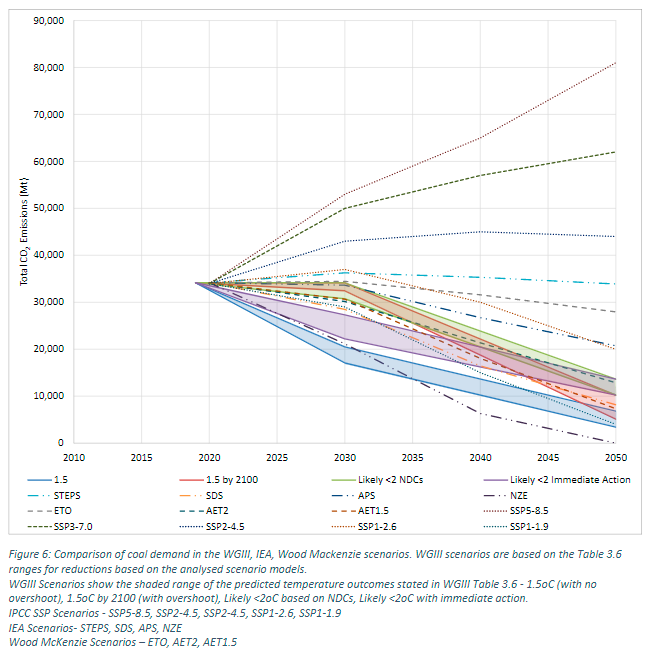
[931] The shaded areas represent temperature outcomes.363 The figure shows the IEA STEPS and APS both exceed 2°C, as does the WM ETO. WM AET 2 is at the upper end of a likely outcome of < 2°C. Both IEA SDS and WM AET 1.5 are on track for 1.5°C by 2100. IEA NZE achieves 1.5°C at 2050.
[932] When taken to the data supporting the charts, Professor Church said AET 1.5 included global emissions that are substantially larger than the carbon budget allows to meet 1.5°C. Dr Warren agreed that was beyond the 50th percentile for achieving 1.5°C, so the AET 1.5 has a lower likelihood of reaching that target.364
[933] The difference in ongoing emissions between AET 1.5 and AET 2 and the IEA and IPCC scenarios matters.
[934] Professor Church observed the total amount of CO2 in the atmosphere determines the Earth’s ultimate temperature. His concern with the AET scenarios is their heavy reliance on CCS to offset the higher emissions. He questioned the feasibility of the scenarios for that reason, a matter I have already discussed, along with Ms Warren’s evidence on the topic.365
[935] The climate change experts also expressed their concern about several uncertainties with the data analysis:366
[936] That makes me wary of accepting a submission that either AET 2 or AET 1.5 are consistent with the long-term temperature goal of the Paris Agreement.
[937] In written submissions, Waratah identifies IEA SDS as a scenario that shows sufficient demand for coal while meeting the Paris Agreement goal and argues it projects coal demand that exceeds all the WM scenarios, including the WM ETO.
[938] This is contrary to the evidence given by both Mr Manley and Ms Wilson.
[939] After a detailed analysis of the WM scenarios, both market experts agreed sufficient demand for the Project coal only existed in the WM ETO scenario, which projects a temperature outcome well above 2°C.367
[940] Waratah had the opportunity to contest that agreed opinion by taking the market experts to other scenarios, such as the SDS, but did not do so.
[941] For example, I could have been assisted by their views on how to equate demand forecasts in the IEA and WM scenarios. I have already explored the difficulty in equating the two because of their different scope, a matter that Waratah alerted me to in challenging the utility of the IEA scenarios. The IEA scenarios project regional coal demand but cannot assist in determining what will be traded in the seaborne market.
[942] Using global demand as a reference point, SDS is close to AET 1.5 but considerably less than WM ETO.368 It stretches credulity for the WM ETO, which Mr Manley said was consistent with a 2.5°C outcome or more, to have less seaborne thermal coal demand projected in 2050 than the SDS which has a temperature outcome in the order of 1.7°C by 2050 with the possibility of reduction to 1.5°C by 2100. Figure 1.5 demonstrates this:369
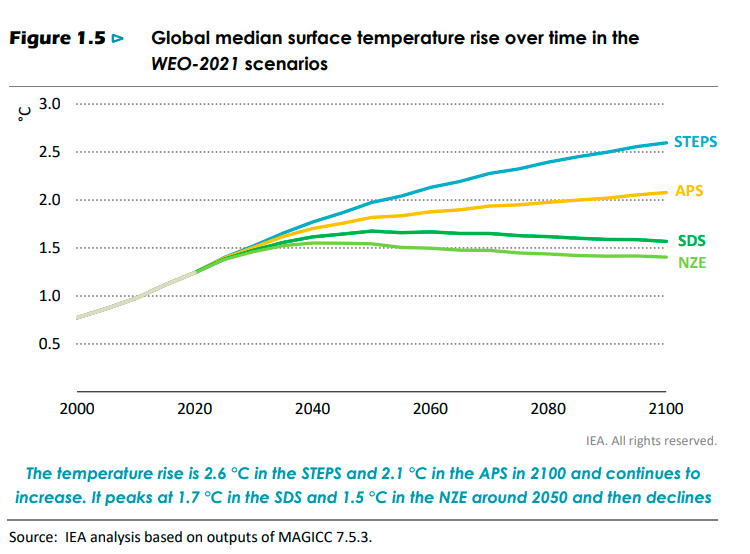
[943] Had Waratah raised the SDS with the market experts during oral evidence they might have been able to explain how that could be. That could then have informed the climate change experts’ supplementary report and may have addressed their reservations about the WM data.
[944] In those circumstances and given the climate change experts’ reservation about the WM data, I have no confidence that the SDS demonstrates a scenario in which there is sufficient demand for the Project coal consistent with the Paris Agreement temperature goal being achieved.
[945] Of course, approving the mine does not mean a certain temperature will be exceeded, or not. I have not approached the scenarios in that way.
[946] I must consider what contribution combustion of the Project coal might make to the temperature outcome. The analysis of the scenarios helps me understand the climate change risks on a range of assumptions, the primary one being there is sufficient demand for coal for the mine to remain viable to 2051.
[947] The market experts were questioned by counsel for YV&TBA about the minimum assumptions necessary for there to be a market for the Project coal out to 2051 on the WM ETO scenario (on the data provided by Waratah to Mr Manley). YV&TBA summarised the propositions agreed to by Mr Manley and Ms Wilson, which I accept as a fair account of their evidence on this topic:370
| • The Applicant is asking the Court to recommend approval of the Proposed Project under the EP Act and the MR Act on the basis of economic benefits of extracting and selling for combustion, the coal in row 145 of Table 1 of the Harris-King spreadsheet (the total saleable coal). | |
| • As per row 145, that occurs over the period 2029 to 2051. | |
| • The minimum assumptions necessary for that market to occur are as follows: |
| ◦ There must be an energy market in which there is demand for coal in 2051. | |
| ◦ Within that coal market, there must be demand for seaborne thermal coal in 2051. | |
| ◦ Within that seaborne thermal coal market: |
| ▪ there must be demand for the coal from the DL, DU and B-seams summarised in row 145, and particularised in rows 146, 147 and 148, out to 2051. | |
| ▪ as the seaborne market will choose coal based on desirability (on the criteria explained by Mr Manley to the Court), and more desirable coal will be bought and burned before less desirable coal, there must be sufficient demand for seaborne thermal coal generally such that all of the coal more desirable than the lowest quality coal in rows 146 to 148 is bought and burned as well, and this must occur out until 2051. | |
| ▪ in order for all of the more desirable coal to be burned, in addition to the coal from the Proposed Project, out to 2051, at least the 608 Mt of seaborne thermal coal projected on the WM ETO (as per the Energy JER and WM Databook) would need to be burned in 2051. |
[948] Waratah argues YV&TBA’s proposition about the connection between coal demand and temperature outcomes wrongly assumes the global thermal coal market will operate perfectly efficiently, and that future demand will be met first with the highest quality coal at the lowest cost.
[949] I am attracted by the argument that perfectly rational market behaviour is improbable, but Waratah’s perfect substitution proposition suffers from the same flaw.
[950] It was Mr Manley who gave the evidence that more desirable coal will be burned first. He said, “if the mine is permitted to go ahead and if its cost basis is better, so it’s a more cost effective mine, it will displace other coal on the market that will not be burnt”.371
[951] Mr Manley repeatedly agreed there must be sufficient demand for the more desirable coal to be burned before the Project coal is reached. His only qualification was that this was subject to substitution.372 Absent substitution, Mr Manley said the only scenario with sufficient demand for the Project coal in 2051 is the WM ETO scenario.
[952] Dr Warren assisted the Court by equating that scenario to the other scenarios discussed in evidence. She considered the WM ETO equated to the following scenarios:
[953] None of those scenarios is consistent with the temperature goal of the Paris Agreement.
[954] Ultimately, Waratah’s answer is that the combustion emissions related to this mine (and the climate change consequences of them) do not matter. The same or a worse outcome will happen if the applications are refused. The same or a better outcome will happen if they are approved.
Will combustion emissions matter?
[955] To assess the competing arguments about whether the combustion emissions from the Project coal matter, the Court must consider supply as well as demand. What coal is already in supply or could be available in the market? What coal competes favourably with the Project coal? What factors might affect the behaviour of competitors and consumers? Can any conclusions be reached about future GHG emissions in those circumstances?
What coal would the project coal displace or be substituted by?
[956] Waratah’s case about supply is confusing and appears internally inconsistent.
[957] On the one hand, Waratah submits there is sufficient supply of thermal coal available to the target market to substitute for the Project coal if the applications are not approved. On the other hand, Mr Manley said there is a need for further supply of high rank coal under the three WM scenarios – the WM ETO and the AET 2 and AET 1.5.
[958] The inconsistency arises from the different ways in which arguments about supply are used by Waratah.
[959] For the perfect substitution proposition, Waratah looks to all thermal coal supply. Indeed, on the evidence of the climate change experts, Waratah cannot say there would be a beneficial outcome from the mine proceeding (and an adverse outcome if it does not) unless the Project coal would displace brown coal (see [1010]).
[960] When considering sustained demand for the Project coal, though, Waratah references other sources of high rank coal, which the market experts agree is the relevant competitor.
[961] Whether looking at supply from the perspective of the perfect substitution proposition, or in asking whether there is sufficient demand to sustain the mine throughout its life, logic says the same reference point is relevant. That is, high rank coal.
[962] Mr Manley said:373
There is significant capital investment in a power station. While switching fuel sources is not unheard of it is a costly process requiring reengineering more than just how the fuel is utilised. Typically fuel switching happens towards the end of life of an asset. More than a third of the current coal-fired power fleet in Asia has been constructed in the last decade, and with a design life of 40-50 years these new power stations are unlikely to be closed, or rebuilt in the near future. Coal fired power plants are built around a design coal specification which details the coal quality parameters that will work for the plant. While there are exceptions, plants designed for high rank coal cannot easily burn sub-bituminous coal or lignite. This limits seaborne competition for Waratah to high rank coal sources. Plants also have to store the left over ash after consumption. Japanese and South Korean coal buyers are particularly ash adverse and will look favourably on both the DU and DL seam ash content.
[963] Mr Manley’s analysis of the relative quality of coal available to supply the target market did not include the B seam, which he thought would not be exported when he prepared the report. Nevertheless, he still considered it high rank coal, albeit with a higher ash content than the other seams in the Project area.
[964] Ms Wilson agreed the main competitor for Waratah in the target market would be other bituminous coal sources.
[965] Mr Manley’s evidence about supply is contained in the Joint Report, supplemented by a databook produced under subpoena.374 As became clear during oral evidence, the databook was not a complete record of the data used by WM in its analysis of supply factors.375
[966] The data is derived from WM’s proprietary database and is precisely targeted to the seaborne thermal coal market. It includes a Project List of approved mines supplying or intended to supply the target market, categorised as operating, highly probable, probable, possible, and suspended. Mr Manley was not sure whether suspended projects were included in the scenarios, because they did not have future production as an input. However, he was sure the proposed Waratah mine was not included as a project for this purpose as it is only in application stage.376
[967] Drawing on that data, YV&TBA say:
1. for all thermal coal – there is supply of 665 Mt: 269 Mt from operating mines and 369 Mt from projects; and 2. for high rank coal – supply of 481 Mt: 205 Mt from operating mines and 276 Mt from projects.
[968] Waratah did not appear to contest those figures.
[969] Using Mr Manley’s WM ETO as the most generous estimate of demand in 2051 (revised to 512 Mt), there is more than enough thermal coal to meet total demand in 2051, and almost enough high rank coal.
[970] The WM ETO equates to climate scenarios that exceed the Paris Agreement temperature goal. Ms Wilson said the IEA NZE scenario assumes no new coal mines are approved, which is an outcome of the fact that there is already sufficient supply to meet that goal.
[971] At this point, I should refer to some evidence given by the climate change experts, to which Waratah objects. Waratah objects to a passage where the climate change experts referred to research papers that they say overwhelmingly indicates that no new fossil fuel mines should be approved.377 I am not considering whether any new mines can be approved, only whether this mine should be. Mr Manley and Ms Wilson gave relevant evidence about supply available for the target market and that is the evidence I have taken into account.
[972] On the market experts’ evidence, it seems that supply presents no immediate impediment to the perfect substitution proposition. On the other hand, it calls into question the public benefit in bringing a new mine to market. Ms Wilson explained how bringing the Project coal into production could have the effect of extending supply of thermal coal in the market and increasing consumption, which would make this more complex from a CO2 perspective. Mr Manley did not disagree.378 This is an avoidable risk given the need for the mine is not established and the remaining carbon budgets for scenarios consistent with the Paris goals, are constrained.
Will there be perfect substitution?
[973] The market experts agree there is potential for the Project coal to displace existing supply and that if the mine is not approved the demand for thermal coal in the market can be met by existing supply.
[974] However, neither said there will be perfect substitution.
[975] In summary, the market experts identified coal quality and cost competitiveness as the primary factors influencing displacement, but agreed import policy, competitor behaviour, and contract arrangements are relevant factors.
[976] They agreed that, on average, the Project coal is of similar quality to coal currently produced and contained in projects in Australia and other seaborne supply countries and is of higher quality than currently produced or contained in projects in Indonesia.379
[977] Mr Manley placed the Project coal against the quality of coal supplied by mines in production (Table 2) or that might be supplied by projects not yet in production (Table 3 – showing projects that are highly probable, probable, suspended, and possible).380
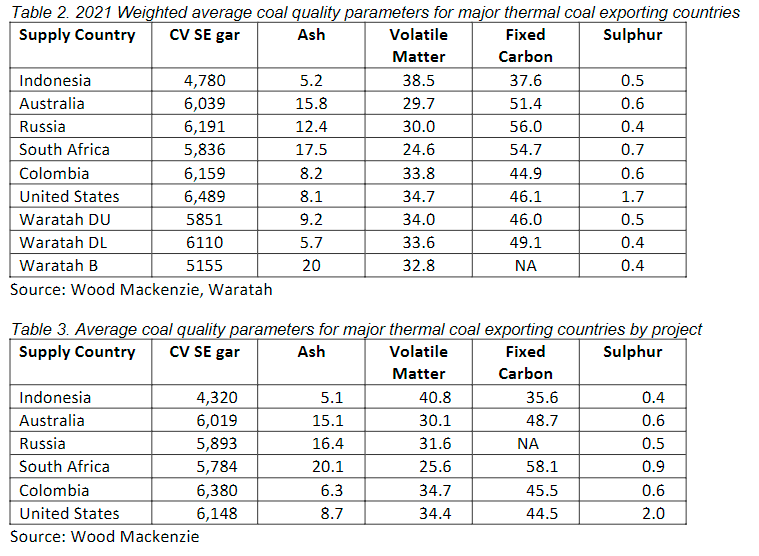
[978] Because this does not provide a mine by mine or seam by seam comparison, YV&TBA say the Court does not know what competition is already in the pipeline for each of Waratah’s coal seams. Had Waratah asked him to, Mr Manley could have produced a pivot table to undertake a comparison by country or by mine.381 As I have observed before in these reasons, it is a matter for Waratah what evidence it wants to lead. It did not seek leave to lead further evidence on the point.
[979] Mr Manley analysed the production cost for the Project coal adjusted on an energy basis. Figure 3 shows Waratah on this total cost curve in the middle of the first quartile, making it very cost competitive.382
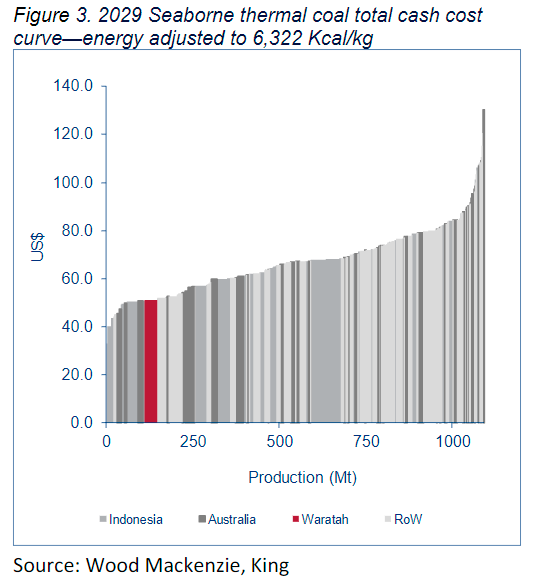

[980] YV&TBA could not interrogate the data underlying that analysis, despite requests for more information and, ultimately, a subpoena.
[981] As for the margin, Mr Manley produced Figure 4 which placed the Project coal in the first quartile of the margin curve making it one of the highest margin operators.383 Margin is important because supply side consolidation has brought with it greater price discipline. There is a preference to keep production costs down and limit supply to ensure the coal produced and sold achieves reasonable margins, sufficient to justify ongoing investment in infrastructure and development.384
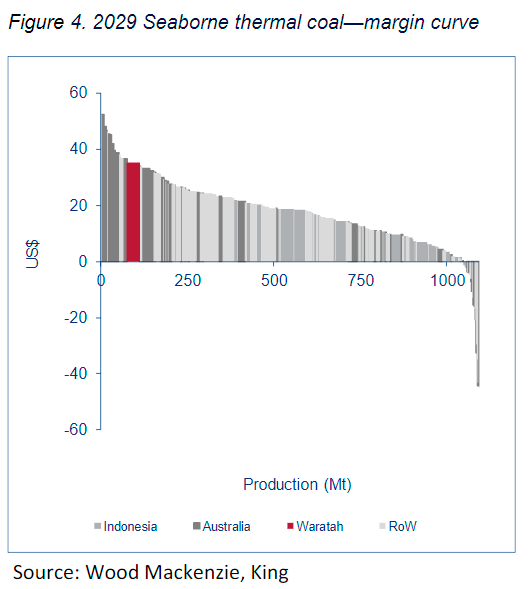
[982] In oral evidence, Mr Manley conceded he made errors that reduced the margin from US$35.42 to US$20.76.385 He subsequently produced a revised Figure 4 which showed the B seam was much less competitive, but that the blended margin was still in the first quartile.386
[983] Waratah submits he included a blended margin because the three seams would not necessarily be sold as separate products and would have sufficiently similar properties to be sold as a blended mix. Mr Manley did not say this in evidence, and it was not put to any other witness. Waratah had the opportunity to call further evidence from Mr Manley on the revised figure but did not do so. While Waratah’s submission makes sense, it is not evidence and I place no weight on it.
[984] Another difficulty with Mr Manley’s margin calculation is his reliance on the information provided by Waratah about price. Price is a function of the cost of production because it needs to be high enough to incentivise production.387 I have explained my view the coal price assumption is not soundly based at [1044]-[1083] when dealing with the economic benefits of the mine.
[985] Waratah says Ms Wilson did not cavil with Mr Manley’s view of the cost competitiveness of the coal in the Joint Report. That is a troubling submission given she did not have access to the data needed to properly assess his conclusions and, ultimately, neither did the Court, at least in relation to Figure 3.
[986] In any case, desirability is not just a feature of cost competitiveness. Mr Manley said that it is also a function of boiler design for a power station. If a boiler is designed for high ash coal, it won’t work with high energy coal, which might break the boiler. Power stations in Vietnam and some in India are designed for very high ash coal. The market for Indonesian coal has been enhanced by the design of new power stations in Southeast Asia. That might mean the B seam coal has a ready market, but that does little to advance the perfect substitution proposition for the other two seams, which are high energy coal.
[987] Moving from coal quality and cost competitiveness, Mr Manley said policy in customer countries could impair displacement, such as the recent Chinese ban on importing Australian coal.388
[988] Ms Wilson said competing coal suppliers might drop prices to maintain their place in the market in the face of competition from the Project coal. Mr Manley said it is not easy to change the cost profile for a mine without a radical change of plan. Ms Wilson disagreed. She said the margin is also important. Competing producers might be willing to continue production and take less profit. Requirements to recover fixed costs, such as to pay investors, mean it is not as simple as assuming a competitor priced out of the market will simply stop producing.
[989] Further, most coal is contracted through long-term contracts so power plant operators have certainty of supply. Mr Manley said some 70%-85% of coal is likely to be in long-term contracts. He agreed the countries without domestic supply are most likely to be under long-term contracts. When asked if this is a factor to think about with displacement he said “absolutely”.389
[990] Mr Manley and Ms Wilson agree the Project coal has the potential to displace other coal. But they did not attempt to assess its actual displacement potential. They did not undertake the nuanced or detailed analysis that would require.390
[991] The same is true for substitution. The market experts do not agree there will be 100% substitution for coal supply if the mine does not proceed.391 That said, Mr Manley did not positively assert that there would be 100% substitution at any point in his written or oral evidence.
[992] Like the potential of the Project coal to displace other supply, assessing the prospects of substitution requires a nuanced and detailed assessment. There are so many variables that interact that it is impossible to make a finding with any certainty on the evidence before the Court.
[993] Mr Manley did not try to predict how much of the Project coal would be substituted. He no longer holds to the WM ETO analysis presented in the Joint Report as the most likely outcome in 2051 and has not reassessed it in light of the revised WM forecast.
[994] Ms Wilson said the global coal markets are not fixed and isolated.392
[995] Not fixed, in the sense that there is a fixed level of demand for coal to 2051 that must come from somewhere. I have explained why I do not accept the likely demand for coal in the relevant market is as modelled by the WM ETO. There are sound reasons for concluding it will fall faster and further than Mr Manley predicts.
[996] I accept there is the possibility of substitution, even in a falling market, but there is insufficient evidence to allow me to make a finding about what that might be, because the market experts did not undertake that exercise.
[997] Waratah has not pointed me to any analysis of the prospects of substitution in a declining market. Ms Wilson agreed the IEA NZE scenario did not examine the substitution or displacement of coal within a level of demand.393 That is not surprising. The IEA NZE did not seek to project demand. It is a goal-driven scenario which finds how much coal can be combusted while staying within the remaining carbon budget for a temperature increase of 1.5°C.
[998] Ms Wilson said the markets are not isolated either.394 While Mr Manley has conducted his analysis on the target market, his analysis does not address whether coal could be procured outside the market.
[999] The market experts agree:395
The global energy market is dynamic and complex, and is made up of a number of loosely intertwined factors that govern thermal coal supply, demand and consumption. The direction of the change in any one of these factors could push coal consumption up or down.
[1000] The market is subject to significant forces driving a decline in demand for electricity generated by thermal coal. These include the policy settings driving a transition from fossil fuels and the increased competitiveness of other sources of energy in the market. I have already considered those factors above.
[1001] I prefer the evidence of Ms Wilson about how the forces driving the declining market affect the perfect substitution proposition.396
[1002] Under a declining demand forecast, coal-for-coal substitution will be limited to the near-term. Increased demand will be short-term and peak soon. The most recent WM forecast shows seaborne thermal coal demand peaking in 2021, when the prior year’s forecast shows the peak occurring in 2025.397
[1003] Demand is most likely to be met by operating mines rather than new ones coming online. While high rank coal might be the preferred feedstock for new power plants, construction of coal-fired power plants is in decline. Many of the existing plants are designed for higher ash, lower energy coal and cannot easily substitute that supply for high rank coal. International policy and national commitments, and constraints on finance, all point in one direction, to drive the transition away from fossil fuels. Costs of alternative energy sources, including storage are declining and will continue to decline. The risks for new mines in that context are substantial.
[1004] I accept Ms Wilson’s opinion that displacement is complicated, and a simple one-for-one substitution is not a realistic assumption given the many variables that act upon the coal market.398
[1005] On all the evidence from the market experts, I can make no certain finding about substitution, except that perfect substitution is not likely, but some substitution is possible.
What difference will it make for GHG emissions?
[1006] If the Project coal’s competition is high rank coal, it appears likely that any substitution would be by coal of similar quality.
[1007] Mr Manley produced some charts to illustrate the relative emissions from the Project coal with coal supplied globally.399 He used them to explain his opinion that two of the three seams have lower emissions than the bulk of the coal produced in Indonesia. Again, Mr Manley has disregarded the lower quality B seam coal which accounts for up to one-third of the Project coal, although the climate change experts said any difference in emissions was negligible unless the comparison coal was subbituminous or brown coal.
[1008] Again, Mr Manley’s charts present as an analysis of individual seams of the Project coal with an average by country or for the rest of the world. I don’t find that particularly helpful, given Mr Manley’s evidence that taking this approach to analysing costs of production and margins did not provide a direct comparison between the two.
[1009] It is not clear whether there is any conflict in the evidence between the climate change experts and Mr Manley about relative GHG emissions of the Project coal and other supply, but to the extent there is, I prefer the evidence of the climate change experts. Mr Manley said he did not disagree with their evidence but had approached his calculations in a different way.400 Mr Manley does not have any expertise in estimating emissions, and Dr Warren is Waratah’s nominated expert on the topic, I look to the climate change experts’ evidence about the difference for combustion emissions.
[1010] They agreed there is only a material difference in GHG emissions from combustion if the substituted coal is brown coal. The experts agree Waratah would most likely displace other high rank coals if the mine is approved. The same logic applies to substitution if the mine is not approved. The coal that would be either displaced or substituted for is of the same type. There may be some minor quality differences between the coals, but the evidence from the climate change experts was that there is only a material difference in emissions if you are comparing high rank coal with brown coal.
[1011] The evidence does not support a finding there will be fewer GHG emissions if the mine proceeds (a beneficial outcome). First, because the market experts have not attempted to assess the extent to which the Project coal has potential to displace competing coal in the seaborne thermal market. Second because their evidence suggests the Project coal is most likely to displace coal of a similar quality, rather than brown coal.
[1012] If the mine is not approved, unless there is perfect substitution for the Project coal that results in higher emissions, there could not be an adverse outcome. The evidence does not support that finding either.
[1013] It is impossible to predict what, if any, displacement or substitution might occur or what that would mean for total global GHG emissions.
[1014] In conclusion, dealing with Waratah’s various propositions:
Conclusions
[1015] Climate change is caused by the concentration of GHGs, primarily CO2 in the atmosphere. It results in an increase in the average global surface temperature with associated impacts. There is a near-linear relationship between increased atmospheric concentration of CO2 and increased temperature. This underpins the carbon budget. Temperature will not stabilise when the world reaches net-zero emissions. How long it will take for the temperature to stabilise and what that temperature will be, will depend on the atmospheric concentrations when we reach net-zero.
[1016] Regardless of where the emissions are generated, the impacts of climate change will be experienced by the Queensland environment, including its people. Some of those impacts are different or disproportionate to impacts experienced by environments and people elsewhere in Australia and the world. Certain people and groups of people within Queensland, including First Nations peoples and children, will bear a different and disproportionate burden of climate change.
[1017] The Paris Agreement seeks to limit temperature at 2100 to well below 2°C above pre-industrial levels by 2100, with the ambition of limiting it to 1.5°C. Above that limit, the climate impacts will become more severe and risk triggering feedback processes that will move the climate into a different state from which it may not be able to recover. The risk of this occurring if temperature is kept well below 2°C is minor, but it increases significantly after this point.
[1018] This mine would contribute to climate change directly and indirectly. The most significant contribution would be through the combustion of the mined coal. Neither the ML nor the EA authorise combustion, but there is no other purpose for the mine. The Court is not prevented by policy or law from considering the impacts of the combustion of coal from the proposed mine, as well as the direct emissions from the mine itself.
[1019] Climate scenarios that are modelled on current commitments by national governments show the Paris Agreement temperature goal will not be met. It can no longer be assumed that NDCs will achieve the temperature goal or that it is a satisfactory means to address the climate change implications of combustion emissions.
[1020] The IEA called for nothing less than a complete transformation of how we produce, transport, and consume energy. It has charted a pathway to net-zero by 2050 that it says is a feasible scenario to achieve the temperature goal. Under that scenario there is already sufficient coal supply to meet the demand for coal that can be combusted.
[1021] The WM ETO is not a reliable prediction of the demand for the Project coal to 2051, because it makes unwarranted assumptions about international and domestic policy, it underestimates the competition from renewable energy sources and other technologies, and it is overly optimistic about the uptake of CCS.
[1022] However, in the absence of any other prediction of demand, I have referred to the WM ETO in assessing the possible climate implications, as that is the basis upon which the economic benefits have been assessed.
[1023] While approving the mine does not commit the world to any particular temperature outcome, in making a recommendation, the Court should consider whether approving the mine would make it harder to achieve the goal to which Australia and Queensland is committed.
[1024] Waratah says predicting the climate outcome is speculative. The same is true of Waratah’s propositions about displacement and substitution and the potential climate change outcomes of the mine being approved or not.
[1025] On the evidence in this hearing, there is no modelled scenario that demonstrates all the Project coal could be combusted, unabated, while still meeting the temperature goal.
[1026] The evidence about the perfect substitution proposition does not satisfy me the mine would have no bearing on GHG emissions. I cannot find that the same amount of coal will be combusted regardless of whether the mine proceeds. Some displacement/substitution is possible. However, demand for coal-fired electricity is falling, driven by international and national policy, and reduced cost and uptake of renewable energy sources and other technologies.
[1027] It is not clear how a decision on this mine, one way or the other, would affect supply or consumption in the target market. There is already adequate supply of thermal coal and almost sufficient supply of high rank coal in operating mines or projects to meet the optimistic demand prediction of the WM ETO. The competition for the Project coal is coal of similar quality, with similar GHG emissions. The evidence does not satisfy me that there will be no net impact or a beneficial impact if the mine does proceed. Nor does it satisfy me that there will be an adverse impact if the mine does not proceed.
[1028] In considering whether the public interest would be prejudiced if the mine proceeds, I am asked to give full weight to the economic benefits of selling the mined coal for combustion. I must also give full weight to the environmental, including health and social costs of that coal being combusted.
[1029] I will now turn to the evidence about both benefits and costs associated with the mine.
ECONOMIC BENEFITS
| Overview | [1030] |
| The financial assessment | [1036] |
| The economic assessment | [1084] |
| Computable General Equilibrium | [1096] |
| Cost Benefit Analysis | [1111] |
| Net Producer Surplus | [1115] |
| Queensland ownership and population attribution of NPS | [1117] |
| Transport Costs | [1123] |
| Projected Revenue | [1131] |
| Royalties | [1138] |
| Company income tax (Queensland proportion) | [1151] |
| Payroll Tax | [1155] |
| Summary of the assessment of benefits in the CBA | [1161] |
| The ecological impacts on Bimblebox | [1163] |
| The cost of GHG emission impacts | [1178] |
| The CBA excludes scope 3 emissions | [1180] |
| The price of carbon | [1195] |
| The discount rate | [1213] |
| Population apportionment | [1224] |
| Summary of assessment of costs in the CBA | [1240] |
| Implications of the CBA | [1249] |
| Mr Coleman’s evidence | [1253] |
| Social impacts | [1261] |
| Conclusions on economic and social benefits | [1280] |
Questions about what is in “the public interest” will ordinarily require consideration of a number of competing arguments about, or features or “facets” of, the public interest … “A question about ‘the public interest’ will seldom be properly seen as having only one dimension”.401
Overview
[1030] Waratah says it is in the public interest to grant the applications because of the economic benefits of the mine. YV&TBA say those economic benefits are overstated and will likely not be realised because of the mine’s tenuous viability.
[1031] The evidence on these topics was given by Waratah’s CEO, Mr Nui Harris, the market experts, Mr Manley and Ms Wilson, and the economists, Mr Andrew Tessler and Mr Rod Campbell.
[1032] In this section of the decision, I deal with the accuracy and adequacy of Waratah’s financial and economic assessments of the mine. I will also consider the evidence given by the actuary, Mr Coleman on climate change losses, and the evidence from Mr Lars Holm on the social impacts of the mine.
[1033] The financial assessment relates to the viability of the mine. Key issues are the assumptions made about the price Waratah can achieve for the Project coal, and the projected demand for that coal in the target market over the life of the mine.
[1034] The economic assessment estimates the costs and benefits to the community. The assumptions about coal price and demand are relevant to the economic as well as the financial assessment. In addition, YV&TBA say the economic assessment overstates the benefits and understates the costs of GHG emissions and ecological impacts. They also say the role of an economic assessment is limited when considering the public interest in the applications being granted.
[1035] Some related issues, addressed elsewhere, are:
The financial assessment
[1036] The original mine plan was to open cut mine Bimblebox. Waratah’s EIS concluded that “the coal resource cannot be economically mined in this part of the Galilee Basin without access to the shallow coal seams underlying the BNR [Bimblebox] and that, as a consequence of mining, the ecological integrity and conservation value of the BNR [Bimblebox] cannot be maintained”.402 Now, Waratah maintains the Project is viable without open cut mining Bimblebox. Mr Harris explained this was for two reasons. First, the substantial decrease in the overall capital costs by utilising the existing rail network and existing port facilities through their change to the transport option. Second, the increased cash margin associated with underground rather than open cut mining.
[1037] Waratah relies on a report prepared by James King, a consultant in the economic aspects of industrial metals and raw materials.403 The purpose of Mr King’s report was to present an independent analysis of the costs of production and financial viability of the project.
[1038] YV&TBA say the report is not independent or robust.
[1039] They say it is not independent, because it is based exclusively on data contained in a spreadsheet attached to Mr King’s report,404 which was provided by Mr Harris.405 While the report is an analysis of the effect of that data, the inputs were not generated or independently substantiated by Mr King.406
[1040] They say it is not robust, because of the tenuous basis for critical assumptions, including about the coal price and project financing. Waratah objects to any evidence about project financing. YV&TBA abandoned the ground of their objection that Waratah did not have the technical and financial capacity to operate the Project. I deal with that objection at [1747]-[1756].
[1041] There is no contest about the quality and volume of the coal or that Waratah’s target market is the seaborne market for thermal coal.
[1042] The parties’ competing submissions identify two aspects of the argument about the coal price: the starting point and the projection as to coal price across the life of the mine. The two are linked because the starting point is the base to which projections about matters which affect price, such as demand, are applied.
[1043] In this case, it is challenging to disentangle the evidence about those two aspects because the starting point is, itself, a projection as to price.
[1044] The financial assessment, and therefore the economic assessment, used a coal price of US$85/t, assuming production commenced in 2025, some 4 years after the figure was chosen.
[1045] Mr Harris settled on the starting point of US$85/t, in consultation with the Waratah Coal working group, because it was the benchmark price for Newcastle 6000 kcal/kg coal on the day Waratah prepared the spreadsheet for Mr King, in about May 2021.
[1046] In his report, Mr King noted the price of thermal coal had fluctuated widely since 2011, when he did his first assessment of the Project. Between 2011 and 2020, the spot price of benchmark thermal coal averaged US$84/t in nominal terms. On that basis, he used the benchmark price as the constant real price for his financial analysis.
[1047] In his sensitivity analysis, Mr King identified this as the most important variable for the Project. A decline of 13% in the coal price to US$74/t takes the Project below a financial break-even point (based on the Net Present Value of Equity Cash Flows After Tax in Year 1).
[1048] That is, a decline in coal price of 13% from the starting point challenges the viability of the Project.
[1049] Waratah says its coal price is reasonable. YV&TBA say it is inflated, having regard to the market projections considered at [808]-[934].
[1050] YV&TBA did not have the opportunity to cross-examine Mr King on his report, but Waratah did not rely on Mr King to support the coal price.
[1051] Waratah says the only witness with expertise in forecasting coal price is Mr Manley, their coal and energy market expert. I accept Mr Manley has considerable experience in thermal coal pricing, that does not mean I should not consider relevant evidence from other witnesses who are appropriately qualified.
[1052] Mr Harris has no particular expertise in coal price forecasting and the basis for the choice of price is discussed below.
[1053] Most witnesses relied upon the price provided by Waratah without specifically considering whether it was reasonable, although the economists appeared to accept it was. Mr King was not called to give evidence.
[1054] Ms Wilson did not suggest a different starting price but said that in the near future increased supply would cause coal prices to fall, affecting the profitability of new coal mine projects. Projects that are expected to be unprofitable will not move forward. She referred to previous examples of the impact of oversupply. She said oversupply of thermal coal will persist as coal consumption falls, driving prices lower. In her opinion, new coal mine projects would inject additional supply into the market and exacerbate those conditions. Mr Manley did not disagree with that evidence.
[1055] Mr Manley is not the source of the coal price, nor did he endorse it.
[1056] The instructions to Mr Manley and Ms Wilson posed a series of questions relevant in assessing the market for the Project coal.407 They were not asked to say what the coal price should be for the financial or economic assessment of the mine.
[1057] Mr Manley said he said he was not surprised that Waratah had prepared its discounted cash flow model using a benchmark price as he had seen this done before.
[1058] He said it was not the number he would have chosen.408
[1059] Mr Manley said the King price (of US$85/t) was more conservative than the “Wood Mac price” that he came up with based on his view of the coal quality. He referred to the evidence in the expert report on that point. That appears in answer to this question:409
In relation to Question 14 of our instructions – Is the Applicant’s coal competitive based on Applicant’s proposed production cost estimates set out in the reports included in your Brief and forecast market conditions?
[1060] The King report formed part of that brief.
[1061] In their Joint Report, Mr Manley and Ms Wilson agreed that, should the coal enter the market, it has the potential to displace higher cost/lower margin supply that sits higher on the supply cost curve.
[1062] In his response to Question 14, Mr Manley identified an error in the King report regarding ash content and said that premia might apply for both the ash and sulphur content of the Project coal. That showed a potential for higher prices than in the King report. He did not apply the premia in analysing the competitiveness of the Project coal because the coal is yet to be market tested. It is in that context that he said the King values were more conservative.410
[1063] In oral evidence, when asked about his adjustments for coal quality, he agreed they were made from the King price not his own real price.411
[1064] The only question asked of Mr Manley and Ms Wilson about coal price was:412
What is the coal price outlook for the market identified in answer to paragraph 1 based on the coal demand forecast?
[1065] Mr Manley and Ms Wilson disagreed about the coal price outlook for the seaborne market because they disagreed about the factors that would affect that outlook. I have considered their evidence about that and it is not necessary to revisit that here.
[1066] Mr Manley was clear in his evidence to the Court that he was not asked to forecast the starting point for the coal price and did not do so.
[1067] Ultimately, then, the Court is left with no evidence from any witness with expertise in forecasting coal price about whether the starting price for the financial assessment of the mine is reasonable. The coal price is the most significant variable for the financial assessment and is a key aspect of both the cost benefit analysis (CBA) and computable general equilibrium (CGE) in the economic assessment.
[1068] Further, the evidence about the coal price outlook suggests a coal price of US$85/t is too high. Mr Manley used the market scenarios to consider the coal price outlook. In Figure 22 he showed that base case for selected benchmark coals.413
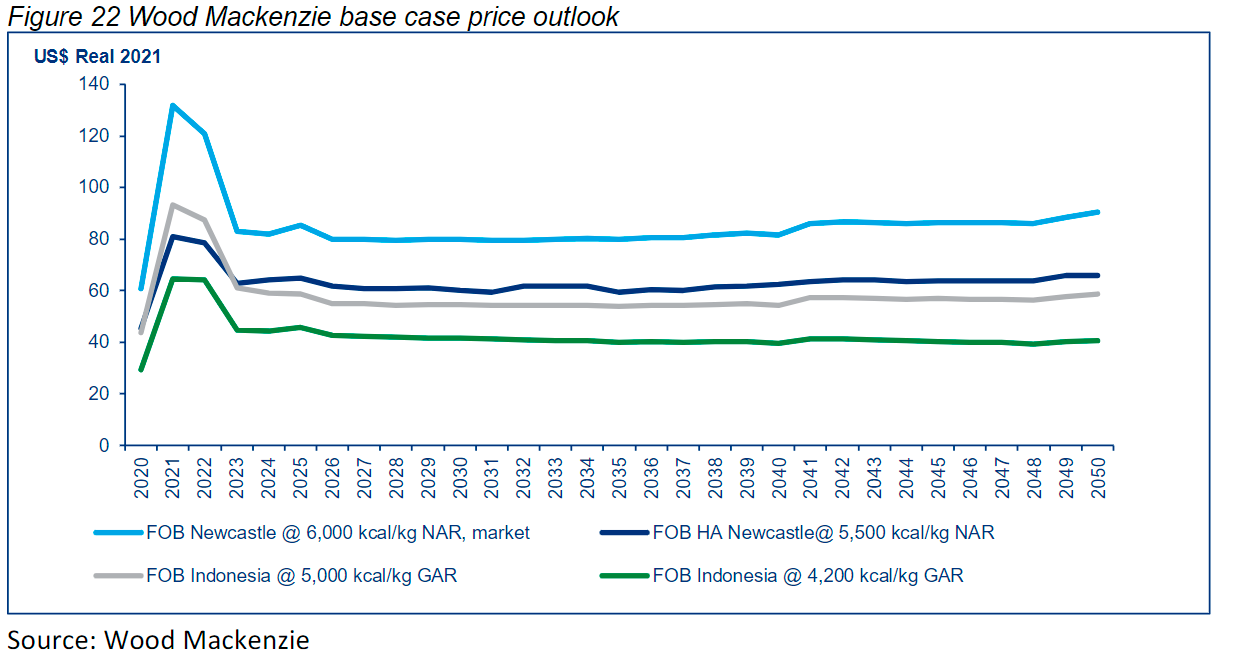
[1069] This shows the price outlook for benchmark coal peaking shortly and falling to 2023 and then plateauing and rising slightly towards the end of the mine’s life.
[1070] In Figure 24, Mr Manley showed the price outlook on the WM ETO, AET 2 and AET 1.5 scenarios.
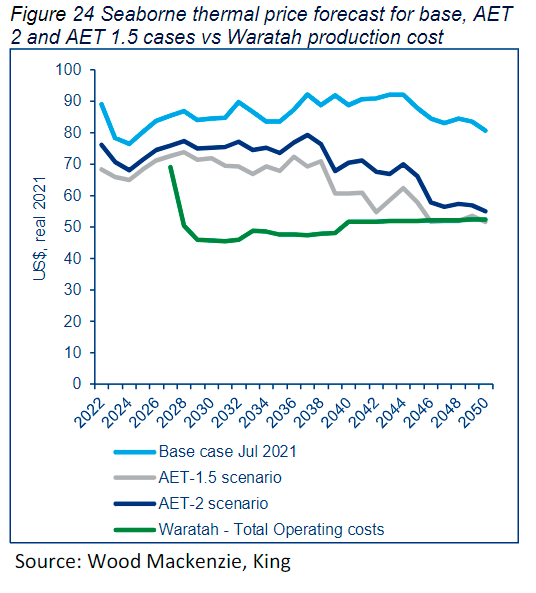
[1071] The WM ETO analysis shows a price exceeding US$80/t out to 2051, except for a brief dip around 2024. For the other two scenarios, the analysis for 2022 to 2051 shows prices ranging from US$77.50/t to US$55/t for AET 2 and US$74/t to US$51.70/t for AET 1.5.
[1072] There are several other price forecasts in evidence:
[1073] Each of the forecasts (other than the WM scenarios) have the mine unviable by 2030.
[1074] Waratah says reduced coal prices will not make the mine financially or economically unviable. Coal forecasts have to be understood by reference to any model in which they are presented because they involve fundamental assumptions about key inputs that determine the price for coal such as demand.
[1075] I accept that. I also accept its submission that the Court cannot assume coal prices will be so low that the mine will never produce a benefit.
[1076] Coal prices have averaged more than US $85/t over the last decade in nominal terms. Current coal prices are much higher, but Mr Manley expects prices to fall from 2023 onwards back to long term fundamentals.419
[1077] There is considerable uncertainty about the future market for thermal coal.
[1078] The WM scenarios are specific for seaborne thermal coal of the quality of the Project coal. WM’s AET 2 and AET 1.5 coal price projections fit comfortably within the broad ranges suggested by the other forecasts YV&TBA referred to. While WM’s AET models both assume sufficient global efforts to achieve a stated temperature goal, its base case also makes assumptions about what countries will do in response to climate change, as well as the uptake of renewables and the use of CCS. Each of those assumptions may be contestable.
[1079] I have considered the evidence about the assumptions made for the WM ETO at [818]-[925] and explained why I consider it is not reasonable to assume it is more probable than scenarios which achieve the global temperature goals.
[1080] Further, there is evidence that demand in the seaborne thermal coal market is already declining at a faster rate than WM assumed in its base case. Between the production of the joint expert report and the hearing, WM had downgraded its demand estimate by 18%. Mr Manley did not explain the implications of that for his base case analysis.
[1081] It is not possible to find now that the mine will not be viable over its projected life.
[1082] However, the viability of the mine is in question. That is relevant in considering whether the resource will be utilised (a matter discussed at [1725]–[1735]). Variations in coal price and production volume have implications for the estimates of net economic benefits (to be enjoyed by Waratah and the community), which Waratah say outweigh the costs of the mine (to be borne by the community).
[1083] That leads me to the estimates of the economic benefits of the proposed mine.
The economic assessment
[1084] The economic evidence was given by Mr Tessler, nominated by Waratah, and Mr Campbell, nominated by YV&TBA.
[1085] Mr Tessler has 20 years of experience as an economist and is currently the Head of Applied Economics at BIS Oxford Economics (BISOE). He specialises in transport economics and has international experience in that field. Mr Tessler has consulted in a range of industries, including energy, transport, infrastructure and the environment. This has involved economic appraisals, valuations, rate of return studies, market analysis and program reviews.
[1086] Mr Campbell is a Research Director at the Australia Institute, where he previously worked as an economist. His research focusses on economic assessment and its role in planning systems and policy making, especially in the mining industry. Previously, Mr Campbell worked as a director and economist at Economists at Large, where he authored a report assessing the potential of exporting brown coal from the Latrobe Valley in Victoria.
[1087] Waratah relies on the Galilee Coal Project Cost-Benefit and CGE Analysis prepared by BISOE,420 and Mr Tessler’s written and oral evidence. Mr Campbell did not do an alternative CBE or CGE but provided his opinion on that work and on work previously provided by Waratah in the EIS and SEIS in support of its applications. Together, the economists prepared a Joint Report and participated in a concurrent evidence session during the hearing.421
[1088] Waratah say I should give little weight to Mr Campbell’s evidence for several reasons.
[1089] First, it objects to his evidence about coal demand.422 In the economics Joint Report, Mr Campbell referred to the estimates in the EIS/SEIS about future coal demand. He said they were overstated given actual coal consumption since 2011.
[1090] Mr Campbell critiqued the economic assessment for the EIS/SEIS with the benefit of hindsight and relied on published data in doing so. His evident purpose was to urge caution about more recent predictions about the market, in the absence of an explanation for the past overstatement. I will receive that evidence.
[1091] However, I uphold the objection to the footnoted passage which does forecast future demand and assess current supply.423 Ms Wilson is the expert engaged by YV&TBA to give evidence on that topic.
[1092] Second, Waratah says Mr Campbell did not do his own CGE or CBA. He was not briefed to do this, nor was it necessary for him to do so in giving evidence in this hearing. In any case, as became evident during the hearing, had he attempted this on the material in his brief, he would have been working with different source data to Mr Tessler. It seems at least two of Waratah’s experts (Mr Tessler and Mr Manley) had access to a different version of the King spreadsheet than was available to their counterparts (Mr Campbell and Ms Wilson) during the expert conferences. As is already apparent from my discussion of the financial assessment, and will become apparent for the economic assessment, the King spreadsheet is a critical source of information for both assessments. Had Mr Campbell prepared his own CBA it would have referenced incorrect information and been yet another cause for confusion and conflict in the hearing.
[1093] Third, Waratah refers to observations made in a previous case in this Court about Mr Campbell’s expertise. I find that unpersuasive. The case was decided seven years ago. Anything said in that case was in the context of evidence and submissions specific to that case. Had Waratah intended to mount a serious challenge to Mr Campbell’s expertise in this hearing it should have done so directly before he commenced to give oral evidence. It did not do so.
[1094] Finally, Waratah says Mr Campbell’s opinions fundamentally misapprehend the nature and scope of a CBA. I do not accept that either. As a general proposition, Mr Campbell questioned the utility of a traditional CBA in a case such as this. As will appear from the discussion of the CBA, he has a legitimate foundation for that opinion.
[1095] Where there are material differences of opinion about what the BISOE CBA did or did not include, I have addressed them below.
Computable General Equilibrium
[1096] One aspect of the economist analysis before the Court is a CGE. A CGE is an assessment using a computable general equilibrium model, which uses economic data to estimate how an economy might respond to a project, in this case to the mine proceeding.
[1097] BISOE engaged a consultant to undertake the CGE and the report is an appendix to the BISOE report. The author was not called to give evidence and Mr Tessler could not speak to the CGE except in general terms.
[1098] The author of the CGE report used a dynamic CGE model called VU-TERM to estimate the impacts of the Project over the lifetime of the mine on items such as employment and Gross Regional and State Product. He also did a national welfare calculation based on the net present value of deviations in private and public consumption from base at national level.
[1099] Unlike the CBA, a CGE model does not seek to deal with externalities, such as the potential costs of environmental damage from mining coal. These would have to be weighed against any ostensible net benefits.424
[1100] The CGE reports growth in regional employment, wages, investment, and aggregate consumption. As existing mining accounts for more than 40% of the Outback South-Central Highlands region’s GDP in 2021, this Project is ‘large’ in both the investment and operational phases relative to that regional economy.425 The regional economic benefits are enhanced when the construction of the rail link is included.426 That no longer seems to be the option Waratah prefers, so the enhancement is unlikely. Ms Atkinson, a non-active objector, said that employment opportunities offered by the Project are short-term and will not benefit the wider community.427 Mr Holm, the social impact expert engaged by Waratah, said the Project would produce a mix of positive and negative social impacts.428 Directly affected landholders would experience largely negative impacts, and the Alpha community, on balance, would be likely to positively experience the mine.
[1101] For costs, the CGE referred to a potential housing market rental squeeze and rising costs of living for residents. That may be limited by Waratah’s plan to construct a ‘purpose-built’ accommodation facility in the town of Alpha. YV&TBA as well as Ms McEwen, an non-active objector, expressed concern in their objections to the ML and EA applications about the impacts of the mine on the local community.
[1102] Mr Holm says that locating accommodation for the mine workforce in proximity to Alpha may have positive and negative impacts including:
[1103] In undertaking the net welfare calculation, the author of the CGE analysed three scenarios, involving two approaches to coal prices, which he referred to as CGE base 1 and CGE base 2.
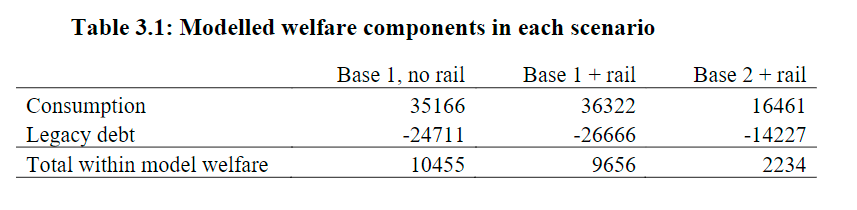
[1104] The author said his welfare calculation is sensitive to the future price of coal. He noted the importance of future coal prices in estimating the returns from a new mine and said they cannot be forecast with reasonable certainty.429
[1105] The CGE uses the CBA baseline (which is derived from the King spreadsheet) as the basis for its analysis of price. In a CGE, price is an endogenous variable, with price affected by elasticity in demand relative to supply. In this model, the export demand elasticity of coal is -4, so that for each 1% increase in supply, the price of coal will fall by 0.25%.430
[1106] CGE base 1 shows the coal price rising throughout the life of the Project reaching US$230/t by 2050. CGE base 2 shows the coal price falling below US$74/t around 2035, making the mine unviable on the King report.431
[1107] Given the author’s caution about the sensitivity of the net welfare benefits to the future price of coal, I treat the estimates with circumspection.
[1108] Mr Tessler said he did not do any critical analysis of the price scenarios modelled by the CGE. He agreed it did not model the coal price falling before 2030, although the WM AET 2 and AET 1.5 scenarios both predict demand for seaborne thermal coal will fall before 2030, more quickly and dramatically than the CGE base 2. As the analysis was done some months earlier, it also cannot have considered the April 2022 update to the WM ETO, which estimates a further 18% reduction in demand for coal by 2050.432
[1109] Because Mr Tessler is not a CGE expert and could not answer questions about the model, YV&TBA did not have the opportunity to properly test the results. Waratah refers to some information in the CGE but placed little emphasis on its results.
[1110] Whilst I accept there will be regional benefits in employment and consumption, I have little confidence in the welfare calculation and give it little weight in demonstrating the economic benefit of the mine.
Cost Benefit Analysis
[1111] Waratah relies on the CBA to demonstrate the Project will result in net present value economic benefits to the State of between $2.5 b and $4 b, depending on whether the cost of rail links is included.
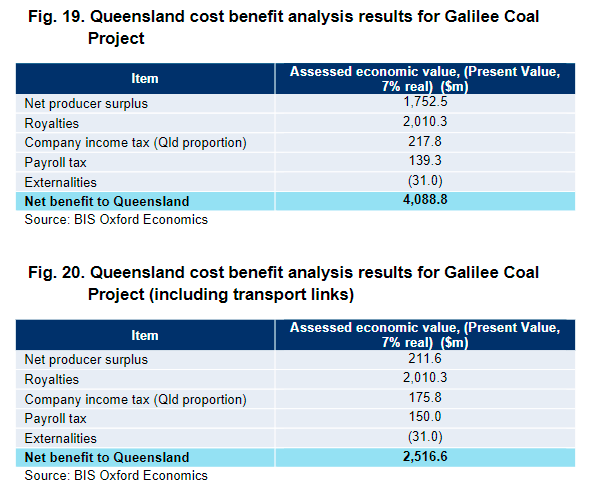
[1112] Mr Tessler has applied the NSW Guideline for the economic assessment of mining proposals in undertaking the CBA. Although they do not apply in Queensland, there is no Queensland equivalent specific to mining, and I accept the NSW Guideline provides a relevant point of reference.
[1113] Although Mr Campbell did not undertake his own CBA, he thought a more useful exercise was to compare the benefits in the form of royalty revenue with external costs, particularly climate impacts. This excluded the tax and profit/surplus estimates, which he thought were likely to be overstated, and, in the case of profit/surplus, accrue to a very small number of Queenslanders. Mr Campbell also thought that if the Project lost money overall or for periods, it would not produce positive economic values. Waratah says this is a speculative and unsubstantiated argument premised on the ‘uncommercial’ assumption that it would not produce positive economic values.433
[1114] Waratah and YV&TBA made several competing submissions about the assessment of costs and benefits in the CBA, which I will deal with in turn.
Net Producer Surplus
[1115] The Net Producer Surplus (NPS) is the private benefit generated by the initiative, essentially the profit. Mr Tessler estimated a NPS of $1,752.5 m or $211.6 m if transport costs are included.
[1116] I will deal with three issues of relevance to the NPS: whether the assessment is conservative because of population attribution, whether transportation costs should be included, and whether the projected revenue is overstated.
Queensland ownership and population attribution of NPS
[1117] The NPS figures in the CBA attribute a share of the profits in accordance with Queensland’s share of the national population (approximately 20%). This assumes 80% of the NPS will ‘leak’ outside Queensland. Mr Tessler agreed with the suggestion by counsel for Waratah that this was a conservative approach, because Waratah’s ownership is entirely located in Queensland.
[1118] The corporate structure suggests otherwise, see the image after [126].
[1119] In any case, assuming the NSW Guidelines provide a reasonable basis for estimating the benefits to Queensland, Mr Tessler’s NPS estimate is not conservative.
[1120] The NSW Guidelines apportion NPS in two steps. The first step is by reference to Australian (not State) ownership of the Project. The second apportions the Australian share by NSW’s population as a percentage of the national population.434
[1121] Whether the Project has Queensland ownership is not relevant to that exercise.
[1122] Mr Harris said Waratah will seek overseas equity finance. If successful, the NPS figure would be overly generous. If not, the CBA accords with the NSW Guidelines and is not a conservative assessment.
Transport Costs
[1123] A more pertinent issue is the uncertainty about transport costs in estimating the NPS.
[1124] Waratah contracted BISOE to undertake a CBA for the mine alone, excluding the construction of the rail link transporting the coal to market and payment to rail and port operators for coal transport and handling.
[1125] It is true, as Waratah says, that the applications are for the mine only, not any associated rail or port project. However, the NPS estimate uses a free on board (FOB) price derived from the King spreadsheet.
[1126] This means the producer bears the cost of transporting the product to and loading it onto the ship, which, depending on the Project, could include costs to construct rail or port infrastructure. Mr Tessler agreed these costs should be included in assessing an NPS where the revenue assessment is based on an FOB price.435
[1127] Waratah’s evidence about the preferred transport option and its costs is wanting.
[1128] Mr Harris told the Court the mine was modelled on transporting the coal to Gladstone using the existing narrow-gauge railway from Alpha.436 His instructions to Mr King were to the same effect.437 Yet Waratah instructed Mr Tessler that the King spreadsheet costed transport to Abbot Point, which requires construction of a fixed rail link from the Project site to the port.438
[1129] Waratah cannot claim some advantage from this uncertainty. It is the source of confusion which it could have remedied. In the absence of better evidence, the Court must accept the transport costs in the King spreadsheet given the FOB price used to estimate project revenues.
[1130] The consequence is the Court must act on the NPS estimate of $211.6 m and, for consideration of the CBA, the starting point of a net benefit to Queensland of $2.5 b.
Projected Revenue
[1131] A further consideration for the NPS is the coal price and the assumption that Waratah would produce coal throughout the proposed life of the mine.
[1132] Dealing first with coal price, Mr Tessler applied the figure in the King spreadsheet of US$85/t as a constant price. While Mr Tessler and Mr Campbell agreed that was a reasonable starting point, neither were called as experts on coal price and they did not assert relevant expertise. For reasons given at [1044] to [1081] I have expressed reservations about that figure, which may be too high.
[1133] Mr Tessler agreed with Mr Campbell that “broadly major projects are subject to optimism bias”.439 Although he applied some caveats to that agreement, the most important one in assessing his CBA is his use of sensitivity tests to address the possibility of optimism bias for this mine. The CBA’s sensitivity tests varied the price by up to +/- 30%, as well as applying variations according to third party forecasts, some involving variations in both price and volume. This analysis was interactive, in the sense that it made consequential adjustments to royalties and company tax, while other aspects of the CBA remained constant.
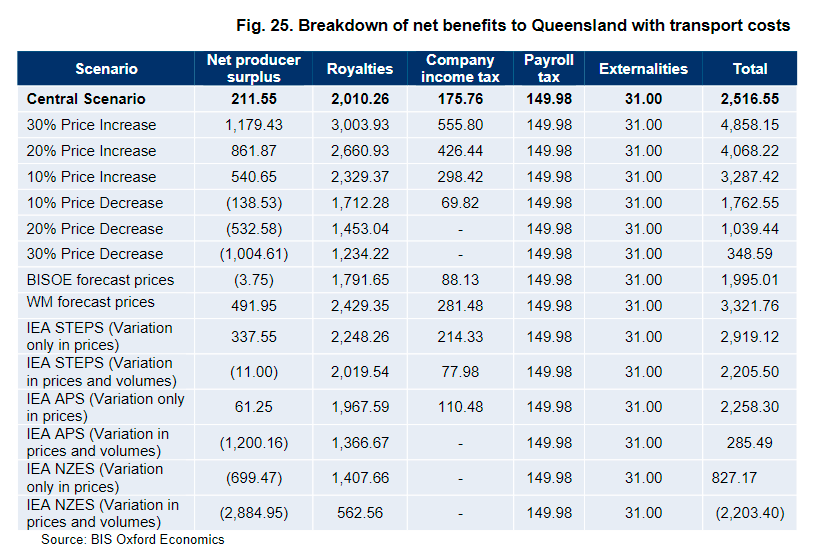
[1134] Mr Tessler forecasts a negative NPS, that is a loss to the miner, in eight of the 14 variations, including the BISOE forecast prices.
[1135] Arguably he underestimates the impact of the IEA scenarios. The coal prices used for those scenarios are price estimates for Coastal China coal. That is derived from both imports and domestic sales. Mr Tessler agreed he would have to use a lower price than the Coastal China coal price to compare with the King price on an FOB basis.440
[1136] Waratah submitted it is difficult to compare price forecasts under models with fundamentally different assumptions. That is true, but that is what Mr Tessler did. If he considered they lacked utility in assessing project upside and downside risk, he should have made that explicit.
[1137] Mr Tessler’s sensitivity analysis demonstrates the price sensitivity of the NPS. It shows negative NPS using nearly all coal price projections other than Mr King’s. Mr Tessler’s sensitivity analysis showed a positive NPS for the STEPS and APS, however, he agreed if they had used the King price, the projections would have been lower.
Royalties
[1138] YV&TBA say the primary benefit to the community from the mine is royalties, because the NPS goes to one person, ultimately, Clive Palmer. While that is contested, the submission does serve to draw the distinction between profit to the miner in the form of NPS, and the return to the State as owner of the resource.
[1139] Mr Tessler calculated the present value of estimated royalties to be $2.01 b.441
[1140] As Mr Tessler observed in his review of the CBA for a NSW coal project known as Tahmoor South, the basis for assessing matters such as royalties and company tax are dependent on the accuracy of estimates of costs and revenue and assumptions about production.442
[1141] In this case, he conducted two sensitivity analyses relating to royalties. The first tested royalties on the base case by up to +/- 30% for the life of the Project.443 Second, his sensitivity analysis on the coal price (and in some scenarios, the production volume) also tested the royalties assessment. His analysis returned royalties on all scenarios, albeit it is considerably reduced (a little over $500,000) on the IEA NZE scenario.
[1142] Mr Campbell said this assumes the mine would operate indefinitely while losing money. He said it is misleading to suggest the mine could produce positive economic values in that context.
[1143] Mr Tessler relied on the distinction between economic and financial viability, observing the Project would be economically viable even when the coal price fell below Mr King’s financial break-even point.
[1144] Royalties comprise 80% of the net benefit on a CBA that includes transport costs. If the mine stops producing, the royalties are not earned. Mr Campbell said the viability of the mine is ‘questionable’ and ‘highly dubious’ and Mr Tessler conceded that there was a risk of the mine never commencing operations or ceasing to produce coal before its projected life.444
[1145] Although Waratah submits the business could trade through losses, YV&TBA say the structural decline of demand for thermal coal indicates that this may not be possible.
[1146] It is also contrary to the evidence.
[1147] Mr Harris said Waratah would seek to secure a long-term offtake agreement with a floor price at the financial break-even point (US$74/t). If that can’t be done, and the price falls below that point, Mr Harris said the Project would go into care and maintenance.445
[1148] That makes sense.
[1149] Mr Campbell says Mr Tessler’s approach is contrary to basic assumptions used for most economic analyses, that parties will behave rationally, and business will seek to maximise profits and minimise losses.
[1150] In theory, the distinction between economic and financial viability serves a purpose. But the failure of the CBA to consider the real prospect of the mine ceasing production for any period limits the assistance it provides this Court in assessing the public benefit of the Project.
Company Income Tax (Queensland proportion)
[1151] Mr Tessler assessed the present value of company tax at $869.2 m when transportation costs are included.
[1152] Mr Tessler relied on the NSW Guidelines to apply the company tax rate of 30%, after depreciation, and then apportioning it for Queensland’s share of the national population (approximately 20%). As with royalties, he performed a discrete sensitivity analysis for tax revenue,446 as well as the analysis responsive to coal price and volume variability. Tax revenue is a minor benefit when compared to the estimated royalty return.
[1153] Mr Campbell said the base estimate (approx. $175 m) is a generous assumption given the amount of tax paid by other prominent Australian thermal coal producers. I accept this is outside Mr Campbell’s area of expertise. In any case, the Court cannot base a finding about the amount of tax Waratah will pay based on what other companies have done.
[1154] Nevertheless, it is reasonable to assume a taxpayer will structure their affairs to minimise their liability in accordance with the law. To that extent, I accept the company tax estimate may be optimistic given Waratah’s corporate structure, which, Mr Tessler acknowledged, may result in tax benefits being retained overseas.
Payroll Tax
[1155] YV&TBA took issue with treating the payment of payroll tax of $150 m (assuming transport costs are included) as a benefit.
[1156] Mr Tessler explained a CBA usually uses a gross producer surplus. Because the NSW CBA Guidelines use an NPS, and because payroll tax is paid in Queensland, his method acknowledged the transfer of that tax from the producer (as a cost) to the State (as a benefit).
[1157] Mr Tessler adopted the same approach when he reviewed the CBA in the Tahmoor South project, albeit in relation to council rates and land tax, when he observed that “technically, in cost benefit terms, taxes are a transfer”.447
[1158] Mr Campbell drew a distinction between a royalty, which is a payment to the owner of a resource for its extraction, and payroll tax which is a proper tax. If the Project proceeds, the royalty revenue will be additional. That is not the case for payroll tax unless it can be demonstrated the mine will generate additional employment. Mr Tessler did not agree with Mr Campbell but could not explain why.448
[1159] Mr Campbell’s view is consistent with the NSW Guidelines:449
Note that a new mine will also pay other taxes, such as payroll tax…The majority of these taxes will have been generated without the project, as people would have been employed elsewhere. Hence these should be included as costs. To the extent that a proponent can demonstrate that other taxes are genuinely additional and will not be offset by lower tax payments elsewhere in the economy, they may be recognised, provided that the impact of these taxes on the overall NPV of the project is reported.
[1160] Mr Tessler said he did not claim there would be any significant benefit in additional payroll tax if the Project proceeds. Given that, I accept Mr Campbell’s evidence that to include payroll tax in the way Mr Tessler has done overstates the benefits of the Project.
Summary of the assessment of benefits in the CBA
[1161] In summary, I find the benefits of the mine are overstated if they do not include transport costs given a FOB coal price is assumed. I have reservations about the coal price, which may be too high. The sensitivity tests do not assess the real risk that the mine will go into care and maintenance or close if the break-even price cannot be achieved. The projected revenue from royalties and taxes is overstated if the price falls below that line. Finally, the treatment of income and payroll tax is generous.
[1162] I now turn to the arguments made about the assessment of costs in the CBA. The key contests relate to two types of costs, the ecological impacts on Bimblebox and costing the impacts of GHG emissions.
The ecological impacts on Bimblebox
[1163] Mr Tessler assessed an ecosystem cost of approximately $0.8 m (or $0.7 m in present value terms) for the impacts on Bimblebox.
[1164] He sought to balance Waratah’s mitigation efforts with the uncertainty about long-term impacts by estimating the value of remnant vegetation which would be cleared and the potential loss of “Of Concern” vegetation due to subsidence. He applied a value of $12.99 m to a loss of 1% of an ecosystem and adjusted that value to reflect the area of vegetation that would be lost as a percentage of the Desert Uplands ecosystem:
[1165] Waratah says Mr Tessler has adopted a conservative approach for two reasons. First, because he did not deduct the value of mitigation costs ordinarily subtracted from valuation. However, Mr Tessler considered Waratah’s efforts to mitigate ecological damage, as well as uncertainties about long term ecological impacts, in choosing what method to use in valuing ecological costs.450 Waratah has not specified what it would do to mitigate the damage or what the value of that would be.
[1166] Second, Mr Tessler included the purchase of offset properties as a cost and did not reduce the ecological cost of the impacts. I accept that could result in an overestimate of costs if the ecological cost estimate had some rigor and there was evidence the offset properties had ecological equivalence for the loss. For reasons already given, I am not persuaded on either score.
[1167] Mr Tessler and Mr Campbell agree it is difficult to quantify non-market values. Mr Tessler attempted to do so, using choice modelling. This means people are asked to choose their most preferred option from a set of alternatives consisting of a bundle of attributes that comprise the non-market outcome. He made his assessment on the results of a 1997 survey of Brisbane households to establish community values for the preservation of remnant vegetation in the Desert Uplands (the Blamey survey).451
[1168] Choice modelling is an accepted method for estimating non-market values in a CBA.452
[1169] However, Mr Campbell thinks it problematic when used for environmental decision-making. He questioned whether survey respondents could make meaningful decisions within choice sets when they have little knowledge of the environmental context for their decision.
[1170] Waratah objects to most of what Mr Campbell said about choice modelling as a submission. I dismiss that objection, Mr Campbell explained the history and context of choice modelling and criticisms of its application in environmental decision making. This is squarely within his expertise and relevant to the task he and Mr Tessler were given.453
[1171] The NSW Technical Notes recognise the hypothetical situations used in stated preference methods such as choice modelling affect their reliability. The Technical Notes state the key assumptions and requirements, presumably for reliability, are that the respondents know how much they would be willing to pay for a non-market good and will answer questions honestly and rationally bearing in mind their income and the need for real world trade offs. The results are contentious and can be unreliable and this method requires careful survey design to avoid behavioural and strategic bias.454
[1172] Mr Tessler agreed the Blamey survey was not specific to Bimblebox, that it did not consider the status of the area as a nature refuge and part of Australia’s reserve system or that the refuge exists because of the efforts of people who have invested both their savings and labour over two decades. He appeared to accept these as limitations of that model.
[1173] He agreed he had not considered whether the limitations of the model meant a qualitative assessment was required, nor had he noted this in the CBA as something the reader may need to consider.
[1174] On occasions, Mr Tessler referred to whether a quantitative or qualitative approach should be taken to ecological costs as a philosophical point. I disagree.
[1175] The purpose of the CBA is to assess the costs and benefits of the Project. That is an important aspect of Waratah’s case for this mine. The risks to Bimblebox lie at the heart of the objections.
[1176] Having chosen a quantitative approach, it was for Mr Tessler to consider and draw to the reader’s attention any reservation or limitation of the chosen method. That applies with equal force to his contribution to the Joint Expert Report.
[1177] I do not accept Waratah’s submission that the CBA demonstrates the benefits are not outweighed by the ecological costs.
The cost of GHG emission impacts
[1178] The CBA costs GHG emission impacts at $1.2 m, calculated as follows:
[1179] YV&TBA contest each of those steps and argue this approach results in a CBA that drastically underestimates the costs of GHG emissions related to this Project.
The CBA excludes scope 3 emissions
[1180] I have given my reasons for finding that, as a matter of law, the Court can consider scope 3 emissions in making recommendations on both applications (see [666]-[717]). In this section of the reasons, I address the arguments about how scope 3 emissions might be treated in the CBA.
[1181] The agreed estimate of scope 3 emissions (1.58 Gt) swamps the combined estimates for scope 1 and 2 emissions (57,530,074t).
[1182] Mr Tessler did include some costings for scope 3 emissions in his narrative for the CBA.455 He came up with two figures - $59 b or $70.1 b. Both figures are his estimate of the cost before attribution by Queensland’s population. They both costed carbon at $74/t and applied a discount rate of 7%, assumptions that YV&TBA contest and which are considered below.
[1183] The difference between Mr Tessler’s two figures is that the costing of $70.1 b uses the estimate from the climate change Joint Report, which made assumptions about rail transport via Abbot Point and, more importantly, combustion of saleable coal based on the estimate for the original, not the revised, mine plan. That results in a combustion estimate of 2.1 Gt, rather than the 1.58 Gt agreed on the reduced production from the revised plan.
[1184] Of Mr Tessler’s two figures, then, the costing at $59 b is the better point of reference, given it does use the revised production estimate, even if he comes up with a larger figure (1.8 Gt) than the active parties have agreed (1.58 Gt).
[1185] Waratah says scope 3 emission impacts are excluded by relevant guidelines about CBAs for mining projects, because companies do not have to report on scope 3 emissions.
[1186] The NSW Guideline provides a helpful description of the role of a CBA:456
CBA estimates and compares, on a common basis, the total benefits and costs of a project or policy to the members of a specified community. CBA provides a technique that allows a systematic treatment of trade-offs and provides a basis on which the Government can assess the net public benefits of decisions. It allows for quantification and valuation of the full range of potential impacts, economic, social or environmental (including human health) that might arise from a project. All costs and benefits should be quantified and monetised if feasible and material. Impacts across the various types of costs and benefits are converted into a common unit. The preferred unit is the Australian dollar in current day prices. These values are then aggregated into a single metric – the expected present value of net benefits from a proposed project. This result is frequently referred to as the NPV (‘net present value’) of a project. Some impacts are difficult to quantify objectively, such as heritage impacts. As unquantified impacts are not included in the NPV, they should be reported alongside the NPV if they are material.
[1187] Although there is no mining-specific Guideline in Queensland there is a general CBA Guide which treats climate change as a qualitative risk which, if significant, should be contrasted against the NPV result.457
[1188] However, the NSW Guideline supports a quantitative approach to the costs of GHG emissions. It refers to GHG emissions as environmental impacts and says the proponent should include the total net environmental costs in the CBA, unless there are cases where these costs are not entirely attributable to the NSW community.458
[1189] Contrary to Waratah’s submission, the NSW Guideline does not only allow for the impact of scope 1 and 2 emissions to be included in the CBA. It makes no reference to scopes at all, but states that guidance on how to identify and value these impacts will be provided in technical notes. It also provides:
Regardless of whether a Technical Note has been released, proponents are expected to address each of the following issues (including quantification where feasible).
[1190] GHG emissions is one of those issues.459
[1191] The Technical Notes advise proponents they may provide estimates for scope 3 emission impacts because this additional information “would be helpful in reducing residual uncertainty around total project emission impacts.”460 The Notes observe there is the risk of double counting. But that is an issue about attribution of responsibility for the purposes of reporting, rather than the comprehensive assessment of impacts.
[1192] Waratah’s submissions on scope 3 emissions conflate reporting requirements, nationally and internationally, with using a CBA to assess the public interest in a proposed mine being approved. How a CBA is conducted for this mine cannot alter Waratah’s reporting obligations under the National Greenhouse and Energy Reporting Act 2007 (Cth), or Australia’s reporting obligations under the Paris Agreement.
[1193] The CBA in this case is put forward as providing relevant information in assessing the public interest. It is a tool which quantifies and monetizes benefits and impacts to the extent that is feasible (in calculating the NPV) and, where that is not feasible, which reports on material benefits and impacts.
[1194] Whatever might be the practice for a CBA using the NSW or other Guideline, in assessing the public interest in the mine being approved, it is appropriate to consider the impact of GHG emissions caused by the combustion of the coal, there being no other purpose for the coal being extracted.
The price of carbon
[1195] The second issue raised by YV&TBA is the price put on carbon in costing GHG emission costs in the CBA. Mr Tessler used the figure of AU$74.42/t which he derived from market-based emission offset schemes.
[1196] Mr Campbell said that the better approach was to use the social cost of carbon, because market schemes do not represent the actual costs to the community of GHG emission impacts.
[1197] This issue was explored in a report by the ACT Climate Change Council published in 2021 - The Social Cost of Carbon and Implications for the ACT.461 The Council used the term social cost of carbon to describe the net damage caused by adding carbon dioxide into the atmosphere. It recommended the social cost of carbon be applied in any CBAs used to inform public investments or policy and regulatory decisions in the ACT.
[1198] The Report provides support for Mr Campbell’s evidence that the market-based carbon schemes reflect supply and regulations, factors with little relevance to the actual costs incurred by the community.462 The Report noted the price put on carbon by governments or through market mechanisms seldom reflect the true costs of that damage. Mr Campbell was particularly critical of the Australian Carbon Credit Units scheme which is a voluntary scheme and is not subject to real market pressures.463
[1199] Mr Campbell referred to the following estimates of the social cost of carbon:
[1200] The ACT Climate Change Council acknowledged the concept of a social cost of carbon is easy to state but difficult to arrive at for several reasons:466
[1201] The consequence, according to the Council, is that “even the highest justifiable Social Cost of Carbon is likely to be an underestimate of the true social cost of emission”.
[1202] Having conducted a survey of national and international research on the topic, it recommended a minimum interim social cost of carbon at AU$204/t for 2022-23.467 Later, the ACT Government announced it would implement a social cost of carbon and set an interim price of AU$20/t, which would go into a special purpose fund and said “[w]e will be drawing on independent and expert advice, including from the ACT Climate Change Council, as we develop an agreed value for the social cost of carbon by 2025”.468
[1203] CBA guidelines provide some support for Mr Tessler’s approach.
[1204] The NSW Treasury Guidelines on CBA469 say market prices can be used if they are not significantly biased as a direct consequence of scheme design. If they are so biased, estimates of damage or damage mitigation costs may be used.
[1205] Further, the NSW Technical Notes identify the European Union Trading Scheme (EU ETS) price as one of the clearest indications of a market-based carbon price linked to longer term emission targets. As such it provides a potential benchmark, although a proponent may justify the use of a different carbon price estimate.470
[1206] There is no consensus about the social cost of carbon. Given that, it is reasonable for Mr Tessler to look to the EU ETS, the market mechanism endorsed by the NSW Technical Notes. However, while Mr Tessler referred to that price he did not adopt it.
[1207] He used the EU ETS to set the upper point of a range. The price at the time was AU$109.90/t (it is now in the order of AU$120/t)471. Mr Tessler thought the EU ETS price might be too high because it had recently increased and might be affected by short term specific supply and demand issues.
[1208] Although he acknowledged the ACCU scheme was voluntary and the unit price is considerably lower, he used the ACCU price of $39/t as the lower point of the range.
[1209] The figure he used for the CBA, $74.42/t, is the midpoint of that range. He then drew some comfort from the US Environmental Protection Agency Social Cost of Carbon - an interim estimate of AU$70.44/t. But YV&TBA say the context for that figure is important. The Biden Administration restored the Obama Administration’s recommended value of the social cost of carbon, updated for inflation. The Biden Executive Order states the range is an interim estimate which will be updated this year. It is widely expected to be increased. Mr Campbell referred to statements by prominent economists Nicholas Stern and Joseph Stiglitz who argue the interim estimate is well below what is required to achieve abatement in line with climate commitments.472
[1210] The ACT Climate Change Council observed that there are actually four interim measures, representing different discount rates – US$15, US$52, US$78 and US$155. It said the US Technical Support Document stressed “the range of four interim SCGHG estimates presented in this TSD likely underestimate societal damages from GHG emissions”.473 Mr Tessler chose the second of those measures.
[1211] Mr Tessler’s use of a social cost estimate (which is acknowledged to be an underestimate) to reduce the price from a market scheme endorsed by NSW Guidelines is questionable.
[1212] In the absence of consensus on the social cost of carbon, the NSW Technical Notes provide guidance, which I consider is the lowest value that can be justified in the CBA. That is the EU ETS price, (then $109.90/t and now AU$120/t), but that, in any case, is likely an underestimate of the actual cost of GHG emissions.
The discount rate
[1213] Mr Tessler discounted costs and benefits in the CBA at a consistent rate of 7% to acknowledge that fewer benefits will accrue to future generations. YV&TBA accept that is standard practice and consistent with CBA guidelines. However, they argue that to discount the cost of GHG emission impacts in this way trammels the principle of intergenerational equity.
[1214] The climate change experts agree the climate impacts felt by those alive in 50-100 years will be significantly more severe than those felt by current generations. Yet the CBA discounts the costs to be borne by those future generations.
[1215] As Mr Tessler explained:474
Costs and benefits in a CBA represent a discounted stream of values overtime. In other words, while future generations are considered, the costs and benefits accruing to such generations are discounted (reduced) relative to the present.
[1216] The ACT Climate Change Council identified several reasons that using discount rates in applying a social cost of carbon is complex. First, not all social impacts can be easily translated into economic terms. Second, the longevity of the impacts of human induced climate change supports low discount rates, possibly declining over time. Third, the extent to which those impacts will be borne by generations which cannot participate in the decisions about choices that will contribute to those impacts makes a reasonable case for lower discount rates. Finally, climate impacts which involve crossing biophysical thresholds (tipping points) have devastating and irreversible consequences that cannot be captured in standard economic theory. The Council concluded:475
In the end, the choice of a social discount rate is primarily an ethical one, not a technical one.
[1217] The Council referred to a recent survey of 200 economists specialising in discounting that produced a distribution of social discount rates with a median value of 2%. Three-quarters of the economists surveyed considered this median value acceptable.476 It noted that, in practice, rates of 1%-7% have been used.
[1218] The median value referred to by the Council is close to the discount rate of 2.65% applied by Mr Tessler in his valuation of the impacts of climate change on the Great Barrier Reef, for a purpose unrelated to this case.477
[1219] Mr Tessler explained that assessment was made in a different context. He was not attempting to produce a CBA that complied with government guidelines.
[1220] Nevertheless, Mr Tessler accepted that if an economist is trying to apply equity between generations in their analysis, there is a good case not to discount the harm caused by GHG emissions.478
[1221] Assuming a different discount rate is applied to the cost of GHG emission impacts than the rate applied to the benefits, the cost of scope 1 and 2 emissions only exceeds the royalty benefit once a discount rate of 4% or less is applied.479 But that does not account for the cost of the impact of scope 3 emissions.
[1222] Mr Tessler resisted the idea that income might be discounted at a different rate to climate change costs, but YV&TBA argue there is no good reason in principle that discount rates within a CBA need be consistent. Income received today by Waratah and the State will be valued more than the promise of future income.
[1223] The standard discounting approach does not adequately account for GHG emission impacts on future generations. As such, an economic assessment conducted on that basis must be approached with circumspection when considering the intergenerational aspects of a project with climate change implications.
Population apportionment
[1224] Another point of contention for the CBA is Mr Tessler’s apportionment of the costs of GHG emission impacts by the Queensland’s population relative to the global population (0.07%).
[1225] The full attribution of the costs of scope 1 and 2 emissions (assuming Mr Tessler’s carbon cost of $74.42 discounted at 7%) is a little over $1.8 b, compared with $1.2 m if attributed by Queensland’s population.480 This would leave only $170 m in royalties and that does not account for any scope 3 emissions.481 On Mr Tessler’s estimate of the cost of scope 3 emissions, the difference that population attribution makes is to reduce the cost of $59 b to $39.1 m.482
[1226] Mr Tessler agreed there has been a controversy about population attribution of the cost of GHG emission impacts. This is another example of an important matter that Mr Tessler could and should have made explicit in his CBA to alert the reader to the controversy.
[1227] In his evaluation of the CBA for the Tahmoor project in NSW, he said apportioning emissions by population is ‘dubious’ and ‘questionable’.483
[1228] When asked about that report, Mr Tessler said the NSW Technical Note has been published since then.484 It provides: “the value of the externality is limited to the impact on NSW, consistent with the Guidelines and how all other costs/benefits are measured within the CBA”.485
[1229] However, it appears the controversy about population attribution continues.486
[1230] YV&TBA referred to a decision made by the Independent Planning Commission (NSW) after the Technical Note was published which declined to apply that approach.487 However, in Gloucester Resources, Preston CJ accepted population attribution accords with the Technical Note.488
[1231] The evidence in this case does call into question how appropriate it is to attribute impacts on a population basis. The actuarial, health and climate change experts explained the impacts may be global, but there is regional differentiation.
[1232] Mr Coleman said Queensland will bear a heavily disproportionate cost of climate change, particularly through heat waves.489 Professor Bambrick said Queensland has a higher level of First Nations people compared to the rest of Australia, and they are disproportionately affected. The climate change experts said Australia’s coasts are experiencing sea level rise at a rate higher than the global average.
[1233] If there was a mandatory market price on carbon in Australia, Waratah would have to pay it. Mr Tessler agreed that, at least so far as scope 1 and 2 emissions is concerned, the ‘externality’ would simply be a cost accounted for in the calculation of NPS. It would not be apportioned by population.490
[1234] Mr Tessler said that if the global costs of scope 3 emissions are considered, then the global benefits need to be accounted for. He thought this would be done by undertaking a separate CBA for power generation in the recipient nations, with its own set of costs and benefits.
[1235] The benefits he identified are a producer surplus (profit) to the owners of the coal-fired power stations, and the consumer surplus to residential electricity consumers (the difference between the price a consumer pays and the price they would be willing to pay for the product).
[1236] For ease of analysis, Mr Tessler referred to work done by Gillespie Economics to illustrate the consumer benefits of electricity generation in South Korea. He arrived at a consumer surplus of $131.9 b, assuming all the coal is combusted in South Korea, and making assumptions about revenue and price elasticity.491
[1237] Mr Tessler agreed the relevant benefit is electricity, however it is produced. Other sources of electricity would not have the carbon cost.492 The evidence about the coal and energy market indicates the Project coal is not required to meet the electricity demand.
[1238] I understood Mr Tessler’s alternative to population attribution was illustrative only, and Waratah did not refer to it in its submissions.
[1239] Mr Tessler’s starting point is that population attribution is the better way to treat costs and benefits from the same community of interest, the Queensland community. That might make sense within the confines of the CBA methodology, but it does not relieve me from deciding how the full weight of GHG emission impacts weighs in the balance in making the recommendations on these applications.
Summary on the assessment of costs in the CBA
[1240] The CBA seeks to monetise the ecological costs of the mine and the impacts of climate change. The preceding discussion demonstrates the complexity of both objectives and the inadequacy of orthodox CBA practice in comprehensively and accurately valuing ecological impacts, and accounting for the global, local, and intergenerational aspects of the impacts of GHG emissions.
[1241] The CBA’s quantification of ecological costs is inadequate. There is great uncertainty about the scale of impacts on Bimblebox and if and how they might be mitigated. That compounds the difficulty in placing sole reliance on a model with the limitations discussed, and which does not grapple with the potential loss of Bimblebox from the national reserve system.
[1242] I will take into account the evidence of YV&TBA’s lay witnesses and the experts in subsidence, surface water, ecology, land use, noise, and air quality, as well as the CBA, in weighing in the balance the economic benefits and ecological costs.
[1243] As to the impacts of GHG emissions, Waratah say the CBA supports the applications regardless of whether the CBA is confined to scope 1 and 2 emissions, or includes Mr Tessler’s quantification of the impact of scope 3 emissions.493
[1244] However, that is not the only contest about the CBA costing of GHG emissions at $1.2 m. That figure is founded on a number of other strongly contested assumptions that affect the calculation of GHG emissions, whatever scopes are included: the cost applied to the impact of carbon emissions (AU$74.42/t), the discount rate to be applied to that cost (7%) and whether the cost should be apportioned by Queensland’s population as a percentage of the global population (0.7%).
[1245] YV&TBA’s submissions include alternative calculations on those assumptions that cast doubt on Waratah’s assertion. I don’t propose to work my way through them as those calculations were only put to Mr Tessler in general terms.
[1246] What I derive from YV&TBA’s calculations is that it demonstrates the fragility of the CBA outcome to changes to the contested factors.
[1247] Both economists addressed the difficulty in quantifying environmental impacts and the need for a commentary to explain the limitations of the quantitative approach. Given the difficulty in assessing the costs of GHG emission impacts within an orthodox CBA framework, the approach recommended by the current Queensland CBA Guideline has some merit. That is, that climate change should be assessed qualitatively.
[1248] Mr Campbell expressed his opinion about the costs and benefits of the Project, taking into account the combustion emissions.494 Waratah objects to that evidence, but YV&TBA say this falls squarely within the parties’ brief to experts to prepare a report to assist the Court in understanding whether the economic benefits of the proposed mine outweigh the costs, and if not, why not. Mr Campbell identified the beneficiaries of the Project as the Queensland Government and the miner and their investors. He identified the costs will be borne by future generations of the Queensland and global community through climate impacts and, to a lesser extent, the impacts on Bimblebox will affect current and future generations of Queenslanders. Mr Campbell said “to summarise, the benefits of this Project are uncertain and accrue to current generations of Queenslanders, whereas, if the Project proceeds, the external costs are relatively certain and will be borne by future generations in Queensland and globally”. I consider that relevant evidence within Mr Campbell’s expertise and responsive to his brief.
The implications of the CBA
[1249] YV&TBA say a CBA plays a limited role in the Court’s assessment and the CBA led by Waratah should be treated with caution, because the benefits are inflated, the assessment of costs is flawed, and the CBA is limited in its analysis of externalities such as the ecological costs and the costs of GHG emission impacts.
[1250] Many of Waratah’s arguments are about compliance with CBA guidelines in NSW and Queensland. While guidelines are informative about the expectations of government agencies for a CBA, they are not regulatory instruments.
[1251] The CBA is a tool that may assist in assessing the economic consequences of the decisions to be made on these applications. Reference to CBA guidelines allows me to consider current practice and the rigour of the analysis. However, CBA practice does not determine the Court’s function on these applications and does not confine me in my consideration of the economic evidence as it relates to the public interest. The CBA, with all its limitations, is one part of the relevant evidence on economic and social costs and benefits.
[1252] There is some other evidence about costs related to climate change from Mr Coleman.
Mr Coleman’s evidence
[1253] Mr Coleman used climate scenario 1 as his baseline because the climate change experts agree that is the best possible outcome. Waratah objects to certain passages of Mr Coleman’s report, and I will deal with those objections here.
[1254] First, Mr Coleman used the term ‘fossil fuel scenario’ to name one of the scenarios he considered. Waratah objects to that term, asserting it is argumentative. YV&TBA say nothing substantive turns on the name of the scenario. I agree. It is clear this equates to climate scenario 3. I am not influenced by Mr Coleman’s choice of name.
[1255] Second, Waratah objects to paragraphs of his report in which Mr Coleman describes his methodology and conclusions by reference to whether the scenarios are consistent with a decision to allow new coal mines to open.495 YV&TBA do not rely on Mr Coleman to express an opinion on causation and to the extent Mr Coleman’s description might appear to do so, they say I can disregard it, and I do. What is important to me is how his scenarios relate to the climate and other scenarios presented during the hearing, and there is no confusion about that. What Mr Coleman calls his moderate scenario equates to climate scenario 2. What he calls the Paris scenario, unsurprisingly, equates to climate scenario 1, which is consistent with the long-term temperature goal of the Paris Agreement.
[1256] Finally, Waratah objects to certain statements which it says is outside Mr Coleman’s area of expertise.496 I dismiss that objection. Mr Coleman explained the role of an actuary in the context of insurance and the relevance of that to climate change in this way:497
An insurance actuary is a professional that analyses financial risk using mathematics, statistics and economic and financial theory and practice.
[1257] In the paragraphs objected to Mr Coleman was either explaining his methodology or analysing his sources and stating their underlying assumptions.
[1258] Mr Coleman estimated the additional cost for his moderate scenario (climate scenario 2) as $5,377 million per annum, having regard to property damage, loss of agricultural production and deaths from cyclones, floods, bushfires, heatwaves, and drought.
[1259] Waratah submits Mr Coleman’s estimate is inaccurate because he referred to a draft CSIRO paper which differed in some respects to the final version of the document. Waratah say the differences in data and cost estimates were substantial. Mr Coleman did not accept there was a material difference. I accept that evidence. In any case, this paper is only one of several sources and a myriad of factors that Mr Coleman considered. His expertise to undertake the analysis was not challenged. No alternative estimate was put to him. There was no expert evidence to the contrary. I am not persuaded his estimate is unreliable.
[1260] I have discussed at some length the difficulty in properly assessing the social cost of carbon (see [1195]-[1202]). Mr Coleman’s evidence is his best estimate on the limited information. It is not specific to this Project alone and does not appear to subject the estimates to discounting, which could have substantial effects over time. Nevertheless, Mr Coleman’s analysis does raise relevant matters and reinforces my assessment that the CBA does not adequately account for the cost to the Queensland community of the combustion emissions that would flow from the Project.
Social Impacts
[1261] The evidence about social impacts was given by Mr Holm, an experienced social impact practitioner with approximately 15 years’ professional experience in the fields of social performance, social policy and communications. Mr Holm prepared an expert report and gave evidence during the hearing.498
[1262] Several of the objectors, including YV&TBA, raised concerns about the social impacts of the Project. Social impacts are “the direct and indirect impacts that affect people and their communities at all stages of the project lifecycle”.499
[1263] In 2010 and 2013, respectively, Waratah developed a social impact assessment (SIA) and a social impact management plan (SIMP) accepted by the Coordinator-General as conforming to the terms of reference for the EIS.500
[1264] Mr Holm is not the author of those documents and did not gather primary data. He criticised the SIA as lacking methodological transparency. This limits “the reliability of the assertions made in the SIA and also the ability to provide an informed assessment of them”.501 Despite this, he considers both the SIA and SIMP are “acceptable, albeit not perfect”.502
[1265] Mr Holm said it would be prudent for Waratah to review and update the SIA and SIMP to ensure the predicted impacts and mitigation measures are still relevant. Mr Holm did not conduct a baseline social impacts study for this Project, but he did look at how the population had changed in the communities surrounding the mine site. He said attitudes towards a project can change over time as a result of delays or how the project has been undertaken in the meantime. Delays can cause anxiety, lack of confidence and cynicism but he does not know what the community was told about the mine.503
[1266] He said an updated SIA would ideally result in a SIMP aligned with the current SIA Guideline, which would be made available to the public prior to construction commencing. The difficulty with that is, as with other types of impacts, there is not a robust SIA before the Court.
[1267] Doing what he could with the data available, Mr Holm concluded the project would produce a mix of positive and negative social impacts, with directly affected landholders experiencing largely negative impacts, and the Alpha community, on balance, likely to positively experience the mine.
[1268] The project aligns with what Mr Holm understands to be the aspirations of the Alpha community to reverse population decline and provide an avenue for economic diversification.
[1269] However, one negative impact of the Project is housing cost increases, for example rental prices. Mr Holm’s experience is that rent may increase during construction. Although it could reduce later in the Project because of Waratah’s housing strategy and other projects, Mr Holm thought increased housing costs would likely be associated with this Project. People with low and median incomes who are renters will require substantial additional wages to compensate for working in the region.
[1270] To ameliorate the price increase in local accommodation, Waratah proposes to build accommodation. However, doing so is not free of consequences for local communities. These include increased feelings of insecurity and changing sense of community and associated social issues because of large numbers of FIFO workers and possible antisocial behaviour. On the other hand, this could lead to opportunities for positive social and economic interaction including increasing local patronage.
[1271] Mr Holm said the directly affected landholders are likely to experience predominantly negative social impacts, associated with their livelihood, their physical amenity and their social wellbeing. He said Waratah’s commitments to managing these impacts are reasonable.
[1272] YV&TBA objected, contending that the Project would affect future generations by diminishing the ability of the current generation to pass on to future generations conservation-oriented farming practices and leave a sustainable means of living on the land.
[1273] There is an inconsistency in the assumptions about Bimblebox in the SIA. In the SIA it was assumed Waratah would acquire one-third of Bimblebox, which would continue to be managed as a cattle operation. In the SIMP it was stated that the three properties to host mine infrastructure would not be able to continue grazing operations. Mr Holm assumed the revised mine plan meant there would not be a total loss of the property and, therefore, the psycho-social impacts would be lesser and grazing would be able to continue.
[1274] While Mr Holm accepted the destruction of Bimblebox would diminish the ability of the current generation to pass on sustainable farming practices, he concluded this would not compromise future generations’ ability to meet their own needs. He also said the scale of the impact would be relatively small, experienced notably by those connected with the small group of individuals concerned with the Bimblebox.
[1275] If Mr Holm had conducted a SIA for the Project, he would have considered the impact on people who have an interest in the land, including those involved in long-term scientific research and conservation activities.
[1276] In summary, the SIA lacks methodological transparency and is not current because Mr Holm was not asked to undertake one, and made a general assessment based on limited resources. Further, the SIMP, which is also dated, does not comply with current best practice, a feature of its age.
[1277] On balance, the Alpha community will experience positive impacts, although renters on low to median incomes will require additional income to rent in the region, and the impacts of an accommodation village close to the town will need to be carefully managed.
[1278] The landowners will largely experience negative social impacts. Waratah’s commitments for managing this are reasonable. There has not been a proper assessment of the social impact of the loss of Bimblebox on the owners and others connected with the refuge.
[1279] Mr Holm did not consider the social impacts of climate change. Although he accepted there were social impacts caused by climate change, the SIA methodology has not been developed to undertake the analysis.
Conclusions on economic and social benefits
[1280] This is a price sensitive mine proposed at a time of uncertainty about the future market for coal.
[1281] There will be regional benefits in employment and consumption, but I have little confidence in the welfare calculation in the CGE. There is not a robust social impact assessment before the Court and the evidence suggests the social impact will be mixed. On balance, the residents of Alpha will experience the mine positively and the landowners will experience it negatively. The social impacts on the owners of Bimblebox have not been properly assessed.
[1282] A relatively small decline in the coal price challenges its viability.
[1283] The mine is at risk of closing for periods, or permanently, if the price falls beneath the break-even point, resulting in some, at least, of the ecological and climate change costs being borne by the community without the full economic benefits being realised.
[1284] The estimates of economic benefit are price sensitive as well as optimistic given market uncertainty and assumptions about the payment of company tax and full production throughout the projected life of the mine regardless of the coal price achieved by Waratah.
[1285] The CBA estimate of the value of the ecological impacts on Bimblebox is not robust. There is considerable uncertainty about what those impacts will be. The model used to value them does not provide a reliable assessment, given its limitations, and there is a serious question about the extent to which those impacts can be offset.
[1286] The climate change implications of the mine cannot be adequately assessed using the method adopted in the CBA. The NPV produced by the CBA excludes the global dimension of emissions from combustion of the coal to be mined. The justification for the carbon price used in the CBA is weak, and the figure chosen to quantify climate change impacts is not an accurate reflection of the costs. The CBA discount rate favours the benefits to this generation over the costs to be borne by future generations. Although there is a basis for population attribution in a state-based assessment of benefits, taking that approach to the costs of a global phenomenon is at odds with climate change science and the evidence that some impacts will be experienced disproportionately by people in Queensland.
[1287] In conclusion, after considering all the evidence, I could not find as a fact that the economic and social benefits outweigh the ecological and climate change costs of the Project. I now turn to the last of the key issues raised by the objectors, the impact of the Project on human rights. I must properly consider that in deciding what recommendation to make on the applications.
HUMAN RIGHTS
| The Climate Change Ground | [1297] |
| Could the Project limit human rights on the Climate Change Ground? | [1298] |
| The meaning of limit in the HRA | [1301] |
| Does international jurisprudence assist? | [1353] |
| What is the limit to human rights? | [1384] |
| Is the limit to human rights justified? | [1410] |
| The nature of the purpose of the limitation, including whether it is consistent with a free and democratic society based on human dignity, equality and freedom (s 13(2)(b)) | [1425] |
| The relationship between the limitation and its purpose, including whether the limitation helps achieve the purpose (s 13(2)(c)) | [1434] |
| Whether there are any less restrictive and reasonably available ways to achieve the purpose (s 13(2)(d)) | [1435] |
| The importance of the purpose of the limitation (s 13(2)(e)) | [1442] |
| Right to life of people in Queensland (s 16) | [1452] |
| The nature of the right (s 13(2)(a)) | [1452] |
| Can climate change impacts amount to a deprivation? | [1458] |
| What is an arbitrary deprivation of life? | [1481] |
| The importance of preserving the right, given the nature and extent of the limitation (s 13(2)(f)) | [1487] |
| The balance between the limitation and the right (s 13(2)(g)) | [1507] |
| Rights of First Nations peoples (s 28) | [1514] |
| The nature of the right (s 13(2)(a)) | [1514] |
| The importance of preserving the right, given the nature and extent of the limitation (s 13(2)(f)) | [1537] |
| The balance between the limitation and the right (s 13(2)(g)) | [1566] |
| Rights of children (s 26(2)) | [1569] |
| The nature of the right (s 13(2)(a)) | [1569] |
| The importance of preserving the right, given the nature and extent of the limitation (s 13(2)(f)) | [1587] |
| The balance between the limitation and the right (s 13(2)(g)) | [1602] |
| Right to Property (s 24(2)) | [1604] |
| The nature of the right (s 13(2)(a)) | [1604] |
| The importance of preserving the right, given the nature and extent of the limitation (s 13(2)(f)) | [1618] |
| The balance between the limitation and the right (s 13(2)(g)) | [1620] |
| Right to privacy and home (s 25(a)) | [1623] |
| The nature of the right (s 13(2)(a)) | [1623] |
| The importance of preserving the right, given the nature and extent of the limitation (s 13(2)(f)) | [1631] |
| The balance between the limitation and the right (s 13(2)(g)) | [1633] |
| Right to enjoy human rights without discrimination (s 15(2)) | [1634] |
| The nature of the right (s 13(2)(a)) | [1634] |
| The importance of preserving the right, given the nature and extent of the limitation (s 13(2)(f)) | [1643] |
| The balance between the limitation and the right (s 13(2)(g)) | [1649] |
| Conclusion on the Climate Change Ground | [1655] |
| The Glen Innes Ground | [1658] |
| Right to property (s 24) | [1662] |
| The nature of the right (s 13(2)(a)) | [1662] |
| The importance of preserving the right, given the nature and extent of the limitation (s 13(2)(f)) | [1672] |
| Right to privacy and home (s 25(a)) | [1682] |
| The nature of the right (s 13(2)(a)) | [1682] |
| The importance of preserving the right, given the nature and extent of the limitation (s 13(2)(f)) | [1691] |
| The balance between the limitation and the rights (s 13(2)(g)) | [1694] |
The Bill aims to ensure that respect for human rights is embedded in the culture of the Queensland public sector and that public functions are exercised in a principled way that is compatible with human rights.504
[1288] Before embarking on a consideration of the human rights arguments, I want to be clear about what is and is not my function in this hearing. I have explained the obligations imposed by HRA s 58 on the Court in its capacity as a public entity (see [77]-[90]) and need not repeat that here, except to say the requirements are both procedural and substantive.
[1289] In deciding what recommendations to make on the applications I am fulfilling the procedural obligation. This means I must properly consider whether granting the applications would be compatible with human rights. In undertaking that exercise, I will reach my own conclusions about whether any human rights would be limited and, if so, whether the limit would be lawful.
[1290] As Waratah submits, the HRA does not graft onto the Court’s function some additional function or power which departs from the MRA and EPA. The conclusions I reach about human rights matters will form part of the process of assessing where the public interest lies in relation to the applications. I will weigh those conclusions in the balance in deciding what to recommend about the applications.
[1291] However, it is not my function to decide whether the Project would be incompatible with human rights.
[1292] If my decision is judicially reviewed, it will be for the Supreme Court of Queensland to decide whether my recommendations are unlawful either because I have not properly considered human rights (the procedural obligation) or because the recommendations would be unlawful because they are incompatible with human rights (the substantive obligation) (s 59).
[1293] YV&TBA say the adverse consequences of GHG emissions, including those that would be emitted if the Project coal is mined and combusted, will unjustifiably limit the enjoyment of several human rights:
[1294] Waratah accepts these rights are ‘engaged’ in the sense that they are relevant to the applications. However, it disputes they are limited. Waratah refers to YV&TBA’s argument on these rights as the Climate Change Ground to distinguish it from the human rights arguments raised in relation to the landowners and people connected with Glen Innes (the lot which comprises Bimblebox Nature Refuge). YV&TBA say the rights to property and to privacy and home of those landowners would be limited by the impacts of mining if the applications are approved. Again, Waratah appears to accept these rights are ‘engaged’ but makes submissions about whether they are limited. It refers to this ground as the Glen Innes Ground.
[1295] I have considered whether any other human rights recognised and protected by the HRA might be affected. I consider the right to privacy and home is also engaged by the Climate Change Ground, in particular with respect to First Nations peoples. No party has suggested others may be engaged.
[1296] I will deal with the Climate Change Ground and the Glen Innes Ground separately.
The Climate Change Ground
[1297] Starting with the Climate Change Ground, Waratah submits the Project could not constitute a limit to any human right. I will deal with that argument before addressing the individual rights engaged, how they are limited and whether the limitation is justified.
Could the Project limit human rights on the Climate Change Ground?
[1298] Waratah says because the act of recommending and granting the ML or EA applications does not authorise the combustion of the mined coal, that act cannot constitute a limit on a human right. Therefore, the only way there can be a limit to a human right is if there is a sufficient causal relationship between the grant of the ML and EA and the harm said to limit the human right.
[1299] YV&TBA accepts the ML and EA do not authorise combustion but still say the link between the act and the harm is direct because, unless the applications are approved, the coal will not be mined and cannot be combusted. They describe approving the mine as ‘unlocking the safe’ on carbon currently safely stored within the land applied for. That is, that the causal relationship is strong enough.
[1300] The relevant question is whether the act (the decision) and the harm (climate change and its impacts) are sufficiently connected to be a limit on a human right.
The meaning of limit in the HRA
[1301] The relevant provisions of the HRA are ss 8 and 13. When interpreting them, I will apply the principles identified at [77]-[90].
[1302] Section 8 defines the term compatible with human rights. One way in which an act may be compatible is that it does not limit a human right. The other is that it is justified:
| 8 Meaning of compatible with human rights | |
| An act, decision or statutory provision is compatible with human rights if the act, decision or provision— |
| (a) does not limit a human right; or | |
| (b) limits a human right only to the extent that is reasonable and demonstrably justifiable in accordance with section 13. |
[1303] Section 13 determines how a limit to a human right may be justified. Although the term ‘limit’ is not used, it is accepted that s 13 embodies what is called a proportionality test in other jurisdictions.505
| 13 Human rights may be limited | |
| An act, decision or statutory provision is compatible with human rights if the act, decision or provision— |
| (1) A human right may be subject under law only to reasonable limits that can be demonstrably justified in a free and democratic society based on human dignity, equality and freedom. | |
| (2) In deciding whether a limit on a human right is reasonable and justifiable as mentioned in subsection (1), the following factors may be relevant— |
| (a) the nature of the human right; | |
| (b) the nature of the purpose of the limitation, including whether it is consistent with a free and democratic society based on human dignity, equality and freedom; | |
| (c) the relationship between the limitation and its purpose, including whether the limitation helps to achieve the purpose; | |
| (d) whether there are any less restrictive and reasonably available ways to achieve the purpose; | |
| (e) the importance of the purpose of the limitation; | |
| (f) the importance of preserving the human right, taking into account the nature and extent of the limitation on the human right; | |
| (g) the balance between the matters mentioned in paragraphs (e) and (f). |
[1304] Although they point to some different or additional evidence in relation to each right, the common proposition advanced by YV&TBA on the Climate Change Ground is that the limitation is demonstrated by the following facts, either agreed or established by the evidence:
[1305] In oral submissions, counsel for YV&TBA put it this way:506
But just to recapitulate, if you take the nature of the decision as I characterised it this morning, the “unlocking the safe” metaphor, together with the agreed facts, and then look at the adverse consequences on the agreed facts of the accumulation of carbon dioxide, and look at the significance in all of that of a decision to by that unlocking emit 1.6 gigatonnes from 2029 to 2051, with the consequences I discussed under the Substitution heading, it really, in our submission, is blindingly obvious that that decision limits the human rights.
[1306] YV&TBA are not the only parties to say there is the necessary connection between the approvals and the harm.
[1307] DES submits:507
The granting by the State of a permission to extract coal cannot logically be separated from its burning (that being the whole point of the exercise). The fact the coal is to be burned overseas is to some extent beside the point: it is agreed here that burning it will result in environmental harm, including in Queensland. Thus, Queensland coal, mined in Queensland, exported from Queensland, and the emissions from which the evidence establishes will give rise to environmental harm to Queensland means these matters ought be considered when deciding whether to grant the EA.
[1308] Although that submission was made in the context of the Court’s function on the EA application, the same logic holds true when considering the human rights implications of that decision on the EA (and, for that matter, of the decision on the ML).
[1309] The HRA s 58 does not set up a distinct human rights decision making process for public entities. Rather, it affects the process by which decisions are made by public entities under other Acts, in this case the MRA and the EPA. Whether considering the public interest criterion under the MRA for the ML application or considering the standard criteria under the EPA for the EA application, the Project’s scope 3 emissions, including the combustion emissions (which are 97.9% of scope 3 emissions), are a relevant factor (see [668]-[717]).
[1310] What weight those emissions bear in the evaluative exercise is a different question. Waratah submits the implication of YV&TBA’s case is that any fossil fuel development could be considered to limit a human right. This suggests there must be some threshold reached before a limit is established.
[1311] The scale of emissions and the uncertainty about total future emissions must be considered in balancing the various considerations under the MRA and the EPA. The proportionality analysis in the HRA is a harmonious mechanism to deal with issues of scale and importance in relation to human rights.
[1312] After all, Waratah appears to concede that, even if the act of approving the applications themselves does not constitute a limit, the limit could be established by a sufficiently strong causal relationship between the act and harm. In the circumstances of this case, Waratah says the causal relationship is not strong enough.
[1313] That submission prompts the question, what is the test of causation they say should apply? Waratah’s submissions on this point are confused and both apply and eschew common law concepts of causation in applying the term ‘limit’ in s 8 of the HRA to the facts in this case.
[1314] The common law approach to causation is the common-sense test.508 In essence, it applies the “but for” test - would the damage have occurred “but for” a person’s act or omission. The influence of that test is clear in Waratah’s submissions (made repeatedly in various iterations) that the Court:
[1315] Some of those submissions rely on the substitution propositions that I have already disposed of (points (4) and (5)). I have explained why I cannot make those findings and why, even if the Project coal could displace some other coal in the market, it is unlikely to make any material difference to emissions (see [955]-[1014]). I will not revisit those propositions here.
[1316] Waratah argues the causal link between the mine and the harm said to limit the human rights is indirect and tenuous; there is no certainty about the level of harm that will occur; there are numerous variables that will determine the actual harm, over which the Court has no control; and whatever level of harm may eventuate, the combustion of the project coal would not be the sole or a substantial contributor to that harm.
[1317] To advance these propositions, Waratah refers to a few passages from the lengthy and detailed judgments of Allsop CJ and Beach J in Minister for Environment v Sharma.509 That was an appeal against a decision by Bromberg J,510 in which his Honour found that the Federal Minister for the Environment has a duty of care pursuant to their obligations under the EPBC Act to protect the child claimants from the foreseeable harm caused by the effects of climate change. The three judges comprising the Full Court of the Federal Court agreed Bromberg J had erred in finding the duty existed, each giving separate reasons for their decision.
[1318] The passages from the judgments of Allsop CJ and Beach J to which Waratah refers, deal with two aspects of the tort of negligence. The first is the circumstances in which a duty of care might arise. The second is what is required to establish a breach of that duty.
[1319] On the question of the duty of care, both Allsop CJ and Beach J considered the causal relationship between an act and the harm could be addressed at a higher level of generality and abstraction than at the point of establishing a breach of the duty.
[1320] Waratah says the Court cannot interpret ‘limit’ in the HRA at that high level of abstraction. It relies, instead, on the reasoning by Allsop CJ about the causal connection required between breach and damage to support its submission that:511
In this case of course, the Court is not approaching the exercise at a high level of abstraction. The Court is concerned with whether a recommendation to approve the Applications would in fact cause a given level of GHG emissions that causes harm and limits the human rights relied upon. What must be looked to is the evidence of whether an approval would in fact follow that chain and limit the human rights relied upon.
[1321] Waratah’s submissions misstate the Court’s function.
[1322] The Court is not required to find the applications “would in fact cause a given level of GHG emissions that causes harm and limits the human rights relied upon”.
[1323] The Court’s function is to make the correct or preferable decision on the applications taking into account relevant considerations, which includes the emissions caused by combusting the Project coal. In making its decision, the Court must also fulfil the obligations imposed on a public entity by the HRA. The Court is engaged in an administrative process, in which it must consider the human rights implications of its decision and must not make a decision that is incompatible with human rights.
[1324] Waratah appreciates and presses the distinction when it suits it (such as whether it bears the burden of justifying any limit on human rights) but fails to give full effect to it when interpreting ‘limit’.
[1325] By way of example, Waratah submits that YV&TBA’s case is simply one of increased risk which may never be realised. This submission once again draws upon the test of causation in the law of negligence to prove compensable damage. Where the breach of duty relied on is an increased risk of injury, the plaintiff must show the risk ‘came home’ in the sense that it played at least a materially contributing role in the injury occurring (see for example Roads and Traffic Authority v Royal).512
[1326] But this is not a proceeding about Waratah’s responsibility for harm attributable to combustion emissions. It is about whether the State, as the owner of the resource, should authorise Waratah to mine and sell the coal for combustion.
[1327] Administrative and civil proceedings are fundamentally distinct in purpose, process, and effect. As Stone J reasoned in Anvil Hill Project Watch Association Inc v Minister for the Environment and Water Resources:513
The common law concept of causation is concerned not only with determining cause and effect but also attributing legal responsibility. This injects and evaluative element into the inquiry. The Minister’s task under s 75 [EPBC Act] is a factual inquiry about the impact of an action. Although there is an element of indeterminacy injected by the requirement that the action has, will have or be likely to have a significant impact, it is quite different from any inquiry into legal causation.
[1328] Respectfully, I agree, and this demonstrates the distinction between this case and the issue the Full Court was dealing with in Sharma.
[1329] The Court’s task in deciding what recommendation to make is forward looking, anticipating the possible consequences, not adjudicative in the sense of attributing liability after the fact.
[1330] Section 58 of the HRA requires the Court, and the ultimate decision makers to properly consider human rights in that process. This adds another dimension to the decision making process. It does not alter its nature.
[1331] Importantly, the consequence of a public entity breaching either of the s 58 obligations is relevant in determining the meaning of limit.
[1332] The HRA draws a bright line between the unlawfulness of an act or decision of a public entity for failure to fulfill the obligations under s 58, and the possibility of relief or remedy for that unlawfulness. A person affected by the public entity’s decision has no stand-alone right to relief for unlawfulness. Under s 59(1), they can only raise HRA unlawfulness if they otherwise have a right of action about the act or decision. This is known as the ‘piggyback provision’. Further, they cannot be awarded damages for s 58 unlawfulness (s 59(3)).
[1333] Those are defining characteristics of the regime established by the HRA which provide crucial context in interpreting what ‘limit’ means in that Act.
[1334] In Sharma, the Full Federal Court looked for a principled basis upon which a duty of care, with attendant personal liability if breached, might be imposed on a Minister making an administrative decision. If anything can be drawn from the judgments in that case, it is the difficulty of importing common law concepts developed to impose personal liability for harm into a statutory framework governing administrative decision making.
[1335] The word ‘limit’ is not defined in the HRA. The Black’s Law Dictionary definition is “a restriction or restraint”.514 The same source gives this as the primary meaning of ‘restraint’:
Confinement, abridgment, or limitation <a restraint on the freedom of speech>.
[1336] When considering whether granting an EA might limit human rights, in the sense of restricting or restraining them because of environmental harm, it is appropriate to have regard to the definition of environmental harm in the EPA:
| 14 Environmental Harm |
| (1) Environmental harm is any adverse effect, or potential adverse effect (whether temporary or permanent and of whatever magnitude, duration or frequency) on an environmental value, and includes environmental nuisance. | |
| (2) Environmental harm may be caused by an activity – |
| (a) whether the harm is a direct or indirect result of the activity; or | |
| (b) whether the harm results from the activity alone or from the combined effects of the activity and other activities or factors. |
[1337] The definition explicitly recognises harm may be caused indirectly and by more than one activity or factor.
[1338] Waratah speaks of a causal chain or link in its submissions. That metaphor is often employed in the law but is unhelpful in this context. A more useful metaphor is the one used by Lord Shaw in Leyland Shipping Co Ltd v Norwich Union Fire Insurance Society Ltd,515 who said:
Causes are spoken of as if they were as distinct from one another as beads in a row or links in a chain, but – if this metaphysical topic has to be referred to – it is not wholly so. The chain of causation is a handy expression, but the figure is inadequate. Causation is not a chain but a net. At each point influences, forces, events, precedent and [the] simultaneous, meet; and the radiation from each point extends infinitely. At the point where these various influences meet it is for the judgment as upon a matter of fact to declare which of the causes thus joined at the point of effect was the approximate and which was the remote cause.
[1339] In his comprehensive text on environmental law, Professor Fisher observed this reasoning is more apt for an environmental context, viewing the causal relationship as a net – or perhaps a web – rather than a chain.516 That is consonant with the way terms such as ‘effect’ or ‘impact’ have been interpreted when used in statutes with an environmental purpose.
[1340] For example, in Minister for the Environment and Heritage v Queensland Conservation Council Inc (the Nathan Dam case),517 when considering the meaning of ‘impact’ in the EPBC Act (which was then undefined) the Full Federal Court said:
The word “impact” is often used with regard to ideas, concepts and ideologies: “impact” in its ordinary meaning can readily include the “indirect” consequences of an action and may include the results of acts done by persons other than the principal actor. Expressions such as “the impact of science on society” or “the impact of drought on the economy” serve to illustrate the point. (emphasis added)
[1341] Dowsett J took a different view on the relationship between the mine and the effects of climate change on matters of national environmental significance on the evidence before the decision maker in Wildlife Preservation Society of Queensland Proserpine/Whitsunday Branch Inc v Minister for the Environment & Heritage.518 However, his Honour also saw the difficulty in applying a test of causation to administrative decision making.
[1342] Dowsett J said there is necessarily a causal relationship between an action and any relevant impact but saw “no reason to introduce notions of causation into the process prescribed”. His Honour observed, in that case, the decision maker had proceeded on the basis that there was a causal relationship, but that the evidence did not establish a significant impact on a matter of national environmental significance, which by then was a prescribed requirement under the relevant section.
[1343] Although Waratah says the combustion emissions are not relevant in assessing the EA application, I have given my reasons for concluding otherwise at [697]-[717]. Viewing the combustion emissions as a limit arising from the Project is consistent with that interpretation.
[1344] Turning to the relationship between ‘limit’ and the ML application, in Xstrata, MacDonald P did not apply the reasoning in the Nathan Dams case when interpreting s 269(4)(j) of the MRA. That is one of the statutory criteria that must be considered for an ML application: “any adverse environmental impact caused by the operations”. Because of the inclusion of the words ‘caused by the operations’, MacDonald P interpreted this criterion to mean the operations authorised by a mining lease.519 This was a more confined test than that applied in the Nathan Dams case.
[1345] Nevertheless, also in Xstrata, MacDonald P proceeded on the basis that there was a sufficient connection between the grant of an ML and combustion emissions from the mine, for those emissions to be a relevant factor when considering whether the public right and interest would be prejudiced by the mine (s 269(4)(k)). The difference in approach to the two criteria is explained by the absence of limiting words in s 269(4)(k).520
[1346] Accepting that combustion emissions are sufficiently connected to the applications that they could constitute a limit to a human right, is, therefore, consistent with the approach I take to the emissions when assessing both the ML and EA applications. This is important because, as Waratah submits, the HRA is not introducing a function or power that departs from the function under the MRA and EPA. A consistent approach is called for.
[1347] Further, the difficulty in quantifying the precise degree of contribution to climate change is not an unusual feature where there are multiple contributors or factors which will determine an outcome. In Gray v Minister for Planning,521 Pain J said:
That the impact from burning the coal will be experienced globally as well as in [New South Wales] but in a way that is not able to be accurately measured, does not suggest the link to causation of an environmental impact is insufficient.
[1348] The Victorian jurisprudence on the Victorian Charter suggests it not necessary or appropriate to apply causation as it relates to breach of duty, when interpreting the Victorian Charter. In Certain Children (No 2) Dixon J said:522
The threshold for identifying the engagement of a Charter right is low. After construing rights ‘in the broadest possible way’, a public authority must understand in general terms how Charter rights may be relevant.
[1349] Waratah says this only deals with engagement, not limit. However, as Waratah also observes, there is no HRA equivalent to s 8(a) in the Victorian Charter. The cognate provision in the Victorian Charter to ss 8 and 13 in the HRA is s 7. It uses a slightly different structure but is almost identical in terms to s 13. Like ss 8 and 13 in the HRA, s 7 of the Victorian Charter uses the term ‘limit’ not ‘engagement.’
[1350] In any case, a fair reading of Dixon J’s reasons shows that he did find the act relied on limited the right, and that limitation could be considered in general terms:523
Parliament in enacting s 38(1) of the Charter clearly intended that human rights would be considered from the early stages of the development of government policy, which by its nature will involve some level of generality.
[1351] Section 38(1) of the Victorian Charter is the cognate provision to s 58 of the HRA. I see no reason to take a different approach in applying s 58.
[1352] I accept the logical and rational connection that DES and YV&TBA have drawn between the act of authorising the applications and the harm that will be caused by the emission of GHGs when the mined coal is burned. That establishes a sufficient causal relationship to find the act has the capacity to limit a human right. What the limit means for individual human rights is best considered with reference to the scope of the individual rights.524
Does international jurisprudence assist?
[1353] Waratah raises other arguments about the meaning of ‘limit’ based on international jurisprudence.
[1354] Cases from international treaty bodies and foreign courts and tribunals may provide a useful source of analogical reasoning, particularly in interpreting the scope of a right, but this jurisprudence must be approached with caution. The claims arise in different legal and constitutional settings, with material differences in the approach to violation of rights. Most international and foreign human rights instruments are remedy-based, requiring the claimant to establish ‘victim status’. Many decisions do not consider the merits because admissibility requirements are not met. When decisions are made on the merits, they are shaped by the particular facts asserted and the articulation of the claim.
[1355] With that strong caveat, I now turn to the international jurisprudence on which Waratah relies relating to the question of limit.
[1356] Osman v United Kingdom,525 a decision of the European Court of Human Rights (ECtHR), is the leading authority on art 2 of the European Convention on Human Rights, which enshrines the right to life. Art 2 opens with this sentence:
Everyone’s right to life shall be protected by law.
[1357] The ECtHR said that sentence “enjoins the State not only to refrain from the intentional and unlawful taking of life, but also to take appropriate steps to safeguard the lives of those within its jurisdiction”.526
[1358] This interprets the right to life as creating both a positive and negative obligation. For a State to breach that obligation there must be knowledge of the existence of a real and immediate risk to life and a failure to take measures to avoid the risk.
[1359] In E v United Kingdom, the ECtHR explored the causal link required for causation where a positive obligation is engaged:527
The test under article 3 however does not require it to be shown that “but for” the failing or omission of the public authority ill-treatment would not have happened. A failure to take reasonably available measures which could have had a real prospect of altering the outcome or mitigating the harm is sufficient to engage the responsibility of the state.
[1360] YV&TBA have not articulated their human rights arguments on the positive obligation of the right to life. They rely on the negative obligation not to arbitrarily deprive a person of their right to life. I will explore that later in these reasons.
[1361] For present purposes, though, the reasoning provides some support for two propositions. The first is one that Waratah makes: that it is not necessary for a claimant to have suffered harm to establish the right to life has been violated. This supports the view I take that the causal link between the act and harm does not require the increased risks of climate change to be materialised for the act to constitute a ‘limit’.
[1362] The second proposition is one I draw from the reasoning. If a more flexible approach to causation is open in a remedy-based rights regime such as the European Convention, a less stringent causal relationship may establish a limit under the HRA, because of the more limited remedies available. As already observed, human rights unlawfulness does not found a right of action in itself and a complainant cannot receive an award of damages for HRA unlawfulness.
[1363] Waratah also refers to a decision of the Committee for the Convention on the Rights of Children (CRC) on claims brought by a group of children against various State parties (Saachi).528 The CRC was established to advise on implementation and to hear complaints under the Convention on the Rights of Children (CROC). The children in Saachi claimed Argentina, Brazil, France, Germany, and Turkey had all contravened their rights under the CROC by failing to take adequate steps to prevent or minimise climate change, specifically in relation to controlling emissions. This is another example of a claim invoking the positive obligation of the right to life.
[1364] Waratah quotes the following passages:529
9.8 The Committee notes the authors’ claims that, while climate change and the subsequent environmental damage and impact on human rights it causes are global collective issues that require a global response, States parties still carry individual responsibility for their own acts or omissions in relation to climate change and their contribution to it. The Committee also notes the authors’ argument that the State party has effective control over the source of carbon emissions within its territory, which have a transboundary effect. 9.9 The Committee considers that it is generally accepted and corroborated by scientific evidence that the carbon emissions originating in the State party contribute to the worsening of climate change, and that climate change has an adverse effect on the enjoyment of rights by individuals both within and beyond the territory of the State party. The Committee considers that, given its ability to regulate activities that are the source of these emissions and to enforce such regulations, the State party has effective control over the emissions. 9.10 In accordance with the principle of common but differentiated responsibilities, as reflected in the Paris Agreement, the Committee finds that the collective nature of the causation of climate change does not absolve the State party of its individual responsibility that may derive from the harm that the emissions originating within its territory may cause to children, whatever their location.”
[1365] Waratah says this decision “preserved the concept of responsibility for emissions occurring within the jurisdiction of a State (even if those emissions have a transboundary effect)”.530
[1366] It is not clear how the CRC’s reasoning advances Waratah’s arguments. The CRC considered and rejected the proposition that the global collective nature of climate change, and the need for a global response, absolved a State from taking “individual responsibility for their own acts or omissions in relation to climate change and their contribution to it”. The CRC found the State parties had effective control over the emissions because they had the ability to regulate the activities that are the source of the emissions.
[1367] Waratah submits:531
The limitation on the duty to prevent environmental damage to activity occurring within the jurisdiction of a State has been described as being a principle of international customary law by the International Court of Justice.
[1368] That is a misstatement of the principle of responsibility for transboundary harm, which has its roots in Principle 21 of the 1972 Stockholm Declaration and was reiterated in Principle 2 of the 1992 Rio Declaration:
Principle 2 States have, in accordance with the Charter of the United Nations and the principles of international law, the sovereign right to exploit their own resources pursuant to their own environmental and developmental policies, and the responsibility to ensure that activities within their jurisdiction or control do not cause damage to the environment of other States or of areas beyond the limits of national jurisdiction.
[1369] The principle contains two elements – a right and a responsibility. They cannot be considered separately without changing the meaning. Waratah relies on the right to limit the responsibility. However, the principle acknowledges the right and still imposes responsibility.
[1370] Accepting that the act of approving mining cannot be logically separated from the combustion of the coal, the ultimate decision makers do have effective control of the emissions from combustion of that coal. At the very least the applications regulate whether this particular coal can be mined for the purpose of combustion.
[1371] In any case, reliance on the principle of responsibility for transboundary harm is misplaced. The applications are made and will be decided in Queensland, about the mining of coal in Queensland, the combustion of which will cause harm to the environment in and the people of Queensland, wherever the combustion occurs.
[1372] Finally, I asked the parties whether they wished to make any submissions about the recent decision of the Human Rights Committee in Billy et al v Australia.532 The HRC is the body of independent experts established under the International Convention on Civil and Policy Rights (ICCPR) to monitor its implementation by member States, including by adjudicating on complaints about its implementation.
[1373] Each of the parties submit I should approach this decision with caution. DES and YV&TBA say it provides little assistance except, according to YV&TBA, as to the scope of the rights considered.
[1374] Waratah says the decision may provide assistance for concepts such as causation and foreseeability at international law. It notes the decision draws a distinction between adaptation and mitigation. The adaptation ground was a failure to adopt measures to protect the rights of the authors from the impacts of climate change. The mitigation ground is a failure to adopt mitigation measures to reduce GHG emissions. Waratah likens YV&TBA’s case here as analogous to the mitigation ground.
[1375] The only reasoning Waratah points to as supporting its view on causation comes from the individual opinion of Member Martinez.533
2. However, full avoidance of the risks and damages derived from climate change is outside the scope of isolated action from the State party as the warming of the Earth is a global phenomenon that can only be addressed globally through a response that includes all, or at least a significant part, of the States of the planet. Therefore, it may not be concluded that the State party has violated the rights of the Applicants by not avoiding risks or not having eliminated in full, any damages that they may suffer derived from climate change. 3. Therefore, the Committee focuses on adaptation measures to combat climate change…
[1376] That is an individual opinion about a State’s individual responsibility to take mitigation action, which is at odds with the reasoning of the CROC set out above.
[1377] However, I am not persuaded the mitigation ground can be likened to the case raised by YV&TBA. Whether on the mitigation or adaptation ground, the claimants in Billy appear to proceed on the positive obligation, on which YV&TBA do not rely. I consider this further at [1460]-[1475] when discussing the nature of the right to life.
[1378] In the majority opinion, the HRC commented generally on State responsibility to protect the right to life from reasonably foreseeable threats such as climate change, but it did not define that obligation with respect to the mitigation ground. In fact, there is very little reasoning in the majority opinion about that ground. Waratah says insight can be gleaned from the way in which the authors advanced their case and the State parties’ response to it, as well as the individual opinions. However, I would be wary of drawing an inference about the majority’s opinion from the arguments put to them.
[1379] In any case, the argument that it establishes some general test of causation does not stand up to scrutiny. The same facts that were said not to constitute a violation of the right to life provided a sufficient causal connection to violate other rights. The decision reflects the specific factual basis and the formulation of the claim. There is some reasoning about the scope of the right to life that may assist the Court, but it does not support the causal requirement that Waratah says should be applied to the word ‘limit’.
[1380] Waratah’s submissions about international jurisprudence do not take their argument on limitation any further.
[1381] To summarise, I have rejected Waratah’s argument that a right is not limited because the ML and EA do not authorise combustion and explained why the causal relationship between the act and the harm is strong enough to constitute a limit.
[1382] As a result, it is not necessary for me to revisit those arguments which Waratah repeats in various ways when addressing each individual right.
[1383] However, having decided there is a sufficient causal relationship, I should explain how I will approach the limit to individual human rights on the evidence before the Court.
What is the limit to human rights?
[1384] YV&TBA use the WM ETO scenario to imagine what the climate impacts could be in 2100 and have framed their Climate Change Ground on the likely impacts if that scenario is realised.
[1385] Waratah is right to say that approving the mine does not commit the world to any temperature outcome, or to that scenario being realised. It repeatedly submits the propositions that the Court cannot be certain about:
[1386] That is partly true. I cannot be certain how much the temperature will increase and, therefore, precisely what the impacts will be. There are simply too many variables, and it is impossible to predict with certainty what decisions governments will make in response to the existential threat posed by climate change. I have already explored those variables at some length.
[1387] However, there is no uncertainty about the nature of climate change impacts or their cause.
[1388] There is no dispute that, unless the emissions are captured, the combustion of the Project coal would contribute to the atmospheric concentration of CO2, and in that way to climate change and the harm it will cause.
[1389] What nobody can be certain of now is the degree to which the Project coal’s emissions would contribute to future climate change. If that could ever be known, it would be when it is too late to do anything about it.
[1390] In making recommendations on the applications, I can only look forward, doing the best I can in the face of uncertainties about both economic benefits and climate change costs.
[1391] The way the parties sought to address uncertainty was to lead evidence about market conditions and climate scenarios. That is the only sensible way to deal with uncertainties, whether about the coal price, falling demand, substitution, or viability of the Project and what the temperature outcome would be if the Project proceeds. The scenarios assist me to properly consider the human rights implications of my recommendations. It is critical, though, that I use scenarios in a consistent way when considering the benefits and costs.
[1392] Waratah asks me to assess the Project on the economic benefits for a project that will operate until 2051. To do so, I must look to the market scenario which supports that case. Absent substitution, Mr Manley said the WM ETO scenario is the only scenario with sufficient demand for the project coal in 2051.
[1393] I have explained my conclusions regarding substitution. In summary, I have rejected Waratah’s argument there will be perfect substitution, therefore no net impact. The evidence does not allow me to make a finding about how much the Project coal might displace other coal (or be substituted by it if the mine does not proceed). In any case, because the competition for the Project coal is from other high rank coal, it is unlikely there would be a material difference in GHG emissions because of displacement/substitution. Therefore, there could be no material beneficial outcome if the mine proceeds or an adverse outcome if it does not.
[1394] That leaves the WM ETO which provides a common reference point and ensures a consistent approach to both benefits and costs.
[1395] It is useful to summarise key findings on the WM ETO assumptions.
[1396] In relation to the CBA, using the WM ETO scenario, the estimate of $2.5b is the appropriate point of reference, because the coal price assumed in the CBA is a free on board price and this estimate includes the cost of transport of the coal to port.
[1397] That estimate is likely inflated by:
[1398] Most importantly, it does not fully account for the costs of damage to Bimblebox (underestimated at $700,000) or the cost of carbon for the Project (underestimated at $1.2 m excluding scope 3 emissions).
[1399] There is insufficient evidence before the Court to adjust Mr Tessler’s assessment of damage to Bimblebox of $700,000, which I have rejected as unreliable. Waratah’s argument the damage can be offset is not supported on the evidence.
[1400] The calculation of the carbon cost of scope 1 and 2 emissions is $1.2 m. Applying the same methodology to scope 3 emissions, Mr Tessler arrived at $39.1 m. However, that figure is likely to be an underestimate given my findings:
[1401] YV&TBA provided alternative calculations on those assumptions, but I am unable to reach a view on them as they do not appear to have been put to Mr Tessler. They do demonstrate, however, the fragility of a CBA assessment where there is a change in any one of those factors.
[1402] In summary, I have found the economic assessment is inflated for various reasons and does not fully account for the loss of Bimblebox or the climate change impacts of combustion of the Project coal.
[1403] There are also the economic and social benefits considered in the CGE. I have explained the reservations I have about that analysis and the author noted how sensitive the analysis was to the coal price. However, it does demonstrate regional benefits if the Project proceeds.
[1404] Turning to climate, the experts explained their reservations with the WM ETO and the difficulty in understanding the assumptions made in the model. Doing the best they could on the information provided to them, they equated the WM ETO to the following climate scenarios discussed in the evidence:
[1405] None of those scenarios is consistent with the temperature goal of the Paris Agreement. All scenarios indicate an increase in global surface average temperature that exceeds 2°C (over pre-industrial levels) at 2100.
[1406] Using the WM ETO as the consistent point of reference to benefits and costs, the difference for climate change is best understood by appreciating the difference between the climate change experts’ scenarios 1 and 2, because the WM ETO can be equated to climate scenario 2.
[1407] In summary, climate scenario 1 means:534
[1408] In summary, climate scenario 2 (WM ETO) means:535
[1409] Approving the Project does not commit the world to climate scenario 2 (WM ETO), but it makes a material contribution to it, by making available coal for combustion that would generate 1.58 Gt of CO2 emissions. It is material because the remaining carbon budget to achieve the Paris Agreement temperature goal will be exhausted in somewhere between 8 to 15.5 years from now at the current rate of emissions, excluding the emissions from combusting the Project coal. This makes it more difficult to achieve climate scenario 1, narrowing the options for achieving the Paris Agreement goals.
Is the limit to human rights justified?
[1410] The human rights protected by the HRA are not absolute, but any limit must be justified:536
| 13 Human rights may be limited |
| (1) A human right may be subject under law only to reasonable limits that can be demonstrably justified in a free and democratic society based on human dignity, equality and freedom. |
[1411] Section 13 (2) identifies seven factors that ‘may be relevant’ in deciding whether a limit on a human right is reasonable and justified. This provides a useful framework, but the identified factors serve the purpose of s 13(1). The relevant question is whether the limit is reasonable and demonstrably justified in a free and democratic society based on human dignity, equality and freedom.
[1412] Waratah says it bears no onus to establish compatibility of the grant of the ML and EA with human rights. YV&TBA says Waratah does, in a practical if not a legal sense, and has failed to do so.
[1413] The cognate provision in the Victorian Charter (s 7) has been held to embody a proportionality test.537 In Owen-D’Arcy v Chief Executive, Queensland Corrective Services, Martin J, as he then was, interpreted s 13 of the HRA consistently with the reasoning of Warren CJ about s 7 of the Victorian Charter in Re Application under the Major Crimes (Investigative Powers) Act 2004.538 His Honour summarised the following points about the question of onus and proof from Warren CJ’s reasons:539
| (a) the onus of demonstrably justifying a limitation in accordance with s 7 resides with the party seeking to uphold the limitation, | |
| (b) given what is required to be justified, the standard of proof is high, | |
| (c) it requires a “degree of probability which is commensurate with the occasion”, and | |
| (d) the issue for the Court is to balance the competing interests of society, including the public interest, and to determine what is required for a person to obtain or retain the benefit of the rights recognised or bestowed by the statute. |
[1414] Martin J concluded:540
It follows, given the analysis by Warren CJ, that the evidence required to prove the elements contained in s 7 should be “cogent and persuasive and make clear to the court the consequences of imposing or not imposing the limit”.
[1415] Waratah says that approach should not be applied here because the Court is exercising an administrative function, not judicially reviewing an administrative decision, which was the case in Owen-D’Arcy.
[1416] Waratah invokes the Full Federal Court decision in Sun v Minister for Immigration and Border Protection as authority for the proposition that the concept of onus of proof has no application to administrative decision-making:541
[63] The concept of an “onus or burden of proof” is a concept buried in common law rules of evidence and the practice and procedure of superior courts of law entrusted with resolving disputes between parties to litigation. [64] As a general proposition, administrative decision-making and decisionmaking by administrative tribunals is not adversarial and past attempts to blur the distinction between adversarial and administrative decision-making have vigorously been rejected: e.g., the procedures employed by administrative tribunals differ greatly from those employed in superior courts: Saunders v Commissioner of Taxation (Cth) (1988) 15 ALD 353 at 358. … [65] Again, as a general proposition, the common law concept of “onus of proof” has no application to administrative decision-making. The concept is a hallmark of judicial – and not administrative – decision-making. Indeed, it would come as a surprise to many Commonwealth administrative decisionmakers, including the present Minister, that there was imposed upon a Minister a legal burden or obligation to prove or disprove facts when resolving applications or claims made. It would be difficult to envisage a hallmark more reminiscent of an adversarial means of adjudication than the imposition upon a decision-maker of a “legal onus or burden of proof”. On such an approach, unless the Minister could discharge the posited burden of proof, he could lawfully reach no requisite state of “satisfaction”. Such a proposition only has to be stated to be rejected – at least as a general proposition. (emphasis added)
[1417] In Sun the Court was not interpreting the meaning of the HRA or an equivalent statute, and the reasons are stated in terms of general propositions. Further, the question considered there was whether the decision maker bore that onus. That is not the proposition here, where the question is whether the applicant for the benefit bears the burden.
[1418] As YV&TBA observes, some of the Victorian cases in which the burden of demonstrating compatibility has fallen to the beneficiary of the limitation do not involve judicial review.542
[1419] A mining objection hearing is not an adversarial civil trial, and the Court is guided by equity and good conscience (Land Court Act 2000 s 7). Nevertheless, there is a ‘mover’ before the Court.
[1420] Waratah stands to benefit from the Court’s recommendation. If I make recommendations that may limit human rights, I must be consider whether the limit is reasonable and demonstrably justified. Warren CJ’s observations about the standard of satisfaction and the evidence required to achieve it, is no less relevant because the Court is engaged in an administrative process. There must be evidence that is cogent and persuasive, which makes clear the consequences of imposing or not imposing the limit.
[1421] The practical effect of that requirement, and of Waratah being the party which stands to benefit from the Court’s recommendations, is that I look to Waratah to identify the relevant evidence.
[1422] Waratah submits:543
In the balance, the evidence establishes that there are cogent reasons that are consistent with a free and democratic society based on human dignity, equality and freedom which outweigh the tenuous nature of any limitation.
[1423] That submission is made by reference to Parts F and J of its written submissions, which comprise in total 365 pages. The applications could not be refused because Waratah failed to fulfil a legal onus of proof, but their interests are served by drawing my attention to cogent and persuasive evidence, given the volume and complexity of evidence on relevant topics in this case.
[1424] I have identified how I will consider the limit and question of onus. The next step is to undertake the proportionality analysis required by s 13(2) of the HRA and consider whether in relation to each right, the limit is demonstrably justified. Because of the number of rights linked to the Climate Change Ground, and because the s 13(2) factors that relate to the Project are the same regardless of the right limited, I will consider the factors relating to the Project first (s 13(2)(b)-(e)). Then I will consider the factors that are specific to the human right for each of the rights individually (s 13(2)(a), (f)-(g)).
The nature of the purpose of the limitation, including whether it is consistent with a free and democratic society based on human dignity, equality and freedom (s 13(2)(b))
[1425] I have explained how I will approach assessing the limit on the Climate Change Ground. In summary, I will take a consistent approach to future uncertainties, using the WM ETO scenario as the common reference point for both Project benefits and costs. Reduced to its essence, the limit is the Project’s contribution to future climate change. It is best understood by considering the difference between climate scenarios 1 and 2, because the WM ETO scenario, under which the Project would be viable, is not consistent with climate scenario 1, but can be equated to climate scenario 2.
[1426] YV&TBA characterises the purpose of the limitation as purely economic benefit, and most of that to one person.
[1427] That is too narrow and ignores legitimate purposes that could be advanced by the Project.
[1428] The limitation is the approval to mine coal that will be combusted to generate electricity. That generates economic benefits, including profits to the miner, royalties and taxes to the State, and social and economic benefits in regional employment and associated activity.
[1429] The limitation also provides electricity to homes, businesses, industries, hospitals, and infrastructure in Waratah’s target market of Southeast Asia. The electricity demand in that region is increasing. Energy security is an aspect of the United Nations Sustainable Development Goals (Goal 7: ensure access to affordable, reliable, sustainable and modern energy for all).
[1430] The purpose of generating economic and other benefits and providing energy security is consistent with a free and democratic society based on human dignity, equality and freedom.
[1431] The interrelationship between human rights, the environment and sustainable development has been recognised internationally for decades, as explored in this advisory opinion on the environment and human rights published by the Inter-American Court of Human Rights:544
there is extensive recognition of the interdependent relationship between protection of the environment, sustainable development, and human rights in international law. This interrelationship has been asserted since the Stockholm Declaration on the Human Environment (hereinafter “Stockholm Declaration”) which established that “[e]conomic and social development is essential for ensuring a favourable living and working environment for man and for creating conditions on earth that are necessary for the improvement of the quality of life,” and asserting the need to balance development with protection of the human environment. Subsequently, in the Rio Declaration on Environment and Development (hereinafter “the Rio Declaration”), the States recognized that “[h]uman beings are at the centre of concerns for sustainable development, “and also underlined that “[i]n order to achieve sustainable development, environmental protection shall constitute an integral part of the development process.” Following this, the Johannesburg Declaration on Sustainable Development established three pillars of sustainable development: economic development, social development and environmental protection. Also, in the corresponding Plan of Implementation of the World Summit on Sustainable Development, the States “acknowledge[d] the consideration being given to the possible relationship between environment and human rights, including the right to development”.
[1432] In Queensland that interdependent relationship inherent in sustainable development is recognised in the ESD objective of the EPA and in the objects of the MRA, which identify the broader societal benefits of development the state’s mineral and energy resources.
[1433] At Commonwealth and State level, relevant policy has articulated an ongoing role for exporting thermal coal, albeit in a declining market. The Project has been assessed through an open hearing where any person has standing to be heard on the proposal.
The relationship between the limitation and its purpose, including whether the limitation helps achieve the purpose (s 13(2)(c))
[1434] There is a close relationship between the limitation and its purpose. Mining and selling the coal for combustion will generate economic and employment benefits. Combusting the coal will supply energy for electricity in Southeast Asia.
Whether there are any less restrictive and reasonably available ways to achieve the purpose (s 13(2)(d))
[1435] YV&TBA say there are no less restrictive and reasonably available ways to achieve the purpose, but that submission is made on the basis the only purpose is economic benefit.
[1436] Waratah says the Court’s decision will have no bearing on the combustion of fossil fuels; that will depend on a foreign regulatory regime. That doesn’t address the question. Waratah invokes energy security in Southeast Asia as a legitimate purpose. It is appropriate, then, to ask whether there are any less restrictive and reasonably available ways to achieve that purpose.
[1437] Fossil fuel supply is not the only way to provide energy security. Demand for electricity cannot be conflated with demand for thermal coal. Coal competes with no, low or lower emission sources of energy to generate electricity: renewable sources, nuclear and less carbon intensive fossil fuels such as gas. The international intention to transition from the unabated use of fossil fuel for energy is well established (see [865]-[880]) and is explicit in the sustainable development goal on which Waratah relies.
| Goal 7 | |
| Ensure access to affordable, reliable, sustainable and modern energy for all. | |
| By 2030, ensure universal access to affordable, reliable and modern energy services. | |
| By 2030, increase substantially the share of renewable energy in the global energy mix. | |
| By 2030, double the global rate of improvement in energy efficiency. | |
| … |
| 7a. By 2030 enhance international cooperation to facilitate access to clean energy research and technology, including renewable energy, energy efficiency and advanced and cleaner fossil-fuel technology, and promote investment in energy infrastructure and clean energy technology. | |
| 7b. By 2030, expand infrastructure and upgrade technology for supplying modern and sustainable energy services for all in developing countries, in particular least developed countries, small island developing States and landlocked developing countries, in accordance with their respective programmes of support. |
[1438] There are already alternatives that are less restrictive in limiting the human rights, which are reasonably available.
[1439] Fossil fuels cannot be replaced entirely by other sources immediately and will continue to play a part in energy supply for some time. However, renewable energy storage and transmission technologies are rapidly developing. As the cost of renewables continues to decline relative to thermal coal, and the challenge of intermittency in supply is overcome, renewable sources will increasingly replace thermal coal as the source of energy.
[1440] Renewable sources are not the only alternative and do not have to be considered alone. Lower emission gas supplies can supplement renewables to achieve a less restrictive alternative. In the QRIDP the Queensland Government recognised the opportunities offered by the transition from fossil fuel and stated its intention to develop both gas supplies and hydrogen to meet international as well as domestic needs.
[1441] In any case, the evidence does not suggest that the Project coal is necessary to provide energy security. To the contrary, the evidence shows that there is sufficient supply to meet the WM ETO projection of demand for thermal coal for the target market in currently operating mines and approved projects. Providing additional supply of thermal coal that is cost competitive, as Waratah says the Project coal would be, could have the consequence of increasing consumption or delaying the transition to lower emission electricity generation.
The importance of the purpose of the limitation (s 13(2)(e))
[1442] YV&TBA say the proportionality test requires the importance of the purpose of the limitation to be pressing and substantial. That is derived from the Canadian Supreme Court decision in R v Oakes.545
[1443] Section 13 establishes a global test of justification. None of the factors identified in s 13(2) establishes a threshold requirement for justification. It is a question of balance (s 13(2)(g)). The purpose of the limitation is a factor, but it does not stand alone. It is weighed against the importance of preserving the human right, and the nature and extent of the limitation. The more important it is to preserve the human right, taking into account the nature and extent of the limitation, the more important the purpose of the limitation would need to be.
[1444] YV&TBA say financial or economic considerations alone are not normally sufficient to justify a limit. It derives this from observations by the Canadian Supreme Court in Newfoundland (Treasury Board) v NAPE. However, there the Court was concerned with an attempt to justify infringements of human rights based on budgetary constraints:546
Courts will continue to look with strong scepticism at attempts to justify infringements of Charter rights on the basis of budgetary constraints.
[1445] Although there is no specific evidence on the importance of the projected revenue to the economy of the State, it can be assumed that developing the mineral resource of the state is an important source of revenue for the Queensland Government. That revenue is applied for the benefit of the people of Queensland.
[1446] The assessed economic benefits are considerable, but also uncertain in a market with declining demand for thermal coal. There is a real prospect the mine will not be viable throughout its projected life and that not all the economic benefits will be realised. Further, the environmental costs of the act of mining on Bimblebox have not been fully accounted for. Nor have the costs of climate change to which combustion of coal from the Project will contribute.
[1447] Mr Coleman estimated the additional cost for his moderate scenario (climate scenario 2) as $5,377 million per annum, having regard to property damage, loss of agricultural production and deaths from cyclones, floods, bushfires, heatwaves, and drought. In the absence of a consensus about how to view the social cost of carbon, Mr Coleman’s evidence is relevant. Of course, it has significant limitations, and that cost cannot be attributed to the Project. Nevertheless it provides a rough picture of the broader economic costs of climate scenario 2 in which to view the estimated benefits of this Project. It is also a reminder that the cost of carbon is not a mere accounting exercise, but relates to real impacts on people, and their property and livelihoods.
[1448] Waratah submits there is significant importance in not departing from established international principles agreed upon by the international community. I take this to be a reference to the international system of accounting for emissions. I have considered this at length in the climate change section. Waratah confuses one means of reducing emissions with the end temperature goal. Refusing the applications would not depart from international principles.
[1449] Waratah also submits that YV&TBA advance a no new coal mines case against their applications, which is contrary to national and international policy. Whatever might be YV&TBA’s views in relation to coal mines generally, this case has been run on evidence that is as specific to this Project as it can be. The proportionality assessment calls for a discrete consideration of the relevant factors and that is what my reasons do, to the extent I can, and on the evidence put forward by the parties.
[1450] The importance of energy security for developing countries is recognised in the SDGs, although, as I have already observed, that purpose could be served in other ways. The State has articulated a plan to supply energy, including to Southeast Asia through less emissions-intensive energy sources, and has an economic interest in doing so.
[1451] Of course, not approving this Project would negate the benefit to the miner. However, that private financial interest needs to be balanced against the public interest in the mine proceeding or not, taking into account the ecological costs, the contribution to climate change and the implications of those matters for protected human rights.
Right to life of people in Qld (s 16)
Every person has the right to life and has the right not to be arbitrarily deprived of life.547
The nature of the right (s 13(2)(a))
[1452] This right is drawn from art 6(1) of the ICCPR and confers both positive and negative obligations.548
[1453] The positive obligation is to take positive steps to ensure the right is protected. YV&TBA do not rely on the positive obligation, and it is not necessary to consider Waratah’s submissions about that aspect of the right.549
[1454] The negative obligation is to refrain from conduct that causes an arbitrary deprivation of life. YV&TBA say the relevant conduct is a decision to approve the ML and EA applications. The limit is the life-threatening consequences of climate change impacts caused by the accumulation of GHG emissions, including those caused by burning the mined coal.
[1455] The scope of the right to life has not been judicially considered in Queensland.550 The relationship between the right and threats posed by climate change has not been considered by any court in Australia.
[1456] I have already expressed the caution with which I approach foreign and international jurisprudence. However, where it illuminates the scope of a right, it may provide some guidance in interpreting the HRA right. There is limited jurisprudence on the right to life and climate change. Ultimately, the extent to which I can be informed by international and national jurisprudence on human rights law is “a question of relevance and weight”.551
[1457] There are two terms in the negative obligation that command attention: deprivation of life and arbitrariness.
Can climate change impacts amount to a deprivation?
[1458] Dealing first with the ICCPR, the HRC considers inter-state and individual complaints as well as publishing interpretations of the content of human rights provisions through General Comments. Although non-binding, General Comments have been considered in interpreting other rights in the Victorian Charter, although not the right to life.552
[1459] In General Comment No 36: Article 6 the Right to Life, the HRC said deprivation of life entails “intentional or otherwise foreseeable and preventable life terminating harm or injury, caused by an act or omission”.553 It identified climate change as one of the most pressing and serious threats to the ability of present and future generations to enjoy the right to life:554
Environmental degradation, climate change and unsustainable development constitute some of the most pressing and serious threats to the ability of present and future generations to enjoy the right to life. The obligations of States parties under international environmental law should thus inform the content of article 6 of the Covenant, and the obligation of States parties to respect and ensure the right to life should also inform their relevant obligations under international environmental law. Implementation of the obligation to respect and ensure the right to life, and in particular life with dignity, depends, inter alia, on measures taken by States parties to preserve the environment and protect it against harm, pollution and climate change caused by public and private actors. States parties should therefore ensure sustainable use of natural resources … and pay due regard to the precautionary approach.
[1460] The HRC has recently considered whether art 6 imposes an obligation on States that extends to protecting its citizens from the threats of climate change in its decision on Billy et al v Australia. The decision must be approached with caution; it turns on the particular facts asserted in the written claim, which are not tested in the HRC process.
[1461] The factual basis for the claim in Billy is very different to the evidence led in this case about this right. In Billy the majority observed:
[W]hile the authors evoke feelings of insecurity engendered by a loss of predictability of seasonal weather patterns, seasonal timing, tides and availability of traditional and culturally important food sources, they have not indicated that they have faced or presently face adverse impacts to their own health or a real and reasonably foreseeable risk of being exposed to a situation of physical endangerment or extreme precarity that could threaten their right to life, including their right to a life with dignity.
[1462] In this case there is specific expert evidence about the threat climate change poses to the lives of people in Queensland.
[1463] In Billy, the complaint raised two grounds:
[1464] Waratah says the complainant’s case in Billy on the mitigation ground can be likened to the case raised by YV&TBA here. It says that is important because the HRC did not find any violation on the mitigation ground. Although there is little said about the mitigation ground in the majority reasons, Waratah says I can glean insight from the parties’ submissions and from the individual opinions. Given the nature of the HRC process, I am not inclined to approach the decision in that way. That would be contrary to the warning given in Momcilovic to approach this jurisprudence with caution.
[1465] In any case, at [1377]-[1378], I have expressed my reservation about whether the complainant’s mitigation ground can be likened to the case raised here when discussing the meaning of a ‘limit’ to a human right. Both aspects of the complaint seem to me to invoke the positive obligation. YV&TBA invoke the negative obligation, by arguing the Court should not exercise the statutory power to recommend the grant of applications because that would limit the right to life.
[1466] For those reasons, I accept the submissions made by both YV&TBA and DES that the case provides very limited assistance.
[1467] The only way in which Billy might assist is in illuminating the scope of the right, in the sense that it accepts climate change could violate the right to life in the ICCPR. In that regard, the majority said:555
With respect to the State party’s position that article 6 (1) of the Covenant does not obligate it to prevent foreseeable loss of life from climate change, the Committee recalls that the right to life cannot be properly understood if it is interpreted in a restrictive manner, and that the protection of that right requires States parties to adopt positive measures to protect the right to life. The Committee also recalls its general comment No. 36 (2018) on the right to life, in which it established that the right to life also includes the right of individuals to enjoy a life with dignity and to be free from acts or omissions that would cause their unnatural or premature death (para. 3). The Committee further recalls that the obligation of States parties to respect and ensure the right to life extends to reasonably foreseeable threats and life-threatening situations that can result in loss of life. States parties may be in violation of article 6 of the Covenant even if such threats and situations do not result in the loss of life. The Committee considers that such threats may include adverse climate change impacts, and recalls that environmental degradation, climate change and unsustainable development constitute some of the most pressing and serious threats to the ability of present and future generations to enjoy the right to life.
[1468] What I take from that reasoning is that the HRC does not interpret the right to life in the ICCPR in a restrictive manner, that the right can be violated by a life-threatening situation even if there is no loss of life, and that climate change is one of the most pressing and serious threats to the right to life.
[1469] A similar approach has been taken to interpreting the right to life in other human rights instruments.
[1470] Article 2 of the European Convention on Human Rights, which protects the right to life, has been interpreted to encompass future threats to life from climate change. That right was invoked by the Urgenda Foundation in its litigation against the State of Netherlands about its emissions targets. The Hague Court of Appeal found the interest protected by art 2 of the ECHR “includes environment-related situations that affect or threaten to affect the right to life”, including a future infringement where the interest has not yet been affected.556
[1471] On appeal, the Supreme Court of the Netherlands accepted art 2 applied to environmental hazards even if they will only materialise over the longer term, endorsing the Court of Appeal’s conclusion that there was:557
a real threat of dangerous climate change, resulting in the serious risk that the current generation of citizens will be confronted with loss of life and/or a disruption of family life.
[1472] In Future Generations v Ministry of the Environment,558 a case dealing with a ‘tetula’ constitutional claim that the deforestation of the Amazon was contravening fundamental rights, the Supreme Court of Colombia also concluded the increasing deterioration of the environment, including by climate change, is a serious attack on current and future life. The Court also recognised the interconnectedness of humans with our environment:
The fundamental rights of life, health, the minimum subsistence, freedom, and human dignity are substantially linked and determined by the environment and the ecosystem. Without a healthy environment, subjects of law and sentient beings in general will not be able to survive, much less protect those rights, for our children or for future generations.
[1473] A temporal issue arises in the international and foreign jurisprudence in applying the right to life.
[1474] In Billy, the HRC referred to the complainants’ assertion that the islands of Boigu and Masig would become uninhabitable in 10 years and Poruma and Warraber in 15 years due to increasing temperatures and rising sea levels. The majority decided that time frame could allow for intervening acts by the State party to take affirmative measures to protect and where necessary relocate the complainants. That recalled an earlier decision to a similar effect in Teitota v New Zealand.559
[1475] As I understand the opinions in both cases, the HRC decided there is still time for the government to take adequate action to mitigate or adapt to climate change.
[1476] However, a different approach was taken by the Hague Court of Appeal in the Urgenda case. The Court accepted the importance of taking immediate response to address climate change, citing the following conclusion from the IPCC AR5 in that regard:560
… Delaying mitigation efforts beyond those in place today through 2030 is estimated to substantially increase the difficulty of transition to low-longer-term emissions levels and narrow the range of options consistent with maintaining temperature change below 2ºC relative to pre-industrial levels.
[1477] This indicates there is not a consensus about the temporal aspect of these claims.
[1478] In any case, while this may be relevant to a claim which invokes the positive obligation of the right to life, its relevance to a case that invokes the negative obligation is not obvious. In a positive case, if there remains a possibility of taking adequate action, the failure has not yet occurred. In a negative case, it is not a failure to take action, but the action that the State proposes to take that is in issue.
[1479] Nevertheless, I consider the temporal issue in undertaking the proportionality analysis. It seems to me that it fits best when considering the importance of preserving the human right, taking into account the nature and extent of the limitation (s 13(2)(f)).
[1480] In summary, several propositions emerge from that jurisprudence that will guide me in interpreting and applying s 16.
What is an arbitrary deprivation of life?
[1481] There is an internal limitation to scope of the right to life which must be considered: s 16 is concerned with the arbitrary deprivation of life.
[1482] Recently, when considering the same internal limitation on the scope of the right to the privacy in the Victorian Charter, the Victorian Court of Appeal adopted a broader definition than the ordinary meaning of the word ‘arbitrary’. It endorsed the view taken by Warren CJ in Re Application under the Major Crime (Investigative Powers) Act 2004 that arbitrary means capricious, or resulting from conduct, which is unpredictable, unjust or unreasonable in the sense of not being proportionate to the legitimate aim sought.561
[1483] While acknowledging there will be some overlap, the Court of Appeal found the assessment of unreasonableness when considering arbitrariness does not incorporate the proportionality analysis.562 Rather, the phrase requires a broad and general assessment of whether, in all the circumstances, the interference extends beyond what is reasonably necessary to achieve the statutory or other lawful purpose being pursued by the public authority.
[1484] In this case, the interference is the threat to life posed by the Project’s material contribution to climate impacts, assessed by reference to the WM ETO, which equates to climate scenario 2. The purpose is the economic benefit, to Waratah and to the State, assessed by the same reference point, and the benefit to consumers of electricity in Southeast Asia.
[1485] What is reasonably necessary involves a value judgment about the relative costs and benefits. Mining thermal coal for combustion is not the only way in which the State can generate an economic benefit and meet the needs of electricity consumers, wherever they may be. The State has developed and is implementing an industry plan which promotes exporting less carbon intensive energy supply. While it also acknowledges the ongoing opportunities of exporting thermal coal, the QRIDP does not identify this as a critical aspect. Approving the Project is necessary for Waratah to secure its financial benefit, but that individual interest must be weighed against the public interest in limiting the extent to which climate change threatens the lives of people in Queensland.
[1486] The Project’s material contribution to the life-threatening conditions of climate change (and associated economic and social costs) is not proportionate to the economic benefit and the supply of thermal coal to Southeast Asia. Assessing the economic benefits and environmental and social costs consistently, the limit is unreasonable in the sense of being disproportionate because it extends beyond what is reasonably necessary to achieve the purpose of the Project.
The importance of the preserving the right, given the nature and extent of the limitation (s 13(2)(f))
[1487] The HRC has described the right to life in the ICCPR as “the supreme right”.563 Under international law it is absolute.
[1488] In this matter, the limitation to the right to life would arise from the combustion emissions from the Project coal. The continued accretion of GHGs in the atmosphere will, among other things, cause increasingly adverse impacts to the environment, including people in Queensland. These include increased fatalities in Queensland due to bushfires and bushfire smoke, heat waves, mosquito borne diseases, floods and cyclones. The level of future climate change impacts is not certain and, therefore, the precise risk to human health cannot be quantified.
[1489] The current and potential health impacts of climate change are not in dispute, although Waratah correctly observes that specific impacts cannot be referenced to approval of the Project alone. I have already explained why I consider the Project will make a material contribution to future climate change.
[1490] Even at current levels of warming, populations are exposed to significant threats to life and human health in Australia, including Queensland, and globally.564 These will become increasingly adverse with increased accretion of greenhouse gases in the atmosphere.565
[1491] Depending on the causal pathway between climate change and the health impacts, Professor Bambrick defined the health impacts of climate change as primary, secondary, or tertiary.
[1492] An example of a primary impact is illness or death directly caused by an acute event such as bushfire. A secondary impact is an increase in transmission of a mosquito borne disease resulting from a warmer and wetter climate. A tertiary impact has a more diffuse and complex pathway between climate and health outcome and includes the mental health impacts of events such as sustained drought or a loss of cultural practices due to sea level rise. Professor Bambrick said it is widely understood that the complex tertiary impacts will deliver the greatest burden on human health.566
[1493] Professor Bambrick identified the main health threats from climate change to include:567
| (a) Illness, injury, and death related directly to the effects of increasingly extreme and – with the exception of cyclones – more frequent events of heatwaves, severe storms, cyclones, floods and bushfires; | |
| (b) Drought affecting availability and affordability of fresh food and as a cause of psychological distress; | |
| (c) Illness and death from hazardous smoke, and increased severe fire weather in areas previously not prone to dangerous fires; | |
| (d) Increased transmission potential of mosquito-borne diseases such as Ross River virus and dengue, and previously rare diseases such as Japanese encephalitis;568 | |
| (e) Reduced water and food security, including limited supply, and more diseases associated with contaminated water and food | |
| (f) Potential for increased allergy and asthma, including thunderstorm asthma events; | |
| (g) Loss of biodiversity, affecting physical and mental health, food supply, and potentially erasing future therapeutic discoveries; | |
| (h) Sea level rise leading to economic, livelihood and cultural loss and psychological distress; | |
| (i) Psychosocial distress and mental illness from loss of livelihoods, and destruction of places of cultural significance; and | |
| (j) Impacts on and increased costs of health services and systems, through increased and potentially highly unpredictable load from extreme events, impacts on the health workforce, and direct damage to facilities and infrastructure. |
[1494] Professor Bambrick said any amount of global warming will affect human health, and more warming is worse. Although there may be unanticipated risks, such as thunderstorm asthma in Melbourne, generally climate change is understood to be a threat multiplier for existing and known risks, whether it exacerbates an existing risk in a given region or population or expands the season for or the geographic range of the hazard.569
[1495] The impact on most health outcomes is unlikely to be linear, “with a response that may include orders of magnitude or step changes in health outcomes as climate thresholds are surpassed”.570 For example, mortality begins to climb in Queensland when maximum daily temperatures reach around 30°C.571 This temperature is comparatively worse in Queensland as it is coupled with higher humidity. Humidity causes greater thermal stress on human bodies at lower temperatures because sweating becomes less effective at cooling, leading to overheating (hyperthermia), heatstroke and possibly death.572 Temperatures over 35°C, combined with humidity of 70%-80% are considered dangerous or extremely dangerous and potentially unliveable.573
[1496] The minimum night-time temperature is also relevant, as a failure to cool overnight means heat stress accumulates. Numbers of hot nights have increased across Queensland in recent decades.574
[1497] Referring to the scenarios used by the climate change experts in their report, Professor Bambrick said the health outcomes under climate scenarios 2 and 3 would be far worse than under climate scenario 1.
[1498] YV&TBA do not rely on Professor Bambrick’s evidence to the extent it purports to express a view about the causes of climate change, the potential contribution of the mine to climate change or whether the mine is consistent with international imperatives or agreements.575 She professed no expertise in such matters and said she repeated or relied on the opinions of others who had relevant expertise.
[1499] From a public health perspective, Professor Bambrick identified climate change scenario 1 as the safest:576
The more the climate changes, the worse the adverse impacts on health and wellbeing will be. To minimise the adverse impacts on health in coming decades, the world needs to urgently and rapidly reduce emissions to stay as close to the 1.5°C Paris threshold as possible.
[1500] Waratah objects to the second sentence in that passage, as amounting to a submission.
[1501] I dismiss the objection. Professor Bambrick’s expertise to advise on the public health effects of climate change was not questioned. In the sentence objected to, Professor Bambrick expresses her opinion about the urgency of reducing emissions to limit public health consequences in the coming decades. That is important because of the temporal issue I adverted to above. In assessing the extent of the limitation, the evidence about the urgency in taking action is relevant.
[1502] The climate change experts explained that the total atmospheric concentration of CO2 when the world reaches net zero emissions will determine the temperature at which the climate stabilises, and how long it takes to stabilise. The higher the total atmospheric concentration of CO2 when the world achieves net-zero emissions, the higher the temperature at which the climate will stabilise, and the longer it will take for it do so. Professor Bambrick’s concern is about the public health consequences of achieving net zero emissions later, rather than sooner.
[1503] On his ‘moderate’ scenario, which equated with the climate scenario 2, Mr Coleman estimated 1,263 additional deaths per annum between 2021-2100 for reasons attributable to climate change. 1,250 of these deaths he attributed to heatwaves and drought.
[1504] He drew on a number of sources, including the Queensland State Heatwave Risk Assessment. That assessment identified these four characteristics are expected to increase dramatically by 2090 under the current projected future climate of Queensland:
[1505] The evidence presents a clear and pressing threat to the right to life that is now experienced by people in Queensland and will only be exacerbated by increasing emissions, to which the Project would make a material contribution.
[1506] Having considered the importance of the right taking into account the nature and extent of the limitation, I must balance that against the importance of the Project.
The balance between the limitation and the right (s 13(2)(g))
[1507] For this factor, the Court must balance the importance of the purpose of the limitation against the importance of preserving the human right, given the nature and extent of the limitation.
[1508] Using the WM ETO scenario as the common point of reference, the Project could deliver economic benefits to a maximum of $2.5 b. That assessment, while considerable, is optimistic. It does not fully cost the likely damage to Bimblebox or the cost of carbon, including the public health and property costs of climate change impacts. The State has not identified exploiting its thermal coal resources as a critical component of its industry strategy and has developed and is implementing a plan that promotes less emissions-intensive developments.
[1509] There would be regional benefits in increased employment and economic activity and a mixed experience of the social benefits, with the landowners experiencing it more negatively and the residents of Alpha more positively.
[1510] The benefits of combustion of coal in the target economies has not been quantified, but it will contribute to meeting demand for electricity in Southeast Asia. However, there is already adequate supply of thermal coal in the seaborne market to meet demand. Providing additional supply could lead to increased consumption or delay the energy transition in that market. The purpose of energy security in Southeast Asia can be pursued, at least to some extent, by less restrictive means that fits with the State’s plan to export low emission sources of energy.
[1511] The WM ETO scenario on which the economic benefits of the Project were assessed, equates to climate scenario 2, with temperatures exceeding the Paris goal at both 2050 and 2100, and an increasing risk of triggering self-reinforcing climate change impacts.
[1512] Climate change at any level will limit the right to life to some extent and is already doing so. Approving the project would contribute to foreseeable and preventable life-terminating harm. The combustion of the Project coal would make a material contribution to the risk of climate scenario 2 being materialised and narrows the options available to achieve climate scenario 1, which is consistent with the Paris Agreement goals.
[1513] The importance of preserving the right to life, taking into account the nature and extent of the limitation, weighs more heavily in the balance than the economic benefits of the mine and furthering energy security for Southeast Asia.
Rights of First Nations Peoples (s 28)
| 28 Cultural rights — Aboriginal peoples and Torres Strait Islander peoples |
| (1) Aboriginal peoples and Torres Strait Islander peoples hold distinct cultural rights. | |
| (2) Aboriginal peoples and Torres Strait Islander peoples must not be denied the right, with other members of their community — |
| (a) to enjoy, maintain, control, protect and develop their identity and cultural heritage, including their traditional knowledge, distinctive spiritual practices, observances, beliefs and teachings; and | |
| (b) to enjoy, maintain, control, protect, develop and use their language, including traditional cultural expressions; and | |
| (c) to enjoy, maintain, control, protect and develop their kinship ties; and | |
| (d) to maintain and strengthen their distinctive spiritual, material and economic relationship with the land, territories, waters, coastal seas and other resources with which they have a connection under Aboriginal tradition or Island custom; and | |
| (e) to conserve and protect the environment and productive capacity of their land, territories, waters, coastal seas and other resources. |
| (3) Aboriginal peoples and Torres Strait Islander peoples have the right not to be subjected to forced assimilation or destruction of their culture. |
The nature of the rights (s 3(2)(a))
[1514] Several key terms in s 28 are not defined in the HRA. While the Acts Interpretation Act 1954 (AIA) provides some assistance, there is a difference that bears noting.
[1515] The AIA defines ‘Aboriginal people’ in the singular form, assuming a homogeneity of people and tradition, although the definition of Aboriginal tradition does acknowledge traditions, observances, customs and beliefs may be distinct to a community or group:
…the body of traditions, observances, customs and beliefs of Aboriginal people generally or of a particular community or group of Aboriginal people, and includes any such traditions, observances, customs and beliefs relating to particular persons, areas, objects or relationships.
[1516] The same is true of the definitions of ‘Torres Strait Islander people’ and ‘Island custom’.577
[1517] Section 28 uses the terms ‘Aboriginal peoples’ and ‘Torres Strait Islander peoples.’ That recognises the multiplicity of societies, and therefore traditions and customs, within the broad rubric of ‘Aboriginal’ and ‘Torres Strait Islander.’
[1518] Waratah notes s 28(2) is expressed in the negative: Aboriginal peoples and Torres Strait Islander peoples must not be denied the right, with other members of their community, to enjoy the cultural heritage and cultural rights contained in that provision.
[1519] It is not clear what significance Waratah attributes to that formulation, whether generally or in the context of this case. Waratah refers me to the case of Cemino v Canna,578 without making it clear what I should make of it.
[1520] In that case, the Supreme Court considered s 19 in the Victorian Charter, the cognate provision to s 28. Section 19 also uses the negative formulation, and that was the subject of submissions on judicial review. Because it was unnecessary for the Supreme Court to decide the point, the judgment provides no guidance.
[1521] Article 27 of the ICCPR, on which s 28 is modelled, is also expressed in the negative form:
| Article 27 | |
| In those States in which ethnic, religious or linguistic minorities exist, persons belonging to such minorities shall not be denied the right, in community with the other members of their group, to enjoy their own culture, to profess and practise their own religion, or to use their own language. |
[1522] In General Comment No 23, the HRC observed art 27 recognises the existence of a right which is distinct from and additional to all the other rights which, as individuals, persons belonging to ethnic, religious or linguistic minorities enjoy. It also states:579
6.1 Although article 27 is expressed in negative terms, that article, nevertheless, does recognize the existence of a “right” and requires that it shall not be denied. Consequently, a State party is under an obligation to ensure that the existence and the exercise of this right are protected against their denial or violation. Positive measures of protection are, therefore, required not only against the acts of the State party itself, whether through its legislative, judicial or administrative authorities, but also against the acts of other persons within the State party.
[1523] Section 28(1) of the HRA is expressed in positive terms, stating Aboriginal peoples and Torres Strait Islander peoples hold distinct cultural rights. The Explanatory Notes also use positive language, stating the right protected by s 28 is “directed towards ensuring the survival and continual development of culture”.580
[1524] One way of reading the positive affirmation of rights in s 28(1) with the negative formulation in s 28(2) is that Aboriginal peoples and Torres Strait Islander peoples have distinct cultural rights which are described specifically in s 28(2), which they must not be denied. Section 28(2) adds detail to the general acknowledgement of distinct cultural rights in s 28(1).
[1525] The explanatory notes to the HRA refer to both art 27 of the ICCPR and to the UN Declaration on the Rights of Indigenous Peoples (UNDRIP):
Whilst not a party to the United Nations Declaration on the Rights of Indigenous Peoples (UNDRIP), the Australian Government supports the declaration as a non-legally binding document.
[1526] The articles of UNDRIP identified in the Explanatory Notes are:
| Article 8 |
| 1. Indigenous peoples and individuals have the right not to be subjected to forced assimilation or destruction of their culture. | |
| 2. States shall provide effective mechanisms for prevention of, and redress for: |
| (a) Any action which has the aim or effect of depriving them of their integrity as distinct peoples, or of their cultural values or ethnic identities; | |
| (b) Any action which has the aim or effect of dispossessing them of their lands, territories or resources; | |
| (c) Any form of forced population transfer which has the aim or effect of violating or undermining any of their rights; | |
| (d) Any form of forced assimilation or integration; | |
| (e) Any form of propaganda designed to promote or incite racial or ethnic discrimination directed against them. |
| … | |
| Article 25 | |
| Indigenous peoples have the right to maintain and strengthen their distinctive spiritual relationship with their traditionally owned or otherwise occupied and used lands, territories, waters and coastal seas and other resources and to uphold their responsibilities to future generations in this regard. | |
| … | |
| Article 29 |
| 1. Indigenous peoples have the right to the conservation and protection of the environment and the productive capacity of their lands or territories and resources. States shall establish and implement assistance programmes for indigenous peoples for such conservation and protection, without discrimination. | |
| 2. States shall take effective measures to ensure that no storage or disposal of hazardous materials shall take place in the lands or territories of indigenous peoples without their free, prior and informed consent. | |
| 3. States shall also take effective measures to ensure, as needed, that programmes for monitoring, maintaining and restoring the health of indigenous peoples, as developed and implemented by the peoples affected by such materials, are duly implemented. |
| … | |
| Article 31 |
| 1. Indigenous peoples have the right to maintain, control, protect and develop their cultural heritage, traditional knowledge and traditional cultural expressions, as well as the manifestations of their sciences, technologies and cultures, including human and genetic resources, seeds, medicines, knowledge of the properties of fauna and flora, oral traditions, literatures, designs, sports and traditional games and visual and performing arts. They also have the right to maintain, control, protect and develop their intellectual property over such cultural heritage, traditional knowledge, and traditional cultural expressions. | |
| 2. In conjunction with indigenous peoples, States shall take effective measures to recognize and protect the exercise of these rights. |
[1527] The UN Expert Mechanism on the Rights of Indigenous Peoples is the body which provides the HRC with expertise and advice on the rights of Indigenous Peoples and which assists member States in achieving the goals of UNDRIP.581 In their study on cultural heritage, the Expert Mechanism advised that Indigenous peoples’ culture includes:582
… tangible and intangible manifestations of their ways of life, world views, achievements and creativity, and should be considered an expression of their self-determination and their spiritual and physical relationships with their lands, territories and resources. While the notion of heritage encompasses traditional practices in a broad sense, including language, art, music, dance, song, stories, sports and traditional games, sacred sites, and ancestral human remains, for indigenous peoples the preservation of heritage is deeply embedded and linked to the protection of traditional territories. Indigenous cultural heritage is a holistic and inter-generational concept based on common material and spiritual values influenced by the environment. It also includes biocultural heritage and traditional food production systems such as rotational farming, pastoralism, artisanal fisheries and other forms of access to natural sources.
[1528] While that advice relates generally to indigenous cultures, and s 28 HRA applies to Aboriginal peoples and Torres Strait Islander peoples of Queensland, the international rights and s 28 contain common themes.
[1529] First, both international rights and s 28 recognise indigenous cultural rights are distinct from other cultural rights. That is expressed in s 28, and in the decision to protect a separate right to the general cultural right protected by s 27.
[1530] Second, the international jurisprudence identifies culture as an expression of self-determination. While not explicit in s 28, the importance of self-determination to Aboriginal peoples and Torres Strait Islander peoples is stated in preamble 6 (see [1538]).
[1531] Third, the international rights are intended to prevent destruction of culture. This is explicit in both the text of s 28 and in the Explanatory Notes:
This right is directed towards ensuring the survival and continual development of culture.
[1532] Given the history for the First Nations peoples in this country, s 28 reflects:583
the deeper truth … that the Indigenous peoples of Australia are the first peoples of this country, and the connection between the Indigenous peoples of Australia and the land and waters that now make up the territory of Australia was not severed or extinguished by European ‘settlement’.
[1533] Fourth, the international rights, like s 28, recognise the holistic nature of indigenous culture, incorporating spiritual, material, and economic relationships with land, waters, and resources. The inclusion of waters and coastal seas in s 28 is important given the evidence from First Nations peoples from coastal North Queensland and the Torres Strait.
[1534] Fifth, like art 29(1) of UNDRIP, s 28(2)(e) protects the right to conserve and protect the environment and productive capacity of land, water and other resources, a right not expressed in s 19 of the Victorian Charter.
[1535] Sixth, art 27 of the ICCPR, art 13(1) of UNDRIP and s 28(2) all protect the right to enjoy, maintain, control, protect, develop and use language and traditional cultural expressions.
[1536] Finally, the international jurisprudence acknowledges cultural rights are both collective and intergenerational. The collective nature of the cultural rights is recognised in the opening words of s 28(2) – “the right, with other members of their community”. Its intergenerational aspect is inherent in the right to maintain and develop culture.
The importance of the preserving the rights, given the nature and extent of the limitation (s 13(2)(f))
[1537] Set against the background of systematic dispossession and destruction of culture these rights are of fundamental importance to First Nations peoples.
[1538] That is recognised in preamble 6 to the HRA:
Although human rights belong to all individuals, human rights have a special importance for the Aboriginal peoples and Torres Strait Islander peoples of Queensland, as Australia’s first people, with their distinctive and diverse spiritual, material and economic relationship with the lands, territories, waters, coastal seas and other resources with which they have a connection under Aboriginal tradition and Ailan Kastom. Of particular significance to Aboriginal peoples and Torres Strait Islander peoples of Queensland is the right to self-determination.
[1539] These rights are additional to all other rights protected by the HRA.
[1540] Their importance should also be seen in the context of native title. Section 28 does not depend on recognition of native title under the Native Title Act 1993 (Cth). The rights do not affect native title rights and interests otherwise than in accordance with the NTA (s 107). The cultural rights are consonant with and accompany and enhance the protection conferred by the NTA.
[1541] The Queensland Government has identified protecting these rights as an important step it has taken towards a reframed relationship between the government and First Nations peoples, in its Statement of Commitment to the First Peoples of Queensland.584
[1542] First Nations peoples will be disproportionately affected by climate change impacts. Queensland has a higher-than-average population of First Nations peoples. The primary threat to life from climate change in Queensland is from heatwaves. There are significant populations of First Nations peoples that will be exposed by their geography to extreme temperatures, particularly those in the Torres Strait and in North Queensland. Professor Bambrick also gave evidence about other disproportionate health impacts on First Nations peoples (see [1645]-[1648]).
[1543] The Torres Strait and coastal Queensland will be affected by sea level rise. Mr Coleman referred to CSIRO research that continuing inundation events are expected to require long-term relocation plans for approximately 2,000 Torres Strait Islander peoples.
[1544] The climate change experts said sea level is rising around many of Australia’s coasts at a rate higher than the global average and is projected to continue to rise through the next several centuries at least. The Torres Strait Islands are at a significantly increased risk of more frequent severe and damaging coastal flooding events and damage from storm surges.585
[1545] They referred to regional projections prepared by CSIRO derived from IPCC AR5 and updated to take account of the IPCC Special Report on the Oceans, Cryosphere and Climate:586
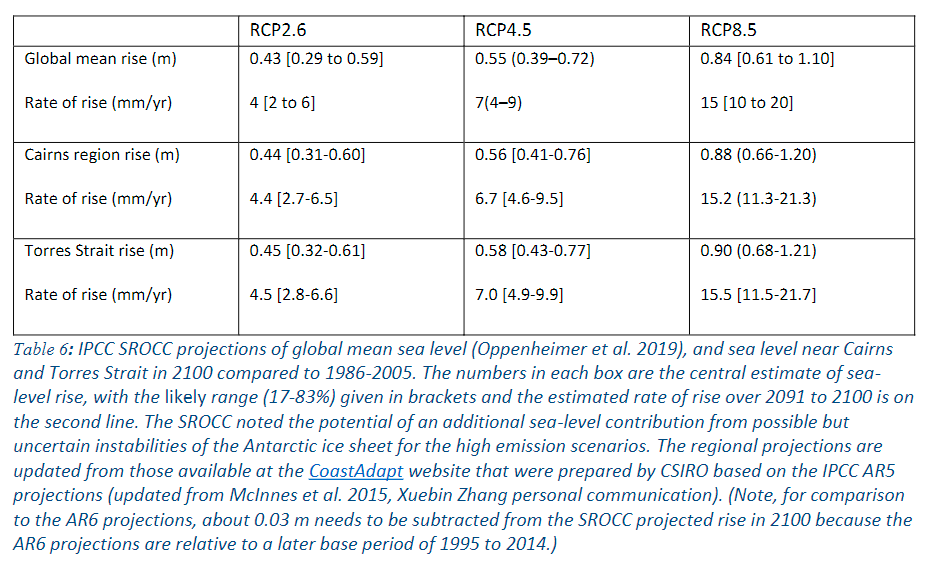
[1546] RCP4.5 equates to climate scenario 2.
[1547] The climate change experts said the rising sea levels near Cairns and in the Torres Strait will have a significant impact on the severity and frequency of coastal flooding events. Flooding events currently likely to occur on a one in 100-year probability are expected to occur several times per year by 2100, leading to increased coastal erosion. They referred to a study (Green et al 2010) that has established several vulnerabilities in the Torres Strait to climate change, including sea-level rise, and the limited adaptive capability for the local populations. The climate change experts said:587
The evidence in the affidavits of Florence Gutchen, Lala Gutchen, Kapua George Gutchen and Jiritju Fourmile is consistent with the expected impact of rising sea levels and climate change. Rising sea levels result in more frequent coastal flooding and this impact is already evident at many locations around the world. For people such as the Torres Strait islanders who are acutely aware of their environment, these impacts may well be noticeable already. Rising sea levels also result in coastal erosion, perhaps enhanced by changes in winds and waves, associated with anthropogenic climate change and natural climate variability. This could lead to the loss of islands, as observed elsewhere (Albert et al. 2016a, b).
[1548] Because of sea level rise alone, the climate change experts agreed the potential changes in the climate system over the next few centuries could well pose an existential threat to Torres Strait Island peoples.
[1549] The nature and extent of the limitation has several dimensions.
[1550] YV&TBA relied on the entirety of the evidence from the First Nations witnesses, both their affidavits and their on-country evidence. They say the entirety of this evidence informs me of the content of s 28(2) and the way this right would be limited.
[1551] The evidence was comprehensive and wide-ranging. I want to record my appreciation to the witnesses for sharing cultural knowledge that they might otherwise not have revealed, particularly their creation stories. I will not attempt to summarise the evidence. I will quote some passages, but this is illustrative only.
[1552] Florence Gutchen now lives with her husband Kapua and family on Erub (Darnley Island) in the Torres Strait, but her country is the island of Poruma (Coconut Island). She eloquently described how she feels to return to her country:588
Your Honour, first of all, like, it's my island home. And my connection to this place through my birth and my upbringing by my parents. And this morning, when I woke up, something come to my mind. It's talked about a mother. So, you know, our land is our mother because we come from the - we come from the land, from the ground. When we first was created, in Genesis, in the beginning, God created us from the ground. So something come to me, I felt, like - like this is my mother. How far you go, although you separate from your mother through birth, court separate you, but you will always go back to the mother. And you - you don't like something bad to happen to your mother. This thought came this morning to me, like Poruma is my home and is my mother, although I am separate from Poruma to go to mine other home. But my heart is still here and am still thinking about my home, for something good. Like, as I see the changes in this place, like, I want something good for this place. I believe this morning, where I felt my mother talking to me, she's happy that I'm returning home. Like, it's a special thing that I'm home here to fight against climate change for my island. Like, this year, like it's a good thing to build this thing for now. But this one can't stop the rising sea. The sea will still rise and I want something good happen for my island, to stop the fossil burning, to stop extinction. It can make a better place for - better place in this world for all of us to share. So that's why this place - my home is special to me, even though I go live in Erub with hills but my home - my heart is still here in Poruma, that I will do anything for my home. That's why it take me - come here, so I can tell my story - tell my story all about my island, because my heart is here. I want to see something good. Something good will save my island. Like, that's - if something comes up, like, where will my people go? Because they can go anywhere, but this is our home. Poruma is our home. We can go anywhere in the world, we stay, but our hearts stay here. So that's why I cry. I look - make this planet a better place, for all of us to enjoy.
[1553] Harold Ludwig, a Guugu Yimiddhir man from the community of Hopevale north of Cooktown, explained he uses the words “culture” and “cultural” in his statement to convey in simple language, what is much more complex. He says “culture” is used as a buzzword by those that have no emotional, cultural, or cultural understanding of what it defines. Every time he says “culture”, he means to convey:589
It is the definition of who we are, where we’re from and our knowledge of Country, the environment, and the species that live within it in each ecosystem or landscape. Before, when we had this completely, we lived. Now, we simply exist. The environment gave us everything: the spiritual strength, nourishment, the cause and the life.
[1554] Florence’s husband, Kapua Gutchen spoke of the gardening culture of Erub and his struggle to maintain it:590
We consider [gardening culture] above the fisherman culture in Torres Strait, whereas the other islands is the fisherman one first …because we got the soil to do it and we grew the food to feed the other islands … It was a very important part of our culture because, even though we islanders, we go fishing and hunting for turtle and fish and everything, but our ancestor always told us that the animals we hunt for, we didn’t sweat to raise them, but our gardening, because we farm, we toil the soil daily. And we also raise domesticated pigs and things, because we sweat to raise them thing, not the creature in the wild: they grew up by themselves. And we only went after – so we consider that part was the prominent part in our culture, the gardening and that’s why important because we have ceremonies with the gardening part and community ceremonies and household ceremonies, yeah. That’s why it’s very important to our culture and that’s why we still trying to cling on to it in the best way we can. Some families have said, well, it’s too hard and they – and others have clung on, like myself, because of – we got competition with the supermarket, the shop, and but we – we cannot change, because it was part of the lifestyle… and now we still practice even though we know they could buy things from the shops, but we still do them because we think it’s the right thing to do; it’s the culture. I would like to continue to stay on the garden culture. I think while I’m around that’s what I will continue to do, and it’s very hard to shake off old habits I will just continue to show my grandchildren and children whatever knowledge we have…
[1555] Lala Gutchen, one of Florence and Kapua’s daughters described the ceremony with which that gardening culture is passed down to the next generation:591
the name of the ceremony is gedubamorama so Jackie, my niece, sort of, planted her first banana fruit, so it’s a significant thing in our culture that we still hold onto is when the child plants his first fruit, and then we harvest it … So Jackie planted her first banana in – here in Dad’s garden with the help of my sister and Dad. So it’s their first fruit … So Jacqueline planted her first one and we celebrated her first fruit. And I had all my family is here – Dad’s family. And we had her there on – my sister’s holding her. So she cuts her first fruits, and the mother receives the first fruits. So my eldest sister is Jackie’s mother – receive the fruit of her labour.
[1556] Lala has followed in her father’s footsteps in systematically recording and teaching language as a vital contribution to the maintenance of culture. She explained the importance of language in keeping culture alive, and her commitment to maintaining the culture she has inherited through both of her parents:
… every time when I fish on my sea country or I dive, some fish I pick up that are in my father's language, I ask my mother "So mum, what's this?". So my mum interpret in her language, so when I come to Coconut Island and have a yarn with my cousins and there is one of my cousins that are from Erub that is in that conversation, and we talk about a specific fish, I can interpret to my other cousin. That's how important for my mum - my mum always do that and every plants and trees, she did that because we can't only have one language. We got parents, mother and a father. It's the identity but you got two language and you have to keep them both strong because how can I tell people that my mum is from Coconut when I can't speak it?
[1557] A striking and enduring theme in the evidence from the First Nations witnesses was their active commitment to and participation in caring for country. This is critical, given the environmental impacts of climate change. It also has distinct significance because of the specific protection by s 28(2)(e) of the right to conserve and protect the environment and the productive capacity of land, waters, and other resources.
[1558] Harold Ludwig described the relationship as reciprocal – not just a right, but a responsibility:592
A very important source of our lore is that the environment is more than just trees, animals, birds and bugs. It is a gift from Yiirimbal (Rainbow Serpent) and provides all necessities to thrive. In turn, we must respect it…
[1559] Lala Gutchen explained it this way:593
So all of us - it's in our - what do you call it - body that we have to - we are obligated to look after the land and the sea. When you born into the world you open your eyes, your parents tell you them things, it's stuck in your head. You have to do it. You can’t neglect them because of something that's taking over. You have to look after it and make it a better place so our children and their children can still practice and land and culture on our country.
[1560] Juritju Fourmile, a Gimuy Walabuara Yidninji man who lives with his family in Cairns is actively involved, as the other First Nations witnesses are, in caring for country. He explained the significance of this by reference to the bats in Cairns, which have already been adversely affected by increased heat:594
What does the – what’s the significance of the bats and those other species to you? Well, you look at the significance of these bats here now. You look at the stories that we get from those bats, you know, the medicine that we get from those bats. Now, we used to use those bats for our asthma and stuff and for our breathing. We would boil those bats up and then we’ll eat them. Now, due to climate change, if all these bats start dying off and they die, then that’s medicine gone. That’s connection to country gone. That’s our stories gone as well, you know? If my daughter was to become someone who has to look after those bats, or she is given the totem to look after those bats, what’s her story? She’s got no story. Then that’s another disconnection on this land further from being dispossessed already, you know? And if this happens to one species, we lose that whole connection. A whole family group can lose connection, you know, to this one story, due to one climate event, and this is one species. Imagine all the other species that are gone that aren’t highlighted with the fact that these bats going.
[1561] When the Court visited the island of Merad, Kapua Gutchen spoke about what has already happened:595
This was an island right up to the Second World War, and now from the rising sea, it had been reduced to this. Just last year, because my daughter got pictures in her phone there, it's bigger than this. So this is the only nesting area now where the grasses is. And when we were on the other island, I - we talked about the kegar rocks, which is the foundation of the island. So as you can see, the foundation of this, once upon a time was an island, is over there. It's lost. It's because of the rising seas now moving everywhere and slowly diminishing into what we are now. Maybe you come next year and it will be even smaller and the year after. We come here annually or twice or thrice, and kids get to replant the grass. So it'll try to maybe grow from it or retain itself, but sadly it doesn't seems to be winning over it. As you can see, the bird nesting now is reduced to that. They're now taking turns. First it was that mob turn there. When we came here, they were nesting here.... Now they've given room to these lot. There's no big space for all of them to congregate on.
[1562] The magnitude of potential cultural loss from sea level rise is illustrated by the example of the threat to the grave of Kapua Gutchen’s grandfather on Erub:596
Well, when we later go to my grandfather grave, which is just over there where that tree there on the high water mark, that common sense will tell us that when he died there, his family, at that time on that day, didn’t say, “Let’s bury granddad at the high water mark.” He would’ve been on the area further in. And granddad was born probably straight after the arrival of Christianity. Probably around 1870 – sorry, late arrives – probably 1880 or 1890. Yeah. So now that high water mark is there at his grave so that tells you the village was further out. They would have buried him in the backyard, not where the erosion will be taking place. So that’s the only way I can put it. And it’s already been eaten away and the cement slab the family’s put there. They didn’t have reinforcement and kind of scattered.
[1563] The intergenerational responsibility of culture is something that all the First Nations witnesses spoke about. Juritju Fourmile explained it to me this way:597
We as Indigenous people, First Nations people don’t just think about one generation or ourselves. We think about the generations that come after us, those that come before us as well. We learn their lessons and we take on their lessons and their knowledge. Their trials and errors tell us about what’s to come, and we are here as a conduit to tell the next generation about what’s to come, the changes here on country. Our stories change. We still tell our stories. They just become more modern now. Like, we use English instead of our language in some cases, just to get that message across, all right, and so it is heard. The significance just by standing here on this ground in this country here, my people were massacred not far from here. Skeleton Creek, their heads were put on stakes and we were then forced out of our traditional homelands in our country. Climate change is forcing us off of our traditional homelands now and the events that are happening now. Where is my daughter going to go fishing later on when all the creeks dry up? Where is she going to go when she can’t go into the bush because it’s too hot and the rainforest dies off? She can’t then pass those stories down to the next generation. I’m telling her now about all these bats dying, and her story to her children later on and the next story that they tell them is about how, “Well, my dad told me the bats died and now we don’t see any bats”. It’s just a story that we pass on. Until one day they might see a bat and that bat then becomes terres, that becomes a new story, because we have lost so many bats due to these climate events and these weather changers, torrential downpours, all these heatwaves that are coming through here. It’s not only just the bats. It’s the trees. Those trees are connected to this land. We as people are connected to those trees. They die, we die. Think of it holistically, the bigger picture, you know? If – I’m young. I’m only 25 years old and I’ve been brought into this. I’ve been born into this. I’ve been born into people’s past mistakes, and hopefully we can correct them, because if we can’t correct them, what’s the – what’s – what’s the point for the next generation coming through? What choice do they have? Are they going to be able to look after this land correctly? Will they have the tools to look after this land correctly?
[1564] There is much more evidence that I could have included, but the Court’s audio recordings and transcript preserve the testimony in full. Their evidence invokes each of the rights specified in s 28(2). In the passages I have quoted, I have focussed on what country and caring for country means, the impacts the First Nations witnesses are already observing, and their fears for the future of the environment, their culture, and for their children.
[1565] These passages convey my understanding that climate change impacts will have a profound impact on cultural rights and, for some peoples who will be displaced from their country, it risks the survival of their culture, the very thing s 28 is intended to protect.
The balance between the limitation and the right (s 13(2)(g))
[1566] I have addressed the balance in relation to the right to life at [1507]-[1513] and the observations I have made there about the economic and energy factors and climate change issues applies to this right equally.
[1567] There is an additional factors for the rights of First Nations peoples which weighs the scale more firmly in favour of the importance of preserving the right.
[1568] The First Nations right is about the survival of culture. The Torres Strait Island peoples face an existential risk from sea level rise. Already First Nations peoples in the north of Australia are experiencing the effects of climate change impacts on their ability to enjoy, maintain, control, and develop culture. More severe impacts mean greater interference with cultural rights. Displacement has the potential to destroy culture. Something that cannot be measured in monetary terms, is at odds with the purpose of s 28 and, set against the history of dispossession of First Nations peoples in this country, counts against the Project being approved.
Rights of children (s 26(2))
Every child has the right, without discrimination, to the protection that is needed by the child, and is in the child’s best interests, because of being a child.
The nature of the rights (s 13(2)(a))
[1569] Child is not defined in the HRA, but is defined in the AIA:
Child, if age rather than descendancy is relevant, means an individual who is under 18.
[1570] Section 26(2) is derived from art 24(1) of the ICCPR, which states:
Every child shall have, without any discrimination as to race, colour, sex, language, religion, national or social origin, property or birth, the right to such measures of protection as are required by his status as a minor, on the part of his family, society and the State.
[1571] The international jurisprudence on art 24(1) of the ICCPR is mainly about parental access and family unity in a migration context.598 Domestically, s 26(2) of the HRA has been considered in cases in which children were at risk at home, school, or work, because of exposure to family violence or criminal offending by others.
[1572] The jurisprudence on the CROC, which is also referenced in the Explanatory Notes, provides a source of reasoning about the both the scope of the rights of children, and how climate change might impact on those rights.
[1573] The decisions and General Comments of the CRC about the CROC have influenced the interpretation of art 24(1) of the ICCPR and of s 17(2) of the Victorian Charter, the cognate provision to s 26(2).599
[1574] YV&TBA say that three of the four overarching principles of the CROC600 are consistent with the text, purpose, and history of s 26(2) and should be given prominence in its construction: non-discrimination, the best interests of the child as a primary consideration, and participation.
[1575] Waratah does not disagree but says the best interests and participation principles are satisfied by the procedural obligation to consider the evidence and the right.
[1576] The right protected by s 26(2) is protection that is in the child’s best interests. This has a substantive element because the measures taken to protect children are guided by what is in their best interests.
[1577] In its General Comment No 14, the CRC explained that ‘the child’s best interests’ is a threefold concept, containing a substantive right, a fundamental, interpretative legal principle and a rule of procedure. In relation to the substantive right it says:601
the right of the child to have his or her best interests assessed and taken as a primary consideration when different interests are being considered in order to reach a decision on the issue at stake, and the guarantee that this right will be implemented whenever a decision is to be made concerning a child, a group of identified or unidentified children or children in general.
[1578] In relation to the procedural aspect of the right, the CRC advised:602
whenever a decision is to be made that will affect a specific child, an identified group of children or children in general, the decision-making process must include an evaluation of the possible impact (positive or negative) of the decision on the child or children concerned. Assessing and determining the best interests of the child require procedural guarantees. Furthermore, the justification of a decision must show that the right has been explicitly taken into account. In this regard, States parties shall explain how the right has been respected in the decision, that is, what has been considered to be in the child’s best interests; what criteria it is based on; and how the child’s interests have been weighed against other considerations, be they broad issues of policy or individual cases.
[1579] While there is no evidence before me about the composition of one of the active party objectors, Youth Verdict Inc, its website describes the organisation as “a group of young people in Queensland fighting for a future where we can thrive on a healthy planet”.603 It is not clear whether any of them are children, but, from a procedural perspective, Youth Verdict has participated in this hearing with the interests of children in mind.
[1580] There is an additional dimension to the principle of participation in the context of climate change. The decisions we make today have far more consequences for children alive and those yet to be borne than it does for today’s adults. While today’s children have some influence over the decisions I must make, by Youth Verdict’s participation in this hearing, the same is not true of the children of the future. The only way I can give meaning to that reality is to acknowledge the significance of this generation making decisions that could lock-in climate trajectories, the impacts of which will be felt by future children.
[1581] There is an important difference between s 26(2) and the CRC jurisprudence about climate change. The CROC includes the right of the child to the enjoyment of the highest attainable standard of health (art 24). That is not within the scope of s 26(2). With that caveat, there are some decisions and comments by the CRC that do assist in relating climate change to “protection that is needed by the child, and is in the child’s best interests, because of being a child”.
[1582] In General Comment No. 15, the CRC recognised the relationship between climate change and art 24 of the CROC and made the following observations:604
[1583] In September last year, the CRC delivered its decision in the claims of Saachi.605 A group of children brought several complaints against different States parties, contending that their rights under the CROC were violated because those State parties had failed to prevent and mitigate the consequences of climate change.
[1584] The complaints were dismissed for failure to exhaust domestic remedies. Although it did not determine the merits of the allegations, the CRC made the following relevant observation:606
as children, the authors are particularly affected by climate change, both in terms of the manner in which they experience its effects and the potential of climate change to have an impact on them throughout their lifetimes, particularly if immediate action is not taken. Due to the particular impact on children, and the recognition by States parties to the Convention that children are entitled to special safeguards, including appropriate legal protection, States have heightened obligations to protect children from foreseeable harm.
[1585] The CRC is now in the process of drafting a General Comment on children’s rights and the environment, with a special focus on climate change. The CRC has issued a concept note which recognises the vulnerability of children to environmental harm and its disproportionate burden on children. The CRC intends the General Comment to emphasise the urgent need to address the adverse effects of environmental harm and climate change on children and to shed light on the societal, legal, and other implications of concepts including ‘future generations’ and ‘intergenerational equity’ to improve administrative measures to uphold the rights of the child in the context of climate change.
[1586] The CRC’s decision and reasoning are helpful in interpreting s 26(2). The scope of the right protected by s 26(2) encompasses the climate change implications of the Project, because of the vulnerability of children to climate change impacts and the disproportionate burden those impacts will have on children today and in the future.
The importance of the preserving the right, given the nature and extent of the limitation (s 13(2)(f))
[1587] The importance of the rights of children lies in the special vulnerabilities of children and their inability to control the decisions that affect them. The HRC has advised art 24, imposes additional obligations on States with respect to children above those owed to adults under the ICCPR.607 The same is true of the HRA and this underlines its importance.
[1588] The intergenerational nature of climate change is critical to the proportionality exercise. This was recently accepted by the German Federal Constitutional Court in a case in which a group of German youth challenged the legislated emission reduction targets. They said the targets were insufficiently stringent and violated their right to life. Albeit in a different context, the Court’s reasoning about this is compelling:608
One generation must not be allowed to consume large portions of the CO2 budget while bearing a relatively minor share of the reduction effort, if this would involve leaving subsequent generations with a drastic reduction burden and expose their lives to serious losses of freedom.
[1589] The active parties in this hearing agree the adverse impacts of climate change will disproportionately affect children who are living now and are born in future, at an ever-increasing level into the future. They also agree that present and future children will be at a disproportionately greater risk of poorer health outcomes and premature mortality. As well as those agreed facts, Professor Bambrick gave evidence about the potential impacts on children.
[1590] Before 2030, there will be more than 1 million children aged 14 years or younger living in Queensland. Young children are more prone to heat stress. There are as-yet unquantified impacts on babies whose mothers are pregnant during hazardous fire events and on young children whose risk of developing asthma or having an episode is increased.609
[1591] A child born today is expected to live to the end of the century. As they grow and age, children will be affected by an increasingly hostile environment that will affect their learning, recreation, and working conditions.610
[1592] The population of Queensland is growing and ageing. Life expectancy has improved, and people live longer. Older people are at greater risk during extreme heat. As the impacts of rising temperatures become increasingly dangerous over time, this will disproportionately affect today’s children as they enter their middle and late years. On current trends, two-thirds of today’s children are expected to develop chronic conditions in their adult years.611
[1593] The current pathway to 2.7°C-3.1°C average warming at 2100 (which is equated with the WM ETO) will result in more extreme maximum temperatures which will make large parts of Queensland unliveable.
[1594] As well as the vulnerability of children today and in the future, there is an intergenerational imbalance in the effects of climate change itself.
[1595] The climate change experts explained that temperature will increase as the atmospheric concentration of CO2 rises. How long it will take for temperature to stabilise and how high that temperature will be is a direct result of the level of atmospheric concentration of CO2 at the point at which the world achieves net-zero emissions. Currently, the world is not on track to reach net-zero emissions by 2050.
[1596] On even the most ambitious of the climate change experts’ scenarios, there will be an overshoot of the temperature goal of 1.5°C mid-century, with a need to draw down emissions in the second half of the century to reach the goal by 2100. The burden of drawing down accumulated CO2 from the atmosphere will fall to today’s children who will be adults then.
[1597] Further, the risk of reaching tipping points, with cascading climate changes, increases at temperatures above 2°C above pre-industrial. The WM ETO scenario equates to temperatures that exceed that increase. The climate change experts’ evidence shows how significant the temperature difference can be between 2050 and 2100, with the more extreme temperatures being experienced in the second half of this century:
[1598] There is an additional dimension to the importance of the rights of children in the circumstances of this case.
[1599] Queensland’s First Nations population is heavily skewed towards children and young people. 55% are 24 years or younger and 35% are 14 years or younger, compared with 32% and 19% respectively for Queensland’s total population.612
[1600] I heard evidence about the impact on the children of the Gutchen family from Erub in the Torres Strait. The children Maima, Katie and Jackie, now aged between 8 and 10, are likely to be alive in or near 2100. This evidence provides an illustration of how a group’s vulnerabilities can intersect with more than one human right, compounding the human rights implications of an act.
[1601] Increased temperatures already hamper the efforts of the First Nations parents to teach their children about their sea country. If, as adults, these children are displaced from their country, that will risks severing their relationship to country and culture. That intersection of rights and impacts for First Nations children is an additional consideration for this right.
The balance between the limitation and the right (s 13(2)(g))
[1602] As I explained when dealing with the rights of First Nations peoples, my consideration of the balance between the limitation and the right set out under the right to life applies here as well. Again, there is an additional aspect to the balancing exercise when dealing with this right.
[1603] The intergenerational aspect of climate change risks makes the rights of children paramount. The year 2100 is the reference point for the Paris Agreement long-term temperature goal. My generation of decision makers will be long gone, but a child born this year will be 78 years old in 2100. The principle of intergenerational equity places responsibility with today’s decision makers to make wise choices for future generations. The children of today and of the future will bear both the more extreme effects of climate change and the burden of adaptation and mitigation in the second half of this century. Their best interests are not served by actions that narrow the options for achieving the Paris Agreement temperature goal. This weighs the balance against approving the applications.
Right to Property (s 24(2))
A person must not be arbitrarily deprived of the person’s property.
The nature of the right (s 13(2)(a))
[1604] This right is derived from art 17 of the Universal Declaration on Human Rights:
All persons have the right to own property alone or in association with others. A person must not be arbitrarily deprived of their property.
[1605] The AIA defines ‘property’ as:
Any legal or equitable estate or interest (whether present or future, vested or contingent, or tangible or intangible) in real or personal property of any description (including money), and includes things in action.
[1606] The cognate right in the Victorian Charter (s 20) has been interpreted more broadly to “encompass economic interests”.613
[1607] It is not necessary to establish an identifiable individual’s rights will be limited. It is sufficient to establish a limit on the rights of a class of persons.614
[1608] YV&TBA summarise the uncontested evidence from Mr Coleman, Professor Bambrick and the First Nations witnesses as to the effects of climate change on property in their submissions:615
[1609] The reference to scenario 3 above is clearly an error and should read scenario 1.
[1610] They say the Project would clearly contribute to the de facto deprivation of property for (at least) thousands of Queenslanders. The Torres Strait Islands are particularly vulnerable to both heatwaves and sea level rise.
[1611] I accept climate change impacts will include destruction of property or a sufficient restriction on the ability to use and enjoy property to amount to a de facto expropriation.
[1612] In James v United Kingdom, the ECtHR said:616
A taking of property effected in pursuance of legitimate social, economic or other policies may be 'in the public interest', even if the community at large has no direct use or enjoyment of the property taken.
[1613] Nevertheless, at a broad and general level of assessment, I consider the deprivation of property would be arbitrary in the sense of not being proportionate to the legitimate aim.
[1614] Mr Coleman’s report sought to quantify the increases in human impact costs in Queensland between 2021 and 2100 on three scenarios. While he described them differently, they equate to the three climate scenarios. Using what he called the moderate scenario, which equates to climate scenario 2, he estimated an increased annual cost or value loss of property in Queensland of $1.512 b from cyclones, storms and flooding, bushfires, heatwaves and drought and sea level rise.
[1615] This figure is higher than a recent paper he referred to in his report (the ANU paper). That paper used Australia-wide averages. Because of Queensland’s disproportionately high exposure to cyclones, heatwaves and sea-level rise when compared to the rest of Australia, Mr Coleman said an Australia-wide average tends to systematically and considerably understate the impact of anticipated weather events.
[1616] To be clear, that cost cannot be attributed specifically to the Project but, as with other human impacts, the Project would make a material contribution to future climate change.
[1617] I have already accepted that the limit to the right to life on the Climate Change Ground would be arbitrary. I make the same finding in relation to the right to property.
The importance of the preserving the right, given the limitation (s 13(2)(f))
[1618] Property has a foundational role in Australian legal history. In Victoria, Bell J said the right to property is “an ancient feature of the common law, established by the time of Magna Carta 1297” and “a fundamental common law right for the purpose of the application of the principle of legality”.617
[1619] The importance of preserving the right has an additional dimension in this case, given the grief and loss of displaced First Nations peoples will be compounded by a cultural loss that cannot be compensated.
The balance between the limitation and the right (s 13(2)(g))
[1620] As I explained when dealing with other rights, my consideration of the balance between the limitation and the right set out under the right to life applies here as well. There is a different aspect to balance here.
[1621] Arguably assessing the limit on this right involves a more straightforward economic analysis. The cost of property damage is not clear on the evidence. Mr Coleman has given his best estimate of climate change related property damage, but that is not specific to the Project alone. Nevertheless increasing the risk to property will have economic consequences which I have concluded are not adequately captured by Waratah’s CBA for the Project.
[1622] The displacement of people from their property, and the associated grief and health impacts of that, must also be considered. For First Nations people, there is the additional profound disruption of culture through disconnection from country. When the human cost of de facto expropriation of property is added to the equation, the scales weigh in favour of preserving the right.
Right to privacy and home (s 25(a))
A person has the right — (i) not to have the person’s privacy, family, home or correspondence unlawfully or arbitrarily interfered with …
The nature of the right (s 13(2)(a))
[1623] This right is derived from art 17 of the ICCPR. The concepts of home, family and private life are closely intertwined as belonging to the private sphere.
[1624] In Director of Housing v Sudi the cognate right in the Victorian Charter was interpreted in this way:618
The rights to privacy, family, home and correspondence in section 13(a) are of fundamental importance to the scheme of the Charter. The purpose of the rights is to protect and enhance the liberty of the person - the existence, autonomy, security and wellbeing of every individual in their own private sphere. The rights ensure everybody can develop individually, socially and spiritually in that sphere, which provides the civil foundation for their effective participation in democratic society. The rights protect those attributes which are private to all individuals, that domain which may be called their home, the intimate relations which they have in their family and that capacity for communication (by whatever means) with others which is their correspondence, each of which is indispensable for their personal actuation, freedom of expression and social engagement.
[1625] Here, what is at stake is home. In Sudi, Bell J said home should be approached “in a common-sense and pragmatic way”. It requires “sufficient and continuous links” with a place to establish that it is a person’s home. It is a question of fact, not law, and is not based on notions of title, legal and equitable rights, and interests.
[1626] Although YV&TBA’s objections did not specifically refer to this right in relation to the Climate Change Ground, and they make no submissions about it, I consider it is engaged because of the evidence about sea level rise and plans to relocate up to 2,000 people from the Torres Strait.
[1627] This right is limited if the person’s home is unlawfully or arbitrarily interfered with. I can exclude unlawfulness as the right would be limited by an authorised activity if the Project is approved.
[1628] Climate change presents a real and serious risk to the homes of residents of the Torres Strait. Extreme heat is expected to make parts of Queensland unliveable by 2100. Although Professor Bambrick was not specific about which parts, it is reasonable to infer from their location that the Torres Strait Islands will be among the first areas to become unliveable. Future sea level rise threatens homes on islands such as Poruma.
[1629] I apply arbitrariness in the same way as for other rights, as a limit that is “capricious, or has resulted from conduct which is unpredictable, unjust or unreasonable in the sense of not being proportionate to the legitimate aim sought”.
[1630] I have already accepted that the limit to the rights to life and property on the Climate Change Ground would be arbitrary, assessed at a broad and general level. I make the same finding in relation to the right to privacy.
The importance of the preserving the right, given the nature and extent of the limitation (s 13(2)(f))
[1631] Justices Bell and Gageler of the High Court recently considered the importance of home in its common law context:619
In the Australian way of thinking, a home is a sanctuary. This sentiment is reflected in common expectations and common practices: “the habits of the country”. Those habits are founded on an ingrained conception of the relationship between the citizen and the state that is rooted in the tradition of the common law. The conception can be traced to the Jacobean resolution of the Court of King's Bench that “the house of every one is to him as his castle ... as for his repose”.
[1632] I have already canvassed the relevant evidence under the cultural right. That evidence establishes a profound interference with this right as well.
The balance between the limitation and the right (s 13(2)(g))
[1633] Once again, my consideration of the balance between the limitation and the right set out under the right to life applies here as well. The difference between interfering with a right to life and a right to home is material, so the factors will weigh differently in the balance for this right. Nevertheless, interference with the sanctuary of the home is a serious matter. In this case, there is the additional dimension that the loss of home for some First Nations peoples risks the loss of culture and the associated health burden that displacement would bring. In the particular circumstances of this case, the balance favours preserving the right.
Right to Enjoy Human Rights without Discrimination (s 15(2))
Every person has the right to enjoy the person’s human rights without discrimination.
The nature of the right (s 13(2)(a))
[1634] This right is modelled on art 26 of the ICCPR. The parties also reference art 2(1) of the ICCPR. The latter right in the ICCPR is an ‘accessory prohibition’, which prohibits discrimination in the enjoyment of other substantive human rights (Re Lifestyle Communities Ltd (No 3)).620 In the Explanatory Notes it is said that s 15(2) is “a stand-alone right, but also permeates all human rights in the Bill”.621
[1635] Discrimination is defined in the HRA as:
Discrimination, in relation to a person, includes direct discrimination or indirect discrimination, within the meaning of the Anti-Discrimination Act 1991, on the basis of an attribute in section 7 of that Act.
[1636] The definition is inclusive and is not confined to an act that would be discriminatory within the meaning of the Anti-Discrimination Act 1991 (ADA).
[1637] The definitions of direct and indirect discrimination in that Act are lengthy and need not be set out in full. The relevant attributes in this case are age and race. Direct discrimination occurs if a person is treated less favourably than another person would be in the same circumstances, because of an attribute (ADA s 10). Indirect discrimination arises when an unreasonable condition, requirement or practice has a disadvantageous effect on a person with such an attribute (ADA s 11).
[1638] Waratah submits:
It would not be direct discrimination because the decision treats all persons the same, and not less favourably because the impacts of climate change do not discriminate between the classes of [sic] disadvantaged people and others. Discrimination must be shown to be directed at a person or class of persons on the basis of an attribute. That cannot arise as a result of a contribution to the risk of harm being caused by climate change which operates indiscriminately and independently of decision making.
[1639] This casts the focus on the act (the decision), rather than the limit and addresses only direct discrimination. Further, it is wrong to say the risk of harm being caused by climate change operates indiscriminately.
[1640] YV&TBA submit the way in which s 15(2) works is that its foundation rests in the limit to another human right. If it can be established that an act or decision has a disparate impact on human rights of different people, that limit is also a limit to s 15(2).
[1641] YV&TBA refers to the way in which s 15(1) of the Canadian Charter of Rights and Freedoms has been interpreted. There are material differences in the wording, but I accept that s 15(1) of that Charter encompasses what s 5(2) of the HRA protects:
15. (1) Every individual is equal before and under the law and has the right to the equal protection and equal benefit of the law without discrimination and, in particular, without discrimination based on race, national or ethnic origin, colour, religion, sex, age or mental or physical disability.
[1642] This right has been interpreted to require the Court to consider whether the act imposes a burden or denies a benefit in a way that has the effect of reinforcing, perpetuating, or exacerbating disadvantage, including historical or systemic disadvantage.622 This casts the focus on the impact, rather than the intention of the act. That is consistent with indirect discrimination, incorporated by the definition in the HRA.
The importance of the preserving the right, given the nature and extent of the limitation (s 13(2)(f))
[1643] The parties agree the impacts of climate change disproportionately affect children now living and those to be born, older people, people living in poverty, other disadvantaged people, and First Nations Aboriginal and Torres Strait Islander peoples.
[1644] I have already referred to Professor Bambrick’s evidence about the disproportionate impact of climate change on children (see [1589]-[1599]). Older people are at great risk of ill-health and of dying during a heatwave because of the health vulnerabilities of age. There is also a disproportionate risk for First Nations peoples.
[1645] Of Australia’s states and territories, Queensland has the second largest population of First Nations people by absolute number and the second highest by proportion of its population.623 Professor Bambrick noted some specific health risks for First Nations People:624
[1646] First Nations people and communities are at heightened risk of illness and death related to extreme heat, due to higher likelihood of underlying chronic conditions such as high blood pressure, diabetes, and kidney disease. These chronic conditions that increase risk of illness and death in extreme heat also affect First Nations people at younger ages than others. First Nations people are also more likely to live in lower quality housing and to not have access to air-conditioning. The locations of some communities may be subjected to even more extreme combinations of heat and humidity with climate change relative to other parts of Queensland, including Far North Queensland and the Torres Strait.
[1647] Professor Bambrick said climate-associated health challenges in Torres Strait are being made worse by climate change:625
[1648] There is an additional intergenerational dimension to the disproportionate impact on Aboriginal and Torres Strait Islander children because changes to their environment and displacement due to climate change and will impair their ability to learn, enjoy and maintain their culture.
The balance between the limitation and the right (s 13(2)(g))
[1649] As I explained when dealing with other rights, my consideration of the balance between the limitation and the right set out under the right to life applies here as well. The burdens of increasing climate change will not be experienced equally. In this case, the disproportionate impact arises in multiple ways.
[1650] It will fall more heavily on those who have vulnerabilities due to age, whether very young or old, or because of underlying health conditions, including those for First Nations peoples.
[1651] The intergenerational aspects are a key consideration for this right. Future generations will not have the same freedom that we have had, because their options for avoiding dangerous climate change will have been restricted.
[1652] The impact on cultural rights of First Nations peoples is an additional dimension to the disproportionate impact.
[1653] The intersection of multiple vulnerabilities of First Nations children, for example, increases the importance of protecting this right in the context of this case.
[1654] Taking all those aspects together, the limit is not a reasonable limit that can be demonstrably justified in a free and democratic society based on human dignity, equality, and freedom.
Conclusion on the Climate Change Ground
[1655] I have found the balance weighs against approving the applications taking into account the s 13(2) factors for each of the right to life, First Nations cultural rights, the rights of children, the rights to property and to privacy and home, and the right to enjoy human rights equally.
[1656] It is my obligation to properly consider human rights in making my decision. In doing so, I have decided approving the applications is not appropriate because, taking the nature and extent of the limit into account, the importance of preserving the human right is more important than the purpose of the Project. That is a discretionary exercise required by the HRA and I have adopted the approach described by Warren CJ described in Re Application under the Major Crimes (Investigative Powers) Act 2004:626
the issue for the Court is to balance the competing interests of society, including the public interest, and to determine what is required for a person to obtain or retain the benefit of the rights recognised or bestowed by the statute.
[1657] On the Climate Change Ground, the Project would impair the ability of the identified groups from retaining the benefit of the individual rights engaged by the Project. The evidence about the economic and other benefits of the Project is not cogent and persuasive in justifying the limit.
The Glen Innes Ground
[1658] YV&TBA say the nuisance and environmental damage that the mine will cause amounts to a limit on the rights to property and privacy. Waratah does not contest the rights are engaged, although it does raise some legal arguments about the limit which I will deal with when considering the nature of each right.
[1659] The limit can be understood as:
[1660] I need not repeat my reasoning on those factors in s 13 that relate to the Project as it applies equally to the Glen Innes Ground. Those are the factors identified in s 13(2)(b)-(e) (see [1425]-[1451]). While I have not repeated my reasoning on those factors, it is integral to the balancing exercise in the proportionality test.
[1661] I will now turn to the rights engaged by this ground and the s 13(2) factors that are relevant to those rights.
Right to property (s 24)
A person must not be arbitrarily deprived of the person’s property.
Nature of the right (s 13(2)(a))
[1662] On the Glen Innes Ground, YV&TBA assert there are two distinct and separate legal entities or properties – the nature refuge, Bimblebox, and the lot, ‘Glen Innes’ which exists independently of the declaration of that land as a nature refuge. They say the owners will be deprived of Bimblebox as a nature refuge if it is degazetted, which I have found to be a realistic prospect if the Project is approved.
[1663] YV&TBA have not explained how declaring a nature refuge creates a legal or equitable estate or interest in real property that is distinct from the ownership of the land itself. Nor have they identified an economic interest that would satisfy a broad conception of property. I am not satisfied any person would be deprived of property by the degazettal of Bimblebox.
[1664] The deprivation asserted in relation to Glen Innes is a different matter.
[1665] Although Waratah accepts the right is engaged by the Project, it says the owners’ rights are not limited, partly because the owners of Glen Innes do not own the minerals. That is not to the point. YV&TBA do not assert a deprivation of property in the coal. They say the noise, dust, light, subsidence, and environmental damage caused to Bimblebox would form such a nuisance that the landowners would be driven from the property.
[1666] Formal expropriation is not required. Destruction of property can amount to a de facto expropriation. In Budayeva v Russia627 the ECtHR held property destruction caused by a preventable mudslide engaged this right in the European Charter. Further, if there is sufficient restriction of a person’s use or enjoyment of property that can amount to a de facto expropriation.628
[1667] The evidence about the subsidence on Glen Innes and the noise and dust impacts of mining on Glen Innes and neighbouring properties establishes there will be a significant restriction on the owners use or enjoyment of the property, not just as a nature refuge, but also for grazing purposes. Waratah has not explained how the current use of the property could co-exist with mining.
[1668] Waratah submits the impact on property rights would not be an arbitrary deprivation because the nuisance and environmental impacts will be regulated by the EA and there is a right to compensation.
[1669] However, the expert witnesses, Mr Elkin and Mr Welchman, predict the Draft EA noise and dust levels will be exceeded at the Glen Innes homestead. That is, the interference would exceed the level DES considers appropriate in striking a reasonable balance between the legitimate mining activity and the owners’ use and enjoyment of the property. I have explained at length how I have assessed the ecological consequences of subsidence and the uncertainty about what can be done to either limit or respond to subsidence impacts.
[1670] The evidence of likely non-compliance with conditions and the uncertainty about the extent of residual serious harm on Bimblebox is relevant in assessing whether the deprivation of property would be arbitrary.
[1671] In the unusual circumstances of this case, and on a broad and general assessment, I am satisfied approving the applications would amount to an arbitrary deprivation of property for the owners of Glen Innes within the meaning of s 24(2).
Importance of preserving the right, taking into account the nature and extent of the limitation (s 13(2)(f))
[1672] I have addressed the importance of the right in relation to the Climate Change Ground and need not repeat that here. However, the nature and extent of the limitation is different on the Glen Innes Ground.
[1673] As well as the evidence that the mining activity would exceed reasonable restrictions on the nuisance impacts of the mine, there will be significant impacts from the underground mining, including lowering the ground surface between 2m - 4m; significant cracking and dilation of the rock strata and surface cracking; a ridge and swale landscape that is stepped and tilted and which will alter the surface water flows and the direction of flows. Some of those impacts could not be remediated at all and, for those that could be, the remediation work would be undesirable because they would likely result in further ecological damage.
[1674] The provisions of the MRA which provide for compensation to landowners, for interference by mining of their use and enjoyment of property, values rural land by its productive capacity. It will not compensate the owners for the loss of the nature refuge, or the painstaking work they and others have invested in maintaining the ecological values of Bimblebox. Nor are the owners entitled to compensation under the NCA if the Refuge is degazetted (s 68). Nor can the loss of that effort and commitment be offset by an environmental offset.
[1675] Before finishing with this right, I will deal with Waratah’s argument that Mr Hoch does not have an interest in Glen Innes Station because he is not on the title. The evidence about the purchase of this property disposes of that argument and demonstrates the importance of preserving the right.
[1676] The Glen Innes Station is Lot 4 on Crown Plan BF22. It is a perpetual lease granted for grazing or agricultural purposes. The registered lessees are Ms Cassoni and Mr & Mrs Rudd.629 However, funds to purchase the leasehold came from a few sources, including the Commonwealth government. Ms Cassoni said the company, Populnea Pty Ltd, was established to consolidate the funds for that purpose.
[1677] Mr Rudd was the prime mover behind the purchase of the Glen Innes Station. He sought support from government as well as friends and others with an interest in conservation. Collectively, private parties contributed $230,000 to the purchase.
[1678] Mr & Mrs Rudd initially contributed $60,000 (taking 60 shares in the company). Within the next two years they bought out Mr & Mrs Herbert (who were signatories with Mr & Mrs Rudd to the Commonwealth funding agreement) to the value of a further $90,000. They contributed $150,000 in total to the purchase and establishment of the Glen Innes Station and hold 150 shares in Populnea.
[1679] At the time, they purchased their shares they had limited financial resources, a young and growing family and had only recently bought a house in Emerald. They extended their mortgage to be able to finance their interest. Mr Rudd described the contribution in this way:630
We were on a basic income and I wasn’t far out of university, but we put everything we possibly could into purchasing Glen Innes, to leave a worthy and lasting environmental legacy. We utilised all of our savings, sold a portion of our share portfolio that we had been building and greatly extended our mortgage. It was a massive commitment for us.
[1680] Ms Cassoni said that she and Mr Hoch contributed $55,000 by buying 55 shares in Populnea. That was their life savings at the time, and she thought, then, that was money well spent.
[1681] Interpreting the right broadly, as the cognate right in the Victorian Charter has been interpreted, the shareholders’ contributions to the purchase establishes an economic interest in the property.
Right to privacy and home (s 25(a))
A person has the right — (i) not to have the person’s privacy, family, home or correspondence unlawfully or arbitrarily interfered with …
Nature of the right (s 13(2)(a))
[1682] Again, I have already considered the nature of this right under the Climate Change Ground and will not repeat that here.
[1683] There is a dispute about whether Bimblebox is a home for any person. In Sudi, Bell J said home should be approached “in a common-sense and pragmatic way”. It require “sufficient and continuous links” with a place to establish that it is a person’s home. It is a question of fact, not law, and is not based on notions of title, legal and equitable rights, and interests.
[1684] The arrangements for the purchase of the Glen Innes Station and the registered lessees are described above. The evidence shows that none of the shareholders of Populnea or the registered lessees live permanently on the property. However, YV&TBA say Bimblebox is the focus of a life-time’s endeavour for Mr Rudd, Ms Cassoni and Mr Hoch and is a home to Ms Cassoni and Mr Hoch.
[1685] Mr Rudd was the instigator of the purchase of Glen Innes Station for conservation purposes and pivotal in raising both government funding and private investment. I have already referred to his long-term bird survey work on the property. He said he was committed to trying to do as much as he could but found it difficult to balance this with maintaining other work and holding up his family, while travelling three hours to the property from Emerald.
[1686] Mr Hoch is its primary caretaker and spends extensive time staying and working on the property, sometimes for months at a time. He has worked tirelessly to maintain the ecological values of Bimblebox.
[1687] Ms Cassoni looks after her family and stock on Kerand, a property on which she and Mr Hoch have lived since 1983, and where Mr Hoch grew up. She also stays at Glen Innes sometimes to prepare for guests and while the guests are staying there. She actively promotes the conservation objectives for Bimblebox.
[1688] Mr Rudd, Mr Hoch, and Ms Cassoni have each devoted substantial time and effort to both care for and understand the natural environment of Bimblebox. They have made the Refuge publicly accessible and shared their knowledge of its ecological values and the possibility of sustainable grazing. They have taken their obligations under the Commonwealth and State Agreements for Bimblebox seriously. The ecologists and land management experts agreed without this the ecological qualities of Bimblebox would not be as good. The landholders have described how devastating it would be for them if the ecological condition of Bimblebox was damaged by the mine, and the value of their years of labour and the long-term research on Bimblebox was lost.
[1689] In describing the nature of the connection between the landholders and Bimblebox, YV&TBA used the phrase ‘a life-time’s endeavour’. This comes from the judgment of Vickery J in Nolan v MBF Investments Pty Ltd.631 DES submits:
There was no evidence given that Mr Hoch, Ms Cassoni-Hoch and Mr Rudd live permanently on BNR or that it is their full time residence. However, their uncontradicted evidence is that BNR has been the focus of their energy and finances for 20 years and the loss of BNR will cause hurt and despair for them. This founds a link with BNR such that it is a ‘home’ for the purposes of the HR Act.
[1690] Interpreting the right broadly, I accept that submission.
Importance of preserving the right, taking into account the nature and extent of the limitation (s 13(2)(f))
[1691] I have considered the importance of the right to home under the Climate Change Ground. The limitation to the right to privacy on the Glen Innes Ground is the same as the limitation on the right to property on that ground.
[1692] There are numerous international examples of violation of an equivalent right by severe environmental pollution or nuisance. These include noise, waste treatment plants, air pollution, and odour.632 Physical exclusion from the home is not required. However, the interference must significantly impar a person’s ability to enjoy their home, private or family life, taking into account matters such as the intensity and duration of the impact and its physical and mental effects.
[1693] The evidence does not provide me with any confidence that Mr Hoch, Ms Cassoni, and Mr Rudd can continue to enjoy Bimblebox and to fulfill their commitments under their agreements with the Commonwealth and State governments.
The balance between the limit and the right, given the nature and extent of the limitation (s 13(2)(g))
[1694] Because of the similarity in the factual matrix for the limit of these two rights, I will address the question of balance together. To avoid doubt, I note here that I have taken into account my reasoning under the Climate Change Ground about the purpose of the limit in balancing the limit with each right engaged on the Glen Innes Ground.
[1695] In most cases, the impacts of a mine on a person’s property and their use and enjoyment of their home, can be adequately dealt with in two ways.
[1696] First, by imposing operating conditions that minimise the impacts, and in some cases that facilitate co-existing uses of the property.
[1697] Second, by a monetary award to compensate the owners for the disturbance or, in large mining operations, the loss of their property and home.
[1698] In a case where that can be done, I would expect that to favour the broader public interest in the economic and social benefits of a mine over the interference with private rights.
[1699] In this case, the evidence shows that, on the current mine plan, the mine is unlikely to be able to meet the operating conditions proposed by DES to minimise nuisance impacts. For the more serious residual impacts on the ecology of Bimblebox due to subsidence damage, at least some damage will be permanent and there is no credible offset plan in place. The landowners’ significant commitment to environmental preservation will not compensated under the compensation regime.
[1700] The loss is not solely a matter of interference with private rights. The values of Bimblebox are a matter of public benefit as well. Nature refuges comprise almost one-third of Queensland’s total protected area system. Careful stewardship of land in private hands depends on confidence the investment of time, effort, and funds will not be lightly disregarded. There is a public interest in only interfering with a nature refuge when there is a compelling reason to do so.
[1701] The combination of those factors makes this case unique.
[1702] In undertaking the discretionary exercise in this case, adopting the approach described by Warren CJ (already referred to for the Climate Change Ground) the Project would impair the ability of those identified above from retaining the benefit of the individual rights engaged by the Project. The evidence about the economic and other benefits of the Project is not cogent and persuasive in justifying the limit.
Conclusion on Human Rights
[1703] On both the Climate Change Ground and the Glen Innes Ground I consider the engaged rights would be limited by the Project and the evidence about its economic and other benefits is not cogent and persuasive in justifying the limit.
[1704] At the beginning of this section of the reasons I explained my task in making my decision is to properly consider human rights relevant to the decision. So there can be no doubt about this, I have taken them into account in weighing the public interest on each application.
[1705] It is not my function to make a legal ruling that the applications would not be compatible with human rights, and I have not done so.
ASSESSMENT OF THE APPLICATION FOR THE MINING LEASE
| Introduction | [1706] |
| Section 269(4)(a) – compliance with the provisions of this Act | [1711] |
| Section 269(4)(b) – the area of land applied for is mineralised or the other purposes for which the lease is sought are appropriate | [1722] |
| Section 269(4)(c) – there will be an acceptable level of development and utilisation of the mineral resources within the area applied for | [1725] |
| Section 269(4)(d) – the land and surface area applied for is of an appropriate size and shape | [1736] |
| Section 269(4)(e) – the term sought is appropriate | [1744] |
| Section 269(4)(f) – the applicant has the necessary financial and technical capabilities | [1747] |
| Section 269(4)(g) – Past Performance | [1757] |
| Section 269(4)(h) – any disadvantage to other tenure holders | [1768] |
| Section 269(4)(i) – the operations will conform with sound land use management | [1769] |
| Section 269(4)(j): whether there will be any adverse environmental impact caused by the operations and, if so, the extent thereof | [1779] |
| Section 269(4)(k) – the public right and interest | [1783] |
| Section 269(4)(l) – any good reason to refuse | [1802] |
| Section 269(4)(m) - Appropriate land use | [1804] |
| Conclusion on the ML application | [1805] |
The principal objectives of this Act are to – (a) encourage and facilitate prospective and exploring for and mining of minerals; (b) enhance knowledge of the mineral resources of the State; (c) minimise land use conflict with respect to prospecting, exploring and mining; (d) encourage environmental responsibility in prospecting, exploring and mining; (e) ensure an appropriate financial return to the State from mining; (f) provide an administrative framework to expedite and regulate prospecting and exploring for and mining of minerals; (g) encourage responsible land care management in prospecting, exploring and mining.
Introduction
[1706] In this section of the reasons, I will specifically address the statutory criteria for the ML application prescribed by s 269(4) of the MRA.
[1707] Throughout its submissions, Waratah refers to the coal in the ML area as the ‘Waratah coal’. While I do not take that to be an assertion of ownership, it prompts me to observe that the State is not regulating Waratah’s use or enjoyment of its own asset. The coal is a public resource, owned by the State, to be exploited, or not, for the public good. There is no default position in favour of or against exploitation.
[1708] Section 269(4) prescribes criteria which I must consider in deciding what recommendation to make. The criteria must be considered in the context of the MRA as a whole, most importantly the objectives of the MRA, which are set out above.
[1709] I must weigh the criteria in the balance. No one criterion establishes a threshold that must be met. It is a matter for me to determine what weight to place on each of these factors. This is a matter of evaluation and discretion. Many of the criteria involve matters that are not capable of precision in analysis.
[1710] In considering the criteria I will refer in summary form and draw upon my findings on the key issues already addressed. If there is a difference in expression in my summary, that should not be interpreted as a different or inconsistent finding.
Section 269(4)(a) – compliance with the provisions of this Act
[1711] There are three matters that have been raised that could relate to this criterion.
[1712] The first is that the ML application was notified for public submission twice before it was referred to the Court. This appears to have dealt with any compliance issue prior to referral.
[1713] The second is an issue with the notice of entry to peg the area of the ML boundary on Glen Innes, which I will deal with under the past performance criterion.
[1714] The third I will deal with here. Three current objectors say Waratah has not complied with the requirement to identify in the application the boundary of restricted land on affected properties.633 The relevant properties (and objectors) are Cavendish (Coynes), Monklands (Baumans), and Glen Innes (YV&TBA).
[1715] Waratah says failure to identify restricted lands is not a compliance issue. I do not agree.
[1716] The Chief Executive may recommend rejection of the application at any time for noncompliance with any requirement placed on the applicant by the MRA in respect of the application.634
[1717] An ML can only be granted over the surface of restricted land with the written consent of the landowner.635 The purpose of requiring the applicant to identify restricted land in their application is to define the boundary of the surface area to be included in the ML area. If an applicant does not do this, the surface area of restricted land could be included in error. The Minister cannot be expected to know the location of restricted land on affected properties. It should not be for a departmental officer or the owner to identify inaccuracies in the applicant’s plan. The MRA places that responsibility with the applicant.
[1718] Restricted land is defined by s 68 of the MERCPA. That includes areas within 200 m laterally of a residence and 50 m laterally of an artesian well, bore, dam or water storage facility and other property infrastructure. Given the underground mining intended for both Cavendish and Glen Innes, and the evidence that this would damage surface infrastructure, this is an issue of significance for mine-planning. For Monklands, the issue is the location of mine infrastructure. The objectors have identified a number of respects in which they say the restricted land identification is inadequate.
[1719] While not conceding the point, Waratah does not say the Restricted Lands Plan it advertised with the application is accurate.636 Mr Harris said Waratah would negotiate with the landowners to either purchase the land or compensate them and, if agreement was not reached about including the restricted land, it would “sterilise the coal” and “create no surface disturbance on the restricted land”.637 He said the mine plan “can and will be” amended to avoid operations on areas of restricted lands.638
[1720] If negotiations have not concluded and there is no clarity about surface area boundaries when it makes its recommendation, the Court does not know precisely what it is recommending by way of surface rights. If the boundaries of the area applied for are not accurate, the Court could be led into error in making its recommendation.
[1721] If I was going to recommend the ML application be granted, I would make that conditional on Waratah providing an accurate Restricted Area Plan so that those areas are excluded from the surface area of the lease, unless the written consent of the landowners is provided.
Section 269(4)(b) – the area of land applied for is mineralised or the other purposes for which the lease is sought are appropriate
[1722] The area applied for is intended to be used for open cut and underground mining of coal and to accommodate infrastructure to support materials handling, coal processing and coal stockpiling, coal reclaiming, water management infrastructure and rail infrastructure.
[1723] There is no current objection about mineralisation and the assessments from Coffey Mining (in 2010)639 and Xenith Consulting (in 2010 and 2017)640 establish the area is mineralised.
[1724] The other purposes for which the ML is sought are ancillary to mining coal and appropriate purposes for a mining lease.
Section 269(4)(c) – there will be an acceptable level of development and utilisation of the mineral resources within the area applied for
[1725] Waratah relies on evidence from Mr Harris about the current mine and infrastructure plans, and its ongoing program of geological and geotechnical investigations to further define the coal resources and to refine the mine plan as the Project progresses.641 That evidence shows an intention to develop and utilise the resources in full.
[1726] However, the profitability of a project is also relevant to this criterion. If a project is unlikely to be profitable, it is unlikely there will be an acceptable level of development and utilisation of the mineral resources.642
[1727] Waratah says the evidence about climate change policy and agreements, coal and energy markets, and economics demonstrates there will be an acceptable level of development and utilisation of the minerals applied for throughout the lifetime of the Project.643
[1728] YV&TBA say there is a high likelihood the mine would become a stranded asset if approved because Waratah’s proposed coal price is over-inflated, demand is in decline and the price will decline with it. If the thermal coal price drops below US$74/t, the mine will go into care and maintenance and would be unlikely to emerge from that status because of the structural decline in thermal coal.
[1729] On Mr King’s financial analysis, the mine is not profitable if the coal price falls below US$74/t. He uses a starting point for his assessment of US$85/t, the figure given to him by Mr Harris. I have canvassed the evidence that suggests that figure is too high. There is considerable uncertainty about the future market for thermal coal. The WM ETO scenario is not a reliable prediction of what the demand will be out to 2051.
[1730] There are two further input assumptions in Mr King’s analysis that YV&TBA rely on. First, that the project will be financed with an 80-20 debt-equity ratio. Waratah objects to my considering the evidence and argument on this issue as it relates to its financial capability to operate the mine. I have explained my approach to that criterion below at [1747]-[1756].
[1731] The second input assumption made by Mr King is that the interest rate on the loan would be 4%. This could relate both to financial capacity and viability. I have only considered it as it relates to viability.
[1732] The interest rate of 4% was a figure chosen by Mr Harris, the Waratah engineers, and Mr Palmer. Although Mr King estimated an interest rate of 5.5% in 2011, Mr Harris said it is now a different time. The cash rates are quite low, if not zero. He said Mineralogy “had a view” that a lender can buy cash at 0.1%, making 3.9% on a 4% interest rate.644 Yet, Mr Harris also agreed interest rates would go up given capital for thermal coal mines is constrained.645
[1733] Ultimately, the Court is left with a finance assessment based on an optimistic assessment of viability given the coal price and low interest rate on debt finance, in a market in structural decline, where the circumstances for financing thermal coal projects have fundamentally shifted.
[1734] Although Mr Harris said he would seek to enter into long term contracts to place a floor on their coal price, he also said if the mine becomes unviable it would go into care and maintenance while it was not profitable.
[1735] The evidence does not rise to the level of establishing the mine is not viable. However, on an assessment of all the evidence, there is a real question about whether the mine will be viable for its projected life and, therefore, whether the coal resource will be fully developed and utilised.
Section 269(4)(d) – the land and surface area applied for is of an appropriate size and shape
[1736] Waratah says the land is an appropriate size and shape. The area covered by the applications is 55,570 ha in total, 24,063 ha of which is surface area.
[1737] YV&TBA objected on the basis that the land and the surface area of the land are not an appropriate size and shape for the mining activities proposed because it includes nearly all of Bimblebox, despite there being no intention to open cut mine the property.646 However, subject to excluding areas of restricted land, a large portion of Bimblebox will be affected by subsidence from underground long wall mining, and this must be included in the ML.647
[1738] Mr Harris says the area covered by the revised mine plan was reduced to better utilise the economic mineral resources,648 and that the size and shape of the land under the ML application was determined according to the coal resource’s location. Further, Waratah requires access to the surface of the ML area to access and maintain mining and water infrastructure.649
[1739] The surface area applied for does not appear to me to cover all areas that may be affected by subsidence from underground longwall mining on the properties of Spring Creek, Cavendish, and Lambton Downs.650 Waratah concedes that if it proceeds with longwall extraction, which will cause subsidence, it must apply for additional surface area. The MRA provides for this in s 275A.651 However, Waratah also says subsidence is not inevitable if short wall or bord and pillar mine extraction is used. The revised EMP does not propose that mining method and Dr Seedsman’s evidence suggests the expense would make the mine unviable. Mr Harris said where subsidence is likely to arise, Waratah will ensure that the requirements of the MRA are met before it occurs.652
[1740] Waratah submits that, although it considers this unnecessary, I could recommend the ML be approved subject to this condition:
provided no part of the application that is not the subject of applied for surface area is affected by the operation of the mining lease.653
[1741] I would not make that recommendation. As with the issue raised about definition of the restricted land, the affected surface area should be clearly identified so the Court (and the Minister) can properly assess the application, and the miner and landowners can negotiate or obtain a determination of compensation on a sound basis.
[1742] This application has a very lengthy history and Waratah should have been able to commit to its method of mining (on which the hearing was conducted) and to identify the surface area that would be affected by the time this application was referred to the Court. The subsidence experts agreed there will be substantial surface changes as a result of underground mining wherever it occurs.
[1743] If I was going to recommend the grant of the ML, it would be on the condition that the ML include the entire surface area above the longwall mines in the revised EMP provided by Waratah during the hearing. I would also make my recommendation conditional on excluding all areas of restricted land for which there is no consent from the owner at the time of grant.
Section 269(4)(e) – the term sought is appropriate
[1744] The term sought by Waratah is 35 years. This includes three years for construction and 32 years for operation, during which coal operations, progressive rehabilitation and decommissioning and closure will occur. However, Mr Harris also notes that detail design, contract specifications and equipment supply will need to be completed prior to the 35 year period commencing.654
[1745] YV&TBA object under this criterion because the term of the ML would allow the mining and burning of coal beyond the time by which thermal coal must be phased out to achieve the Paris Agreement’s aims.655 Waratah says the mining and burning of coal is not precluded by the Paris Agreement, nor is it required to be phased out to achieve the aims of the Paris Agreement.656
[1746] I have extensively considered the climate change arguments and refer to my conclusions in relation to the public interest criterion. Putting that to one side, the term sought is appropriate having regard to the size of the resource and the method and scale of operations.
Section 269(4)(f) – the applicant has the necessary financial and technical capabilities
[1747] Originally, YV&TBA objected that Waratah does not have the necessary financial and technical capabilities because Waratah’s proposal did not account for increased difficulties in obtaining finance and insurance from third parties due to declining demand and global policy precipitating a structural decline in coal. YV&TBA’s particulars provided further reasons for this, including that Waratah does not have the ability to raise sufficient capital for the Project, it cannot insure the Project and it does not have the technical expertise.657
[1748] YV&TBA have now withdrawn this objection.
[1749] Waratah says there are no issues in dispute for this criterion because I cannot consider evidence led or submissions made by YV&TBA on the topic. I accept that submission. Section 268(3) of the MRA provides the Court cannot entertain any ground of objection or any evidence in relation to any ground if the ground is not made in a duly lodged objection. This provision has been interpreted to include submissions on a matter that does not fall within a duly lodged objection.658
[1750] While the MRA provides for the withdrawal of an objection, not a ground of objection, I have previously applied Practice Direction 4 of 2018, which governs the procedure for mining objection hearings, to hold objectors to a clear statement that it no longer maintains a ground of objection, or particular facts and circumstances relied on for a ground of objection.659 Although that decision was subject to judicial review, there was no challenge to that ruling.
[1751] I adopt the same approach here. YV&TBA clearly abandoned the objection on this criterion. Had it intended to pursue the arguments raised on this ground as particulars of other grounds of objection, it could and should have made that clear when it abandoned this ground.
[1752] I will not entertain evidence elicited from Mr Harris by YV&TBA or its submissions about Waratah’s ability to raise sufficient capital or to insure its financial risks, or its technical expertise to undertake the Project. To be clear, this does not apply to evidence relating to the financial viability of the mine, a topic already explored in these reasons, and in relation to another criterion.
[1753] Mr Harris’s affidavit provides evidence of Waratah’s financial and technical capacity to undertake the Project and I could not make a recommendation against the grant because of any concern in that regard.660
[1754] Nevertheless, the consequence of Waratah failing to object to Mr Harris being cross-examined about these matters is that there is evidence before the Court, elicited by YV&TBA, which supplements Mr Harris’ affidavit evidence and, arguably, calls into question some assertions he has made.661
[1755] Although I have interpreted the Court’s procedures in a way that prevents me from considering that evidence, it is a matter for the Minister to consider whether they are so constrained, either by s 268(3) or by Practice Direction 4 of 2018.
[1756] In the circumstances, it is not appropriate for me to make any further observation on this criterion.
Section 269(4)(g) – Past Performance
[1757] YV&TBA objected on the basis that Applicant’s past performance has not been satisfactory because:
[1758] YV&TBA say because of this, Waratah’s past performance is entirely unsatisfactory, and this is relevant to the risk of non-compliance with future ML (and EA) conditions.664
[1759] Further, it contends even Waratah’s past non-performance is unsatisfactory, having failed to progress the Project for several years, leaving landholders and the local community in a state of uncertainty about their future.665
[1760] Waratah objects to this submission as being outside their objections. However, it does relate to YV&TBA’s particulars for that ground that “the Applicant’s dealings with landholders have demonstrated a lack of consideration for the landholders’ rights”. I dismiss the objection.
[1761] Waratah also disputes that delay in progressing an application can bear negatively on a proponent’s past performance.666 There is some merit in that argument.
[1762] Delay alone is unlikely to be a performance issue. There may be many legitimate reasons a project does not proceed, governed by factors such as market conditions and an applicant’s attention to other projects. The progress of the application is not only a matter for the applicant; the Department of Resources also has a role to play. Notification of an application is triggered by the Chief Executive issuing a mining lease notice.667 If that notice is delayed because an applicant has not provided complete or sufficient information for the application to proceed, the Chief Executive can reject the application.668
[1763] However, the way in which an applicant engages with landowners under exploration and other tenements, and during the application process might be relevant in demonstrating their approach to landowners and their ability to comply with regulatory requirements.
[1764] Mr Harris disputes some aspects of Ms Cassoni’s evidence about past performance. In a video exhibited to her affidavit she said she had not heard from Mr Palmer or Waratah between 2009 and 2019. Mr Harris gave details of meetings or communications with Ms Cassoni and Mr Hoch in 2015, 2016, and 2017 about inspecting and rehabilitating exploration drill holes and about compensation for land access for exploration purposes. There was also contact with Ms Cassoni about entry to Glen Innes to peg the ML boundary in 2019.
[1765] Waratah submits that strained relationships between mining proponents and affected landholders are unavoidable and do not rise to the level of unsatisfactory past performance.669 It acknowledges its past performance has not been perfect, but says it is comparatively better than other proponents whose past performance has been ‘satisfactory’. I am not sure what this is a reference to, but, in any case, I must consider each application on its merits and cannot undertake a comparative analysis of the past performance of different applicants. Establishing a harmonious relationship may not be possible where the miner’s and landholders’ plans for the property are fundamentally opposed, as is the case for Bimblebox. That should not prevent the parties from establishing a respectful relationship.
[1766] Mr Harris said Waratah will engage consultants and managers to monitor compliance with the conditions and legal obligations imposed, over whom he will have oversight.670 That would be a positive step, although a single point of contact would be most conducive to building a stronger relationship.
[1767] In my view, the relevance of this criterion is whether the past performance is so unsatisfactory that it weighs in the balance against the grant of the mine or whether specific conditions about specific issues are needed. It is concerning that Waratah was unable to comply with basic entry notice requirements. This suggests either a lack of competence or care. It is also concerning that there were failures in relation to rehabilitation. That is material, but not significant, to my recommendation in this case.
Section 269(4)(h) – any disadvantage to other tenure holders
[1768] There is no objection on this criterion. Waratah is the sole holder of the tenements underlying MLA 70454 and no other person or entity has applied for or holds an existing exploration permit or mineral development licence for the ML area.671 There would be no disadvantage to any other tenement holders if I were to recommend approval of the applications.
Section 269(4)(i) – the operations will conform with sound land use management
[1769] YV&TBA objected to the Project on this ground because they say the appropriate use and the highest and best use of Glen Innes is for the Bimblebox Nature Refuge.672
[1770] Waratah says its revised mine involves no land clearing or placement of infrastructure on Bimblebox. It has developed management plans to ensure the land is managed in an appropriate way and has committed, or is required, to develop further management plans to ensure the mine activities constitute sound land use management.673
[1771] While I am satisfied that Waratah could develop and implement appropriate plans to manage Glen Innes and the other properties as a mining project, in this case, I interpret this criterion to relate to maintaining the capacity of the land to be returned to its former use or for a future beneficial use.
[1772] The evidence supports a finding that the affected properties that are already cleared and are used solely for grazing could be rehabilitated to resume that activity post-mining. Waratah has committed to implement mitigation and rehabilitation measures in relation to cattle grazing activities to reduce impacts and in decommissioning the mine.674
[1773] To that extent, the Project would conform with sound land use management, allowing different uses, sequentially, controlling the mining use to ensure grazing productivity is restored. That is relevant for most of the affected properties in the area applied for.
[1774] It does not apply, though, for Bimblebox and parts of Lambton Meadows. I have extensively considered the impact of the Project on Bimblebox. The ecologists observed that parts of Lambton Meadows have residual woodland which is in very good ecological condition. Like Bimblebox, Lambton Meadows would be affected by underground mining, albeit a smaller portion of that property.
[1775] Although Mr Harris said many aspects of the current use of Bimblebox can co-exist with the project, having heard the evidence in full at the hearing, I am not satisfied that is so. In my view, the Project would make it impracticable for Bimblebox to continue as a nature refuge, with the associated uses of sustainable cattle grazing, scientific research, and public access for citizen science, recreational and artistic purposes. I have also concluded the effects of subsidence on the topography, surface water flows and vegetation, and the difficulty in remediating that subsidence without causing further damage, counts against the Project being approved. Those conclusions related to Bimblebox. However, similar findings could be made about Lambton Meadows, at least in respect of any uncleared woodlands on that property that would be affected by subsidence.
[1776] I have also explained my findings that some subsidence damage to Bimblebox could not be remediated and, for those impacts that could be, the remediation itself would cause further, and possibly worse, damage.
[1777] The consequence for Bimblebox is that its value as a nature refuge would likely be destroyed. There may be some benefit in a new native ecology emerging post mining, but the threat of buffel grass invasion in the absence of the devoted caretaking of Mr Hoch indicates the ecological outcome would be substantially inferior.
[1778] In those circumstances, mining Bimblebox would not conform with sound land use management.
Section 269(4)(j): whether there will be any adverse environmental impact caused by the operations and, if so, the extent thereof
[1779] This criterion is limited to the activities that are authorised by the ML and I will not have regard to the climate impacts of scope 3 emissions in forming a view on this criterion.
[1780] The expert evidence establishes significant nuisance impacts on Bimblebox and other properties. The owners of some affected properties have not objected, others withdrew their objection before the hearing. It is reasonable to assume some form of agreement has been reached for those properties.
[1781] However, objections remain from the owners of Glen Innes, Cavendish and Monklands. Waratah’s expert witnesses on noise and air quality have supported many of the additional conditions sought by the owners of Cavendish and Monklands and DES has included those in the Revised Draft EA. If I was going to recommend the grant of the ML, it would be on the basis that the EA for the ML area included those additional conditions.
[1782] However, I have concluded the evidence does not support the grant of the EA, even on the Revised Draft EA, because I am not satisfied that appropriate conditions can be imposed to deal with subsidence, rehabilitation and offsets or that such conditions could be complied with. It is not necessary to say more here.
Section 269(4)(k) – the public right and interest
[1783] In considering the public right and interest in the application I have considered a range of factors: the economic and social benefits of the mine, the implications for the Bimblebox Nature Refuge, the contribution combustion of the Project coal would make to climate change, and the public health, property and human rights consequences of the climate change to which the Project coal would contribute.
[1784] I have explained in some detail my method in assessing those factors and my conclusions, to the extent I can make any firm findings. The following summary must be read in conjunction with my detailed reasons on the respective issues.
[1785] The Project would deliver substantial profit to the miner, and royalties and taxation revenue to the State. However, this is a price sensitive mine proposed at a time of uncertainty about the future market for thermal coal. There will be regional benefits in employment and consumption, but I have little confidence in the welfare calculation in the CGE. A relatively small decline in the coal price challenges its viability, and it is at risk of closing for periods, or permanently, resulting in some, at least, of the ecological and climate change costs being borne by the community without the full economic benefits being realised.
[1786] Waratah’s assessment of the economic benefits of the mine is optimistic and does not adequately account for the ecological damage to Bimblebox Nature Refuge or the contribution of the Project coal to the social cost of climate change impacts, including public health and property loss. I could not find as a fact that the benefits outweigh the ecological and climate change costs of the Project.
[1787] It is reasonable to assume Bimblebox has no future as a nature refuge if the Project is approved. Quite apart from the subsidence impacts, Waratah has indicated its solution to noncompliance with the air and noise conditions in the Draft EA is to seek degazettal of the Refuge. The greater threat, however, arises from the subsidence damage and the uncertainty about what could or should be done about it.
[1788] There is no certainty the loss of the biodiversity of Bimblebox could be offset. The loss of the other values of Bimblebox cannot be offset. There is a public interest in not disturbing a private refuge without a strong case to do so given the importance of nature refuges in private hands to Queensland’s protected area estate, the acceptance at both Commonwealth and State levels of the conservation significance of Bimblebox, the public funds provided to purchase and establish it, the long-term scientific research, the use of Bimblebox to promote an understanding and appreciation of biodiversity conservation and sustainable grazing, and the dedication of time, effort and funds by private citizens who have diligently fulfilled their obligations under agreements with governments over decades.
[1789] Absent substitution, the only scenario before the Court under which Waratah’s market expert says there will be sufficient demand for the coal to 2051, that is under which the Project would be viable, is the WM ETO. That scenario equates to climate scenario 2, which projects a temperature increase over pre-industrial levels at 2100 well exceeding the long-term temperature goal of the Paris Agreement.
[1790] Approving the Project does guarantee that outcome, but I reject Waratah’s submission approving the mine would make no difference (no net impact) because I reject the prefect substitution proposition.
[1791] The Project coal has the capacity to displace some existing supply, but the market experts did not undertake the analysis necessary to express an opinion on how much might be displaced. There is evidence that increasing supply risks increasing consumption or delaying the energy transition.
[1792] The competition for the Project coal, and therefore the coal it would displace or be substituted by, is other high rank coal. There is little material difference in the GHG emissions from coal within the category of high rank coal. The evidence does not support Waratah’s argument there will be a beneficial outcome if the mine proceeds and an adverse outcome if it does not.
[1793] Combustion of the Project coal would make a material contribution to the remaining carbon budget to meet the Paris goal and would make it harder to achieve that goal. Given that contribution, there needs to be a strong case for the Project to be in the public interest.
[1794] There is a public benefit in energy security, albeit in Southeast Asia, which is the target market for the Project coal, but there are less emission intensive options available.
[1795] There is an additional dimension to the public interest in this case arising from the limitation by climate change consequences of the right to life, the rights of First Nations peoples, the rights of children, the right to property, the right to privacy and home, and the right to equal enjoyment of human rights.
[1796] The nature of the limit to each of those rights is clear. The extent of limit, which is caused by the combustion of the Project coal, is incapable of precise analysis now, and when that could be determined, it would be too late to do anything to prevent it. Allowing the Project’s material contribution to the remaining carbon budget to achieve the Paris Agreement goal is not demonstrably justified.
[1797] The loss of Bimblebox would limit the right to property of those with an economic interest in Glen Innes and the right to privacy and home of those who have made it their life’s endeavour. That limit is not demonstrably justified.
[1798] I have considered multiple factors for this criterion, and the Minister could take a different view, or I could be found to have erred in relation to one or more of them. So I will state my view on discrete issues and then on the combination of all factors.
[1799] Weighing the benefits of the Project against the loss of Bimblebox alone, with or without my findings on the limits to relevant human rights, I would say the public interest does not favour the Project.
[1800] Weighing the benefits of the Project against the climate change implications of combustion of the coal alone, with or without my findings on the limits to relevant human rights, I would say the public interest does not favour the Project.
[1801] Weighing all those factors in the balance, the Project would prejudice the public right or interest.
Section 269(4)(l) – any good reason to refuse
[1802] The factors I would consider under this criterion have all been canvassed except for one, the potential impact caused to communities exposed to fine particulate coal dust during transport. Professor Bambrick gave evidence about black lung disease among workers and the communities near coal mines and along transport corridors. She understood Waratah intended to construct a new rail line, which would expose people along that line to a new risk. Assuming the coal was transported across an existing rail line already carrying coal, her concern was about any increased exposure because of the transport of product from this mine. When asked about Waratah’s proposal to use fibreglass covers on coal during transport to reduce coal dust, Professor Bambrick said she expected that would reduce the risk when compared to uncovered coal trucks.
[1803] While I consider this a relevant factor, it is a risk that could be adequately managed by conditions and is not a good reason to refuse the mine.
Section 269(4)(m) - Appropriate land use
[1804] The focus of the parties’ submissions on this criterion was Bimblebox. Given my conclusion that losing the Bimblebox Nature Refuge is not in the public interest, I consider it is not an appropriate use of that land. I do not make the same finding about the other affected properties.
Conclusion on the ML application
[1805] Waratah appears not to have properly defined the surface area with reference to restricted land on the affected properties. The land is mineralised and the other purposes for which the ML is sought are appropriate, as is the term, given the size of the resource and the scale of the proposed mine. Waratah plans to appropriately utilise the resource. However, the mine is price sensitive and the coal would enter a market in structural decline. This challenges its viability for the life of the mine and risks the economic benefits not being realised in full.
[1806] There is evidence to support Waratah’s financial and technical capacity to undertake the operations. It will be for the Minister to decide whether to take into account evidence and submissions that are beyond the Court’s jurisdiction. Waratah’s past performance shows a lack of competence or care about regulatory requirements, but that could be addressed. No other tenure holders would be affected by the ML being granted.
[1807] The mine would conform with sound land use management on the grazing properties because they could be returned to that use post-mining. For that reason, mining is an appropriate use of those properties. However, mining Bimblebox would damage its ecological values and lead to a loss of its status as a nature refuge. That does not conform with sound land use management and is not an appropriate use for that land.
[1808] The Project is not in the public interest whether the economic and other benefits are considered against either or both of the loss of Bimblebox and the climate change implications of combustion of the Project coal. That does not depend on my conclusions that the limit to relevant human rights is not demonstrably justified, but that adds another dimension to the public interest considerations. There is no good reason to refuse the application that has not already been addressed.
[1809] Weighing all those factors in the balance, I recommend MLA 70454 is refused.
ASSESSMENT OF THE APPLICATION FOR THE ENVIRONMENTAL AUTHORITY
| Introduction | [1810] |
| Section 223(a) Application documents | [1815] |
| Section 223(b) Relevant regulatory requirements | [1829] |
| Section 223(c) Standard criteria | [1830] |
| Standard criteria (a) The principles of ecologically sustainable development as set out in the National Strategy for Ecologically Sustainable Development | [1832] |
| Intergenerational equity | [1836] |
| The global dimension of environmental impacts of actions and policies | [1846] |
| The precautionary principle | [1849] |
| A strong, growing and diversified economy | [1881] |
| Standard criteria (b) Any applicable environmental protection policy | [1883] |
| Standard criteria (c) Any applicable Commonwealth, State or local government plans, standards, agreements or requirements | [1886] |
| Standard criteria (d) Any applicable environmental impact study, assessment or report | [1892] |
| Standard criteria (e) The character, resilience and values of the receiving environment | [1893] |
| Noise | [1895] |
| Air | [1904] |
| Open cut mining | [1910] |
| Subsidence | [1911] |
| Black-throated finch | [1915] |
| Hairy-Nosed Wombat | [1921] |
| Shipping coal on the GBR | [1924] |
| Standard criteria (f) All submissions made by the applicant and submitters; and section 223(e) each current objection | [1928] |
| Standard criteria (g) The best practice environmental management for activities under any relevant instrument | [1929] |
| Standard criteria (h) The financial implications of the requirements under relevant instruments | [1933] |
| Standard criteria (i) The public interest | [1934] |
| Conclusion on the EA Application | [1935] |
The object of this Act is to protect Queensland’s environment while allowing for development that improves the total quality of life, both now and in the future, in a way that maintains the ecological processes on which life depends (ecologically sustainable development).675
Introduction
[1810] In this section of the reasons, I will specifically address the statutory criteria for the EA application prescribed by s 223 of the EPA.
[1811] Section 223 prescribes criteria which I must consider in deciding what recommendation to make. The criteria must be considered in the context of the EPA as a whole, including the objective of ecologically sustainable development.
[1812] Waratah submits the following statutory criteria are not engaged:
| 223 Matters to be considered for objections decision |
| … | |
| (d) to the extent the application relates to mining activities in a wild river area — the wild river declaration for the area; | |
| … | |
| (f) any suitability report obtained for the application; |
[1813] I agree. I will not address them further. I can also dispose quickly of the criterion in s 223(g), the status of any application under the MRA for each mining tenement. As required, the ML application and EA application are being considered contemporaneously in this hearing.
[1814] I make the same introductory observations as I did for the application for the ML:
Section 223(a) Application documents
[1815] I have described the application and assessment process when introducing the Project. Waratah provided both an EIS and SEIS to the Coordinator-General which were evaluated, along with the numerous submissions from the public and relevant agencies. In August 2013 the Coordinator-General decided the Project should proceed. All that material is before the Court.
[1816] The application was referred to the Court on 22 April 2020, 12 months later, on 15 April 2021, Waratah advised it had revised its mine plan in relation to the Bimblebox Nature Refuge, removing open cut mining, but maintaining its original plans for underground mining on the refuge.676 Waratah said this change would reduce the impacts, a simplistic view of the change in hindsight. In an earlier decision, I accepted Waratah’s arguments that the Court has jurisdiction to consider the application, despite the revision, and allowed the hearing to proceed.677
[1817] A necessary consequence of the revised mine plan is that the EIS and SEIS do not specifically address the impacts of the revised mine plan on Bimblebox. Waratah provides a helpful summary that relates its evidence to the issues raised by the objectors. In that summary, it makes no reference to the EIS and SEIS. In footnote 1588 of its written submissions, however, Waratah says it does rely on them in full to the extent they are necessary to understand the opinions of the experts or the evidence of Mr Harris and Ms McIntosh, and to the extent they have not been superseded by the opinions of the experts. That is not a very helpful identification of the way in which it relies on those documents.
[1818] The EIS and SEIS assumed a total loss of Bimblebox because of open cut mining. By the end of the hearing, I had no confidence that the EIS and SEIS provided relevant or reliable information to use in assessing the application. As well as addressing a different mine plan, most of Waratah’s experts found the EIS and SEIS wanting in some respect.
[1819] The following witnesses drew my attention to inadequacies either in the data or the methodology used in those studies, and sometimes both: the social impact expert (Mr Holm), the noise expert (Mr Elkin), the air quality expert (Mr Welchman), the subsidence expert (Dr Seedsman), the surface water expert (Dr Vitale), the ecologists (Dr Daniel and Mr Caneris), the soil and land management and rehabilitation expert (Mr Thompson), and the offsets expert (Dr Cousin).
[1820] Understandably the focus of counsels’ questioning of the expert witnesses, and in their submissions to me, has been on the individual and joint expert reports prepared for this hearing. Ultimately, I have found the EIS and SEIS of limited utility in making my decision.
[1821] I want to acknowledge the assistance that DES has provided during this hearing, not just to this Court, but also to Waratah.
[1822] Waratah’s decision to revise the mine plan after the application had been referred for hearing meant the Draft EA, based on the assessment by the Coordinator-General of the original mine plan, had to be revisited.
[1823] Correctly, DES submits Waratah has had the benefit of significant flexibility in this hearing. DES has done all it could reasonably have been asked to do to obtain the necessary information from Waratah, to test the revised plan, and to draft conditions that might address the environmental impacts of the revised mine plan. I have no doubt that involved sizeable and unanticipated public resources being devoted to Waratah’s application.
[1824] It also meant the delegate decision maker, Kate Bennink, not only attended the hearing but continued to formulate potential conditions on the run and in response to the expert witnesses’ oral evidence. Without that work by DES, and specifically Ms Bennink678 and the DES legal team (in-house and counsel), Waratah could not have argued its revised mine plan had been sufficiently assessed, and I would not have had the benefit of specialist input from the agency tasked with administering the EPA.
[1825] I acknowledge this placed an additional load on both the objectors and the expert witnesses, who then had to respond to the possibility of different environmental conditions.
[1826] Ms Bennink stressed, in oral evidence, that she did not put forward these conditions as the ones that she would impose. She had to await the Court’s recommendation to decide the application. Her purpose in formulating conditions was to assist the Court to consider whether and how an impact could be adequately conditioned.
[1827] In the end, as I have observed repeatedly, there remains uncertainty about the nature and extent of important impacts on Bimblebox and about what could or should be done to avoid, mitigate, remediate or offset those impacts. Waratah submits some uncertainty is to be expected with a Project of this scale, and that is true. However, the uncertainty, particularly about biodiversity impacts and offsets, would likely have been reduced if the revised mine plan had been assessed in the usual way. That might have provided me with more confidence that the environmental impacts of the mine on Bimblebox could be adequately managed through the EA.
[1828] I recommend the Minister for Environment consider whether the EPA should be amended to provide a better process for a case such as this.
Section 223(b) Relevant regulatory requirements
[1829] Although YV&TBA initially objected on this ground, I understood this to relate to the deficiencies in the EIS and SEIS. Because of the way the revised mine plan was assessed, and the hearing was conducted, it seems to me this objection largely fell away. YV&TBA maintain their argument the information base for assessing the environmental impacts is inadequate, but not as a matter of regulatory requirement.
Section 223 (c) Standard criteria
[1830] The ‘standard criteria’ is a defined term in the EPA and includes several factors. Waratah says the following are not engaged by this EA application:
| Standard criteria means |
| … | |
| (j) any applicable site management plan; and | |
| (k) any relevant integrated environmental management system or proposed integrated environmental management system; and | |
| (l) any other matter prescribed under a regulation. |
[1831] I will work my way through the remaining criteria, which overlap to some extent, doing my best to avoid unnecessary repetition.
Standard criteria (a) the principles of ecologically sustainable development as set out in the ‘National Strategy for Ecologically Sustainable Development’
[1832] I have considered the principles of ecologically sustainable development at [102]-[108] but, given the length of these reasons, it is helpful to recap on key concepts before proceeding.
[1833] The guiding principles of the National Strategy for ESD are:
[1834] These principles must be considered as a package with none predominating over the others, requiring a balanced approach in pursuing the goal of ESD. The parties have identified four factors of specific relevance which arise from the first four of the guiding principles: intergenerational equity, the precautionary principle, the global dimension of environmental impacts, and the need to develop a strong, growing and diversified economy.
[1835] In this section of the reasons, I will bring together the arguments on those principles as they relate to the evidence, to the extent that I have not already done so.
Intergenerational Equity
[1836] The principle of intergenerational equity calls on the present generation to ensure the health, diversity and productivity of the environment is maintained or enhanced for the benefit of future generations.
[1837] YV&TBA say the principle of intergenerational equity is engaged by both the Project’s ecological impacts on Bimblebox and its contributions to climate change.679
[1838] Dealing with Bimblebox first, they say that if you remove the activities of the landholders and the community, and allow the potential impacts of the Project, there is a serious risk this nature refuge and its ecosystem will be lost for future generations. This was a matter of agreement between the ecologists. Where they differed is how important that loss would be.
[1839] Waratah says the intergenerational equity principle should not weigh against the Project because I should not assume that, but for the mine, Bimblebox would continue as a refuge in perpetuity. Unless it is degazetted it will retain its status as a refuge. The ecology evidence is that the extent of the understory vegetation on Bimblebox is both an aspect of its biodiversity value and also inhibits the spread of invasive species. Nevertheless, I accept that maintaining Bimblebox’s ecological values in the longer term requires ongoing vigilance to keep buffel grass and other invasive species at bay. The current owners and managers have demonstrated that commitment over some two decades. There is no reason to think their attitude will change. They have built a wider community of people who visit and care for the refuge, which gives some optimism that others will continue that work in the future.
[1840] Turning to climate change, Waratah says this doesn’t arise under the EPA as I cannot consider scope 3 emissions. I have already disposed of that elsewhere and have given detailed consideration to the competing arguments about whether and to what extent combustion of the Project coal would contribute to climate change impacts.
[1841] There is no dispute, though, that climate change has an intergenerational component and that the children of today, as adults, and the children born in the future, will be the ones who bear the legacy of decisions taken today, and who will experience the worst impacts of climate change. While future generations will also experience some of the Project’s benefits, that will be disproportionate to the benefits experienced by today’s generations.
[1842] Applying Preston CJ’s principles underpinning the concept of intergenerational equity helps to provide a specific focus to the application of a general principle to decision making.
| 1. The conservation of options principle requires each generation to conserve the natural and cultural diversity in order to ensure development options are available to future generations. |
[1843] This is not well served by the Project which would prevent the ongoing co-existing uses of Bimblebox for conservation and sustainable grazing, and the associated research about its effectiveness. The contribution of the combustion emissions from the Project coal could well constrain development options for future generations who will be faced with the need to draw down CO2 from the atmosphere to achieve the Paris Agreement temperature goal as the remaining carbon budget for that goal is exhausted.
| 2. The conservation of quality principle means each generation must maintain the quality of the earth so that it is passed on in no worse condition than it was received. |
[1844] In relation to Bimblebox, were there confidence that the loss of biodiversity value could be offset to achieve a net gain outcome, this principle would be observed. But the evidence does not give me that confidence. As to climate change, there is no dispute about the harm GHG emissions are doing to the earth system, and the combustion of the Project coal would make a material contribution to those emissions.
| 3. The conservation of access principle is that each generation should have a reasonable and equitable right of access to the natural and cultural resources of the earth. |
[1845] Currently, the public has access to the Bimblebox Nature Refuge and that would be lost for 35 years during the life of the mine. Further, if the Nature Refuge is degazetted and its ecological value degraded by mining, it is unlikely its former status could be re-established. A decision not to mine the coal resource now will preserve it for use for future generations should a practicable way of using coal without causing harm be developed.
The global dimension of environmental impacts of actions and policies
[1846] I have gone to some lengths to explain how the Paris Agreement relates to my decision. In summary:
[1847] Waratah’s reliance on the international legal principle of responsibility for transboundary harm is misconceived as this EA application is assessed on a decision made in Queensland to make available coal for combustion, which will contribute to a global phenomenon, that will cause harm here in Queensland. That harm will be experienced disproportionately by certain groups: First Nations peoples, children, elderly people, poor and disadvantaged people, and will have greater impacts in some parts of Queensland than others. That is relevant to both intergenerational and intragenerational equity, which is encompassed in the first of the ESD principles.
[1848] The other international agreement identified by the parties is the Convention on Biological Diversity 1992. There were few specific submissions on this agreement. YV&TBA say it is consistent with the EPA. I agree. The NCA is also in relevantly consistent terms. I have considered both Acts in exploring the evidence about the biodiversity of Bimblebox and whether its loss could be offset.
The precautionary principle
[1849] The precautionary principle is:680
| • Where there are threats of serious or irreversible environmental damage, lack of full scientific certainty should not be used as reason for postponing measures to prevent environmental degradation. | |
| • In the application of the precautionary principle, public and private decisions should be guided by: |
| ◦ careful evaluation to avoid, whenever practicable, serious or irreversible damage to the environment; and | |
| ◦ an assessment of the risk-weighted consequences of various options. |
[1850] YV&TBA say the evidence of local impacts in this matter requires the Court to apply the principle due to the flawed and inadequate foundation the EIS, SEIS and Coordinator-General’s Report provide for the remaining expert evidence. They say the result is that I am asked to ‘take a leap of faith’ and recommend approval of the Project, despite the risks and permanence of the harm once it is done.
[1851] Waratah contends that the precautionary principle does not arise in this matter. It says that YV&TBA’s position that it does arise is unclear and contains internal inconsistencies. For example, YV&TBA say the impacts on Bimblebox are of an unacceptable degree and would require its degazettal but are sufficiently uncertain to engage the precautionary principle. Waratah says it cannot be both.
[1852] Waratah submits there is no uncertainty about the noise, air quality or ecological impacts of the mine.
[1853] The only uncertainty arises in the subsidence impacts and the extent to which those impacts will affect ecological values. As the precautionary principle operates proportionately, and in this case the impacts are minimal and can be managed through adaptive management plans and offsets, the principle is not engaged.
[1854] Using Preston CJ’s analysis of the precautionary principle will assist. He identified two preconditions to the application of the principle:
[1855] On the first, I accept what Waratah says about noise and air quality for Bimblebox. Accepting for the moment that the damage caused by noise and air quality impacts might be serious, there is no uncertainty about the damage, at least as it relates to humans. How that damage relates to other parts of the ecosystem is not certain. There was very limited evidence about that. Further, the assessments of noise and air quality prepared by Waratah’s experts assumed the limits in the Draft EA would apply only to the homestead. I have explained my view of the application of those condition across Bimblebox as a whole and the evidence about whether they can be complied with. Waratah’s solution to noncompliance across the Refuge is either to alter the conditions, which DES has not done in its Revised Draft EA, or to degazette the Nature Refuge. If the solution to noncompliance is degazettal that weighs against the application being granted.
[1856] The evidence demonstrates the mine presents a threat of serious or irreversible damage to the ecological values of Bimblebox, most significantly from subsidence. While the threat of damage is clear, there is scientific uncertainty as to the extent of the damage. That scientific uncertainty is the result of a few factors.
[1857] The ecological values of Bimblebox have not been adequately assessed, either in the EIS and SEIS or by Dr Daniel and Mr Caneris, who were not asked to do a proper assessment.
[1858] The likely extent of subsidence, most importantly differential subsidence, is not certain. Dr Seedsman was not asked to make a prediction. As this is a new basin with no prior experience of underground mining, any prediction Dr Seedsman would have made would have been based on geometric principles. But that would have provided relevant information in which to consider the uncertainty arising from a lack of empirical prediction.
[1859] The impact of subsidence on the ecological values is not certain because of the lack of knowledge of both the existing values and the possible extent of subsidence.
[1860] What effect remediation of the subsidence would have on the ecological values is not certain, because of the uncertainty about the values and the extent of subsidence.
[1861] What effect no or limited remediation would mean for the ecological values is not certain, for the same reason.
[1862] I have taken some trouble in the Bimblebox section of these reasons to explore those uncertainties and what might be done in relation to them.
[1863] In summary, there is considerable uncertainty about three matters: the degree of subsidence, the consequences for rehabilitation and ecological impacts, and whether the loss can be offset. That is scientific uncertainty about the environmental damage, on the evidence before the Court, which engages the precautionary principle.
[1864] As Stein J explained:681
Its [the precautionary principle’s] premise is that where uncertainty or ignorance exists concerning the nature or scope of environmental harm (whether this follows from policies, decisions or activities) decision makers should be cautious.
[1865] DES did its best to respond to the expert witnesses’ advice on these matters by formulating further conditions that might be imposed.
[1866] The conditions dealing with subsidence and rehabilitation apply an adaptive management approach. That is, a baseline would be established and then, as mining progresses and more is known about matters such mine geology, and subsidence and ecological impacts, the mine method and rehabilitation requirements could be refined.
[1867] The difficulty with this is that there are no objective parameters within which those conditions would operate. That is, no firm criteria are set to measure performance against. This prevents me from making a finding that the environmental impacts would be acceptable under that regime.
[1868] Nor can I be confident that the environmental impacts could be managed in an appropriate way. The objective criteria for subsidence in the Draft EA relate to tilt, which the experts say will be exceeded, and surface water requirements, which are likely to require substantial earthworks that would cause further damage.
[1869] Waratah’s response of proposing a very different mining method during the hearing without proper consideration is no answer and deferring the decision about mining method to post-approval risks a different Project being approved to the one applied for.
[1870] In Telstra, Preston CJ said that, once the precautionary principle is activated:682
…there is a shifting of an evidentiary burden of proof. A decision-maker must assume that the threat of serious or irreversible environmental damage is no longer uncertain, but is a reality. The burden of showing that this threat does not in fact exist or is negligible effectively reverts to the proponent of the … project.
[1871] On the evidence before the Court, assuming the threat is certain, the Project is assessed on the basis that the ecological values of Bimblebox Nature Refuge will be destroyed.
[1872] Preston CJ explained the rationale for requiring the shift of the burden of proof “is to ensure preventative anticipation: to act before scientific certainty of cause and effect is established”. That case involved the judicial review of a decision by a local authority. It might be said that the reference to burden of proof related to those proceedings, rather than the original decision-making process, although the reference to ‘a decision maker’ would suggest otherwise.
[1873] In any case, whether or not Waratah bears an evidentiary burden, the evidence does not satisfy me that the threat does not exist or is negligible.
[1874] That brings me to the third uncertain matter, offsets. The proposed condition defers the development and assessment of the offset plan to post-approval. There is no credible offset plan before the Court and the evidence gives me no confidence that one could be developed.
[1875] The combination of those three factors justifies the Court taking a precautionary approach to the application.
[1876] In relation to GHG emissions and climate change, Waratah says the precautionary principle is not invoked in relation to the combustion emissions, because that is not a relevant factor on the EA application. I have disposed of that argument elsewhere.
[1877] Waratah says that even if the precautionary principle could be said to apply to scope 3 emissions and the impacts of climate change, it must be exercised proportionately and would not be enlivened to prohibit the Project’s approval. The proper approach is to assess the risk-weighted consequences of various options and select the option that affords the appropriate degree of precaution for the set of risks associated with the option. This is because the purpose of the principle is not served by refusing the Project, and application of the principle in that way would serve to prohibit the approval of any fossil fuel project in the future.
[1878] It is not clear what other options Waratah thinks I should assess. In any case, while it is possible the decision on this application might affect how another applicant decides to proceed, my function is to consider this application alone. I am not asked to consider, and my recommendation will not determine, whether any other fossil fuel project can be approved.
[1879] The fact that the precautionary principle is engaged, does not determine the outcome. Rather, it applies to the decision making process and calls for a precautionary approach to be taken. This is consistent with the approach taken by Bond J in National Land Services of Coast and Country Inc v Chief Executive, Department of Environment and Heritage.683
[1880] Sufficient uncertainty to engage the precautionary principle does not mean, therefore, that the application must be refused. However, in assessing the application I should carefully consider that uncertainty, taking a precautionary approach to it. Where there is a finely balanced discretion to be exercised, the precautionary principle says the decision maker should proceed carefully.
A strong, growing and diversified economy
[1881] I have considered the economic benefits of the Project. The assessment is that they are substantial. That must be tempered by my conclusion that the assessment is optimistic and does not adequately account for the loss of Bimblebox and climate change costs.
[1882] There is a benefit in strengthening and diversifying the regional economy and this is an aspiration for the Alpha community, a factor that weighs in favour of the Project.
Standard criteria (b) any applicable environmental protection policy
[1883] I have considered Ms McIntosh’s evidence about the environmental protection policies for noise, air, water, and waste management made under the EPA.
[1884] I have considered the EPP (Noise) and EPP (Air) closely in my reasons relating to Bimblebox. My conclusions about the application of those policies, specifically as they relate to Bimblebox, appear at [252]-[272] and [278]-[302] respectively.
[1885] I need say no more here, except to note Ms McIntosh refers to an earlier version of the EPP (Noise) and the evidence given during the hearing was directed to the most recent version of that policy. Further, the EPP (Water) has been repealed by the Environment Protection (Water and Wetland Biodiversity) Policy 2019. Ms Bennink updated the Revised Draft EA to account for policy developments. No party drew to my attention any issue arising from those changes. Nor was there any issue raised about the EPP (Waste Management).
Standard criteria (c) any applicable Commonwealth, State or local government plans, standards, agreements or requirements
[1886] Waratah identified the following as relevant:
[1887] DES identified other policies and plans that I have referred to where relevant: the Under2 MOU, Queensland Climate Action Plan 2030, and the QRIDP.
[1888] In the course of considering the issues raised by the parties, I have also had regard to the NCA and the HRA. Since the hearing, the Commonwealth government passed the Climate Change Act 2022 (Cth), which gives legislative force to Australia’s recently amended NDCs.
[1889] Although this criterion does not specifically mention international policies, I have also had regard to international climate change and international and foreign human rights instruments.
[1890] I have considered each of those legislative and policy instruments and, where there was something material to say about them, I have already done so in discussing the substantive issues.
[1891] I note the Federal Environment Minister has recently announced she will reconsider the Waratah Coal mine application under the EPBC Act. I do not know whether that will include reconsideration of offsets for matters of national environmental significance under the Environmental Offsets Policy.
Standard criteria (d) any applicable environmental impact study, assessment or report
[1892] Ms McIntosh described the pre-referral process of assessment of the Project, including the EIS and SEIS prepared for evaluation by the Coordinator-General. I have referred to the utility of that material under the first criterion on the EA application.
Standard criteria (e) the character, resilience and values of the receiving environment
[1893] I have closely examined the evidence and the parties’ submissions about the character, resilience and values of the receiving environment of Bimblebox, at [150]-[217]. In summary, I concluded:
Bimblebox plays a critical role in biodiversity conservation. Its ecological value is recognised under commonwealth and state conservation regimes. The owners have carefully managed Bimblebox to eradicate or control invasive species. The long-term grazing trials and other research provide a valuable contribution to our knowledge base for developing sustainable land management. It has nurtured a creative community which has successfully exhibited both the productivity of the camps and the importance of places like Bimblebox.
[1894] There are several other environmental impacts, either on other affected properties, or elsewhere, that are conveniently dealt with now.684
Noise
[1895] Neither the Cavendish homestead nor the Spring Creek homestead are predicted to be subject to noise exceedances,685 but Mr Elkin predicted noise exceedances at the homesteads on the properties Kia Ora and Monklands.
[1896] Kia Ora is within Open Cut Two North Pit and, if the mine proceeds, that homestead will be lost or relocated. Monklands is within the ML area but not the subject of open cut activity. It is 1.5 km from the closest noise source, a Coal Handling and Preparation Plant.
[1897] Mr Elkin said that because the Kia Ora homestead will be within the Open Cut Two North Pit and the Monklands Homestead will be within 1.5 km of the CHPP, it will make it difficult to reduce noise to acceptable levels using reasonable and feasible mitigation measures. The measures typically used at mine sites are unlikely to give the required 20 dB noise reduction.686
[1898] In its 2015 draft Environmental Management Plan, Waratah stated its intention to either acquire these properties or relocate the homesteads, so the noise impacts for these receptors would not be relevant.687
[1899] Kia Ora is a freehold property owned by Lance and Colleen Sypher, who have withdrawn their objections to the applications. It is reasonable to infer they have come to an agreement with Waratah, but that is not before the Court.
[1900] Monklands is a freehold property owned by the Bauman family,688 who have objected to the applications, but did not elect to be active parties in the hearing. Cavendish is owned by the Coyne family. Like the Baumans, they have objected, but did not elect to be an active party.
[1901] The Bauman and Coyne families proposed additional conditions to monitor and respond to noise at their residences. In its Revised Draft EA,689 DES acted on Mr Elkin’s opinion, which partly supported the objectors’ proposals.690
[1902] The amended Draft EA provides the following in relation to Monklands only, because Cavendish is not predicted to have noise levels exceeding the Revised Draft EA limits:
| D8 The holder of this environmental authority must undertake continuous noise and vibration monitoring and recording at the following locations, at any given time: |
| (a) Monklands homestead. |
[1903] The revised conditions provide assurance that, if the mine were to proceed, there would be sufficient monitoring to proactively manage potential impacts. On the evidence, I do not consider further conditions are required to deal with the concerns raised by the Bauman and Coyne families regarding noise.
Air
[1904] The SEIS included a cumulative air quality assessment accounting for the summation of pollutants from this Project, the Alpha Coal mine and the Kevin’s Corner mine.691
[1905] Mr Welchman subsequently considered the cumulative air quality impacts of the project and identified five sensitive receptors which would be significantly impacted by excessive maximum 24-hour PM10 emissions. These were Kia Ora Homestead, Hobartville Homestead, Cavendish Homestead, Glen Innes Homestead, and Monklands. Excessive annual average emissions were only predicted for Kia Ora Homestead.
[1906] As for PM2.5, maximum 24-hour emissions exceeded air quality objectives at Kia Ora Homestead, Glen Innes Homestead, and Monklands. Similar to above, excessive annual average emissions were only predicted for Kia Ora Homestead.
[1907] Mr Welchman cautioned that ‘coarse assumptions’ were made when considering the cumulative air quality impacts, namely about how and when the surrounding mining operations would most adversely impact air quality.
[1908] As a result, Mr Welchman strongly advised the EA include a requirement for a reactive air quality management plan, with continuous monitoring at the following receptors if they were not acquired by Waratah: Kia Ora Homestead, Hobartville Homestead, Cavendish Homestead, Monklands, and Spring Creek.
[1909] The Revised Draft EA includes that condition. I consider that is adequate to protect the values of those receiving environments from this impact.
Open cut mining
[1910] Waratah proposes two open cut pits on Kia Ora. The owners of that property have withdrawn their objection. Waratah intends to purchase the property. If it cannot reach agreement the landowners will be compensated for the loss. The Revised Draft EA includes orthodox conditions to deal with the environmental impacts and permanent changes arising from open cut mining.
Subsidence
[1911] Subsidence is likely to occur as a result of the Project on properties outside Bimblebox, under which underground mining will take place. These include Spring Creek, Lambton Meadows, Kia Ora, and Cavendish.
[1912] In his single expert report, Mr Thompson, the expert engaged by Waratah for soils, land use and rehabilitation, said of the impacts of subsidence on grazing areas:692
| The impacts of subsidence [on grazing areas] may take various forms. The ridge and swale topography will require a degree of earthworks to reestablish surface drainage to achieve sustainable soil conservation outcomes. The extent of these works will depend on the ridge and swale topography. The required amount of earthworks will be greater under the SEIS and Dr Pells estimates and less for the Seedsman estimates for multiple stacked and offset configurations – simply because of the higher ridge and swale frequency predicted by the SEIS and Dr Pells. There are a number of approaches that will mitigate impacts on the grazing lands. These include: |
| • Surface soil disturbance should be minimised and where earthworks are required, topsoil should be salvaged and re-used with minimal stock pile storage time. | |
| • Areas of exposed subsoil and particularly areas where the lateralised pans are exposed by subsidence will need specific earthworks attention. | |
| • There will be some surface cracking due to subsidence. Blade ploughing currently used throughout the grazing lands to renovate the buffel pastures will suffice in these sandy light textured soils. | |
| • Livestock management and modified stocking rates will be needed. |
[1913] Despite objecting to Dr Pells’ evidence on rehabilitation, Waratah relies on Dr Pells’ evidence that “[i]t may be necessary to limit access for cattle grazing until the surface cracking is remediated. Even the widest cracks can be remediated by carefully designed and effectively implemented earthworks followed by reseeding”.693 Although Waratah relied on that evidence in relation to Bimblebox, I consider it is relevant to the other affected properties.
[1914] There is the same uncertainty as for Bimblebox about the extent of subsidence on the other affected properties. However, I am less concerned about the uncertainty because of the evidence that these properties (except for parts of Lambton Meadows) are cleared grazing lands and rehabilitation would be easier to achieve.
Black-throated finch
[1915] Several objections, including one made by the Black-Throated Finch Recovery Team (BTFRT), were made on the basis the mine would threaten the black-throated finch, which has been declared a threatened species.694 The objections raise concerns about clearing the habitat of the finch. There is a dispute about the prevalence of the finch on Bimblebox.
[1916] The BTFRT said the methodology undertaken in the EIS to establish the prevalence of the finch in Bimblebox was deficient. Mr Rudd’s affidavit includes sound recordings of the finch, apparently made on BNR.
[1917] Ms McIntosh said the field survey methodology used by Waratah was in accordance with the relevant State and Commonwealth guidelines and was informed by discussions with representatives of DERM from Threatened Species Partnerships (Brisbane), Biodiversity Planning (Emerald), and Environmental Performance and Coordination Branch (Brisbane). Surveys targeting the finch in and around the ML area were carried out over a total of 62 days.
[1918] Mr Caneris said these surveys were ‘comprehensive’ and there has only ever been one reported sighting of the finch, flying over the northwest of Bimblebox. Follow up surveys in the same area and during the same season have revealed no sightings. Because of the extent of survey effort, Mr Caneris is “comfortable BNR is not utilised by this species regularly or as a breeding habitat. Regardless of the species’ presence (confirmed or not) the extant habitats present as holding areas of high value feeding and breeding resources and should be viewed as aligning with BTF habitat”.695
[1919] To avoid and reduce potential impacts of the Project on the finch, Ms McIntosh says Waratah relies on biodiversity offsets, a fauna management plan, inspections of sites immediately prior to vegetation clearing by a DES accredited spotter catcher and rehabilitation of the site post-mine closure.696
[1920] Those are orthodox measures for managing this type of risk. If there were more evidence of this species on Bimblebox I would have looked more closely at whether those conditions were adequate. On the limited evidence of their prevalence, I accept the conditions are sufficient.
Hairy-Nosed Wombat
[1921] Ms Kitson objected to the Project because the EIS did not consider the impact of the proposed mine on the hairy-nosed wombats at the Epping Forest National Park,697 approximately 100 km north of the ML area. Specifically, her concern was about the impact of vibration, given the wombats live in underground burrows.
[1922] Mr Elkin addressed this. His opinion was that the Epping Forest National Park is sufficiently far away for there to be no vibration from blasting at that location.698
[1923] In the absence of evidence to the contrary, I do not find the Project will have adverse impacts on the hairy-nosed wombat population at the Epping Forest National Park.
Shipping coal on the Great Barrier Reef
[1924] Mr Sharov and Ms Sosnina (non-active objectors) objected to the Project partly on the basis that the Project coal will be shipped through the World Heritage listed Great Barrier Reef, which they say will create environmental risks and pollute the Reef.
[1925] Waratah makes no submissions about this objection but relies on Mr Harris’ affidavit.
[1926] Mr Harris said that the current proceedings relate to the ML application and do not include any request for approval to ship the coal through the GBR. However, he says if coal from the Project is to be shipped from Abbot Point and thereby through the Reef, Waratah will take necessary steps to minimise environmental impacts.699
[1927] The terms under which transport would occur are beyond the jurisdiction of the Court. I note Waratah has made non-binding commitments in this regard.
Standard criteria (f) all submissions made by the applicant and submitters; and section 223(e) each current objection
[1928] I have considered all the submissions made by Waratah and the current objectors, in forming my view on the application.
Standard criteria (g) the best practice environmental management for activities under any relevant instrument
[1929] This criterion relates to the way in which the activities would be undertaken if the EA is approved.
[1930] I assume the Revised Draft EA has been prepared with best practice environmental management principles in mind. Where the expert witnesses have recommended additional or amended conditions, Waratah has largely supported them and DES has done its best to reflect those recommendations in the Revised Draft EA. As observed earlier, these are not conditions that DES has resolved to apply were I to recommend the grant of the EA. They have been put forward only to assist the Court with the formulation of conditions.
[1931] I have carefully considered all the lay and expert evidence about the current uses and values of Bimblebox, the way in which they might be impacted by mining and what can be done to avoid, mitigate, rehabilitate, or offset those impacts. Having done so, I am not satisfied that appropriate conditions can be imposed to deal with subsidence, rehabilitation, and offsets or that such conditions could be complied with.
[1932] Given that, I am not confident best practice environmental management would be achieved under Waratah’s EMP and the Revised Draft EA.
Standard criteria (h) the financial implications of the requirements under relevant instruments
[1933] I have addressed Waratah’s financial capacity in relation to the ML application. As I understand this criterion, I should consider the proportionality of the requirements imposed on an activity under the EA, taking into account the financial implications of those requirements. I have no specific evidence to draw upon. I note that, if the EA is granted, the mine would be subject to the rehabilitation cost provisions of the EPA and the financial contributions would be a matter for a different process to this one.
Standard criteria (i) the public interest
[1934] I have already addressed the public interest factors under the ML application. The same considerations arise in relation to the EA application, and I reach the same conclusions.
Conclusion on the EA application
[1935] I am satisfied the Project could likely be managed to minimise impacts and rehabilitate environmental harm to an acceptable standard on the affected properties other than the Bimblebox Nature Refuge.
[1936] DES has done its best to assess the revised mine plan and formulate conditions that are responsive to the changes. However, I am not satisfied the Revised Draft EA is adequate. The remaining uncertainties about the ecological values of Bimblebox, subsidence impacts, and what could or should be done to remediate them leaves me unsure about what level of harm would be authorised by the EA. Assuming it is a loss of Bimblebox’s biodiversity value as a nature refuge, the evidence of the offset experts gives me cause to question Waratah’s assurance this can be offset.
[1937] The contribution of the combustion of the Project coal to the remaining carbon budget to meet the Paris Agreement goal is material (1.58 Gt to a remaining carbon budget of between 320 Gt and 620 Gt). Approving the Project would narrow the options for achieving that goal.
[1938] I have applied the principles of ecologically sustainable development in deciding what recommendation to make. Approving the application would risk disproportionate burdens for future generations, which does not give effect to the goal of intergenerational equity. There are also intragenerational inequities in the way in which climate change impacts are experienced between different groups of people in Queensland. The precautionary principle means I should take a cautious approach to the application given the uncertainties about the impacts on Bimblebox and which climate outcome is realised in the future.
[1939] While there would be substantial economic benefit if the application is approved, other factors must be considered. The impact on Bimblebox, the contribution of combustion emissions to climate change and the limitations on human rights cannot be reduced to a common quantitative unit of measurement, such as money.
[1940] Deciding what recommendation to make is a qualitative exercise and “the ultimate decision involves an intuitive synthesis of various matters”.700
[1941] Having regard to all the factors engaged by the statutory criteria, I recommend EPML 00571313 should be refused.
RECOMMENDATION
APPENDIX
Appendix A: Glossary
| ADA | Anti-Discrimination Act 1991 (Qld) |
| AET 1.5 | Wood Mackenzie Advanced Energy Transition 1.5 |
| AET 2.0 | Wood Mackenzie Advanced Energy Transition 2.0 |
| AIA | Acts Interpretation Act 1954 (Qld) |
| APS | International Energy Agency Announced Pledges Scenario |
| AQO | In relation to air: Air Quality Objective In relation to noise: Acoustic Quality Objective |
| AR6 | Sixth Assessment Report of the Intergovernmental Panel on Climate Change |
| BISOE | BIS Oxford Economics |
| BTFRT | Black-throated finch recovery team |
| CBA | Cost-benefit analysis |
| CCS | Carbon capture and storage |
| CDR | Carbon dioxide removal |
| CGE | Computable general equilibrium |
| CHPP | Coal Handling and Preparation Plant |
| COP | Conference of the Parties |
| CO2 | Carbon dioxide |
| CO2-e | Carbon dioxide equivalent |
| CRC | Committee on the Rights of the Child |
| CROC | Convention on the Rights of the Child |
| DAWE | Queensland Government Department of Agriculture, Water and the Environment |
| DERM | Queensland Government Department of Environment and Resource Management |
| DES | Queensland Government Department of Environment and Science |
| EA | Environmental Authority |
| ECtHR | European Court of Human Rights |
| EIS | Environmental Impact Statement |
| EMP | Environmental Management Plan |
| EPA | Environmental Protection Act 1994 (Qld) |
| EPBC Act | Environment Protection and Biodiversity Conservation Act 1999 (Cth) |
| EPP (Noise) | Environmental Protection (Noise) Policy 2019 |
| EPP (Air) | Environmental Protection (Air) Policy 2019 |
| EU ETS | European Union Emissions Trading Scheme |
| FOB | free-on-board |
| GBR | Great Barrier Reef |
| GHGs | Greenhouse Gas emissions |
| Gt | Giga tonne |
| HRA | Human Rights Act 2019 (Qld) |
| HRC | United Nations Human Rights Commission |
| ICCPR | International Covenant on Civil and Political Rights |
| IEA | International Energy Agency |
| IPCC | Intergovernmental Panel on Climate Change |
| ML | Mining Lease |
| MRA | Mineral Resources Act 1989 (Qld) |
| Mt | Mega tonne |
| Mtpa | Million tonnes per annum |
| NCA | Nature Conservation Act 1992 (Qld) |
| NDCs | Nationally Determined Contributions |
| NPS | Net Producer Surplus |
| NPV | Net Present Value |
| NTA | Native Title Act 1993 (Cth) |
| NZE | Net-Zero Emissions Scenario |
| PIN | Penalty infringement notice |
| QRIDP | Queensland Resources Industry Development Plan |
| RBL | Rating Background Level |
| RCP | Radiative Concentrated Pathways |
| ROM | Run-of-mine |
| SDPWOA | State Development and Public Works Organisation Act 1971 (Qld) |
| SDS | International Energy Agency Sustainable Development Scenario |
| SEIS | Supplementary Environmental Impact Statement |
| SIA | Social Impact Assessment |
| SIMP | Social Impact Management Plan |
| SSPs | Shared Socioeconomic Pathways |
| STEPS | International Energy Agency Stated Policies Scenario |
| UNDRIP | United Nations Declaration on the Rights of Indigenous Peoples |
| UNFCCC | United Nations Framework Convention on Climate Change |
| Waratah | Waratah Coal Pty Ltd |
| WEO | International Energy Agency’s World Energy Outlook 2021 |
| WG I | Intergovernmental Panel on Climate Change Working Group I: The Physical Science Basis |
| WG II | Intergovernmental Panel on Climate Change Working Group II: Impacts, Adaptation and Vulnerability |
| WG III | Intergovernmental Panel on Climate Change Working Group III: Mitigation of Climate Change |
| WM | Wood Mackenzie |
| WM ETO | Wood Mackenzie Energy Transition Outlook |
| YV | Youth Verdict Ltd |
| YV&TBA | Youth Verdict Limited and The Bimblebox Alliance |