




INTER-AMERICAN COURT OF HUMAN RIGHTS
CASE OF THE INDIGENOUS COMMUNITIES OF THE LHAKA HONHAT (OUR LAND) ASSOCIATION V. ARGENTINA
JUDGMENT OF FEBRUARY 6, 2020 (Merits, reparations and costs)
In the case of the Indigenous Communities of the Lhaka Honhat (Our Land) Association v. Argentina,
the Inter-American Court of Human Rights (hereinafter also “the Inter-American Court” or “the Court”), composed of the following judges:*
Elizabeth Odio Benito, President L. Patricio Pazmiño Freire, Vice President Eduardo Vio Grossi, Judge Humberto Antonio Sierra Porto, Judge Eduardo Ferrer Mac-Gregor Poisot, Judge, and Ricardo Pérez Manrique, Judge
also present,
Pablo Saavedra Alessandri, Secretary,
pursuant to Articles 62(3) and 63(1) of the American Convention on Human Rights (hereinafter also “the American Convention” or “the Convention”) and Articles 31, 32, 65 and 67 of the Rules of Procedure of the Court (hereinafter “the Rules of Procedure”), delivers this judgment, structured as follows:
I INTRODUCTION OF THE CASE AND PURPOSE OF THE DISPUTE
1. The case submitted to the Court. On February 1, 2018, the Inter-American Commission on Human Rights (hereinafter “the Inter-American Commission” or “the Commission”) submitted to the Court the case of the Indigenous Communities of the Lhaka Honhat (Our Land) Association v. Argentina. According to the Commission, the case relates to the presumed violation of the right to property over the ancestral territory of the indigenous communities that are members of the Lhaka Honhat Association of Aboriginal Communities (infra para. 61; hereinafter also “the Lhaka Honhat Association” or “Lhaka Honhat”). The Commission indicated that, when it issued Merits Report No. 2/12 (hereinafter also “the Merits Report”), “two decades had passed” since the communities had “presented their initial request for title in 1991.” It noted that, despite this, the Argentine Republic (hereinafter also “the State” or “Argentina”)1 had failed to grant the communities “effective title to their ancestral territory.” The land in question is located in two properties that, together, cover around 643,000 hectares (ha), currently identified with the cadastral registration numbers 175 and 5557 of the department of Rivadavia, province of Salta (infra para. 80; hereinafter also, with regard to both properties, “Lots 14 and 55”). Prior to 2014, these properties were considered to be “fiscal” lands, owned by the State, and known as “Fiscal Lots 14 and 55.” In 2012, the lots were “allocated” for “subsequent adjudication” to indigenous communities and non-indigenous settlers (criollos) residing in the area and, in 2014, they were “transferred” integrally to this population. The Commission indicated that, in addition to the failure to grant title to the land, the State’s failure to “adopt effective actions to control the illegal deforestation of indigenous territory” had violated the right to property, and also that the State had carried out “public works” and granted “concessions for oil and gas exploration” without complying with the requirements of conducting prior “social and environmental impact assessments” and “prior, free and informed consultations.” It argued that Argentina had also violated the communities’ rights “of access to information and […] to take part in matters that might affect them.” Lastly, it “found that the right to judicial guarantees and judicial protection had been violated owing to the failure to provide an effective procedure to obtain ownership of the ancestral territory; and also due to the successive variations in the applicable administrative procedure for claiming indigenous territory.”
2. Procedure before the Commission. The procedure before the Commission was as follows:
a) Petition. On August 4, 1998, the Commission received the initial petition lodged by Lhaka Honhat, sponsored by the Centro de Estudios Legales y Sociales (CELS) and the Center for Justice and International Law (CEJIL).
b) Admissibility and Merits Reports. On October 21, 2006, the Commission adopted Admissibility Report No. 78/06, declaring the petition admissible. On January 26, 2012, it adopted Merits Report No. 2/12, in which it reached a series of conclusions,2 and made several recommendations to Argentina.3
c) Notification to the State. The Commission notified the Merits Report to the State in a communication dated March 26, 2012, and sent the following day, granting it two months to report on compliance with the recommendations.
d) Reports on the Commission’s recommendations. On May 25, 2012, the State responded to the Merits Report. It indicated that it had forwarded it to the competent provincial authorities asking them to send their observations, and requested an extension of the time frame to report on the measures taken. According to the file of the procedure before the Commission, the State was granted 22 extensions, the last one on November 1, 2017. These extensions were granted because the Commission noted some progress in the implementation of its recommendations. In this regard, some actions may be underlined. In briefs dated January 15 and July 8, 2014, the State presented reports on the actions undertaken and the resources provided in the area by the State and by the province of Salta (hereinafter also “Salta” or “the province”), and on the “road map” to comply with the recommendations. On July 19, 2016, Argentina provided the Commission with information on the measures taken and noted their complexity. On October 25, 2017, the parties and the Commission held a working meeting in which it was agreed that the State would submit a detailed proposal for compliance with the recommendations. On November 1 that year, the Commission granted the last extension to the State, which submitted its proposal dated November 24, as well as a new report and a request for an extension in a communication dated January 16, 2018. This request was denied. The Commission considered that, although some progress had been made, the proposal submitted by the State “only offered long-term possibilities of implementation” and that there was no prospect that the recommendations would be implemented within a reasonable time.
3. Submission to the Court. On February 1, 2018, based on the foregoing, the Commission submitted this case to the Court. It appointed then Commissioner Luis Ernesto Vargas Silva and Executive Secretary Paulo Abrão as delegates, and Elizabeth Abi-Mershed, then Deputy Executive Secretary, and Silvia Serrano Guzmán and Paulina Corominas as legal advisers.
4. The Commission’s requests. The Commission asked this Court to find and declare the international responsibility of Argentina for the violations established in the Merits Report and to order, as measures of reparations, the recommendations included therein (supra footnotes 2 and 3).
II. PROCEEDINGS BEFORE THE COURT
5. Notification of the State and the representatives. The submission of the case was notified to the State and to the representatives (infra para. 6) on February 7, 2018.
6. Brief with pleadings, motions and evidence. On May 25, 2018, CELS and Lhaka Honhat (hereinafter, referring to both organizations, “the representatives”) presented their brief with pleadings, motions and evidence (hereinafter “pleadings and motions brief”), pursuant to Articles 25 and 40 of the Rules of Procedure. They agreed with the Commission’s conclusions concerning the articles of the Convention that had been violated (supra footnote 2). In addition, they alleged the violation of the rights to recognition of juridical personality, freedom of association, and freedom of movement and residence, as well as the rights to cultural identity, adequate food (hereinafter also “the right to food”) and a healthy environment that they alleged were contained in Article 26 of the Convention. They asked the Court to order the State to take different measures of reparation and to reimburse costs and expenses.
7. Answering brief. On September 4, 2018, the State presented its brief with a preliminary objection, answering the submission of the case and with observations on the pleadings and motions brief (hereinafter “the answering brief”). It submitted an argument that it called a “preliminary objection” (infra para. 15), denied the alleged violations, and responded to the requests for reparation.
8. Public hearing. On February 8, 2019, the then President of the Court4 (hereinafter, “the President”) issued an order in which he called the State, the representatives and the Inter-American Commission to a public hearing on the alleged “preliminary objection” and the possible merits, reparations and costs, in order to hear the final oral arguments and observations of the parties and of the Commission, respectively. In addition, he called on two members of the indigenous communities proposed by the representatives to testify at this hearing, as well as two expert witnesses, one proposed by the State and the other by the Commission. He also required affidavits to be received from eight deponents proposed by the State; five members of the indigenous communities presumed victims, and three witnesses; and also from two expert witnesses, proposed by the representatives. The hearing was held on March 14, 2019, at the seat of the Court during its 130th regular session.5 During the hearing, members of the Court asked the parties and the Commission to provide certain information and explanations. In addition, the Court advised that it had accepted the representative’s request, made in the pleadings and motions brief, to conduct an on-site procedure (infra para. 10).
9. Amicus curiae. The Court received amicus curiae briefs from: (i) Asociación de Abogados y Abogadas de Derecho Indígena (AADI) and the Servicio Paz y Justicia (SERPAJ),6 (ii) the Human Rights Center of the Jurisprudence Faculty of the Pontificia Universidad Católica del Ecuador;7 (iii) the Fundación Ambiente y Recursos Naturales (FARN);8 (iv) the Due Process of Law Foundation (DPLF), the Human Rights Clinic of the University of Ottawa, the Democracy and Human Rights Institute of the Pontificia Universidad Católica del Perú, the Center for Studies on International Human Rights Systems of the Universidade Federal do Paraná, the International Human Rights Clinic of the Universidad de Guadalajara, and the O'Neill Institute for National and Global Health Law at Georgetown University Law Center;9 (v) various organizations coordinated by the Secretariat of the International Economic, Social and Cultural Rights Network (ESCR-Net);10 (vi) Tierraviva a los pueblos indígenos del Chaco (hereinafter “Tierraviva”);11 (vii) the Legal Clinic of the Human Rights Center of the Law Faculty of the Universidad de Buenos Aires (CDH-UBA),12 and (viii) Oliver De Schutter, Professor at the Université catholique de Louvain (UCL) and former United Nations Special Rapporteur on the right to food (2008–2014).13
10. On-site procedure. In their pleadings and motions brief, and also on October 31, 2018, the representatives requested an “on-site visit.” On November 13, 2018, the State indicated that an on-site procedure (hereinafter “on-site visit” or “visit”) was extremely important and the Commission considered it was “useful and pertinent.” Bearing in mind the principle of immediacy, the Court understood that it would be appropriate to conduct this on-site procedure and it took place on May 17, 2019.14 During the visit to the village of Santa María an assembly of representatives of indigenous communities was held. On that occasion, they discussed the purpose of the case before the Court. Subsequently, the delegation visited the areas surrounding Santa María in order to observe, above all, the alleged presence of fencing and livestock. The delegation then traveled to the Misión la Paz International Bridge. In addition, a meeting was held with representatives of criollo families in Santa Victoria Este. Following this, the delegation visited part of the area in which, according to the parties and the Commission, criollo families would be transferred and spoke to a relocated criollo family who explained their situation.
11. Final written arguments and observations. On June 3, 2019, the representatives and Argentina forwarded their final written arguments with attached documents and the Commission submitted its final written observations.15 The representatives provided information on facts that had occurred following the presentation of the pleadings and motions brief: the increase in the number of communities, and flooding that had occurred at the beginning of 2019 (infra paras. 24, 28 and 39).
12. Deliberation of this case. The Court began to deliberate this judgment on November 27, 2019, and continued starting on January 29, 2020.
III JURISDICTION
13. The Inter-American Court has jurisdiction to hear this case pursuant to Article 62(3) of the Convention because Argentina has been a State Party to the American Convention since September 5, 1984, and accepted the contentious jurisdiction of the Court on that same date.
IV PRELIMINARY CONSIDERATIONS
14. Before reviewing the evidence received and the facts of the case, and examining its merits, the Court will now include some considerations on: (a) the State’s opposition to the Court examining facts that occurred after January 26, 2012, and (b) determination of the presumed victims.
| A) Facts subsequent to January 26, 2012 |
| A.1 Arguments of the parties and the Commission |
15. The State argued, referring to this as a “preliminary objection,” that the Court “did not have jurisdiction” for facts subsequent to January 26, 2012, the date on which Merits Report No. 2/12 was adopted. It indicated that domestic remedies had not been exhausted with regard to such facts.
16. Argentina made this assertion in general terms, referring to all the facts that had taken place following the said date. Nevertheless, it mentioned some facts as “examples,” and did so alluding to allegations made by the representatives in relation to those facts. The factual circumstances mentioned by the State in this regard are as follows: (1) the issue of Decree 2398/12, published on July 25, 2012, concerning the adjudication of land; (2) the adoption, in 2013, of the additional protocol on collaboration between the National Institute for Indigenous Affairs (INAI) and the Provincial Executing Unit (UEP), ratified by Decree 2001/13, which established a “work plan” for the land distribution; (3) the issue, in 2014, of Decree 1498/14, which “recognizes and transfers” property; (4) meetings held between officials on June 23 (or July) and July 11, 2012, during which it was indicated that the communities required legal status in order to formalize communal property ownership; (5) “episodes” that occurred in “mid-2015” and towards the end of 2016, in which, respectively, a topographer had attempted to ignore a map prepared by members of indigenous communities, and the UEP had done some work without guaranteeing the participation of indigenous communities; (6) the adoption of the project “Northeastern Argentine Gas Pipeline (GNEA),” which the representatives indicated they had become aware of in 2014, and that was approved in 2015 by Provincial Resolution 16/15, and the subsequent “attempts” to stop this, and (7) the alleged “attempts to develop Rancho El Ñato,” which the representatives indicated they had become aware of towards the end of 2016.
17. The representatives argued that all the facts that had occurred after the issue of the Merits Report should be examined because they were related “directly […] to its contents.”
18. The Commission observed that the State’s argument did not constitute a preliminary objection because it referred to the merits of the case: the factual framework.
| A.2 Considerations of the Court |
19. The Court notes that the State's objection does not relate to the Court’s jurisdiction or to the requirements for the admissibility of the case, but rather to the determination of its factual framework. Therefore, it does not constitute a preliminary objection.
20. It should be recalled that, although the factual framework of the case is based on the facts set out in the Merits Report, it can also comprise the supervening facts that may be forwarded to the Court at any stage of the proceedings before the delivery of the judgment, provided they are related to the facts of the case.16
21. That said, the State did not explain clearly why it considered that all the facts subsequent to January 26, 2012, should be denied the status of supervening facts; Argentina only mentioned some examples included in the allegations made by the representatives.
22. Among those examples, the State referred to facts related to the project “Northeastern Argentine Gas Pipeline (GNEA),” which, it indicated, had been approved in 2015, as well as alleged “attempts” “to develop” a locality within the area claimed by the indigenous communities called “Rancho El Ñato,” which the representatives had become aware of at the end of 2016.
23. Not only were these facts subsequent to those described in the Merits Report, but they are also independent of the latter. The Merits Report mentioned various public works or projects in the territory, describing the construction of an international bridge, the “construction and widening” of roads, and oil and gas exploration. The Court finds that the facts indicated by the representatives regarding the gas pipeline and the infrastructure development do not evolve from the facts contained in the Merits Report; nor are they supplementary circumstances that explain in greater detail the facts described by the Commission. To the contrary, although they may relate to the communal property that is claimed or to the rights related to this, they are facts that would constitute new and different violations to those that the Commission submitted to the consideration of the Court. Consequently, the Court understands that the alleged facts relating to the construction of a gas pipeline in 2015 and the development of Rancho El Ñato do not form part of the factual framework of this case. Hence, nor does an administrative action relating to the gas pipeline, which the representatives alleged was filed in July 2015, form part of the factual framework. The Court will not analyze these factual circumstances or the arguments that refer specifically to them.
24. Added to the above, and although it does not form part of the “examples” described by the State, the following should be clarified: in their final written arguments, the representatives advised that, owing to the construction “without consultation” of route 54, “the normal run-off of water was affected, and this caused extensive flooding at the beginning of 2018.” The facts relating to public works on provincial route 54 fall within the factual framework established in the Merits Report, but this does not cover subsequent circumstances that could possibly relate, in part, to the way in which the work was carried out. An analysis of this would constitute an excessive addition to the facts of the case. Therefore, the Court determines that the said flooding does not form part of the factual framework of the case.
25. To the contrary, other facts should not be excluded. The Merits Report described various circumstances related to the “[s]ituation of the indigenous communal property.” With the exception of the facts that have been excluded, the other facts alluded to by the State (supra para. 16) are acts that relate to the recognition of property rights. Thus, they constitute a development or evolution of the facts described in the Merits Report. Therefore, they are facts that are part of the case submitted to this Court and can be considered supervening facts; they correspond to the factual framework of the case, and they will be examined.
26. It remains to clarify that, since the supervening facts are part of the factual framework of the case, by definition, they do not constitute a new case or a new situation that presumably violates rights. Accordingly, it is not appropriate to examine the State’s arguments concerning the requirement of prior exhaustion of domestic remedies (supra para. 15).
| B) Determination of the presumed victims |
| B.1 Arguments of the parties and the Commission |
27. The Commission, in the Merits Report issued on January 26, 2012, considered that the victims were 27 communities that, based on information provided by the State, are members of the Lhaka Honhat Association. It also noted that “the number of indigenous communities that inhabit [former] Fiscal Lots 55 and 14 has varied in the course of the present proceedings.”17 In its final written observations, the Commission indicated that “regardless of those represented by [Lhaka Honhat,] all [the communities] have a legitimate right to their ancestral territory.”
28. The representatives indicated that, according to Provincial Decree 1498/14 of 2014, the State had recognized 71 communities as holders of communal property rights; that by March 14, 2018, another 18 had been established, and that by April 25 that year there were “at least 92 communities that were fighting for their rights.”18 They explained that the variation was “due to the nature of the communities, which merge to form new communities and separate to create others.” On June 3, 2019, they presented an updated list of the indigenous communities at May that year, identifying a total of 132 indigenous communities in the territory.19 They explained that this did not represent “individuals who were not already incorporated”; rather, they were “the same individuals who were already living in the territory,” but who, for different reasons, had decided to form other communities.
29. The State argued that it was “necessary to consider the complexity represented by the appearance of new communities that, in future, may not want to be part of a single title, which could lead to inter-community conflicts because they all have shared ownership and use of natural resources.” Argentina disputed the supervening nature of the most recent list of communities presented by the representatives and indicated that it “has no information” as to the authenticity of the list.
| B.2 Considerations of the Court |
30. First, the Court notes that it is admissible, in cases relating to the inherent rights of indigenous peoples, that the indigenous “communities” are considered presumed victims.20
31. In addition, although, according to Article 35(1) of the Rules of Procedure, the Merits Report should identify the presumed victims, Article 35(2) of these rules establishes an exception, which applies when “it has not been possible to identify one or more of the alleged victims in cases of massive or collective violations of human rights.”21 The Court has assessed the particular characteristics of each case when determining whether this exception is admissible.
32. The information presented to the Court indicates that the number of indigenous communities settled on the land claimed has varied. The representatives advised that, in June 2019, there were 132 communities, which is more than the number indicated in the pleadings and motions brief. Although the State disputed the supervening nature of the increase, it did not provide any reasons for this. There is no reason to consider that the information provided by the representatives is false. Moreover, they have clarified that the increase does not refer to new individuals; rather, the same individuals have formed new communities.
33. It has been pointed out that the variations in the numbers respond to the inherent characteristics of the peoples concerned because they are nomadic communities, whose ancestral social structure involves the dynamic known as “fission-fusion.”22 This has not been indicated merely by the representatives and the Commission, but is also revealed by the expert evidence. Thus, expert witness Naharro stated that “it is very difficult to calculate the exact number of communities; the figure is constantly changing because the process of fission and fusion of the residential units is part of the main social repertoire aimed at maintaining peaceful coexistence.”
34. This difficulty relates to the cultural characteristics of the indigenous communities. This is a factual situation that, as such, exists regardless of formal delimitations that could be established for practical reasons such as those revealed by the State’s argument concerning the possible “complexity” due to the failure to make a precise determination (supra para. 29). Delimiting the presumed victims by ignoring the cultural characteristics of the communities concerned would be inconsistent with the protection of the rights of indigenous peoples and communities based on their cultural identity; it could also have an impact on the effectiveness of the decision taken by the Court which would be circumscribed to a group of communities defined on a merely formal basis that did not necessarily correspond to the factual reality.
35. This Court finds that the case is collective in nature and that Article 35(2) of the Rules of Procedure is applicable. The Court considers that all the indigenous communities indicated by the representatives in their final written arguments that live on the land previously identified as “Fiscal Lots 14 and 55” and currently identified with cadastral registration numbers 175 and 5557 of the department of Rivadavia, in the province of Salta, are presumed victims (supra para. 1 and infra para. 80). Therefore, the presumed victims in this case are the 132 indigenous communities indicated by the representatives (supra para. 28 and Annex V). It should be understood that this includes the communities of the indigenous peoples involved in this case (infra para. 47) who inhabit the said territory, and that may derive from those 132 communities through the said “fission-fusion” process (supra para. 33).23
36. It is also pertinent to establish that the Court has taken note that Lots 14 and 55 are also inhabited by “criollos” or non-indigenous settlers. The Court is prevented from ruling directly on the rights of the non-indigenous settlers because they are not a formal party to these international judicial proceedings. However, it is undeniable that they are a party, in the physical sense, to the substantive conflict related to the use and ownership of the land. Although this Court is unable to rule on their rights, it understands that it is relevant to take their situation into account in order to examine this case appropriately and to ensure the effectiveness of the decision adopted in this judgment. The Court has endeavored, within the procedural rules that govern its actions, to listen to the criollos, and it met with several individuals representing criollo families and organizations in the context of the on-site visit. During the meeting, the territorial problems involved were discussed, and they expressed their points of view on the procedure to locate the criollo settlers, the conditions required to resolve the territorial conflict, and the State’s intervention in this regard. In addition, the Court’s delegation received documentation presented by the criollos during the meeting and afterwards. This documentation contains a “proposal” to differentiate the indigenous territory from the land corresponding to the criollo population. The Court has also receive written testimony from some criollos (infra para. 45), in which they referred to the facts of this case describing, among other matters, the impact and the difficulties arising from the territorial relocation process. The Court will bear all this in mind, in particular when evaluating the actions taken in the case in relation to the presence of criollo settlers on the land claimed by the indigenous communities and their relocation, and when considering the measures of reparation that could be required in this regard.
V EVIDENCE
| A) Admissibility of the documentary evidence |
37. The Court received diverse documents presented as evidence by the Commission, the representatives and the State, attached to their main briefs (supra paras. 1, 3, 6 and 7). It also received documents attached to the final written arguments of the representatives and the State (supra para. 11), two documents handed over during the on-site visit, and one document sent later by the criollo settlers (infra paras. 40 and 43, and footnote 27). Videos of the visit were also incorporated into the case file (infra para. 39).
38. The Court admits those documents presented at the appropriate moment by the parties and the Commission the admissibility of which was not contested or challenged and whose authenticity was not questioned.24 Also, on August 29, 2019, the Court advised the parties and the Commission that it had incorporated evidence, ex officio, and asked the State to provide helpful evidence. The parties and the Commission did not object to the admissibility of this documentation, which has been incorporated into the case file.25
39. The representatives presented two sets of documents with their final written arguments: (a) a report on flooding at the beginning of 2019, prepared by Luis María de la Cruz, together with his curriculum vitae, and (b) a list of 132 indigenous communities and a series of documents indicating the names of the communities and of the caciques, or in which representatives of indigenous communities state that they are settled in the territory claimed in this case and that they support Lhaka Honhat. On June 5, 2019, the representatives forwarded videos, photographs and audio recordings of the assembly of caciques held on May 17, 2019, during the Court’s visit. On June 18, 2019, the State considered all the preceding documents were time-barred owing to the moment when they were presented and asked the Court to reject them. Also, during the visit and on different days of June 2019, videos on that procedure were presented.26
40. First, the Court recalls that, on April 26, 2019, the Court’s Secretariat had requested the parties to forward the audiovisual recording of the visit. In addition, the on-site procedure, carried out pursuant to the principle of immediacy, is evidence that will be taken into consideration. The above-mentioned documents cannot, in themselves, be considered as “documentary proof”; rather they play a supporting role, providing an account of what the Court’s two judges witnessed directly. To this extent, the documents are useful. Therefore, the Court admits the videos of the visit forwarded by the representatives and the State. It also considers that the documents received during the visit are useful and admits them pursuant to Article 58 of the Rules of Procedure.27 The second set of document indicated in the preceding paragraph, forwarded by the representatives with their final written arguments are also useful and are admitted.
41. The report by Luis María de la Cruz (supra para. 39) was not requested and refers to the 2019 floods, an event that is not part of the factual framework (supra para. 24). Consequently, neither the report nor the author’s curriculum vitae is admissible.
42. On June 3, 2019, together with its final written arguments, the State presented Resolution 4811/96 and Resolution 328/2010, which the Court had requested during the public hearing of March 14, 2019. The representatives and the Commission made no observations in this regard. The Court admits these documents because they were requested.
43. Lastly, on July 29, 2019, the Court received a document from the following “Associations of Criollo Families”: Organization of Criollo families (OFC), Asociación de Pequeños Productores Real Frontera, Asociación Ganadera 20 de Septiembre, Asociación Vecinos Unidos, Asociación Nuestro Chaco and “some unaffiliated holders of occupancy rights,” with “a comprehensive proposal to resolve the […] land processes in relation to […] Lots […] 55 and 14.”
44. The Court has indicated that the criollos are not a formal party to these proceedings (supra para. 36), but notes that the document they forwarded is useful. The Court takes into account the particular circumstances of this case as regards the involvement of the criollo population in the disputed aspects, and also that the testimony of some members of this population has been received both in written statements and during the on-site procedure. Consequently, the Court admits this document based on its authority under Article 58(a) of the Rules of Procedure.28
| B) Admissibility of the testimonial and expert evidence |
45. During the public hearing, the Court heard the statement of two caciques of indigenous communities, Francisco Pérez and Rogelio Segundo. It also received the affidavits of Francisco Gómez, Humberto Chenes, Constantino Fortunato, Asencio Pérez and Víctor González, who are members of indigenous communities, and of the witnesses Abraham Ricalde, Zaturnio Ceballos and Oscar Dante Albornoz, criollo settlers. In addition, it received affidavits with the expert opinions of Nancy Adriana Yáñez Fuenzalida, Rodrigo Sebastián Solá, Norma Teresa Naharro and Emiliana Catalina Buliubasich.29 All these statements were admitted.
VI FACTS
46. The facts of this case refer to a claim by indigenous communities to the ownership of lands located in the Argentine province of Salta, which has been ongoing for nearly 35 years. Over this period, the State has taken various steps and enacted several laws. Some of these, especially in 1991, 2012 and 2014, made progress towards the recognition of indigenous land ownership. As will be described, implementation of actions related to the indigenous territory has not yet concluded. The relevant circumstances include the presence of non-indigenous settlers on the land claimed and also various activities being carried out on these lands: livestock farming, installation of fences and illegal logging. The factual framework of the case also includes projects and civil works on these lands. In addition, there have been several administrative and judicial actions that relate to this case, including the establishment, in 1992, of the Lhaka Honhat civil association to claim the land and its request, in 2017, to be recognized as an indigenous organization. The relevant facts are set forth below, and in the following chapters of this judgment. The Court will now describe: (a) the population that lives on Lots 14 and 55; (b) the relevant legislation on indigenous land; (c) the indigenous territorial claims in this case; (d) the civil works, activities and projects in the territory claimed, and (e) the administrative and judicial actions filed in this case.
| A) Introduction: the indigenous and criollo population on Lots 14 and 55 |
47. Numerous communities of the indigenous peoples Wichí (Mataco), Iyjwaja (Chorote), Komlek (Toba), Niwackle (Chulupí) and Tapy’y (Tapiete) inhabit an area that was previously known as Fiscal Lots 14 and 55 (supra para. 1 and infra para. 80), in the department of Rivadavia, in the Argentine province of Salta, in the Chaco Salteño region. The two lots are adjacent and together cover an area of approximately 643,000 hectares.30 The area borders with the Republic of Paraguay and the Plurinational State of Bolivia. None of this is contested.
48. Maps showing the location of this territory are included below:
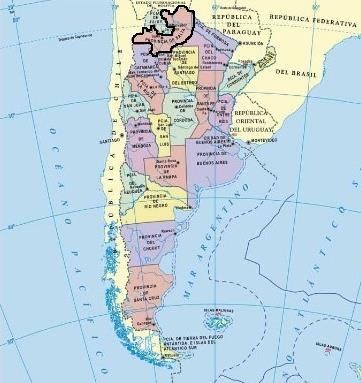 1.
1.
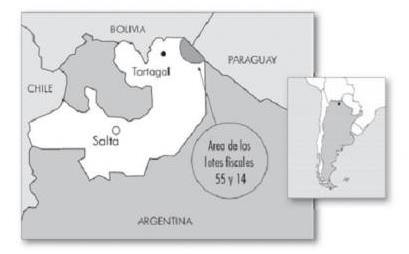 2.
2.
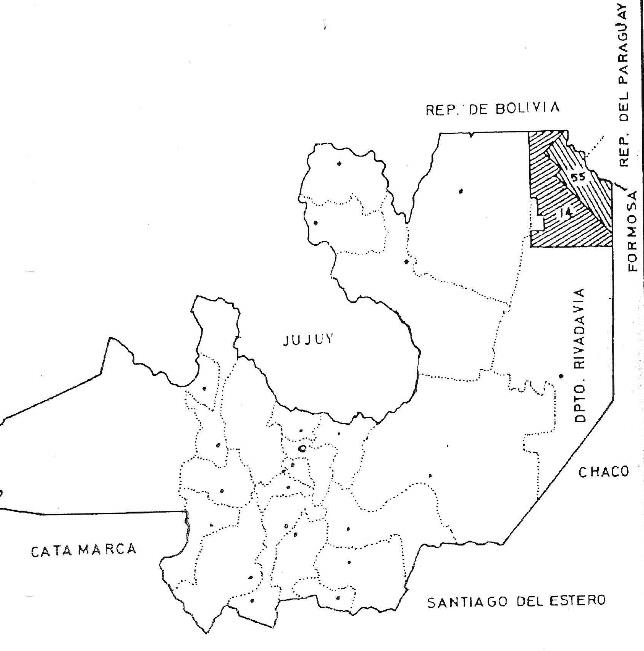 3.31
3.31
49. According to the expert opinions of Ms. Naharro and Ms. Buliubasich, indigenous people were present in the area prior to 1629 and, therefore, before the establishment of the Argentine State in the nineteenth century. Ms. Naharro’s expert opinion indicated that numerous testimonies and documents produced between the eighteenth century and the beginning of the twentieth century “mention the presence of hunter-gatherers in the area of the Pilcomayo [River].” Most of the indigenous people who have continued to live in this place up until today belong to the Wichí ethnic group. Different reports “reveal the importance of their relationship […] with their land and territory, and indicate the threat posed by the development of productive activities that are incompatible with their way of life.” State documentation indicates that the “aboriginal” population of the area belongs to the “so-called Chaco proto-culture” and is composed of “nomadic or semi-nomadic groups with an economy based on hunting, gathering and fishing.”32
50. The number of indigenous communities on Lots 14 and 55 is variable owing to the constant dynamic of community fragmentation and fusion that characterizes these peoples (supra para. 33).33 The State and the representatives indicated the existence of more than 2,000 indigenous families. The representatives affirmed that, at May 2018, “the indigenous communities were made up of around 2,031 families and approximately 10,155 persons.” There is no dispute that these are communities of indigenous peoples, or regarding their ancestral ties to the land they inhabit (infra footnote 88).
51. The indigenous presence in the area referred to has been constant and, in addition, the land has been occupied from at least the beginning of the twentieth century34 by individuals identified as “criollos,” in other words non-indigenous settlers or peasant farmers. Colonia Buenaventura was founded in 1902 and the national government transferred 625 hectares to the “criollo” families who settled there; subsequently, more land of the same or a greater area was transferred. However, in 1905, the Salta government advised the national government that lots adjudicated as national fiscal lands might be located within provincial territory and, in fact, later, at least after 1967, it was formally established that the land belonged to the province.35
52. The parties agree that, currently, the number of criollo families in the area exceeds 465. Argentina indicated that these are “small subsistence farmers who are basically dedicated to cattle raising” on “unfenced land,” “most of them” without hired hands. Several criollo families have installed fencing.36
| B) Relevant general legislation on indigenous lands |
53. Before describing the specific facts relating to the territorial claim in this case, the Court will indicate the pertinent State regulations with regard to rights of indigenous peoples. Bearing in mind that Argentina is a federal State and that the facts of this case relate to indigenous communities that inhabit the province of Salta, the Court will, first, refer to the national legislation, and then to that of Salta.
54. The Court notes that, at the national level, the following relevant legal provisions exist:
a) 1985 and 1989. Law 23,302 and Decree 155/1989. National law 23,302 on Indigenous policy and support for the Aboriginal Communities, enacted in 1985, created the National Institute for Indigenous Affairs (INAI).37 Its articles 7 to 13 refer to the adjudication of fiscal lands in favor of some of the country’s indigenous communities, establishing that INAI should draw up “plans” for land adjudication.38 Law 23,302 was regulated by Decree 155/1989 of the National Executive Branch (PEN),39 and, among its provisions, it states that INAI “[s]hall invite the provinces to accede to Law 23,302.” Law 23,302 and Decree 155/89 have remained in force following the 1994 constitutional amendment.
b) 1992. Law 24,071. Law 24,071 was promulgated on April 7, 1992, adopting Convention 169 of the International Labour Organization (ILO) on Indigenous and Tribal Peoples (hereinafter “Convention 169” or “ILO Convention 169”).40
c) 1994. Amendment of the Constitution. On August 22, 1994, the Constitution was amended.41 The pertinent aspect of the reform accorded constitutional rank to international human rights instruments including the American Convention. Article 75.17 established that: “[i]t shall correspond to Congress [… t]o recognize the ethnic and cultural pre-existence of the Argentine indigenous peoples[;…t]o recognize the communal ownership and possession of the lands they traditionally occupy, and to regulate the transfer of other suitable lands that are sufficient for human development, none of which shall be entailed, conveyed or attached.”
d) 2006. Law 26,160 and subsequent renewals. Law No. 26,160 on the Territorial Survey of Indigenous Communities, published on November 29, 2006, was promulgated to respond to the emergency situation with regard to the possession and ownership of lands occupied by indigenous communities in Argentine territory. The justification given by the PEN when submitting the respective bill to Congress indicated that it sought to “contribute to the policies that are already being implemented but that have not yet achieved their objective of recognizing the communal ownership of the lands occupied by the communities.”42 The text of the law establishes that execution of eviction proceedings and judgments be suspended for four years and that the indigenous territories be surveyed in order to achieve the “legalization of ownership.” The suspension of evictions indicated in the law was extended on several occasions, most recently until the end of 2021.43
e) 2010. Decree 700/2010. PEN Decree 700/2010 of May 20, 2010, set up a committee for the “analysis and legalization of indigenous communal property,” establishing that one of its objectives was to draw up “a bill to officialize a procedure that implements the constitutional guarantee of recognition of indigenous communal land possession and ownership, stipulating its legal nature and characteristics.”
f) 2010. INAI Resolution 328/2010: INAI Resolution 328/2010, issued on July 19, 2010, created the National Registry of Organizations of Indigenous Peoples (Re.No.Pi.).44
g) 2016. National Civil and Commercial Code. On January 1, 2016, Law 26,994, promulgated on October 7, 2014, entered into force, repealing the Civil and Commercial Codes and adopting the National Civil and Commercial Code, applicable at both the national and provincial level. Article 9 of the law indicates that “[t]he rights of the indigenous peoples, in particular to communal property […] shall be subject to a special law,” and article 18 of the new Code establishes that “the recognized indigenous communities have the right to the communal ownership and possession of the lands they traditionally occupy and other suitable lands that are sufficient for human development as established by law pursuant to the provisions of article 75.17 of the Constitution” (italics added).
55. In the case of Salta, in 1986, the province adopted Law 6,373 on Promotion of Aboriginal Development, establishing that the “Provincial Institute for Aboriginal People,” set up under this law would carry out a survey of “aboriginal settlements” and then conduct the necessary procedures for the “adjudication” of “ownership” to the land. In 1992, by Law 6,681, Salta acceded to National Law 23,302 on Indigenous policy and support for the Aboriginal Communities. In 1998, the Salta Constitution was amended and the current wording of the relevant part of article 15 recognizes the indigenous peoples’ “communal possession and ownership of the fiscal lands that they traditionally occupy.” In 2000, Salta adopted Law 7,121, concerning the development of the indigenous peoples of Salta. The law created the Provincial Institute of Indigenous Peoples of Salta (IPPIS) and contains a chapter on land adjudication the articles of which include a similar text to the respective articles in Law 6,373. In 2011, Salta issued, Decree 3459/11, ratifying a cooperation agreement between the provincial Ministry of Human Development and INAI. In 2014, Decree 3505/14 “to reinforce the legalization process […]to guarantee recognition of the property of the communities.” It ordered the creation of the “Provincial Executing Unit for the Territorial Survey of Indigenous Communities of the province of Salta (U.E.P.Re.Te.C.I.),” “to coordinate” actions between the nation and the province to “survey” “land occupied by the indigenous communities.”
| C) Indigenous territorial claims in this case |
56. The Court will now outline the events following the indigenous land claims. For greater clarity, the incidents that have taken place over almost 35 years (calculated from the initial actions) will be divided into stages. As this Court has been able to note, these respond to changes in State policies regarding indigenous property. Accordingly, the Court will describe: (a) a first stage (prior to 1999), in which the State received the initial claims and took steps towards a unified recognition of ownership; (b) a second stage (1999 - 2004), during which the State’s policy tended towards a fragmented recognition of ownership; (c) a third stage (2005 and 2006), marked by a referendum on property ownership and the creation of a specific State entity to implement actions concerning land, and (d) a fourth stage (after 2007) during which agreements were signed between criollos and indigenous peoples and steps were taken to implement these.
| C.1 First stage (prior to 1999): first claims and commitments to grant land titles |
57. One of the precedents to the facts of this case was that, on June 26, 1984, indigenous communities settled on Lots 14 and 55, in a “Joint declaration,” requested Salta to grant them title to the land and contested the sub-division of the territory.45
58. In 1987 the provincial state decided to recognize land ownership to the “occupants” of Lot 55, whatever their “condition” (that is, both criollos and indigenous peoples) who met certain requirements.46
59. On July 28, 27 indigenous communities settled on Lot 55 submitted a formal claim to Salta for “legalization of the title to ownership of the land.”47
60. On December 15, 1991, Decree No. 2609/91 was issued ratifying the terms of a memorandum of understanding of December 5. The Decree established as an obligation of the province: (a) unification of Lots 14 and 55 “to subject them to a common purpose,” and (b) adjudication of “a surface area without subdivisions, by a single title of ownership, to the [indigenous] communities.”48
61. On December 9, 1992, Ministerial Resolution 499 was issued adopting the statute of the “Lhaka Honhat Association of Aboriginal Communities” and granting it legal status. The Association is composed of inhabitants of Lots 14 and 55 who are members of indigenous communities. Its “objectives” include: “obtaining land ownership titles”; “protecting the forest and the river”; “monitoring and controlling the exploitation of the area’s renewable natural resources […] as established by the pertinent laws in coordination with the relevant State agencies,” and “ensuring respect for the universally recognized rights of the aboriginal peoples to use freely their natural wealth and their resources to meet their particular needs.”49
62. In 1995, Salta issue Decree 3097/9550 adopting recommendations made in April that year by an advisory committee created in 1993 by Decree 18/93.51 It had been suggested that two-thirds of the total surface area of Lots 14 and 55 should be transferred to indigenous communities and one-third to the criollo population. At that time, the petitioners advised the Inter-American Commission that the indigenous communities had accepted this. Subsequently, in April 1996, the Lhaka Honhat Association and Salta signed a memorandum of understanding “to advance towards a plan to regularize the settlements on Fiscal Lots 55 and 14.”52
63. In 1995, the construction of an international bridge was started in the territory claimed by indigenous communities. On August 25 and September 16, 1996, several members of the indigenous communities occupied the bridge (infra para. 180). The Governor of Salta visited the site in person and signed an agreement in which he undertook to issue a decree within 30 days that “ensured the final adjudication of the land in question, establishing the terms and conditions.”53
64. Between 1996 and 1998, Lhaka Honhat sent several letters to the authorities asking them to formalize communal ownership of the property.54
| C.2 Second stage (1999-2004): attempts to divide up the land into individual parcels and indigenous opposition |
65. On November 8, 1999, the province published edicts pursuant to Resolution 423/99 issued on November 2, serving notice to all those who considered that they had rights over the land of Lot 55, because some of the land would be adjudicated to inhabitants of that land who had been surveyed.55 On December 24, by Decree 461, Salta adjudicated parcels within Lot 55 to some individuals and indigenous communities settled on the land.56
66. On November 1, 2000, it was agreed to initiate a process of “discussions” for the State to suspend the civil works on the territory and halt the land grant process.57 On December 15 that year, Salta presented a proposal for the adjudication of Lot 55, granting parcels to each community, but subject to each one having legal status. In a letter of February 6, 2001, Lhaka Honhat contested the proposal arguing that it did not include Lot 14, that it did not establish a single title, but rather fragmented titles, that it subjected the granting of land to agreements with criollos, and that it required each community to obtain legal status.58 In August 2001, the State informed the Inter-American Commission that it agreed to incorporate Lot 14 into its proposal.59
67. On February 22, 2001, Salta issued Decree No. 339/01, creating a committee composed of representatives of the State, the criollos and the indigenous communities to complete the “mapping” of Lots 14 and 55 in order to establish the “location of the different indigenous and criollo communities.”60 On December 26 that year, Lhaka Honhat advised the Inter-American Commission that the said committee had never met and that the indigenous communities themselves had begun to survey the population and map the lots.61
68. On September 11, 2001, June 4 and July 8, 2002, and August 5 and September 9, 2004, the petitioners at the time advised the Inter-American Commission that Salta’s agents continued to survey and demarcate Lots 14 and 55.62 On August 5, 2004, the State indicated that it would refrain from carrying out any other public works or infrastructure that had not been agreed with the petitioners and that it would not conduct any further surveys or make partial land grants on the lots claimed.63
| C.3 Third stage (2005-2006): Creation of the Provincial Executing Unit (UEP), referendum and subsequent actions |
69. On March 2, 2005, during a working meeting at the seat of the Inter-American Commission, the province of Salta presented a land distribution proposal.64
70. On May 10, 2005, Provincial Decree 939/05 was published creating the “Provincial Executing Unit (UEP)” to be the authority responsible for executing Salta’s proposal of March 2005, and one of its functions was to identify the area occupied traditionally, move the criollos, and verify the relocation agreements.65
71. During March 2005, in the context of the international processing of the case before the Commission, Salta expressed its intention of holding a referendum. In May and June that year various national State entities expressed their opposition to this consultation.66 Nevertheless, on July 25, 2005, provincial Law 7,352 was published announcing the referendum for the entire population of the department of Rivadavia eligible to vote to decide on the “handing over” of the land comprised by Lots 14 and 55. Specifically, the law called on “the electorate of the department of Rivadavia to vote responding whether or not they wanted the lands corresponding to Fiscal Lots 55 and 14 to be transferred to the current occupants.” On October 8, 2005, the caciques, members of Lhaka Honhat, signed a public statement asking for the referendum to be suspended.67
72. The referendum was held on October 23, 2005, at the same time as the provincial and national legislative elections. A “yes” vote meant that the voter was “in favor of transferring the land corresponding to Fiscal Lots 55 and 14 to the current occupants, both aboriginals and criollos, executing the necessary infrastructure works.” The “yes” vote obtained the majority with 98% of the votes cast.68
73. Between December 2, 2005, and April 19, 2006, Salta published orders aimed at taking steps to implement the transfer of the land in keeping with the result of the referendum, summoning criollo families to submit forms to confirm certain requirements in this regard.69
74. Despite the foregoing, on March 14, 2006, in a meeting between the Secretary General of the Office of the Governor of Salta and the General Coordinator of Lhaka Honhat, it was agreed that the traditional occupation of the land should be respected; in other words, a minimum of 400,000 ha under a single title. In this regard, the representatives indicated that following the mapping exercise conducted at the beginning of 2000, it had been concluded that the communities used around 530,000 ha, but had decided to reduce their claim to 400,000 ha.70
| C.4. Fourth stage (after 2007) |
| C.4.1 October 2007 Memorandum of Understanding and implementing actions |
75. On June 1 and August 24, 2007, Lhaka Honhat and the Organization of Criollo Families (OFC) reached agreement, recorded in memoranda, on the surface area of the land that would correspond to the indigenous peoples (400,000 ha), and the area that would be destined to relocate any criollo families that had to be moved, and on the applicable distribution criteria.71 On October 17, 2007, a Memorandum of Understanding was signed with representatives of Salta and the national State, confirming this.72 On October 23, Salta issued Decree 2786/0773 formally endorsing the Memorandum of Understanding and allocating the ownership of Lots 14 and 55 to the occupants: 400,000 ha to the indigenous communities and 243,000 ha to the criollo population. This decree revoked the obligation of the communities to obtain legal status in order to obtain individual titles, which had been established in Ministerial Resolution 65/06 the purpose of which was to execute the results of the referendum.
76. On October 28, 2008, Salta issued Decree 4705/08 creating a technical team, composed of members of the UEP, to implement the land transfer. Subsequently, in 2009, the year in which a series of meeting was held between the criollo and the indigenous populations, Salta issued Resolution 340/09, establishing the final list of criollo settlers who met the previously established requirements to prove their occupation of the land.74
77. Between 2009 and 2011 various meeting were held to try and reach agreements between the indigenous communities and the criollo families on the adjudication of the land.
| C.4.2 Decree 2398 of 2012 and subsequent actions75 |
78. On July 25, 2012, Salta issued Decree 2398/12, the text of which cites the Merits Report as a precedent. The decree established the “allocation, for its subsequent adjudication” of 243,000 ha of Lots 14 and 55” to the criollo families “that have authenticated their right” pursuant to Resolutions 65/06 and 340/09, and 400,000 ha to the indigenous communities “under communal ownership and under the titling arrangement that each of them determines.” In addition, it ordered the publication of the said allocations by the corresponding registration in the Land Registry.76
79. On July 12, 2013, Provincial Decree 2001/13 was published and this included a “Program to legalize the communal property” that mentioned a “work plan” to define the territorial delimitations based on “participatory workshops” with indigenous peoples and criollos.77 In addition, at the same time, the representatives and the State agreed that a map prepared by the Lhaka Honhat communities would be used as a basis for any fieldwork.78
| C.4.3 Decree 1498 of 2014 and subsequent actions |
80. On May 29, 2014, Salta issued Decree 1498/14, establishing that it: (a) “recognize[d] and transfer[red]”; (i) “communal ownership” to 71 indigenous communities of approximately 400,000 ha of the “real estate” with cadastral registration numbers 175 and 5557 of the department of Rivadavia, in the province of Salta” (previously identified as Fiscal Lots 55 and 14),79 and (ii) “ownership under the condominium regime” of the same land in favor of numerous criollo families;80 (b) reserve[d] to the provincial state 6.34% of the land for “institutional use”’ (c) established that the “specific determination” of the land and lots that correspond[ed] to the indigenous and the criollo families “and all the necessary acts and procedures prior to the adjudication and obtaining of the corresponding registration” would be carried out through the UEP.
81. In its considerations, Decree 1498/14 indicated that, for the specific location of territories of the communities and lots of criollo families, it would take into account, “as a reference” the map provided to the province by Lhaka Honhat.81 A version of this map, copied below, was forwarded to the Court by the representatives:82
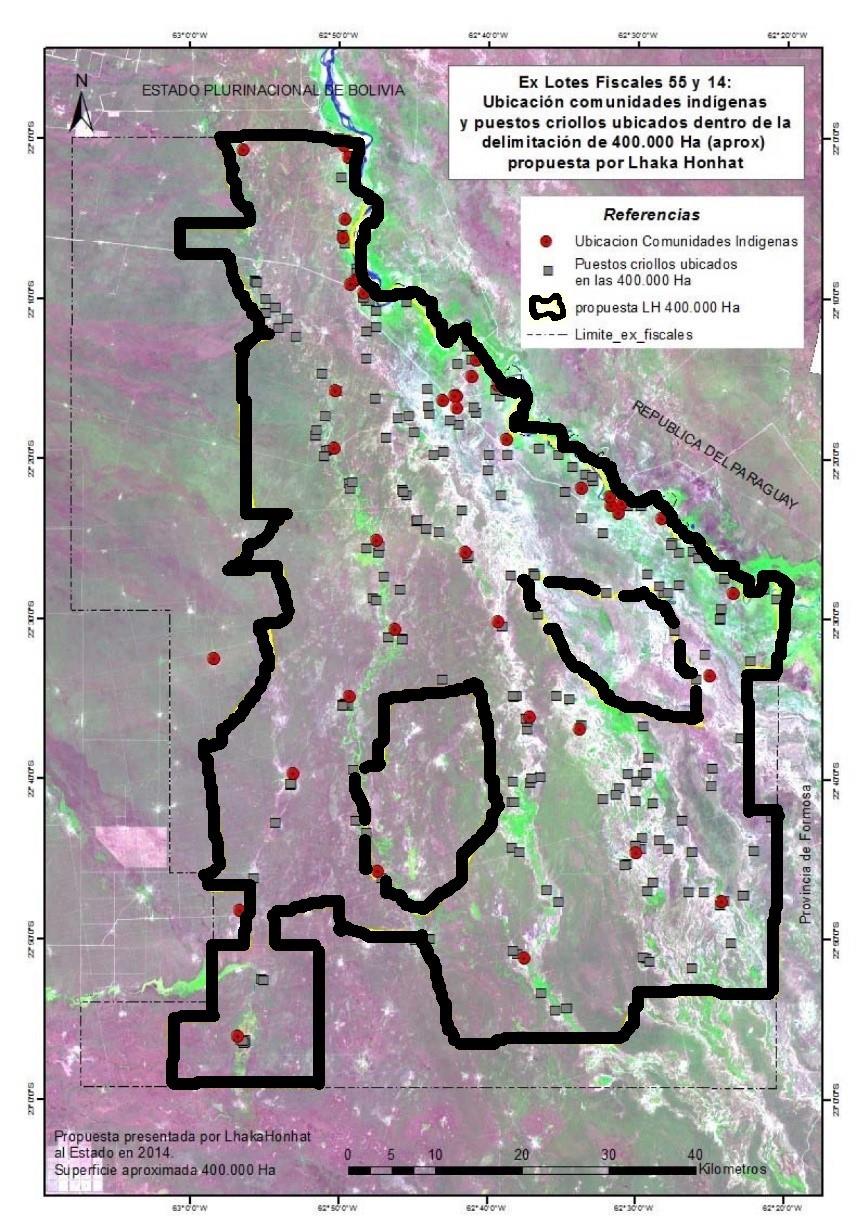
82. On July 28, 2014, Salta issued Resolution 654, adopting cooperation agreements in relation to the “work plan” for Lots 14 and 55. These agreements had been signed by the Salta Human Rights Ministry and the UEP with Lhaka Honhat and the OFC, and established that these two organizations would appoint five persons to incorporate the UEP as “field technicians.”83
83. On November 27, 2014, and during the first months of 2015, the indigenous communities informed the Commission that delays continued in the demarcation and titling fieldwork.84
84. According to information presented by the representatives, from September 2015 to the end of June 2016, budgetary resource were not available for the procedures and infrastructure works required for the relocations.85 In addition, there was no information on coordination of tasks by the national State and the UEP. On July 19 that year, the State advised the Inter-American Commission that a series of agreements had been signed to move forward with the legalization of the indigenous communal property.86
85. On October 25, 2017, during a working meeting with the Commission, the State announced a “comprehensive work plan to comply with the recommendations [of the Merits Report],” which established an implementation time frame of eight years.87
| D) Construction work, activities and projects on the territory claimed |
86. Information has been presented indicating that illegal logging activities have been carried out in the area of Lots 14 and 55. It has also been indicated that the criollo population raises cattle and has installed fencing. This information is described below (infra paras. 257 to 266).
87. The Court will also describe below (infra paras. 177, 178 and 180, and footnotes 165 and 166) facts and indications related to work carried out or planned on the territory in relation to: (a) construction of an international bridge; (b) national highway 86; (c) provincial route 54, and (d) oil and gas exploration.
| E) Administrative and judicial actions filed in this case |
88. Lhaka Honhat filed judicial actions related to the facts of the case: (a) on September 11, 1995, an application for amparo before the Salta Court of Justice (hereinafter also “CJS”) requesting the immediate suspension of the work on the international bridge (supra para. 87 and infra para. 180); (b) on March 8, 2000, an application for amparo against Decree 461/99 and Resolution 423/99 (supra para. 65), and (c) on August 11, 2005, an action before the National Supreme Court of Justice (hereinafter also “CSJN”) requiring a declaratory judgment against the referendum law (supra para. 71). These actions will be dealt with below (infra paras. 297, 300 and 303). Also, in 2017, Lhaka Honhat applied for recognition as an indigenous organization in the administrative jurisdiction (infra footnote 148). There is no record that this application was decided.
VII MERITS
89. In this case, there is no dispute that the indigenous communities have ancestral ties to the territory or their right to its ownership,88 and this has been recognized in different domestic laws. The dispute relates to whether the State's actions have provided legal certainty to the right to property and its full exercise. Thus, while Argentina has indicated that it has acted diligently to ensure this, the Commission and the representatives maintain the contrary. In addition, it has been indicated that activities carried out on the territory have harmed the environment, food sources and cultural identity. In this regard, it has been alleged that several rights have been violated89 and the Court has been asked to consider various situations, including judicial proceedings.
90. The facts set out previously – and more will be described below – reveal that the State’s conduct has involved laws, but also different actions and procedures, to determine the property and possible relocation of settlers who are “criollos” – in other words, non-indigenous settlers – who inhabit the area, and to effect their relocation. Actions have also been taken to control illegal logging and the installation of fencing. All this has occurred over the course of several years in relation to a more extensive area of land inhabited by a large population composed of criollos and numerous indigenous communities belonging to different peoples, whose numbers vary. The State’s actions in these circumstances have required the intervention of different provincial and national government agencies, as well as the allocation of human and budgetary resources. The Court notes these circumstances and the significant complexity they represent and will take them into account.
91. The Court will make its analysis as follows: (1) first, it will refer to the right to communal property, and examine other rights that, as has been alleged, are related to property in this case: (a) it will set out some general considerations on indigenous communal property and then outline the respective arguments of the Commission and the parties together with the Court’s analysis of: (b) the recognition and determination of communal property, and (c) projects and construction works executed on the territory claimed. The Court will then examine: (2) the arguments relating to violations of the rights to freedom of movement and residence, a healthy environment, food and cultural identity, also considering the right to water, and (3) the alleged violations of the rights to judicial guarantees and judicial protection in relation to judicial actions filed in this case.
VII.1 RIGHT TO INDIGENOUS COMMUNAL PROPERTY90
| A) General considerations on communal property |
92. The Court will refer to different elements of the right to communal property and finds it useful to establish some general consideration on this right and refer to some aspects regarding which it has developed case law.
93. The Court has referred to the content of the right to indigenous communal property and its implications. In 2001, in the case of the Mayagna (Sumo) Awas Tingni Community v. Nicaragua, taking into account different interpretation parameters,91 it established that the right to private property recognized in Article 21 of the Convention included, in the case of indigenous peoples, the communal ownership of their lands.92 Thus it explained that:
Among indigenous [people] there is a community tradition that relates to a communal form of collective ownership of the land, in the sense that its possession is not centered on an individual, but rather on the group and its community. Indigenous people, due to their very existence, have the right to live freely on their own territories; the close relationship that indigenous people have with the land should be recognized and understood as the very foundation of their cultures, their spiritual life, their integrity, and their economic survival.93
94. In 2005, when deciding the case of the Yakye Axa Indigenous Community v. Paraguay, the Court understood that the right to property protects not only the connection of the indigenous communities to their territories, but also “the natural resources these territories contain that are connected to their culture, as well as the intangible elements derived from them.”94 Then, in the case of the Saramaka People v. Suriname, it indicated that “the right to the use and enjoyment of the territory would have no meaning if it was not connected to the natural resources that are found within that territory.” Consequently, the ownership of the land relates to the “need to ensure the security and permanence of the control and use of the natural resources […], which, in turn, preserves the way of life” of the communities. The resources that are protected by the right to communal property are those that the communities “have used traditionally and that are necessary for the very survival, development and continuity of their way of life.”95 Therefore, any activities by the State or third parties that could “affect the integrity of the land and natural resources” should respect certain parameters that the State must guarantee: the real participation of the communities concerned; their reasonable benefit, and the prior execution of social and environmental impact assessments.96
95. In addition in the 2001 judgment in the case of the Mayagna (Sumo) Awas Tingni Community v. Nicaragua, the Court indicated that “the possession of the land should suffice for the indigenous communities […] to obtain official recognition of their communal ownership and its consequent registration.”97 This action declares the pre-existing right; it does not constitute the right.98 In its 2005 judgment in the case of the Yakye Axa Indigenous Community v. Paraguay, the Court underscored that the State should not only acknowledge the right to communal property, but should also make this “truly effective in practice.”99 The Court has indicated that the relationship of the indigenous peoples with the land “is not merely a privilege that is granted to use the land that can be taken away by the State or overshadowed by property rights of third parties, but a right […] to obtain title to their territory in order to guarantee the permanent use and enjoyment of this land.”100 When ruling on the case of the Sawhoyamaxa Indigenous Community v. Paraguay in 2006, the Court stipulated that:
(1) traditional possession of their lands by indigenous people has equivalent effects to those of a state-granted full property title; (2) traditional possession entitles indigenous people to demand official recognition and registration of property title; (3) the members of indigenous peoples who have unwillingly left their traditional lands, or lost possession thereof, maintain property rights thereto,101 even though they lack legal title, unless the lands have been lawfully transferred to third parties in good faith, and (4) the members of indigenous peoples who have unwillingly lost possession of their lands, when those lands have been lawfully transferred to innocent third parties, are entitled to restitution thereof or to obtain other lands of equal extension and quality.”102
96. The State is obliged to give “geographical certainty” to the communal property as this Court indicated when deciding the case of the Mayagna (Sumo) Awas Tingni Community v. Nicaragua. On that occasion, and in subsequent decisions, the Court referred to the obligation ”to delimit” and “to demarcate” the territory, in addition to the obligation to “grant title to it.”103 For example, in 2014, in the case of the Kuna Indigenous People of Madungandí and the Emberá Indigenous People of Bayano and their members v. Panama, the Court stated that, “based on the principle of legal certainty, the State obligation to take measures to ensure the right to property of the indigenous peoples necessarily signifies, that the State must demarcate, delimit, and grant title to the territories of the indigenous communities […]. Therefore, failure to comply with these obligations constitutes a violation of the use and enjoyment of the property of the members of the said communities.”104 Demarcation and granting title should result in the peaceful use and enjoyment of the property.105
97. In keeping with the foregoing, in 2015, the Court underlined that “based on the principle of legal certainty, the territorial rights of indigenous peoples must be implemented by the adoption of the legislative and administrative measures required to create an effective mechanism for delimitation, demarcation and titling that recognizes those rights in practice” and makes them enforceable before the State authorities or third parties.106 It included similar findings in its 2018 decision in the case of the Xucuru Indigenous People and its members v. Brazil.107
98. Based on the above, it is relevant to recall that the State must ensure the effective ownership of the indigenous peoples and, therefore, it must: (a) delimit indigenous lands from others and grant collective title to the lands of the communities;108 (b) “refrain from carrying out actions that may result in agents of the State or third parties acting with its acquiescence or tolerance, adversely affecting the existence, value, use and enjoyment of their territory,”109 and (c) guarantee the right of the indigenous peoples to truly control and use their territory and natural resources,110 and to own their territory without any type of external interference from third parties.111
| B) Recognition and determination of communal property |
99. The Court will now consider the arguments submitted by the Commission and the parties with regard to the recognition and determination of the property. In other words, it will assess the arguments on the alleged absence of appropriate procedure to guarantee the ownership and granting of an adequate property title that would provide legal certainty to the right. It will also examine the obligation to ensure the right to property in relation to the presence of non-indigenous settlers on the claimed territory. These arguments relate to the right to property established in Article 21 of the Convention. The violation of the rights to an effective procedure for the protection of property, to recognition of juridical personality, to freedom of association, and of political rights has also been alleged. These are established, respectively, in Articles 8 and 25, 3, 16 and 23 of the Convention.
| B.1 Arguments of the Commission and of the parties |
100. The Commission argued that the State had violated the communities’ right to property “because it had not provided effective access to property titles over ancestral territory,” and added that this violation occurred: (a) because it had failed to implement domestic norms that recognized this, and (b) in relation to the rights to judicial guarantees and protection, owing to the absence of an effective procedure to recognize and “legalize” ownership.112 In its Merits Report, the Commission linked this to non-compliance with Articles 1(1) and 2 of the Convention, which establish, respectively, the obligations to respect and to ensure rights, and to adopt domestic legal provisions.113
101. The Commission indicated that it was 23 years after the first agreement, in 1991, that Decree 1498/14 transferred the ownership to the communities. However, the dispute had continued with regard to the demarcation of the territory and the way in which the land had been titled. It argued that “the communities still do not have a single, communal title” and it concluded that “the State continues to fail to comply with its obligation to make decisive and definitive progress in demarcation and delimitation.”
102. The Commission also understood that the State had violated the right to property owing to the failure to “provide clear title” to the territory. It noted the presence of non-indigenous settler families on Lots 14 and 55.114 It argued that “the State had failed to comply with its duty to prevent non-indigenous families from continuing to settle on the ancestral territory.” It concluded that “now that more than 20 years ha[d] passed since the first agreement signed with the province of Salta and [five] years since the issue of Decree 1498/14, the communities have not been able to enjoy the territory effectively.”
103. The representatives argued the violation of the right to communal property owing to: (a) the ineffectiveness of norms to allow the real enjoyment of this right; (b) the enactment of laws contrary to the realization of the “right to communal property”; (c) “the implementation of a fieldwork methodology characterized, first, by the successive and unilateral changes in the applicable procedures and, then, by the decision to subject […] the process to the will of third parties” (criollo settlers), and (d) the absence “in […] Argentina and Salta of an institutional mechanism for the delimitation and demarcation of territories.” They alleged the violation of the same rights and obligations as those indicated by the Commission.115
104. The representatives argued that the State had not provided an effective procedure that would make it possible to “delimit, demarcate and title indigenous territory”’; one that could “provide a concrete response to the territorial claims of the communities”, including with regard to the “providing clear title to the [territory].”
105. They indicated that the violation of the right to property was “constituted” because “the indigenous communities still do not have title to their communal property [and] that much remains to be done in relation to the demarcation and delimitation of their territories.” They emphasized that, to respect the “traditions and cultural norms” of the communities, the title required was “a single collective title without internal subdivisions” or “individual parcels.”116 They pointed out that Decree 1498/14 is not the same as a title and that “it has established a condominium arrangement between communities […], criollo families and the province of Salta itself over Lots 55 and 14.”
106. In this regard, they affirmed that the State had implemented a work methodology that disregarded its duty to return the indigenous lands and territories, because it was operating under the assumption that relocation agreements existed between indigenous and criollo families. They indicated that, “by failing to develop an alternative mechanism to guarantee the territorial rights if agreements were not reached,” the State was trying “to subject any guarantee of rights of the indigenous communities to the wishes of third parties.”117 They added that an “extremely” serious violation of political rights had been verified produced by the “fraudulent” referendum held in 2005 and affirmed that it was not possible to submit the guarantee and protection of fundamental rights of the indigenous communities to a plebiscite.118
107. The representatives also argued that the recognition of juridical personality had not been effective because, in 1992, several communities had to organize themselves into a civil association to obtain legal status and negotiate the property claim. They indicated that this type of association bears no relationship to the traditional form of organization of the indigenous communities. They explained that, on October 23, 2017, an explicit request was sent to the Salta Ministry of Indigenous Affairs for recognition of Lhaka Honhat as an indigenous organization with its respective legal status. They pointed out that the Ministry had not replied to this request and indicated that “the lack of juridical personality […], also interferes in the exercise of the right to freedom of association, because […] it prevents the exercise of forms of community association for territorial and cultural claims.” They added that “the registration” in the National Registry of Indigenous Peoples (Re.No.Pi.), regulated by INAI Resolution 328/2010, “does nothing to resolve the violation of the right […] to juridical personality […] because it contains a series of requirements that are not adapted to the form of organization adopted by Lhaka Honhat.”119 The also noted that this resolution is from 2010 and that, at that date, the violation of the right to juridical personality had already been “consolidated.”
108. The representatives also affirmed that, given the presence of the criollo population, there was a “failure to guarantee the property rights.” They indicated that, on May 25, 2018, of 282 criollo families who should have been relocated, only two had completed the process fully (infra footnote 143).
109. The State denied that rights relating to the land had been violated. It argued that “there can be no doubt regarding recognition of the communities’ right to property,” and that Argentina had “worked continuously to achieve the full enjoyment of all the rights.” It underscored the “complexity” of the case, which it classified as “extreme” indicating, among other reasons, the presence of “criollo settlers with rights in the area,” the need for “public works” to “facilitate the relocation of the settlers,” the “problems” relating to “specific competences” of Salta and the national State, and “the complexity resulting from the appearance of new communities that, perhaps in the future, do not want to be part of a single title.”
110. The State developed its arguments, indicating that it had recognized the communities’ right to property in different acts.120 It affirmed that “[t]he communities] already possess the single title based on Provincial Decree 1498/14.” It asserted that “[t]he criteria for recognition of the lands […] was based on provincial, national and international laws that recognize the areas of traditional use as the territory of the communities.” Argentina added that “financial and human resources ha[d] consistently been devoted to the historical process of land regularization.” It also indicated that the referendum had produced no legal effect and, therefore, the Court should not rule on that situation.121
111. Argentina explained that it was developing a participatory working method in agreement with the parties (criollos and indigenous peoples), based on the map presented by the “petitioners.” The “methodology” involved a “dialogue” between the indigenous communities and the criollo families. Argentina asked the Court to “take into account the characteristics of the conflict and the realistic way of resolving it, noting the progress that had been made towards finding a peaceful and participatory solution.” It emphasized that “owing to the agreements reached, it had been possible to delimit the territory” and that “demarcation required the participation of all those concerned.”122 It explained that, in order to “grant the single title to the indigenous communities in which the criollo families do not appear as co-owners, […] it is essential that all the agreements between the parties have been signed, and this involves the active participation of the communities and the criollos, so that achieving this depends to a great extent on the willingness of the said parties.” It added that “[t]he survey and demarcation were also indispensable, as well as the signature of the deed transferring ownership to the criollo families. Once this formal act has been completed, the criollo families will cease to appear registered as titleholders of Lots [14 and 55].” It also indicated that difficulties had been encountered in the “relocation” process.123
112. The State recalled that Article 21 of the Convention indicated the possibility of subordinating the use and enjoyment of property to “the interests of society,” and understood that such interests are “constituted” in this case not only for the indigenous communities affiliated with Lhaka Honhat, but also for other communities who are not affiliated and for criollo families. It alleged that the criollo families are “vulnerable rural settlers.” It indicated that it was necessary to harmonize the rights of the indigenous communities affiliated with the Lhaka Honhat Association with those of the indigenous communities that were not represented by this Association,124 as well as the criollo population. Hence, it argued that the State “also has to guarantee the right of the settlers to obtain title to the lands that they have historically inhabited” and that the said right was “guaranteed by responding to the claims of [the indigenous communities] and reaching total agreement with them.”
113. Responding to the arguments concerning the presumed violation of the rights to juridical personality and to freedom of association, Argentina explained that the Re.No.Pi. was created to register organizations of indigenous peoples and that Lhaka Honhat had never applied for registration. It also indicated that “the actual organizational structure does not affect [Lhaka Honhat].” Argentina argued that the fact that Salta had recognized the right of the indigenous communities to communal property by Decree 1,498/14, as well as the “permanent” dialogue between the UEP and the communities revealed the absence of a violation of juridical personality. In its final written arguments dated June 3, 2019, the State indicated that “for approximately 10 years, the presumed victims had been able to register themselves, adopting the organizational structure in keeping with their traditions, without needing to organize under associative forms that were alien to their culture.”
| B.2 Considerations of the Court |
| B.2.1 Description of the State’s actions in this case and the corresponding analysis |
114. It has been established that the indigenous communities’ right to ownership of their ancestral territory is not in discussion and this has been recognized in different State acts (supra para. 89). This will also be referred to below (infra paras. 130, 145, 146, 149, 156 and 167). However, the Court must determine whether the State’s actions in this case have provided adequate legal certainty to the right to communal property and have permitted the free exercise and enjoyment of that right by the indigenous communities.
115. In this regard, based on the standards previously mentioned (supra paras. 93 to 98), the Court has indicated that the indigenous communities have the right to be granted a “formal property title, or other similar State recognition, that grants legal certainty to the indigenous ownership of land vis-à-vis the action or third parties or of agents of the State itself.”125 In this context, the diverse and specific ways and means of control, ownership, use and enjoyment of the territories by the communities should be acknowledged,126 without interference from third parties (supra para. 98).
116. As already indicated (supra para. 97), in order to implement the territorial rights of the indigenous peoples protected by Article 21 of the Convention, States must provide an effective mechanism by the adoption of the necessary legislative and administrative measures. These must meet the requirements of due process established in Articles 8 and 25 of the American Convention.127 In light of Article 2 of the Convention, States must adapt their domestic laws to ensure that such mechanisms exist and are adequate128 and effective: thus, they must provide a real possibility for the communities to be able to defend their rights and exercise effective control of their territory without any external interference.129 In addition, it should be established that the indigenous peoples have a right not to be subjected to an unreasonable delay in the final settlement of their claims.130
117. What happened in this case must be assessed in relation to the preceding parameters. The Court notes that, as will be explained, the State has recognized the communal property, but it must now analyze whether this was done adequately and in a way that was compatible with the Convention. The State has taken various measures with regard to the recognition of property; however, such measures have not been the result of the implementation of a regulated procedure, previously established by law. What occurred was a property claim by the indigenous communities in 1991, followed by an interaction between the communities and the government. Over the years, this has been marked by various events in which the criollo population has intervened and several agreements have been reached with the latter, ratified by pieces of State legislation. That interaction, which was not conducted in keeping with legally established procedural standards resulted in various government acts – basically decrees issued by the Salta Executive – that, in different ways, advanced the recognition of ownership.
118. That said, the Court has indicated that, in light of Articles 2, 8, 21 and 25 of the Convention, considered as a whole, States must establish appropriate procedures to facilitate indigenous territorial claims in their domestic law (supra para. 116). However, if, in a specific case, the State has realized the right to communal property in another way, it is not necessary to examine whether its domestic laws are adapted to this right. To the contrary, if it is concluded that the right has not been realized, it would be relevant to analyze whether relevant aspects of the legal system have had an impact on this.
119. Consequently, first the Court will examine whether Argentina has adequately ensured the right to property under Article 21 of the Convention and then, if this is so, the compatibility of the State’s laws with the Convention. The Court will not take into account Articles 8 and 25 of the Convention when making this initial analysis, because they are not applicable since, as indicated, the actions were not part of a previously regulated procedure (supra para. 117). Thus, it will not analyze whether a reasonable time was ensured as a procedural guarantee, although it may take into account the impact of time on the exercise of the right to property.
120. It should also be clarified that the Court will examine compliance with Article 21 of the Convention in relation to the obligation to ensure rights established in Article 1(1) of this instrument, but also with regard to Article 2, although in a different sense to that indicated previously. Article 2 relates not only to the formal adaptation of domestic law to the Convention by the adoption of “legislative measures,” but also to the adoption of “other measures” to give effect to the rights. Such measures may include those addressed at implementing the laws that the State has adopted in order to realize a right.131 Hence the Court will assess the State's conduct considering its actions that have formally made progress in the recognition of the property rights, but also the measures taken to implement this.
121. On this basis, the Court will therefore evaluate whether the State has adequately facilitated the recognition of property rights. As will be described (infra para. 130), it is clear that, at least since 2007, based on agreements between the criollo and indigenous populations, ratified by the State, it has been determined that an area of 400,000 ha in Lots 14 and 55 corresponds to the indigenous communities. The facts also reveal that, despite this, the separation of indigenous property from the land corresponding to the criollo population has still not been completed; the presence of criollos continues and the “dialogue” methodology (which will be described below, infra paras. 131 and 140 to 144) to reach agreement on the different “relocation” sites and transfer the criollos has not concluded.132
122. Based on the above, the Court will now analyze the State’s conduct reviewing the events in chronological order.
| B.2.2 Actions taken towards recognition of ownership |
| B.2.2.1 Prior to 1999 |
123. As the description of the facts reveals, the original indigenous claims over Lots 14 and 55 were made more than 35 years ago. However, based on the information provided to the Court, within its temporal jurisdiction (supra para. 13 and footnote 45) it was in July 1991 when, for the first time, a claim was formally made (supra para. 59). The State’s conduct will be evaluated as of that time.
124. In December 1991, Decree No 2609/91 was issued ordering the merger of Lots 14 and 55 so that they could then be “adjudicated” by a “single property title” (supra para. 60). Although this objective was not met at that time, the Court does not find that, prior to 1999, the State acted in a way that was contrary to its substantive international obligations.133 Nevertheless, it should be considered that, between 1996 and 1998, Lhaka Honhat sent several letters to the authorities asking them to give effect to the formalization of the communal ownership of the territory,134 without any record of progress at that time.
| B.2.2.2 From 1999 to 2004 |
125. A change in the State's conduct can be noted in 1999 following Decree 461/99, by which the province adjudicated parcels within Lot 55 to some individuals and indigenous communities settled there.135 The decree sought to allocate parcels that contravened the unity of the indigenous territory and the terms that had been established by the State itself in Decree 2609/91 (supra paras. 60 and 124). In 2007, the Salta Court of Justice declared that Decree 461/99 was “null and void” (infra para. 300), indicating that it had been issued without the preceding process complying with the “safeguard of the fundamental rights of the aboriginal peoples” because it “prevented […] them from having adequate opportunity to make known their opinions in defense of the rights that they claim over the land.”136
126. Following the issue of Decree 461 in 1999, other State actions were taken to the same effect; that is, contrary to the unity and continuity of the territory. These actions included, in particular, the publication of edicts to adjudicate land in Lots 14 and 55, and governmental proposals to transfer ownership in a fragmented manner (supra paras. 65 and 66). Also, even though in themselves they did not infringe the right to property, Decree No. 339/01 issued to complete the “mapping” of Lots 55 and 14, and the surveys conducted in 2001 and the following years (supra paras. 67 and 68) reveal – from an analysis of all the facts of the case – that they formed part of State actions contrary to the unified recognition of indigenous territory.
127. Those actions contravened acts relating to indigenous property that the State itself had implemented following Decree 2609/91 establishing the unity of the territory.
| B.2.2.3 2005 and 2006 |
128. In 2005 a referendum was held and this has been described in Chapter VI of this judgment (supra paras. 71 to 73).
129. The Court notes that, as the State has indicated, the result of the referendum had no effect because, as will be explained below, subsequent orders were issued that, disregarding the result of this consultation, signified the State's recognition of ownership by the indigenous communities. The Court understands that, in principle, it could be contrary to respect for the right to indigenous communal property that its recognition be submitted to the majority decision of the citizenship. However, in this case, the Court considers that it is not necessary to rule on the referendum because it had no effect. Therefore, it is not necessary to examine the representatives’ arguments in relation to the referendum concerning the presumed violation of political rights established in Article 23 of the Convention.
| B.2.2.4 The agreements reached starting in 2007 |
130. As revealed by the facts, following the referendum and unrelated to its result, discussions between the parties continued. Meetings were held in 2006 and 2007, and on October 23, 2007, Decree 2786/07 was issued formally adopting the Memorandum of Understanding of October 17 that year, which, in turn, had been preceded by other agreements (supra paras. 74 and 75). Based on this Decree and on Decree 1498/14, issued in 2014, the State recognized the indigenous communities’ property rights over their 400,000 ha area in legal instruments.
131. Decree 2786/07 called for a series of subsequent actions, which it indicated were required for “transferring” the land ownership title and drawing up the corresponding public deeds. It established a method for negotiating agreements between the parties on the exact territorial boundaries and also that, when “all the necessary procedures” had been concluded, the corresponding government agencies would intervene to carry out any “procedures [that] were required.” The foregoing was addressed at achieving the “final transfer of the land ownership title” and “granting of the respective public deed to the beneficiaries without any cost to them.” From 2007 to date, a process has been implemented characterized by the State’s intervention through the UEP and the dialogue between the criollo and indigenous populations to reach agreements for the final demarcation of the property and the relocation of the criollo population.
132. This process has not concluded. Since it began, Decree 2398/12 was issued in 2012, establishing that each community would determine “the type of [land] title,” even though, among its premises, it cited Decree 2786/07, which – referring to the Memorandum of Understanding that preceded it – ordered that the “continuity” of the land should be “respected,” and the Inter-American Commission’s recommendations urging the State “to formalize” ownership, considering the “right to a continuous territory.” The Court considers that this reference to “the type of [land] title” in article 1 of Decree 2398/12 was contrary to the legal certainty required to realize the right to property of the indigenous communities. In 2014, Decree 1498/14 established that the territory would be delimited and the lots would be specifically determined through the intervention of the UEP and agreements between the parties.
133. It should be stressed that the State has indicated that the “transfer” of the single communal title depends on the conclusion of this process of “agreements” (supra para. 111). The representatives have argued that the guarantee of the indigenous territorial rights cannot be dependent on the willingness of third parties, so that an “alternative mechanism” was required to overcome the absence of agreements (supra para. 106).
134. The Court finds it appropriate to include some considerations in order to adequately assess the dialogue process and the agreements. This is due, above all, to the characteristics of the case in which not only indigenous communities are involved, but also a significant number of “criollo” families whose connection to the land is determinant for their way of life.
| B.2.2.4.1 The dialogue with the criollo population |
135. The State has characterized the criollo families as “vulnerable rural settlers” (supra para. 112). Expert witness Buliubasich referred to them as an “impoverished” group. The insight gained from the on-site visit was consistent with these characterizations.137
136. The State's remarks on the criollo settlers who inhabit Lots 14 and 55 correspond to the considerations included in the United Nations Declaration on the Rights of Peasants and Other People Working in Rural Areas (hereinafter “Declaration on the Rights of Peasants”),138 The document states that, in general, peasants “suffer disproportionately from poverty, hunger and malnutrition”; that “several factors make it difficult for peasants […] to make their voices heard [and] to defend their human rights,” and to “gain access to courts, police officers, prosecutors and lawyers.” In particular, the Declaration indicates that “access to land” and natural resources is an “increasing challenge” for the “rural people” and that there are “several factors that make it difficult” for them to be able to “defend their […] tenure rights and to secure the sustainable use of the natural resources on which they depend.” The Declaration states that “States shall elaborate and apply relevant international agreements and standards […] in a manner consistent with their human rights obligations as applicable to peasants and other people working in rural areas.” The Court clarifies that it is not assessing State responsibility based on the Declaration on the Rights of Peasants, but is alluding to it merely as a supplementary reference that, in keeping with Argentina’s comments on the vulnerability of the criollo population, reveals the pertinence of taking into account the particular situation of this population in order to safeguard their rights.
137. The Court cannot ignore that the State has obligations towards the criollo population, because, given their vulnerable situation, the State must take positive steps to ensure their rights.
138. That said, as already indicated, there is no doubt about the indigenous communities’ ownership of 400,000 ha of Lots 14 and 55. To guarantee this right, the State should have demarcated the indigenous property and taken steps to transfer or relocate the criollo population outside it. Nevertheless, the way in which the State must comply with this obligation cannot be ignored. Thus, the actions taken by Argentina should respect the rights of the criollo population (infra para. 329(d) and footnote 323).
139. This is relevant because it provides necessary input when considering the procedure to be followed. In light of the land area and the number of people involved, with their different characteristics and problems, it is evident that the situation is complex. The Court highlights and appreciates the dialogue process that is underway in this case between the State, criollo settlers and indigenous communities, because it understands that this type of procedure has the potential to allow the State to comply with its diverse obligations and realize the rights involved.
| B.2.2.4.2 The procedure followed in this case |
140. During the aforementioned process, which has not concluded, various actions were taken, including the following. In 2008, a technical team within the UEP was created to move forward with the transfer of the land. Previously, various meetings had been held, and then one in 2009, to define how land ownership would be recognized. That year, a work timetable was drawn up and also a list of criollo settlers who met the requirements to prove they occupied land. In 2013, Salta signed agreements with INAI to ensure the support of this national institution for the process. The same year the Salta government issued Decree 2001/13 establishing a “program” to “implement communal ownership” which included a “work plan” based on “participatory workshops” for the criollo and the indigenous populations; the government also agreed to carry out work based on a map prepared by the indigenous communities. In 2014, the previously mentioned Decree 1498/14 was issued, and also Resolution No. 654, which approved agreements for a “work plan” and, in mid-2015, the “demarcation” of part of the northern area of Lots 14 and 55 was carried out.
141. The process has also encountered difficulties and disagreements, and it is useful to indicate some examples. In April 2009, representatives of communities that are members of Lhaka Honhat questioned the land distribution that the UEP had intended to implement, and also the fact that the UEP had not allowed indigenous communities to participate in the technical team. In May that year, the representatives indicated that the State had tried to transfer land “unilaterally.” In 2012, after the Merits Report had been notified, Decree 2398/12 was issued and, as previously explained, was not designed to establish a “single property title.” According to information provided by the representatives, in 2013, 93% of the work of agreements, demarcation and delimitation remained pending and, in July that year, criollos and members of indigenous communities noted the “inaction” of the UEP. At the end of 2013, work in the area was suspended due to a process of restructuration in the UEP. According to the representatives, budgetary problems affected the transfers from September 2015 to June 2016.
142. The representatives have described the methodology being following at the present time, through the UEP, referring to the stages of the procedure as follows: (1) agreements (between the indigenous peoples and the criollos), diagram and notarization; (2) survey; (3) titling; (4) relocation of family and livestock (and “in parallel,” “carrying out the necessary infrastructure work”).139
143. The representatives have alleged that “[o]ne of the most important errors in the work of the UEP” was the failure to “guarantee” “the indigenous territorial rights” when criollo families on indigenous territory indicated that “they would not move and they would not reach agreements,”140 because this “completely paralyzed” the “delimitation [and] demarcation […] of the territory.” They indicated that, under the procedure established in Decree 2786/07. the State “subordinate[d] the handing over of the lands to the agreements […] without providing any solution for cases in which […] these were not obtained.”
144. Although it appreciates the agreement process, the Court considers that the procedures should evidently be appropriate to guarantee the indigenous communities’ ownership of their territory. The State cannot subordinate this guarantee to the willingness of private individuals.141 The Memorandum of Understanding approved by Decree 2786/07 indicated that “if agreement cannot be reached, the parties shall be invited to submit to an arbitral procedure” and that if they did not do so, “the corresponding judicial decision will be taken.” There is no record that a mechanism was established to determine when the attempt to achieve an agreement had finally failed, or that the said arbitral or judicial procedures have been attempted. Based on the above, the Court has no evidence to conclude that the State, for the reason indicated by the representatives, rendered the agreement procedures ineffective.
145. The most recent act that signifies an official recognition of ownership, and which is still in force, is Decree 1498/14 of 2014. The decree states that its purpose is to “give effect to the titling of the lands.” Its articles grant the “communal ownership” of 58.27% of the “land identified with the cadastral registration numbers 175 and 5557 of the department of Rivadavia (Lots 14 and 55) to 71 indigenous communities, and “co-ownership,” pursuant to the provisions of the Civil Code, of the same lots, in favor of criollo “applicants.” In addition, it “reserved” 6.34% of the land for Salta, for necessary infrastructure work, and also for “any other purpose necessary for obtaining the agreements of the parties and for the specific determination of the lots allocated.” It also provided for the future “delimitation” and “specific determination of the territories and lots,” and that this “would be carried out through the UEP.”
146. Decree 1498/14 clearly recognizes the indigenous communities’ ownership of their territory. However, it also establishes a “co-ownership” over the same land in favor of criollo settlers. Therefore, and according to the text, which establishes a property right for criollos and indigenous communities over the same land and provides for future actions “to determine” and “to delimit,” it cannot be understood as a definitive act that fulfills the State’s obligation to ensure the communities’ right to property. Also, although the State has argued that Decree 1498/14 constituted the “single title” claimed by the communities, it has also affirmed that “to grant the single title” it was necessary to conclude agreements (supra paras. 110, 111 and 133). Consequently, although it is possible to understand Decree 1498/14 as an act that recognizes the communities’ right to property and provides them with greater legal certainty, this is only so insofar as it is understood as an act that provides for the subsequent modification of the situation it establishes.142 However, the situation has remained unaltered to date.
147. The Court notes the complexity of the case and the difficulties encountered by the State to implement the actions required to adequately guarantee the right to property. Argentina has stressed the complexity entailed, among other matters, by “the relocation of criollo settlers, adults, adolescents, children, entire families with their livestock and economic subsistence units, which make it necessary, first, […] to install the necessary infrastructure to guarantee access to potable water, health care, safety, education, electricity and roads, as well as fencing for the livestock so that it does not invade the communities’ territory.” The State also advised that the “participatory process to regularize ownership” had required “redoubling efforts in terms of time and human resources.” In addition, even though not all its aspects are necessarily linked to the guarantee of communal property, the Court takes note that the State has indicated that it has made progress on a “public works plan” for the area that entails significant financial disbursements, and that is “underway” to ensure “not only the right to property,” but also “access to health care and education and the improvement of access to the area, among other matters.”
148. On this basis, the Court observes and appreciates the State’s actions but must note that the right to indigenous communal property has not been fully implemented and guaranteed, even though more than 28 years have passed since the first claims that the Court is able to examine.
149. Consequently, the Court understands that the State has recognized, in legal acts, the right to property of the indigenous communities. In this regard, there is a title or legal recognition of ownership; thus, the State has “unequivocally recognized” this right. Nevertheless, the Court cannot ignore the fact that recognition of indigenous ownership should be carried out providing the right with legal certainty, so that it is enforceable vis-à-vis third parties. The actions to this end have not been completed. Decree 1498/14 should be understood as an act that has not yet been implemented because its text provides for future actions. Therefore, the existing legal recognition is not yet adequate or sufficient for the full exercise of the right to property. Even though this Court appreciates the progress made by the State, it must conclude that the indigenous communities’ right to ownership of their territory has not been realized.
150. In this regard, despite some differences in the information presented by the representatives and the State, according to information provided by both parties, the procedures that Argentina indicated are necessary for “granting” the “single title” have not concluded, and a significant part of the actions required to achieve this have not yet been completed.143 The representatives have indicated that more than 99% of the relocations still have to be implemented (supra para. 108), and the State, in 2017, indicated that it would need eight more years to complete the process (supra paras. 85 and infra paras. 315 and 323). Also, the State has indicated that the tasks relating to demarcation remain pending (supra para. 111).
| B.2.3 Assessment of the actions taken by the State |
151. As already indicated, it is clear that the procedures established have not been sufficient because, more than 28 years after the initial claims for recognition of ownership, the indigenous communities living on Lots 14 and 55 have not achieved the full guarantee of that right over their territory.
152. That said, in order to assess the full dimension of the characteristics of the failure to ensure the right to property, some particularities of its relationship to the right to juridical personality and general provisions of domestic law should be noted.
| B.2.3.1 Alleged violation of juridical personality in this case |
153. It should be underlined that the adequate guarantee of communal property does not entail merely its nominal recognition, but includes observance and respect for the autonomy and self-determination of the indigenous communities over their territory.
154. It should be recalled that “international law on indigenous and tribal peoples and communities recognizes rights to them as collective subjects of international law, rather than merely to their members; […] indigenous and tribal peoples and communities, unified by their particular way of life and identity, exercise some of the rights recognized in the Convention collectively”; these include the right to ownership of the land.144 The Court has referred to the indigenous peoples’ right to self-determination in relation to the ability to “freely dispose […] of their natural resources and wealth,” which is necessary to ensure that they are not deprived of “their inherent means of subsistence.”145 It has already been noted that the right to communal property must be ensured in order to guarantee the control by the indigenous peoples of the natural resources on the territory, and also their way of life (supra para. 94). Both Convention 169 and the United Nations Declaration on the Rights of Indigenous Peoples recognize that indigenous peoples are holders of human rights. Articles VI and IX, respectively, of the American Declaration on the Rights of Indigenous Peoples establish the obligation of States to recognize “the right of indigenous peoples to their collective action,” and “the juridical personality of indigenous peoples, respecting indigenous forms of organization and promoting the full exercise of the rights recognized in this Declaration.”
155. This is relevant because the Court has indicated that “the right to have their juridical personality recognized by the State is one of the special measures that should be provided to indigenous and tribal groups to ensure that they are able to enjoy their territories in accordance with their traditions.”146 To this end, the juridical personality should be recognized to the communities to enable them to take decision on the land in accordance with their traditions and forms of organization.147
156. Decree 1498/14 provided for actions to recognize the land ownership of the indigenous communities who live on Lots 14 and 55. It is true that it refers to 71 communities, but in light of the “fission-fusion” process that characterizes them, it should be understood that the increase in the number of communities since the issue of Decree 1498/14 is simply a derivation of those 71. Therefore, all the indigenous communities who live on Lots 14 and 55 that have formed based on the said 71 should be considered included in the recognition of ownership in Decree 1498/14, in the understanding that it covers all the communities identified as presumed victims (supra para. 35 and Annex V). The Court notes that any other interpretation of Decree 1498/14, that might imply denying the communities’ ownership under the pretext that they are not explicitly named in that decree would be contrary to the Convention. The State should refrain from actions or a biased or excessively rigorous interpretation of the norms that could result in causing artificial divisions among the indigenous communities involved in this case. In the context of the appropriate understanding of Decree 1498/14, it cannot be concluded that the State, in the way in which it has recognized ownership, would prevent the collective action of all the communities that are entitled to this right. Accordingly, as the State has recognized the ownership of all the indigenous communities, there appears to be no violation of the right to the recognition of their juridical personality. However, it is quite another matter whether, over and above this formal recognition, the right to property has been complied with as regards the effective implementation of the actions necessary for the definition, legal certainty and free enjoyment of property. This will also be examined in the judgment, but is not relevant to the issue of juridical personality.
157. It should be clarified that the establishment of Lhaka Honhat as a civil association was not imposed by the State; rather, it was the result of a valid act of association determined by the people concerned, and then recognized by the State. This State recognition, arising from a free and voluntary act, did not entail a violation of juridical personality, which as indicated was not violated in any other way.148 Furthermore, the Court finds no reason to determine a violation of the right to freedom of association.
| B.2.3.2 Impact of domestic law |
158. As indicated, the State has been unable to implement the right to communal property and, in this context, it failed to respect the directives of its own domestic law, especially of Salta Executive Decrees 2609/91, 2786/07 and 1498/14. The latter ordered subsequent actions that were not completed and no other provision has been issued that makes adequate progress on the recognition of property ownership. This implementation failure has resulted in the lack of an adequate guarantee of the right to communal property. As indicated (supra paras. 120 and 151), this entails a violation not only of the right to property and the obligation to ensure this, pursuant to Articles 21 and 1(1) of the Convention, but also of the obligation to adopt the measures established in Article 2 of this instrument.
159. In consequence, as already explained (supra paras. 118 and 119), it is appropriate to assess whether the said absence of adequate titling was only related to the State’s failure to implement certain actions or the delay in doing so, or whether it was also related to deficiencies in Argentine law.
160. It should be understood that, pursuant to laws of a constitutional rank (supra para. 54), there can be no doubt that the State recognizes the right to indigenous communal property149 and that this, as expert witness Solá has also indicated, should be understood to be operative inasmuch as the State has the immediate and unconditional obligation to respect this. The possible absence of domestic laws does not excuse the State. Nevertheless, it is appropriate to consider whether the particularities of the State’s legal system have represented an additional obstacle to the safeguard of the relevant right to property in this case.
161. In light of the federal system in Argentina, first, it should be established that it is relevant to evaluate both the provincial and the national laws. As can be seen from the description of the norms given in the chapter on “Facts” of this judgment (supra paras. 54 and 55), the Civil and Commercial Code, applicable in both the national and the provincial sphere, establishes the right to communal property. In addition, the provincial and national powers in relation to the rights of indigenous peoples are “concurrent” – in other words, common to both levels of the State – and the highest courts of the nation and of Salta have indicated that the national norms represent a “minimum standard” in this regard.150 Accordingly, even though the Salta authorities have intervened in this case and it has been the provincial state that has issued norms addressed at the recognition of ownership, it is relevant to examine the national legislation.
162. Nevertheless, the inadequacy of the existing Argentine laws in relation to procedures for claiming indigenous lands should be pointed out. As already indicated (supra paras. 116 and 118), the way in which those procedures are established relates to Articles 2, 21, 8 and 25 of the Convention.
163. It should be noted that Salta Law 6,681 conformed to national Law 23,302 (supra para. 55). The latter, as well as its regulatory decree 155/1989 (supra para. 54), does not establish a procedure that allows the right to communal property to be claimed as a fundamental right that must be recognized. The said laws only establish that the authorities should take “steps” to transfer lands.151 Meanwhile, Salta Law 7,121 (supra para. 55) indicates that communal ownership must be adapted to “one of the different forms admitted by law”;152 however, according to the information received by the Court, the general legislation does not include regulations on a particular form for communal ownership or specific procedures to this end.
164. The failure of these norms to address the issue of indigenous property adequately and sufficiently can be inferred from national legislation following the 1994 constitutional reform (supra para. 54). As will be explained below, those laws pointed to an “emergency” situation in relation to indigenous property and the need to adopt specific legislation and procedures in this regard. Thus, it is based on the comments made by the State itself on the provisions indicated below that the Court understands that the State’s existing legal system is not appropriate to ensure the right to communal property.
165. Indeed, the State itself has noted the insufficiency of its legal system, as follows:
a) Law 26,160 and its extensions recognize that an “emergency” situation exists with regard to indigenous property and provides for actions to be taken over a specific period of time that do not modify the existing legal regime on procedures for the recognition of property ownership;
b) Law 26,994, adopting the Civil and Commercial Code, indicated that “the rights of the indigenous peoples,” including that of communal property, “shall be the subject of a special law,” and the Code, similarly, recognizes that right, but “as established by law,” and
c) National Executive Decree 700/2010 expressly recognizes the need to draw up a law to “implement a procedure” to give effect to the right in question. The reasoning for the law indicates that article 75.17 of the National Constitution was directly operational, but that “the absence of legal procedures to facilitate the effective implementation of the constitutional provisions endangers the effectiveness of the guarantee that it recognizes” and that, “since their recognition in the Constitution, the indigenous communities have been in danger of erroneous judicial interpretations or interpretations that fail to recognize the constitutional intentions.”153 Expert witness Solá also noted that Argentina’s national legal system was insufficient.154
166. The Court understands that, owing to the legal problems described, the right to property of the indigenous communities in this case has not received effective protection and they have, therefore, been dependent on the progress made through government negotiations and decisions on their property that, in the practice, 28 years after the first claim for the recognition of property rights, have not implemented their right adequately.
| B.2.3.3 Conclusion on recognition and determination of ownership |
167. In conclusion to the above, the Court notes that Decrees 2786/07 and 1498/14 were acts that recognized the communal ownership of the land claimed. However, the State has not provided adequate title to this land to provide it with legal certainty. The land has not been demarcated and the presence of third parties continues. Also, Argentina does not have appropriate laws to guarantee the right to communal property satisfactorily.
168. Based on the above, the Court finds that the State violated, to the detriment of the indigenous communities victims in this case (supra para. 35 and Annex V to this judgment), the right to property in relation to the right to have access to adequate procedures and to the obligation to guarantee rights, and to adopt domestic legal provisions. Therefore, Argentina failed to comply with Article 21 of the Convention in relation to its Articles 8(1), 25(1), 1(1) and 2.
| C) The right to participate in relation to projects or works on communal property |
169. It remains for the Court to consider, in relation to the right to property, the projects and works that it is alleged have been implemented without respecting the rights of the indigenous communities.
| C.1 Arguments of the Commission and of the parties |
170. The Commission argued that the State had violated the communities’ right to property “as well as their rights of access to information and to participation, by failing to meet its obligations when carrying out public works or granting concessions on indigenous territory.” It considered that “none of the public workers undertaken by the State […] on ancestral territory” complied with the obligation to ensure that it was preceded by a social and environmental impact assessment, and that it guaranteed adequate participation and benefits for the indigenous communities.155 It alleged that, in addition, the State had not complied with its obligation to conduct a prior, free and informed consultation, and to allow and facilitate access to the corresponding public information to the indigenous communities concerned. It pointed out that the State “failed to conduct an appropriate consultation that complied with the said standards” and that “Argentina does not possess a law on prior, free and informed consultation.”
171. The representatives argued that the absence of a single title “had serious consequences because various public works were executed (bridges, roads, etc.) without first consulting the communities.” They understood that the State was responsible for “planning and executing work on the ancestral territory,” because it had failed to comply with the corresponding standards and requirements regarding free, prior and informed consultation and the participation of the communities in the projects. They added that the communities had not received any type of benefit from the works and that these were implemented without social and environmental impact assessments.156 The representatives also argued that “in order to determine the existence of a violation, it was irrelevant whether or not – due to reasons unrelated to the communities’ land claims – the works were executed.” They indicated that “some works were completed and others, even if they were abandoned, […] were executed to the point that they had diverse impacts on the territory.” The representatives understood that “the effects of the unconsulted construction of route 54 on the La Estrella community, among others, were devastating.”
172. The State noted that “the works about which [the representatives] are complaining were not implemented and, therefore, their arguments have become theoretical.”157 Also, in its answering brief, it alleged that, at that time, no public work or concession was planned for the area. It also indicated that the representatives of Lhaka Honhat were systematically invited to each UEP activity and were periodically advised of the progress made in matters relating to their territory and resources.158
| C.2 Considerations of the Court |
173. To ensure the use and enjoyment of collective property, the State should ensure certain safeguards that will be described in the following paragraph. Their purpose is to protect the property and they are also based on the right of the indigenous peoples to take part in decisions that affect their rights. As the Court has indicated, based on the “political rights” relating to participation recognized in Article 23 of the Convention, in matters concerning their lands, the indigenous peoples must be consulted adequately through institutions that represent them.159
174. As already indicated by the Court in relation to works or activities on indigenous territory, the State must observe the requirements that are the same for any limitation of the right to property “for reasons of public utility or social interest” according to Article 21 of the Convention, which entails the payment of compensation.160 In addition, it must comply “with the following three guarantees”: First, “ensure the effective participation” of the peoples or communities, “in conformity with their customs and traditions,” an obligation that requires the State to receive and provide information and also to ensure constant communication between the parties. The consultations should be conducted in good faith, using culturally acceptable procedures and should be aimed at reaching an agreement.161 Second, it should be “guaranteed that no concession will be granted on the territory unless and until independent and technically capable entities, under the State’s supervision, have made a prior environmental impact assessment.”162 Third, the State must ensure that the indigenous communities “receive reasonable benefit from the projects implemented on their territory.”163
175. The said requirements seek “to preserve, protect and guarantee the special relationship” that the indigenous peoples have with their territory which, in turn, guarantees their subsistence. Even though the Convention cannot be interpreted in a way that prevents the State from carrying out, itself or through third parties, projects and public work on the territory, the impact of such activities must never negate the ability of members of indigenous and tribal peoples to ensure their own survival.164
176. In the instant case, the Court will limit its analysis to those public works or projects that fall within the factual framework of the case and regarding which there are sufficient arguments and evidence to make their examination possible. However, the Court understands that the Commission and the parties have not presented sufficient precise information and arguments to enable the Court to evaluate aspects relating to the work on parts of national highway 86,165 or the alleged oil and gas exploration.166 Nevertheless, the Court will make the pertinent examination of: (1) the work on provincial route 54 and (2) the construction of the international bridge and adjacent works, and it will then (3) set out its conclusions.
| C.2.1 Provincial route 54 |
177. In 2001, work was done to provide provincial route 54 with a gravel surface between Santa Victoria Este and the highway to La Paz. The work was terminated the same year. At the beginning of 2005, the Provincial Highway Directorate once again started work on the part of provincial route 54 that runs between Tartagal and the international bridge over the Pilcomayo River. On February 8, 2005, the representatives reported this situation to the Ministry of Foreign Affairs and the Governor of Salta.167 In 2014, more work was carried out and the representatives filed a request for information.168 The project continued and was concluded.
178. The representatives indicated that this intervention resulted in tree felling for the production of fired bricks in Misión La Paz, and that they had not received an answer to their request for information. The Court notes that the State has clarified that the work was carried out on the existing layout of route 54. In other words, the work was not exactly new, but rather an improvement of work that already existed. In a communication, the Secretary General of Governance of Salta explained that “the work was not related to the opening up of a new route, but rather to improving the actual one” and that the work was carried out “in agreement with the inhabitants” and was “necessary and urgent to permit the population’s continued access to the health care and education services provided by the State – fundamental rights […] in a region with a high rate of poverty.”169
179. The Court understands that, bearing in mind the circumstances, it may be pertinent – in relation to the right to consultation – to distinguish between maintenance or improvement of existing infrastructure and the execution of new projects or public works. Activities merely to adequately maintain or improve public works do not always require the intervention of prior consultation procedures. The contrary could entail an unreasonable or excessive understanding of the State’s obligations with regard to the rights to consultation and participation, a matter that must be evaluated based on the specific circumstances. In this case, even though the representatives mentioned that the work required the felling of some trees, they did not specify the magnitude of the impact. Also, even though it appears that the authorities did not respond promptly to the representatives’ note asking for information, they indicated that the work was being done “in agreement with the inhabitants.” However, this indication is insufficient to know whether any consultation procedures might have taken place; the information and arguments submitted by the representatives are also insufficient. Consequently, and taking into account that the situation relates to the maintenance or improvement of existing work, the Court considers that it has insufficient evidence to determine that the right of the indigenous communities to participation and consultation was violated.
| C.2.2 International bridge and related civil works |
180. The facts reveal that the bridge construction began in 1995. Between August 25 and September 16, 1996, members of indigenous communities peacefully occupied the international bridge. The bridge construction concluded in 1995 and 1996 but construction of roads and infrastructure works continued.170
181. The Court underlines that the work in question was an international bridge and, therefore, it was an important undertaking for border transit and international trade. A civil work of this kind involves State policies and administration of territorial borders, as well as decisions with implications for the economy. Thus, the interests of the State and its sovereignty are involved, as well as the government’s management of the interests of the Argentine population in general.
182. Therefore, the Court recognizes that the importance of the work warranted a careful evaluation that took into account the said implications. However, this does not authorize the State to disregard the communities’ right to be consulted. It should be stressed that, in its answering brief, Argentina indicated that the National Institute for Indigenous Affairs had “considered that the construction of the international bridge over the Pilcomayo River from Misión La Paz (Argentina) to Pozo Hondo (Paraguay), as well as other roads and various buildings would have a significant impact on the way of life of the indigenous communities and that it would have been desirable to hold consultations, and have an assessment of the environmental impact of these constructions.”
183. The Court notes that there is no record that a prior consultation procedure was conducted.
| C.2.3 Conclusion |
184. Based on the above, regarding the construction of the international bridge, the Court concludes that the State did not comply with its obligation to ensure adequate mechanisms for a free, prior and informed consultation of the indigenous communities concerned. Consequently, it violated their right to property and to participation in relation to the State obligations to respect and to ensure these rights. Consequently, it failed to comply with Articles 21 and 23(1) of the Convention, in relation to Article 1(1) of this instrument.
185. The Court considers that it does not have specific evidence to determine whether there was a violation of the right to information in addition to the violation of the right to participation. Therefore, it finds that it is not in a position to rule on the alleged violation of Article 13 of the Convention.
VII.2 RIGHTS TO MOVEMENT AND RESIDENCE, TO A HEALTHY ENVIRONMENT, TO ADEQUATE FOOD, TO WATER AND TO TAKE PART IN CULTURAL LIFE IN RELATION TO THE OBLIGATIONS TO RESPECT AND TO ENSURE THE RIGHTS171
| A) Arguments of the parties 172 |
186. The representatives alleged that the installation of fencing by third parties involved “illegitimate and unjustified interference” in the exercise of the freedom of movement of the indigenous communities that the authorities failed to respond to. They indicated that this violated Article 22 of the Convention. They also argued that the State had violated “the rights to a [healthy] environment, cultural identity and [adequate] food,” as autonomous rights that they understood were contained in Article 26 of the Convention.173 They argued that these rights had been violated because the State was aware of and had failed to act appropriately with regard to the presence and the actions of private individuals that had harmed the integrity of the territory by installing fencing and grazing their cattle, and also by illegal logging.
187. In particular, regarding the right to a healthy environment, they argued that “the environmental degradation of the territory claimed” had been “a continuous and significant process” that “started at the beginning of the twentieth century with the introduction of cattle by the criollo settlers.” They argued that “as a result of over-grazing by the cattle,” the “illegal logging of the forests” and the “fences put up by the criollo families” the environment had been “degraded”; moreover, “[t]he cattle have destroyed the herbaceous and arboreal vegetation, and this has ruined the irrigation and regeneration capacity of the land,” which “has resulted in desertification and fissures.” They added that “the illegal logging of native forests, using ‘mining’ methods – indiscriminate and unsustainable extraction – significantly affects the resilience and renewal capacity of tracts of forest.” They also indicated that the loss of flora had had an impact on the natural habitat of the wildlife, which also had to compete with the cattle for food and water, adding that the loss of autochthonous flora and fauna was also related to the installation of fencing in the territory, which “constitutes a natural obstacle” to their development.174
188. The representatives also argued that “as a result of the environmental degradation” and the “fencing” installed by the criollos, “the communities’ right to food is also violated.” They specified that the livestock of the criollo settlers: (a) “eat the same fruits as the indigenous communities, including carob, mistol [Ziziphus mistol] and chañar [Geoffroea decorticans]”; (b) “browse […] on palatable trees such as the carob and the quebracho [Schinopsis spp.]” and eat “the new growth, preventing regeneration”; (c) “consume the water that the communities themselves need for their subsistence and there have been situations in which the water has been contaminated by animal feces”; (d) lead to the decrease in wildlife, “which has traditionally been hunted and is an important part of the communities’ diet,” and (e) “destroy the fences that the indigenous communities erect to protect their family vegetable plots.” They also indicated that the fencing installed by the criollo families: (a) “affects the transit of wildlife confining it to distant locations”; (b) “restricts the free movement of the communities obstructing their traditional displacement and hunting routes,” and (c) “frequently […] encloses water reservoirs […] and complete stands of carob trees.”
189. The representatives added that “the presence of hundreds of criollo families on [the] ancestral territory, the environmental degradation, […] and the alteration of the hunting and gathering lands of the [indigenous] communities has had a profound impact on their cultural identity and traditional practices.” They argued that, for the communities, this had resulted in “significant changes” in “their customs, their social and individual habits, their economic practices and their conception of the world and their own life.” They observed that, given the special relationship of the communities with their land, “the degradation of the environment and the changes in the flora and fauna go beyond the merely economic and subsistence aspects, affecting their [cultural] identity.”
190. The representatives also indicated that the State “was fully aware of the details of the environmental degradation” and had failed to take steps to prevent the process or to reverse it, or “to reinforce the peoples’ access to and use of the resources and means that safeguard their way of life,” reproducing a phrase used by the United Nations Committee on Economic, Social and Cultural Rights (hereinafter also “the CESCR”).
191. The State argued, with regard to the right to a healthy environment, that a “disproportionate or impossible burden” should not be placed on it, and that the awareness of a situation of risk should be proved in order to result in a positive obligation. It also listed measures it had taken and indicated that “it had provided technical and financial assistance for the implementation and management of projects of the Comprehensive Community Plan, under the Forests and Communities Fund.”175 It also indicated that the Salta Ministry of the Environment “is ensuring compliance with the environmental regulations in force,” including control of illegal logging and deforestation. It asserted that it was “constantly monitoring and supervising the territory using remote sensing with satellite imagery.”
192. Regarding the right to food, the State argued that the representatives’ allegations had not been proved and that there was no “technical opinion or report indicating that malnutrition levels or food shortages had increased due to the presence of the criollos’ livestock and activities.” It added that many members of the indigenous communities “practice livestock farming as a result of a historical process of coexistence with the criollos.”176
193. Argentina added that “there was no truth” in the allegations of the violation of cultural identity because: (a) “it had used all available means to ensure that, despite the complexity of the matter, […] the communities could truly exercise the right that had already been recognized,” and (b) the communities themselves had “introduced changes into their behavior and ways of life.”177
| B) Considerations of the Court |
194. First, the Court establishes that Article 22 of the Convention, which relates to the right to freedom of movement and residence, refers to the right to choose the place of residence, and to enter, leave and move about in national territory,178 and is not applicable in this case. The ability of a person to move about in lands that belong to him is, in principle, included in the right to property, which has already been examined. Also, the alleged specific or particular impact of the installation of fencing in this case will be examined below in relation to the rights contained in Article 26 of the American Convention.
195. The Court has asserted its competence to determine violations of Article 26 of the American Convention179 and has indicated that this protects those economic, social, cultural and environmental rights (ESCER) derived from the Charter of the Organization of American States (hereinafter “the OAS Charter” or “the Charter”), and the norms of interpretation established in Article 29 of the Convention are pertinent for their interpretation.180
196. The Court has explained that “to identify those rights that may be derived by interpretation from Article 26, it should be considered that this makes a direct referral to the economic, social, educational, scientific and cultural standards contained in the OAS Charter.”181 Consequently, once it has been established that it is understood that a right should be included in Article 26 of the Convention, its scope must be established in light of the corresponding international corpus iuris.182 It is pertinent to underscore that the Court has recalled that:
The Convention itself makes explicit reference to the norms of international law for its interpretation and application, specifically Article 29, which establishes the pro persona principle.183 In this way, as has been the consistent practice of the Court,184 when determining the compatibility of the acts and omission of the State, or of its laws, with the Convention or other treaties for which the Court has jurisdiction, the Court is able to interpret the obligations and rights they contain in light of other pertinent norms and treaties.185
197. Similarly, the Court has indicated that:
Human rights treaties are living instruments the interpretation of which must evolve with the times and current conditions. This evolutive interpretation is consistent with the general rules of interpretation established in Article 29 of the American Convention, as well as in the Vienna Convention on the Law of Treaties.186 […] Furthermore, the third paragraph of Article 31 of the Vienna Convention authorizes the use of means of interpretation such as the agreements or practice or relevant rules of international law applicable in the relations between the parties, which are some of the methods related to an evolutive perspective of the treaty.187
198. Thus, in order to determine the scope of the respective rights included in Article 26 of the Convention, the Court will refer to the relevant instruments of the international corpus iuris.
199. By proceeding in this way, the Court makes an interpretation that allows it to update the meaning of the rights derived from the Charter that are recognized in Article 26 of the Convention.188 This is why what it does is an application of this norm and, as explained previously, “it is not assuming competence over treaties for which it does not have this, and it is not according Convention rank to provisions contained in other national or international instruments concerning the [economic, social, cultural and environmental rights].”189
200. The Court will now proceed, based on the preceding considerations, to verify the pertinent content and recognition of the rights included in Article 26 of the Convention involved in this case. The Court notes that the representatives of the indigenous communities have not alleged the violation of the human right to water. However, based on the following considerations, the facts of the case relate to the enjoyment of this right. The Court is able to examine this right because it has competence, based on the iura novit curia principle, to analyze the possible violation of provisions of the Convention that have not been alleged in the understanding that the parties have been able to express their respective positions in relation to the facts that support this.190
201. The Court notes that this is the first contentious case in which it must rule on the rights to a healthy environment, to adequate food, to water and to take part in cultural life based on Article 26 of the Convention. Consequently, it finds it useful to include some considerations on these rights, as well as on their impact and particularities in the case of indigenous peoples. To this end: (1) in the following section it will examine: (a) first, the legal recognition and, as relevant for the case, the content of the said rights, and (b) second, the interdependence of the four rights and their relevant particularities in the case of indigenous peoples. Then (2) in the second section, (a) it will describe the relevant facts of the case, and (b) it will analyze whether they reveal State responsibility.
| B.1 The rights to a healthy environment, to adequate food, to water and to take part in cultural life |
| B.1.1 Legal recognition and relevant content |
| B.1.1.1 The right to a healthy environment |
202. This Court has already stated that the right to a healthy environment “must be considered one of the rights […] protected by Article 26 of the American Convention,” given the obligation of the State to ensure “integral development for their peoples,” as revealed by Articles 30, 31, 33 and 34 of the Charter.191
203. The Court has already referred to the content and scope of this right based on various relevant norms in its Advisory Opinion OC-23/17, and therefore refers back to that opinion.192 On that occasion, it stated that the right to a healthy environment “constitutes a universal value”; it “is a fundamental right for the existence of humankind,” and that “as an autonomous right […] it protects the components of the environment, such as forests, rivers and seas, as legal interests in themselves, even in the absence of the certainty or evidence of a risk to individuals. This means that nature must be protected, not only because of its benefits or effects for humanity, “but because of its importance for the other living organisms with which we share the planet.” This evidently does not mean that other human rights will not be violated as a result of damage to the environment.193
204. It is relevant to establish that Argentina recognizes the right to a healthy environment in its Constitution. Article 41 of the National Constitution stipulates that:
Every inhabitant enjoys the right to a healthy balanced environment that is appropriate for human development and so that productive activities may meet present needs without compromising those of future generations, and has the obligation to preserve it. […] The authorities will provide for the protection of this right, for the rational use of natural resources, for the conservation of the natural and cultural heritage and of biological diversity, and for environmental information and education.
Meanwhile, article 30 of the Salta Constitution establishes that: “[e]veryone has the obligation to conserve a balanced and harmonious environment, as well as the right to enjoy it. The public authorities shall defend and safeguard the environment in order to improve the quality of life, prevent environmental contamination, and punish any offense against this.” Also, article 80 stipulated that: “[i]t is an obligation of the state and of everyone to protect the essential ecological processes and living systems on which human development and survival depend.”
205. In addition, Argentina has ratified the Additional Protocol to the American Convention on Human Rights in the Area of Economic, Social and Cultural Rights “Protocol of San Salvador” (hereinafter “Protocol of San Salvador”),194 and its Article 11, entitled “Right to a Healthy Environment” establishes that: “1. Everyone shall have the right to live in a healthy environment and to have access to basic public services. 2. The States Parties shall promote the protection, preservation and improvement of the environment.”
206. Additionally, the Court notes that the right to a healthy environment has been recognized by various countries of the Americas and, as the Court has already noted, at least 16 States of the hemisphere include this in their Constitutions.195
207. Regarding the right to a healthy environment, for the purposes of this case it should be pointed out States not only have the obligation to respect this,196 but also the obligation established in Article 1(1) of the Convention to ensure it, and one of the ways of complying with this is by preventing violations. This obligation extends to the “private sphere” in order to avoid “third parties violating the protected rights,” and “encompasses all those legal, political, administrative and cultural measures that promote the safeguard of human rights and that ensure that eventual violations of those rights are examined and dealt with as wrongful acts.”197 In this regard, the Court has indicated that, at times, the States have the obligation to establish adequate mechanisms to monitor and supervise certain activities in order to ensure human rights, protecting them from actions of public entities and also private individuals.198 The obligation to prevent is an obligation “of means or conduct and non-compliance is not proved by the mere fact that a right has been violated.”199 Since the foregoing is applicable to all the rights included in the American Convention, it is useful to establish that it also refers to the rights to adequate food, to water and to take part in cultural life.
208. Nevertheless, specifically with regard to the environment, it should be stressed that the principle of prevention of environmental harm forms part of customary international law and entails the State obligation to implement the necessary measures ex ante damage is caused to the environment, taking into account that, owing to its particularities, after the damage has occurred, it will frequently not be possible to restore the previous situation. Based on the duty of prevention, the Court has pointed out that “States are bound to use all the means at their disposal to avoid activities under its jurisdiction causing significant harm to the environment.”200 This obligation must be fulfilled in keeping with the standard of due diligence, which must be appropriate and proportionate to the level of risk of environmental harm.201 Even though it is not possible to include a detailed list of all the measures that States could take to comply with this obligation, the following are some measures that must be taken in relation to activities that could potentially cause harm: (i) regulate; (ii) supervise and monitor; (iii) require and approve environmental impact assessments; (iv) establish contingency plans, and (v) mitigate, when environmental damage has occurred.202
209. The Court has also taken into account that several rights may be affected as a result of environmental problems,203 and that this “may be felt with greater intensity by certain groups in vulnerable situations”; these include indigenous peoples and “communities that, essentially, depend economically or for their survival on environmental resources[, such as] from the marine environment, forested areas and river basins.” Hence, “pursuant to ‘human rights law, States are legally obliged to confront these vulnerabilities based on the principle of equality and non-discrimination.’”204
| B.1.1.2 The right to adequate food |
210. Regarding the right to adequate food, Article 34(j) of the Charter indicates that “[t]he Member States agree […] to devote their utmost efforts to accomplishing the following basic goals: […] proper nutrition, especially through the acceleration of national efforts to increase the production and availability of food.”
211. The right to food can also be identified in Article XI of the American Declaration of the Rights and Duties of Man (hereinafter also “the American Declaration”),205 which, among other aspects, establishes that: “[e]very person has the right to the preservation of his health through sanitary and social measures relating to food.”
212. Also, Article 12(1) of the Protocol of San Salvador states that: “[e]veryone has the right to adequate nutrition which guarantees the possibility of enjoying the highest level of physical, emotional and intellectual development.”
213. In the universal sphere, Article 25(1) of the Universal Declaration of Human Rights,206 establishes that: “[e]veryone has the right to a standard of living adequate for the health and well-being of himself and of his family, including food” and other aspects indicated in the article. While Article 11(1) of the International Covenant on Economic, Social and Cultural Rights (ICESCR) also establishes that “[t]he States Parties […] recognize the right of everyone to an adequate standard of living for himself and his family, including adequate food,”207 among other factors.
214. In addition, article 75.22 of the Argentine National Constitution adopted on December 15, 1994, indicates that “[t]he American Declaration of the Rights and Duties of Man; the Universal Declaration of Human Rights; the American Convention on Human Rights[, and] the International Covenant on Economic, Social and Cultural Rights,” among other international instruments, “have constitutional rank.” Consequently, the right to food, as established in those instruments, has “constitutional rank.” Meanwhile, the Constitution of Salta recognizes the right to health in general terms, closely related to food, and has specific provisions on food in relation to “childhood” and “older persons.”208
215. Additionally, the Court points out that several countries have recognized the right to food in their domestic law. The Working Group to examine the national reports envisioned in the Protocol of San Salvador (hereinafter “WGPSS”) has indicated that “a growing number of States have explicitly recognized the right to adequate food in their political constitutions and increasingly in their domestic legislation (by means of both framework laws and sectoral laws). Latin America is at the leading edge of this world trend.”209
216. From Article 34(j) of the Charter, interpreted in light of the American Declaration, and considering the other instruments cited, it is possible to derive elements that constitute the right to adequate food. The Court considers that, essentially, this right protects access to food that permits nutrition that is adequate and appropriate to ensure health. As the CESCR has indicated, this right is realized when everyone has “physical and economic access at all times to adequate food or means for its procurement […] and shall therefore not be interpreted in a narrow or restrictive sense which equates it with a minimum package of calories, proteins and other specific nutrients.”210
217. Even though the right to food is widely recognized in the international corpus iuris,211 based on the ICESCR, the CESCR has developed the content of the right to food very clearly and this has facilitated the Court’s interpretation of the content of this right.212
218. In its General Comment No. 12, the CESCR indicated that the “core content” of the right to food implied “[t]he availability of food in a quantity and quality sufficient to satisfy the dietary needs of individuals, free from adverse substances, and acceptable within a given culture” and “[t]he accessibility of such food in ways that are sustainable and that do not interfere with the enjoyment of other human rights.”213
219. The Committee underlined that availability should be understood as “the possibilities either for feeding oneself directly from productive land or other natural resources, or for well-functioning distribution, processing and market systems that can move food from the site of production to where it is needed in accordance with demand.” It also explained that accessibility “encompasses both economic and physical accessibility.”214
220. It is also relevant to underline for the purposes of this case that the concepts of “adequacy” and “food security” are particularly important in relation to the right to food. The former serves to underline that it is not just any type of food that satisfies the right; rather there are a number of factors that must be taken into account when determining whether particular food is “appropriate.” The second concept relates to “sustainability” and “implies food being accessible for both present and future generations.” The CESCR also explained the need for “cultural or consumer acceptability, [which] implies the need also to take into account, as far as possible, perceived non-nutrient-based values attached to food and food consumption.”215
221. States have the obligation not only to respect,216 but also to ensure the right to food, and should understand that this obligation includes the obligation to “protect” this right as this was conceived by the CESCR: “[t]he obligation to protect requires measures by the State to ensure that enterprises or individuals do not deprive individuals of their access to adequate food.” Accordingly, the right is violated by a State’s “failure to regulate activities of individuals or groups so as to prevent them from violating the right to food of others.”217
| B.1.1.3 The right to water |
222. The right to water is protected by Article 26 of the American Convention and this is revealed by the provisions of the OAS Charter that permit deriving rights from which, in turn, the right to water can be understood.218 These include, for example, the right to a healthy environment and the right to adequate food, and their inclusions in the said Article 26 has already been established in this judgment, as has the right to health, which the Court has also indicated is included in this article.219 The right to water may be connected to other rights, even the right to take part in cultural life, which is also addressed in this judgment (infra paras. 231 to 242).220
223. It should also be underlined that the Article 25 of the Universal Declaration of Human Rights establishes the right to an adequate standard of living, as does Article 11 of the ICESCR. It should be considered that this right includes the right to water, as pointed out by the CESCR which has also considered its relationship to other rights. Thus, the existence of the right to water has also been determined in the universal sphere despite the absence of general explicit recognition.221 However, some treaties of the universal system relating to specific areas of human rights protection do refer expressly to water; for example, the Convention on the Rights of the Child (Article 24), or the Convention on the Elimination of All Forms of Discrimination against Women (Article 14), which relates to “the particular problems faced by rural women.”
224. Furthermore, it should be underlined that, on July 28, 2010, the United Nations General Assembly issued Resolution 64/292 entitled “The human right to water and sanitation,” which recognizes the right to safe and clean drinking water and sanitation as a human right that is essential for the full enjoyment of life and all human rights.” Likewise, article 9 in Chapter III of the Social Charter of the Americas asserts that “[t]he […] States recognize that water is fundamental for life and central to socioeconomic development and environmental sustainability” and that they “undertake to continue working to ensure access to safe drinking water and sanitation services for present and future generations.” Also, in 2007 and 2012, the OAS General Assembly adopted resolutions 2349/07 and 2760/12, entitled, respectively, “Water, health and human rights” and “The human right to safe drinking water and sanitation.” In its articles 1 and 4, the former resolves “to recognize that water is essential for life and health” and “indispensable for a life with human dignity,” as well as “to recognize and respect, in accordance with national law, the ancestral use of water by urban, rural and indigenous communities in the framework of their habits and customs on water use.” The second, in its first article resolves “to invite” States “to continue working to ensure access to safe drinking water and sanitation services for present and future generations.” The right is also established in Article 12 of the Inter-American Convention on Protecting the Human Rights of Older Persons.222
225. Additionally, it is pertinent to mention the relevant constitutional provisions in this case. The Argentine National Constitution includes the right to a healthy environment and, since it accords human rights instruments “constitutional rank,” also the rights to food and to health, among others, which are closely related to the right to water. Article 83 of the Salta Constitution indicates that “[t]he use of water in the public domain destined for the needs of consumption of the population is its right.” In addition, as already indicated, it establishes the right to a healthy environment and to health, and has specific provisions concerning food (supra paras. 204 and 214).
226. Having described the legal provisions that support this right, it is relevant to indicate its content. The CESCR has indicated that:
The human right to water entitles everyone to sufficient, safe, acceptable, physically accessible and affordable water for personal and domestic uses. An adequate amount of safe water is necessary to prevent death from dehydration, to reduce the risk of water-related disease and to provide for consumption, cooking, personal and domestic hygienic requirements.223
Similarly, the Court, following the guidance of the CESCR has stated that “access to […] water […] includes ‘consumption, sanitation, laundry, food preparation, and personal and domestic hygiene,’ and for some individuals and groups it will also include ‘additional water resources based on health, climate and working conditions.’”224
227. The CESCR has indicated that “[t]he right to water contains both freedoms and entitlements.” The former “include the right to maintain access to existing water supplies” and “to be free form interferences,” including the possible “contamination of water supplies.” Meanwhile, the entitlements are related to “a system of water supply and management that provides equality of opportunity for people to enjoy the right to water.” It also emphasized that “[w]ater should be treated as a social and cultural good, and not primarily as an economic good,”225 and that “the following factors apply in all circumstances:
(a) Availability. The water supply for each person must be sufficient and continuous for personal and domestic uses […].
(b) Quality. The water required for each personal or domestic use must be safe […]. Furthermore, water should be of an acceptable colour, odour and taste for each personal or domestic use
(c) Accessibility. Water and water facilities and services have to be accessible to everyone without discrimination, within the jurisdiction of the State party.”226
228. When explaining how the right to water is related to other rights, the CESCR noted “the importance of ensuring sustainable access to water resources for agriculture to realize the right to adequate food.” It added that “States […] should ensure that there is adequate access to water for subsistence farming and for securing the livelihoods of indigenous peoples.” It asserted that “[e]nvironmental hygiene, as an aspect of the right to health […], encompasses taking steps on a non-discriminatory basis to prevent threats to health from unsafe and toxic water conditions.”227 Similarly, the Court has already noted that “the right to water” (as also the rights to food and to take part in cultural life) are “among the rights that are especially vulnerable to environmental impact.”228
229. Regarding the obligations entailed by the right to water, it is worth adding some more specific elements. Clearly, there is an obligation to respect the exercise of this right,229 as well as the obligation to ensure it, as indicated in Article 1(1) of the Convention. This Court has indicated that “access to water” involves “obligations to be realized progressively”; “however, States have immediate obligations such as ensuring [access] without discrimination and taking measures to achieve [its] full realization.”230 The State duties that it can be understood are contained in the obligation to ensure this right include providing protection against actions by private individuals, and this requires the States to prevent third parties from impairing the enjoyment of the right to water, as well as “ensuring an essential minimum of water” in “specific cases of individuals or groups of individuals who are unable to access water […] by themselves for reasons beyond their control.”231
230. The Court agrees with the CESCR that, in compliance with their obligations in relation to the right to water, States “should give special attention to those individuals and groups who have traditionally faced difficulties in exercising this right, including […] indigenous peoples.” And should ensure that “[i]ndigenous peoples’ access to water resources on their ancestral lands is protected from encroachment and unlawful pollution [… and] provide resources for indigenous peoples to design, deliver and control their access to water,” and also that “Nomadic and traveller communities have access to adequate water at traditional […] halting sites.”232
| B.1.1.4 The right to take part in cultural life |
231. Regarding the right to take part in cultural life, which includes the right to cultural identity,233 Articles 30, 45(f), 47 and 48 of the Charter establish the commitment of the States to ensure: (a) the integral development [of] their people [… which] encompasses the […] cultural [aspect]”; (b) “the incorporation and increasing participation of the marginal sectors of the population, in both rural and urban areas, in the […] cultural […] life of the nation, in order to achieve the full integration of the national community”; (c) the “encouragement of […] culture,” and (d) the “preserv[ation] and enrich[ment of] the cultural heritage of the American peoples.”234
232. In addition, Article XIII of the American Declaration indicates that “[e]very person has the right to take part in the cultural life of the community.”
233. Article 14(1)(a) of the Protocol of San Salvador recognizes “the right of everyone: […] to take part in the cultural […] life of the community.”
234. In the universal sphere, Article 27(1) of the Universal Declaration of Human Rights stipulates that: “[e]veryone has the right freely to participate in the cultural life of the community.” And, Article 15(1)(a) of the ICESCR indicates “the right of everyone [… t]o take part in cultural life.” Furthermore, Article 27 of the International Covenant on Civil and Political Rights (ICCPR) establishes that “[i]n those States in which ethnic, religious or linguistic minorities exist, persons belonging to such minorities shall not be denied the right, in community with the other members of their group, to enjoy their own culture, to profess and practise their own religion, or to use their own language.”
235. Meanwhile, the Argentine National Constitution, as already indicated, has assigned “constitutional rank” to the Universal Declaration of Human Rights, the American Declaration, the American Convention, the ICESCR and the ICCPR. In particular, with regard to indigenous peoples and as already indicated (supra para. 54), article 75 of the Constitution establishes that “[i]t shall correspond to Congress [… t]o recognize the ethnic and cultural pre-existence of the Argentine indigenous peoples” and, among other obligations, “to ensure respect for their identity.” Article 52 of the Constitution of Salta “ensures to all the inhabitants the right to accede to culture” and indicates that the State “promotes collective cultural expressions.” Also, specifically with regard to indigenous peoples, article 15 of the Salta Constitution indicates, among other matters, that “[t]he province recognizes the ethnic and cultural pre-existence of the indigenous peoples who reside in the territory of Salta [and] recognizes and guarantees respect for their identity.”
236. The constitutional texts of various countries in the region, using different expressions (including “cultural identity” and “cultural diversity), in general, and/or with regard to indigenous or tribal peoples, protect cultural identity and/or participation in cultural life. The relevant provisions include: article 30 of the Constitution of Bolivia; articles 215 and 231 of the Constitution of Brazil; article 7 of the Constitution of Colombia; articles 21 and 23 of the Constitution of Ecuador; articles 57, 58 and 66 of the Constitution of Guatemala; article 4 of the Constitution of Mexico; articles 5 and 89 to 91 of the Constitution of Nicaragua; article 90 of the Constitution of Panama; articles 63 and 65 of the Constitution of Paraguay; articles 2 and 89 of the Constitution of Peru, and article 121 of the Constitution of Venezuela.
237. That said, regarding the concept of “culture,” it is useful to take into account the definition of the United Nations Educational, Scientific and Cultural Organization (UNESCO), that this is “the set of distinctive spiritual, material, intellectual and emotional features of society or a social group, and that it encompasses, in addition to art and literature, lifestyles, ways of living together, value systems, traditions and beliefs.”235
238. Cultural diversity and its richness should be protected by the States because, in the words of UNESCO, it “is as necessary for humankind as biodiversity is for nature[;] it is the common heritage of humanity and should be recognized and affirmed for the benefit of present and future generations.” States are obliged to protect and promote cultural diversity and “[p]olicies for the inclusion and participation of all citizens are guarantees of social cohesion, the vitality of civil society and peace.” Therefore, “cultural pluralism gives policy expression to the reality of cultural diversity.”236
239. The CESCR has indicated that:
The concept of culture must be seen not as a series of isolated manifestations or hermetic compartments, but as an interactive process whereby individuals and communities, while preserving their specificity and purposes, give expression to the culture of humanity. This concept takes account of the individuality and otherness of culture as the creation and product of society.237
240. The Court understands that the right to cultural identity protects the freedom of individuals, including when they are acting together or as a community, to identify with one or several societies, communities or social groups, to follow a way of life connected to the culture to which they belong and to take part in its development. Thus, this right protects the distinctive features that characterize a social group without denying the historical, dynamic and evolutive nature of culture.238
241. It is useful to stress that, among the “necessary conditions for the full realization of the right of everyone to take part in cultural life,” the CESCR has highlighted the following:
(a) Availability, which it conceives as the “presence of cultural goods and services,” among which it includes “nature’s gifts, such as […], rivers, mountains, forests […] flora and fauna” as well as “intangible cultural goods, such as […] customs [and] traditions, […] as well as values, which make up identity and contribute to the cultural diversity of individuals and communities”;
(b) Accessibility, which “consists of effective and concrete opportunities for individuals and communities to enjoy culture fully”;
(c) Acceptability, which “entails that the laws, policies, strategies, programmes and measures adopted by the State […] for the enjoyment of cultural rights should be formulated and implemented in such a way as to be acceptable to the individuals and communities involved;
(d) Adaptability, which “refers to the flexibility and relevance of strategies, policies, programmes and measures adopted by the State […] in any area of cultural life, which must be respectful of the cultural diversity of individuals and communities,” and
(e) Appropriateness, which “refers to the realization of a specific human right in a way that is pertinent and suitable to a given cultural modality or context, that is, respectful of the culture and cultural rights of individuals and communities, including minorities and indigenous people.” In this regard, the CESCR “stress[ed …] the need to take into account, as far as possible, cultural values attached to, inter alia, food and food consumption [and] the use of water.”239
242. Among the State obligations relating to the right to take part in cultural life, the CESCR has indicated “the obligation to fulfill” that “requires States […] to take appropriate legislative, administrative, judicial, budgetary, promotional and other measures aimed at the full realization of the right,” and “the obligation to protect” that “requires States […] to take steps to prevent third parties from interfering in the right to take part in cultural life.” The CESCR explained that the States have “minimum core obligations,” which include “[t]o protect the right of everyone to engage in their own cultural practices.” It also indicated the right is violated “through the omission or failure of a State party to take the necessary measures to comply with its [respective] legal obligations.”240
| B.1.2 Interdependence between the rights to a healthy environment, adequate food, water and cultural identity and specificity in relation to indigenous peoples |
243. The rights referred to above are closely related, so that some aspects related to the observance of one of them may overlap with the realization of others.
244. Referring to diverse statements made by international bodies,241 the Court has underlined the “close” relationship or “interdependence” between the environment and human rights. This is because the latter may be adversely affected by environmental degradation and, in turn, because – as United Nations agencies have indicated – “effective environmental protection often depends on the exercise of human rights.”242
245. In this context, there are threats to the environment that may have an impact on food. The right to food, and also the right to take part in cultural life and the right to water, are “particularly vulnerable” to “environmental impact” (supra para. 228). The CESCR has indicated that the “policies” that should be “adopted” owing to the right to food include “environmental” policies.”243 Likewise, it has indicated that “in economic development and environmental policies and programs” the States should “[r]espect and protect the cultural heritage of all the groups and communities, in particular the most disadvantaged and marginalized individuals and groups.”244
246. The CESCR has also pointed out that:
the right to adequate food is […] indispensable for the fulfilment of other human rights [… and] also inseparable from social justice, requiring the adoption of appropriate economic, environmental and social policies, at both the national and international levels, oriented to the eradication of poverty and the fulfilment of all human rights for all.245
It added that the “the precise meaning of ‘adequacy’ is to a large extent determined by prevailing social, economic, cultural, climatic, ecological and other conditions.”246 The WGPSS has indicated, similarly, that it is “necessary to consider” the “cultural dimension” of the right to adequate food and that “because food is a cultural manifestation of peoples, it is necessary to adopt an integral approach and with a direct interdependence between civil and political rights and economic, social and cultural rights.”247
247. Regarding the indigenous peoples in particular, it should be pointed out that Articles 4(1), 7(1), 15(1) and 23 of Convention 169 establish, respectively: the State obligation that “special measures shall be adopted as appropriate for safeguarding the […] cultures and environment of [indigenous and tribal] peoples”; the right of such peoples “to decide their own priorities for the process of development as it affects their lives, […] and the lands they occupy or otherwise use”; “the rights of [these] peoples to the natural resources pertaining to their lands,” which “include the right of these peoples to participate in the use, management and conservation of these resources,” and that “subsistence economy and traditional activities of the peoples concerned, such as hunting, fishing, trapping and gathering, shall be recognizes as important factors in the maintenance of their cultures and in their economic self-reliance and development.”
248. Likewise, articles 20(1), 29(1) and 32(1) of the United Nations Declaration on the Rights of Indigenous Peoples indicate the rights of the indigenous peoples “to be secure in the enjoyment of their own means of subsistence and development”; “to the conservation and protection of the environment and the productive capacity of their lands or territories and resources” and “to determine and develop priorities and strategies for the development or use of their lands or territories and other resources.” Meanwhile, article XIX of the American Declaration on the Rights of Indigenous Peoples refers to the “the right to protection of a heath environment,” which includes the right of the “indigenous peoples” “to live in harmony with nature and to a healthy, safe, and sustainable environment”; “to conserve, restore, and protect the environment and to manage their lands, territories and resources in a sustainable way,” and “to the conservation and protection of the environment and the productive capacity of their lands or territories and resources.”248
249. In this regard, it is pertinent to bear in mind that the CESCR has indicated that:
The strong communal dimension of indigenous peoples’ cultural life is indispensable to their existence, well-being and full development, and includes the right to the lands, territories and resources which they have traditionally owned, occupied or otherwise used or acquired. Indigenous peoples’ cultural values and rights associated with their ancestral lands and their relationship with nature should be regarded with respect and protected, in order to prevent the degradation of their particular way of life, including their means of subsistence, the loss of their natural resources and, ultimately, their cultural identity. States parties must therefore take measures to recognize and protect the rights of indigenous peoples to own, develop, control and use their communal lands, territories and resources, and, where they have been otherwise inhabited or used without their free and informed consent, take steps to return these lands and territories.249
250. It is also important to emphasize that the management by the indigenous communities of the resources that exist in their territories should be understood in pragmatic terms, favorable to environmental preservation. The Court has considered that:
In general, indigenous peoples play a significant role in the conservation of nature because certain traditional customs result in sustainable practices and are considered essential for effective conservation strategies. Hence, respect for the rights of indigenous peoples may have a positive effects on environmental conservation. Consequently, the rights of such communities and the international environmental standards should be understood as complementary and non-exclusive rights.250
Principle 22 of the Rio Declaration is very clear in this regard when it indicates that “indigenous people and their communities […] have a vital role in environmental management and development because of their knowledge and traditional practices. States should recognize and duly support their identity, culture and interests and enable their effective participation in the achievement of sustainable development.”251
251. Additionally, it is necessary to take into account the indications of the Human Rights Committee that the right of the people to enjoy a particular culture “may consist in a way of life closely associated with territory and the use of its resources” as in the case of members of indigenous communities.252 The right to cultural identity may be expressed in different ways; in the case of indigenous peoples this includes “a particular way of life associated with the use of land resources […]. That right may include such traditional activities a fishing or hunting and the right to live in reserves protected by law.”253 In this regard, the Court has had occasion to note that the right to collective ownership of indigenous people is connected to the protection of and access to the natural resources that are on their territories (supra para. 94). Likewise, the WGPSS has noted that “the physical, spiritual, and cultural well-being of indigenous communities is closely tied to the quality of the environment where they live.”254
252. The Court has also had occasion to examine circumstances which reveal that “the relationship of the members of a community with their territories” is “essential and an integral part of their cultural and nutritional survival.”255 In this understanding, the United Nations Special Rapporteur on the right to food has referred to vital issues relating to the enjoyment of that right that frequently concern indigenous peoples. He stated that:
The realization of indigenous peoples’ right to food often depends crucially on their access to and control over the natural resources in the land and territories they occupy or use. Only then can they maintain traditional economic and subsistence activities such as hunting, gathering or fishing that enable them to feed themselves and preserve their culture and distinct identity.256
253. Similarly, the Special Rapporteur on the situation of human rights and fundamental freedoms of indigenous people has stated that “land, territory and resources together constitute an essential human rights issue for the survival of indigenous peoples,”257 and the Organization for Food and Agriculture of the United Nations (FAO) has indicated that “States should take measures to promote and protect the security of land tenure, […] promot[ing] conservation and sustainable use of land,” and “[s]pecial consideration should be given to the situation of indigenous communities.”258 While, the CESCR has underlined that “many indigenous population groups whose access to their ancestral lands may be threatened”259 are particularly vulnerable to their enjoyment of their right to food being violated.
254. The right to food should not be understood in a restrictive sense. What is being protected by the right is not mere physical subsistence and, particularly in the case of indigenous peoples, it has a significant cultural dimension. The Special Rapporteur on the right to food has explained that:
Understanding what the right to food means to indigenous peoples is however far more complex than merely examining statistics on hunger, malnutrition or poverty. Many indigenous peoples have their own particular conceptions of food, hunger, and subsistence. In general, it is difficult to conceptually separate indigenous peoples’ relationships with food from their relationships to land, resources, culture, values and social organization. Food, procurement and consumption of food are often an important part of culture, as well as of social, economic and political organization. Many indigenous peoples understand the right to adequate food as a collective right. They often see subsistence activities such as hunting, fishing and gathering as essential not only to their right to food, but to nurturing their cultures, languages, social life and identity. Their right to food often depends closely on their access to and control over their lands and other natural resources in their territories.260
| B.2 Relevant facts of the case and analysis of State responsibility |
| B.2.1 Facts |
255. Regarding the relevant facts of the case, it should be emphasized that there is no dispute concerning the fact that cattle-raising activities are being carried out on Lots 14 and 55 by the criollo population, who have installed fencing and also carried out illegal logging activities. In this regard, it is interesting to underscore that Argentina has stated that “fences of […] criollo families exist,” indicating that “they were erected prior to the Merits Report.” Also, the State had proposed actions to move the livestock in the 2017 “Comprehensive Work Plan.” Added to this, the State took several measures to prevent illegal logging, when it became aware that “exploitation of the forest” was being carried out without “legal authorization” (infra paras. 269 to 271).
256. Consequently, it is a fact that the indigenous communities do not possess their territory, free of interference. This is not limited merely to the presence of non-indigenous settlers, but also to the said activities. The Court will now describe these activities and their impact.
| B.2.1.1 Livestock, illegal logging and fencing |
257. Livestock. According to the documentary evidence provided by the representatives, a serious environmental problem for the Wichí people has been the “introduction of livestock, overgrazing, and contamination of sources of water with animal feces.”261 Documentation issued by Salta explains that, before 1860, the indigenous communities “based their economy on hunting-fishing-gathering and some primitive agricultural practices, without having stable population settlements, [and that] they had only incorporated sheep and horses, which they reared in relatively small numbers.” The same document indicates that, after the 1860s, the criollo population settled in the department of Rivadavia introduced cattle, and that, since the beginning of the twentieth century, this has “led to the deteriorated of bushes and herbaceous forage crops and to the expansion of invasive woody species.”262
258. More specifically, the State has indicated that the criollo settlers raise “livestock” in open terrain. The Honorary Advisory Committee created by Decree 18/93 in 1993 to regularize the settlements on Fiscal Lot 55 indicated that “uncontrolled cattle grazing has led to the destruction of the resources, and about fifty herbaceous species and bushes have disappeared within a very short time.” It also stressed that, as a result of uncontrolled grazing, there had been “a general loss of biodiversity because cattle are selective in their eating habits, while the countryside has been transformed by the elimination of areas of open grasslands.”263
259. A document presented by the national State in 2006 explicitly recognized the serious environmental degradation owing to the anthropogenic activity in the territory of the communities. It indicated that the cattle-raising activities “had an impact on the composition and abundance of the wildlife that was a major source of protein for the indigenous population.”264 According to the testimony of Cacique Francisco Pérez, the cattle consume foodstuffs that the indigenous population would use.
260. Reports forwarded as documentary evidence also note that “the cattle of the criollo population eat the same fruits as the communities, such as the carob, the mistol and the chañar; they eat the edible shoots of the trees such as the carob and the quebracho; they destroy the communities’ fences and eat the produce of indigenous horticulture.”265 Moreover, reference has been made to “the importance of the ‘carob’ for the Wichís and for the different ethnic groups of the Chaco in general, because it is a basic component of the alimentation of the people of the region and a motive of important traditional celebrations, such as the “carob festivals” held in the past.”266 In addition, the native species are used by the original peoples of the region in the preparation of traditional medicines.
261. In addition, access to water has also been affected.267 In certain areas, the increased pressure due to cattle-grazing has produced desertification (formation of “bare patches”).268 In addition, the cattle consume the water that the communities also require for their subsistence,269 and it has been verified that the water is frequently contaminated by animal feces. Added to this, as indicated by expert witness Naharro, “[i]n view of the scarcity of water, at times the communities are banned from access to water storage facilities, because the criollo families erect fencing around them, preventing the indigenous people from using this water.”270
262. Illegal logging. Another aspect indicated by the representatives is illegal logging. According to the representatives, the “illegal” nature of the logging activity is based on various provisions that, as of 1991, restrict logging activities (infra para. 269). State documents have indicated that one of the causes of the “bio-socio-economic degradation of the department of Rivadavia” is “logging” which “is carried out without applying minimum standards of reasonableness or foresight that would ensure the future of the woodlands and, above all, be compatible with livestock use and the requirements of the fauna. The [vast] environmental legislation in force has had no positive effect, […] the clandestine logging activity is almost the norm.”271
263. The indigenous communities pointed out that the environmental degradation of the territory began at the start of the twentieth century with the introduction of animals by the criollo settlers. They argued that the activities developed over time had the immediate consequences of forest clearance and the use of the wood in the logging and charcoal industries and for the enclosures and fences erected by the criollo families.
264. The Inter-American Commission indicated that “the petitioner indigenous communities had constantly and consistently reported the occurrence of illegal logging and extraction of wood and other natural resources in their territories,” and that different State authorities had been made aware of such activities, particularly during the procedure before the Commission. The representatives have described the methods used in this practice: trees are felled in the forests, and then tractors and trucks are used to go in and take out the logs by different trails. State authorities have acknowledged the existence of this problem, as revealed by the actions described below (infra paras. 269 to 271)272 and, during the processing of this case, they have undertaken to take steps to prevent it from occurring.
265. During the public hearing before this Court, Cacique Rogelio Segundo explained that logging “causes extensive harm to the territory” because “it destroys the forests,” “there are no flowers or fruit,” the animals leave and there are less bee colonies for the collection of honey. He added that, despite the complaints made to the State, it has not been possible to curb this activity and that, one of the results has been flooding. Cacique Francisco Pérez indicated that “the State does not exercise control; the criollos cut down the trees and we, the caciques, tell them ‘we are going to complain,’ and nothing happens; complain, complain and nothing happens; there is no response.” When he was asked, during the public hearing, how they obtained their medicines owing to the scarcity of typical tree species, Mr. Pérez indicated that their medicine system depended on the woodlands and that, “when it rains, the plants grow, but the problem is that when the plant grows and they are young and tender the animals come and eat them; that is why there are no plants. We think that if they take away all the animals immediately, in two years we could have a beautiful forest.”
266. Fencing. Regarding the aforementioned fencing, already in 1991, the communities had indicated that the criollos had erected these fences. At that time, they indicated that over the ten previous years, the criollos [had put up] kilometers […] of wire fencing, blocking the paths to the river and the forest.273 Cacique Rogelio Segundo declared that the fencing affects the indigenous peoples because it prevents them from “walking around freely […] to seek food.” Various records, including some issued by the State (infra paras. 267 and 268), denote the presence of fencing over the years.
| B.2.1.2 Steps taken by the State |
267. On different occasions, the State undertook to take steps with regard to the fencing. In December 2000, it indicated that it would take measures to prevent its installation and “establish” controls in this regard.274 Subsequently, on February 6, 2001, the province undertook to present a report on the illegal erection of fencing;275 however, there is no record that this was done. On August 2, 2002, the Salta Ministry of Production and Employment issued Resolution 295 prohibiting the installation of fencing on Fiscal Lots 14 and 55 until the land regularization process had been completed.276 Additionally, in 2014, Decree 1498/14 was adopted (supra para. 80), article 8 of which stipulated that “[u]ntil the territory that corresponds to the indigenous communities and the lots of the criollo families have been delimited, no new fencing may be erected and no forestry resources may be exploited, beyond those necessary for subsistence.”
268. In its answering brief, the State advised that it “continued working on prevention and control of the erection of new fencing, which is prohibited in the area claimed by the indigenous peoples,” and that, following the issue of the Merits Report, provincial authorities had adopted a protocol of actions to reinforce control of the fencing that established prevention and control actions based on formal complaints. The State indicated that, “[a]t December 2017,” it had not received any complaint concerning the installation of new fencing, and that “in the different cases in which it was aware […] of the existence of new fences erected in the area claimed by the indigenous peoples, it had taken administrative and judicial actions. The State did not provide any information on the number or the results of these actions. In April 2018, there were numerous fences on indigenous territory,277 and fencing was observed during the on-site visit in May 2019 (supra para. 10).
269. Regarding illegal logging, the State has adopted various legal provisions: in 1991 and 1995, the province issued two decrees, Nos. 2609 and 3097, ordering the suspension of logging permits on Fiscal Lots 14 and 55 and declared the lots an area of environmental conservation and recovery until the delivery of the permanent titles to the indigenous communities and to the criollos. In December 2000, it undertook to ensure that the provincial police force and the Ministry of the Environment, and also the national gendarmerie would monitor the situation.278 On October 10, 2007, the Salta Ministry of the Environment and Sustainable Development adopted Resolution 948 in which it confirmed that “it had found numerous instances of logging of Palo Santo (lignum vitae) on the fiscal lots, some without legal authorization,” and had therefore ordered measures to be taken in this regard.279 The same year, Decree 2786/07 (supra para. 75) established that the provincial state should install checkpoints to prevent people breaking the law in force concerning logging. Subsequently, in July 2012, Decree 2398/12 (supra para. 78) ordered provincial ministries to take “all necessary measures to ensure the preservation of natural resources and the effective control of deforestation on Lots […] 55 and 14.” In 2014, Decree 1498/14 (supra para. 80) stipulated that “until the territory corresponding to the indigenous communities and to the lots of the criollo families has been delimited, no new fencing may be erected or any forestry resources exploited beyond those necessary for subsistence.” In January that year, provincial authorities handed control posts and vehicles for the work of controlling deforestation over to State officials.280 On October 17, that year, the Salta Ministries of Security and of Human Rights signed an undertaking to deal with the issue of deforestation.281
270. Despite this, on January 4, 2007, the representatives forwarded a report prepared by the civil organization ASOCIANA to the Commission, confirming that the illegal logging situation had worsened.282 In August that year, Lhaka Honhat and the OFC signed a memorandum of understanding283 establishing that they would require the government to ensure the total cessation of indiscriminate logging, in compliance with Decree 3097/95 and Provincial Law 7,070 on environmental protection.284 In 2010 and 2013, the OFC and Lhaka Honhat made presentations requiring the authorities to ensure effective implementation of the systems to control illegal logging in the region.285 The representatives asserted that the control posts stipulated in Decree 2786/07 had not been installed. They also advised that several complaints had been filed.286 In a note of April 26, 2017, addressed to the Commission, the representatives indicated that illegal logging was being carried out in: (a) the border near “Puesto Azuquilar” claimed by the Pozo El Toro Community, which was within the 400,000 ha recognized to the petitioners; (b) Puesto el Anta, of the Pereyra family, south of the Pozo El Bravo Community; (c) Desemboque; (d) San Miguel; (e) Vertientes Chicas and Pozo La China, and (f) Rancho El Ñato.
271. According to the representatives, illegal logging and extraction continues. The State argued that it was “constantly monitoring and controlling the territory using remote sensing (satellite imagery),” either ex officio or based on complaints.
| B.2.2 Analysis of State responsibility |
272. When examining State responsibility it is necessary to establish that, as revealed by the foregoing, notwithstanding the obligation to adopt measures to achieve “progressively” the “full realization” of the rights included in Article 26 of the Convention, the content of such rights includes aspects that are enforceable immediately. The Court has already indicated that, in this regard, the obligations established in Articles 1(1) and 2 of the Convention apply.287 In this case, the arguments submitted by the parties allude to the State obligation to ensure the enjoyment of the rights by preventing or avoiding their violation by private individuals. The Court will focus its analysis on this point. The case does not call for an examination of the State conduct in relation to “progressive” development towards the “full realization” of the rights.
273. The Court notes that the facts described reveal the presence of criollos on indigenous territory, as well as different activities that have had an impact. The issue to be determined is whether, in this case, that impact involved the violation of specific rights, in addition to the simple interference in the enjoyment of property, a matter that has been examined in the preceding chapter of this judgment. Also, if appropriate, the Court must determine whether the harm that occurred can be attributed to the State.
274. The Court understands that it must take into consideration the interdependence of the rights analyzed and the correlation that the enjoyment of these rights has, in the circumstances of the case. In addition, these right should not be understood restrictively. The Court has already indicated (supra paras. 203, 209, 222, 228, 243 to 247 and 251) that the environment is connected to other rights and that there are “threats to the environment” that may have an impact on food, water and cultural life. Furthermore, it is not just any food that meets the requirements of the respective right, but it must be acceptable to a specific culture, which means that values that are unrelated to nutrition must be taken into account. At the same time, food is essential for the enjoyment of other rights and, for it to be “adequate,” this may depend on environmental and cultural factors. Thus, food may be considered as one of the “distinctive features” that characterize a social group and, consequently, included in the protection of the right to cultural identity by the safeguard of such features, without this entailing a denial of the historical, dynamic and evolutive nature of culture.
275. This is even more evident in the case of indigenous peoples, regarding whom there are specific laws that require the safeguard of their environment, the protection of the productive capacity of their lands and resources, and considering traditional activities and those related to their subsistence economy such as hunting, gathering and others as “important factors for preserving their culture” (supra paras. 247 and 248). The Court has emphasized that “the lack of access to the territories and corresponding natural resources may expose the indigenous communities to […] several violations of their human rights in addition to causing them suffering and prejudicing the preservation of their way of life, customs and language.” In addition, it has noted that States must protect “the close relationship that [indigenous peoples] have with the land” and “their life project, in both its individual and its collective dimensions.”288
276. That said, the State has not admitted that there has been environmental harm, and has argued, with regard to food and cultural identity, that there is no evidence of malnutrition or food deficit, and that it is the communities themselves that have introduced changes into their way of life (supra paras. 192 and 193).
277. The Court understands that the State’s argument entails a restrictive or limited understanding of the rights in question that fails to consider their interdependence and particularities in the case of indigenous peoples.
278. Based on the standards indicated previously, the Court understands that there has been a relevant impact on the way of life of the indigenous communities in relation to their territory and it is necessary to clarify the characteristics of that impact.
279. Expert witness Yáñez Fuenzalida, referring to the “cultural pertinence” that the “title recognizing indigenous collective property and ownership of their ancestral lands” should have, explained that this meant that the title should be appropriate to recognize the “specific [forms] of the right to the use and enjoyment of property based on the culture, traditions, customs and beliefs of each people.” Thus, she asserted that, in this case, the State should provide a “property title that recognizes [the] ethnic and cultural specificity of the communities […] who use the territory in nomadic circuits that they follow based on their cultural tradition and the effective availability of natural resources for their subsistence, occupying the entire habitat that constitutes their traditional territory where the trails […] are superimposed, overlap and cut across each other.” The expert witness concluded that “if the indigenous communal property is not recognized, other related rights could be violated, such as the right to cultural identity, to their organized survival as a people [and] to food.”289 This is relevant because, as already determined in this judgment, the State has not adequately guaranteed the right to property.
280. Expert witness Naharro referred to reports indicating that it is “highly probable” that the “livestock are accelerating environmental deterioration processes,” and that the “spatial distribution of grazing […] is leading to […] deterioration of the ecosystem.” In her expert opinion, she also indicated that “[a]s the number of cattle increase, this is gradually destroying the indigenous peoples’ means of subsistence.” She explained that the cattle affect the wildlife and, also, feed on the fruits that are part of the “aboriginal diet,” and that cattle-raising has “prejudiced” the “way the indigenous communities have of moving around the territory and taking advantage of communal resources.” She also noted that, according to different experts, “cattle-raising has had an impact on the Pilcomayo River” owing to the “erosion” around the “headwaters” and along its “path due to overgrazing,” which has “had an impact on the survival of the aboriginal cultures that live beside and depend on the river.” The expert witness indicated that reports have indicated that “logging” increases the harmful effects, because it contributes to the “disappearance of the vegetation and, consequently, the animals in the area.” She indicated that fieldwork conducted in September 2017 revealed that “illegal logging has had negative consequences for the environment and for the indigenous communities.”290 The evidence submitted shows that there has been an impact on the resources protected by the rights cited.
281. Expert witness Buliubasich stressed that the “degradation of the environment as a result of the livestock and logging activities” has affected the indigenous way of life and that “cattle-raising and the traditional indigenous activities are incompatible.” She noted that “environmental erosion has been progressive so that [criollos and indigenous people] require an ever-increasing area of land, leading to mounting competitive exclusion.”
282. Expert witness Naharro also explained that “[g]iven the scarcity of water, the [indigenous communities] are sometimes prevented from having access to the water storage facilities, because the criollo families erect fences around them, preventing the indigenous people from using them.” She added that the “food situation of the hunter-gatherer peoples of the area of the Pilcomayo [River] should be understood in relation to the changes that have had an impact on the provision of food.” In this regard, “[a]s a result of environmental degradation, the resources available in the forest are increasingly insufficient, meaning that the indigenous peoples have had to incorporate new industrialized foods into their diet. And, as these have to be obtained with cash earnings that are extremely scarce, […] they are insufficient to complete their food needs.” She also indicated that “most of the communities do not have potable water and even though they may have a well and a pump, the water obtained […] is untreated. Human waste is disposed of in the open as many communities have no waste treatment facilities.” She added that “the water for human consumption has to be shared with […] criollos,” and that the water to which the communities have access is “insufficient.”
283. In this regard, the Court notes that both the State and the representatives agree that there have been changes in the way of life of the indigenous communities, and the representatives have referred to “alterations” in their “customs,” “individual and social habits,” “economic practices” and “conceptions” (supra paras. 189 and 193).
284. First, it should be made clear that, given the evolutive and dynamic nature of culture, the inherent cultural patterns of the indigenous peoples may change over time and based on their contact with other human groups. Evidently, this does not take away the indigenous nature of the respective peoples. In addition, this dynamic characteristic cannot, in itself, lead to denying the occurrence, when applicable, of real harm to cultural identity. In the circumstances of this case, the changes in the way of life of the communities, noted by both the State and the representatives, have been related to the interference in their territory by non-indigenous settlers and activities alien to their traditional customs. This interference, which was never agreed to by the communities, but occurred in a context of a violation of the free enjoyment of their ancestral territory, affected natural or environmental resources on this territory that had an impact on the indigenous communities traditional means of feeding themselves and on their access to water. In this context, the alterations to the indigenous way of life cannot be considered, as the State claims, as introduced by the communities themselves, as if they had been the result of a deliberate and voluntary decision. Consequently, there has been harm to cultural identity related to natural and food resources.
285. Expert witness Buliubasich called attention to the seriousness of the situation, indicating that, while it is not resolved, criollos and indigenous peoples require increasing amounts of land. She stated that:
The main victim [of the above] is the aboriginal who, deprived of forest food resources cannot survive. Furthermore, he is unable to migrate because he has already reached a point where he can go no further, and he is not prepared to migrate to urban centers. […] His destiny is simply hunger, with its stages of malnutrition, diseases and death. In a degraded environment, there will be no animals or food plants, or fruit to exploit and sell […]. In that scenario, a culturally significant territory, a world vision and linguistic diversity are destroyed.
According to the expert witness the “second victim” was the “criollo” who is impoverished and whose foreseeable future is migration to urban centers; as the “third victim,” she identified the “environment […] with the forest becoming a desert, with the loss of valuable resources and biodiversity.”
286. Having established the foregoing, the Court must now analyze whether the State bears any responsibility for this harm.
287. Based on the facts, it is evident that the State has been aware of all the said activities. It is also clear that the State has taken different actions (supra paras. 267 to 269); but they have not been effective to detain the harmful activities. The facts reveal that, more than 28 years after the original indigenous territorial claim, the livestock and fences are still present. Regarding the illegal logging, its clandestine nature means that it is impossible to be certain to what extent it continues. However, the State has not denied that these acts have taken place, and they have been reported by the representatives at least up until 2017.
288. In this case, the ineffectiveness of the State’s actions has occurred in a context in which the State has failed to guarantee the indigenous communities the possibility of deciding, freely or by adequate consultation, the activities on their territory.
289. Consequently, the Court finds that Argentina has violated to the detriment of the indigenous communities victims in this case their interrelated rights to take part in cultural life in relation to cultural identity, and to a healthy environment, adequate food, and water contained in Article 26 of the American Convention, in relation to the obligation to ensure the rights established in Article 1(1) of this instrument.
VII.3 RIGHTS TO JUDICIAL GUARANTEES AND PROTECTION IN RELATION TO THE OBLIGATIONS TO RESPECT AND TO ENSURE THESE RIGHTS WITH REGARD TO THE JUDICIAL ACTIONS FILED BY LHAKA HONHAT291
290. The Court will now examine the arguments of the parties regarding different actions filed in relation to some of the circumstances revealed in this case. First, it will summarize the arguments of the parties and then proceed to outline its considerations.
| A) Arguments of the parties |
291. The representatives alleged the violation of judicial guarantees and judicial protection, established in Articles 8 and 25 of the Convention, in light of the inadequacy and lack of effectiveness of the remedies available to safeguard the rights of the indigenous communities when these were threatened or had been violated. They described various situations in which, they argued, there had been “complete […] ineffectiveness,” alluding to the “judicial proceedings” in relation to: (a) the construction of the international bridge by the province of Salta in 1995;292 (b) the partial adjudications of lands in December 1999,293 and (c) the attempts to stop the referendum in 1995.294 The indicated that “[a]t a time of extreme vulnerability, the courts of justice played a major role in the violation of rights, and increased that vulnerability.”
292. The State argued that, as acknowledged by the “petitioners” themselves, they had access to legally established judicial remedies and, in one case, had obtained a judgment in their favor. It also asserted that the referendum had produced no effects and argued that it was not possible to invoke the violation of the articles cited because, over the years, the indigenous communities had been able to have recourse to provincial, national and international justice.
| B) Considerations of the Court |
293. First, the Court will make some general consideration with regard to Articles 8(1) and 25(1) of the Convention and, then, it will examine the specific case and, lastly, set out its conclusions.
| B.1. General considerations |
294. Regarding the judicial guarantees contained in Article 8(1) of the Convention, this Court has understood that due process of law “includes the conditions that must be met to ensure the adequate defense of those whose rights or obligations are being considered by the court.”295 Meanwhile, Article 25 of the Convention establishes “the obligation of the States Parties to ensure, to all persons subject to their jurisdiction, a simple, prompt and effective remedy before a competent judge or court.”296 Articles 8, 25 and 1 are interrelated insofar as “effective judicial remedies […] must be substantiated pursuant to the rules of due process of law, […] under the general obligation of the […] States to ensure the free and full exercise of the rights recognized by the Convention to all persons subject to their jurisdiction (Art. 1).”297 The effectiveness of the remedies should be assessed in each specific case taking into account whether “domestic remedies exist that guarantee real access to justice to claim reparation for a violation.”298
295. The Court has stipulated that the State is obliged to provide effective remedies that allow individuals to dispute those acts of the authorities that they consider have violated their rights, “regardless of whether the judicial authority declares the claim of the individual who files the remedy inadmissible because it is not included in the norm he invokes or does not find a violation of the right that is alleged to have been violated.”299 The Court notes that Articles 8 and 25 of the Convention also recognize the right to obtain a response to the claims and requests filed before the judicial authorities because the efficacy of the remedy entails a positive obligation to provide a response within a reasonable time.300
296. On this basis, the Court will examine the different judicial remedies indicated by the representatives.
| B.2 Examination of the circumstances of the case |
| B.2.1 Application for amparo regarding the construction of the international bridge |
297. Facts. The construction of the international bridge began in 1995 (supra para. 63). On September 11, 1995, a legal representative of Lhaka Honhat filed an application for amparo with the Salta Court of Justice (CJS) requesting it to order the immediate suspension of the work.301 The request for an injunction and the application for amparo were rejected on November 8, 1995, and April 29, 1996, respectively. The CJS understood that the contested act lacked “manifest arbitrariness or illegitimacy” and required "greater discussion and evidence” than allowed by the remedy filed. On May 14, 1996, Lhaka Honhat filed a federal special remedy that was rejected. On February 27, 1997, the Association’s representatives filed a remedy of complaint against the rejection of the federal special remedy. This appeal was dismissed by the National Supreme Court of Justice (CSJN) in a ruling of December 10, 1997, notified on February 5, 1998, because it had not been filed against a final judgment.302 By then the bridge had been built.
298. Considerations. As has already been pointed out, the rights recognized in Articles 25 and 8 of the Convention should be examined in relation to whether, in the specific case, there was a real possibility of access to justice and whether the guarantees of due process have been respected. The Court observes that the application for amparo did not have the result that Lhaka Honhat expected, but this, alone, does not prove that the State has not provide adequate and effective judicial remedies.
299. In this regard, the CJS understood that the application was not admissible and that the claim filed required another type of remedy. Subsequently, the CSJN understood that, since it was not challenging a final judgment, the appeal filed before it was inadmissible. The decision of the CJS indicated that the procedural remedy filed by Lhaka Honhat was not appropriate. The Inter-American Court has not received arguments indicating the ineffectiveness or inexistence of other remedies. Consequently, the Court cannot understand that the rejection of the application for amparo signified the denial of the right to judicial protection. In addition, the decision of the CSJN was based on procedural aspects regarding the admissibility of the special remedy inherent in the Argentine system of justice, and the Inter-American Court has no evidence to consider that this was contrary to the Convention. In conclusion, the Court has not received the arguments required to determine that there has been a violation of judicial protection or judicial guarantees.
| B.2.2 Actions relating to Decree 461/99 and Resolution 423/99 |
300. Facts. As already indicated, in 1999, Salta issued Decree 461/99 and Resolution 423/99, with regard to the adjudication of parcels of land (supra para. 65). On March 8, 2000, Lhaka Honhat filed an application for amparo against these government acts.303 The application was rejected by the provincial court. Following the filing of a federal special appeal,304 the CSJN revoked the rejection on June 15, 2004, ruling that the provincial court should adopt a new decision.305 On May 8, 2007, the CJS revoked the resolution and the decree.306
301. Considerations. In its case law, this Court has indicated that “the obligation to provide adequate and effective judicial remedies signifies that the proceedings must be held within a reasonable time.”307 The Court has considered that, based on “a significant delay in the proceedings […] without a justified explanation,” it is not “necessary to analyze the [different] criteria [for evaluating the time taken].”308
302. In this case, the Court notes that, in all, the judicial proceedings lasted nearly seven years. In particular, around three years elapsed after the CSJN had ordered the provincial court to issue a new ruling. The Inter-American Court does not observe any justification for this three-year delay and the State has presented no explanation in this regard.309 Consequently, the Court observes that there is sufficient reason to understand that the length of time mentioned has been excessive and unjustified and, therefore, cannot be considered reasonable in the terms of Article 8(1) of the Convention.
| B.2.3. Judicial action against the 2005 referendum310 |
303. Facts. On August 11, 2005, Lhaka Honhat filed an action for a declaratory judgment with the CSJN against the referendum law, asking the CSJN to declare it unconstitutional. In a judgment of September 27, 2005,311 the CSJN rejected the appeal considering that it did not have competence to rule on acts of the provincial legal system.
304. Considerations. As mentioned previously (supra paras. 295 and 298), the fact that the response of a domestic court is not favorable to the petitioners’ claims does not necessarily violate Articles 8 and 25 of the Convention. In this case, the rejection of the appeal for a declaratory judgment was based on procedural reasons: lack of competence. The circumstances in which the CSJN has competence relate to domestic procedural matters, and it is not for the Inter-American Court to determine them. However, having established this, it should be clarified that the fact that the CSJN declared itself incompetent does not, in itself, reveal that there were no other appropriate judicial remedies. Consequently, the Inter-American Court cannot find the State responsible.
| B.3 Conclusion |
305. Based on the foregoing in relation to the actions against Decree 461/99 and Resolution 423/99, the Court determines that the State violated the guarantee of a reasonable time. Consequently, it violated Article 8(1) of the Convention, in relation to its Article 1(1), to the detriment of the indigenous communities that inhabit Lots 14 and 55.312
VIII REPARATIONS
306. On the basis of the provisions of Article 63(1) of the American Convention, the Court has indicated that any violation of an international obligation that has caused harm entails the obligation to repair this adequately, and that this provision reflects a customary norm that constitutes one of the fundamental principles of contemporary international law on State responsibility.313
307. The reparation of the harm caused by the violation of an international obligation requires, whenever possible, full restitution (restitutio in integrum), which consists in the re-establishment of the previous situation. If this is not feasible, as in most cases of human rights violations, the Court will determine measures to guarantee the rights that have been violated and to redress the consequences of the violations. Based on the case, the Court has considered the need to grant diverse measures of reparation. Thus, pecuniary measures, and measures of restitution, rehabilitation and satisfaction as well as guarantees of non-repetition may have special relevance for the harm caused. The reparations must have a causal nexus to the facts of the case, the violations declared, and the damage proved, and also be related to the measures requested.314
308. Taking into consideration the violations declared in the preceding chapter, the Court will now analyze the claims submitted by the Commission and the victims’ representatives, as well as the arguments of the State.
| A) Injured party |
309. Pursuant to Article 63(1) of the Convention, the injured party is considered to be anyone who has been declared a victim of the violation of any right recognized therein.315 Therefore, based on the foregoing, this Court considers as “injured party” the 132 indigenous communities identified in Annex V of this judgment, settled on the territory identified previously as Fiscal Lots 14 and 55 and currently identified with the cadastral registration numbers 175 and 5557 of the department of Rivadavia, in the Argentine province of Salta, in the understanding that this includes the communities that, increasing or decreasing the total number, may derive from the said 132 through the process of “fission-fusion” referred to in this judgment (supra paras. 33, 35, 50 and 156 and footnotes 22 and 23).
| B) Measures of restitution |
310. The Commission indicated, when submitting the case to the Court, that a pertinent measure of reparation would be “to finalize process conducted” on Fiscal Lots 14 and 55. It then specified that it understood that it would be appropriate for the Court to order the delimitation, demarcation and titling, free of all encumbrances, of all the indigenous territory. It also asked the Court to require the State to make the necessary human and financial resources available to relocate the criollo families. It understood that if the Court established a specific timetable, this would facilitate compliance with the judgment.
311. The representatives asked the Court to require the State: (a) within no more than six months: (i) to carry out the delimitation, demarcation and titling of the 400,000 ha claimed in Lots 14 and 55 in a single collective title in the name of all the indigenous communities that inhabit those lots; (ii) to ensure the elimination of all the fencing and to take the necessary steps to prevent the erection of new enclosures, including the elaboration and implementation, in consultation with the communities, of a protocol for the actions to be taken by the State in this regard; (iii) to guarantee, the provision to the indigenous communities of an adequate, sufficient, accessible and permanent supply of water apt for human consumption, and (iv) to halt the illegal logging on indigenous territory and, to this end, (a) “create a State agency, with the permanent presence of environmental police, and a model for the control of deforestation in the region,” and (b) within no more than two years, complete the relocation of all the criollo population, as well as all their livestock.316 The representatives understood that legal measures would have to be taken to “restore” the “possession and ownership” of the indigenous peoples if agreement could not be reached with the criollo settlers.
312. It also considered that it was necessary to “prohibit” the State from undertaking “any project in the [indigenous] territory” without, first, “fully complying with the standards of the inter-American system.
313. The representatives also asked the Court to “require the State to provide reports every two months on the progress made in the measures of restitution, including by presenting them on an indicator matrix.
314. Furthermore, they requested the creation of a community development fund for the indigenous communities that inhabit former Fiscal Lots 14 and 55. They argued that this was pertinent in light of the deterioration of the natural resources owing to the presence of fences and livestock on the territory as well as the illegal logging, which, they alleged, had caused significant environmental damage and harmed the communities’ food sources and cultural identity. They considered that the fund “would provide a great opportunity for implementing programs in the area of education, health care, food security, crop-growing techniques, the history of community traditions, land management workshops, and publications on the land claim process, among many other possible uses.” The representatives expressed their “commitment” to present “specific information” on the possible allocation of the funds “within two months of delivery of the judgment.” They asked the Court to determine the amount of the fund and that a committee be created to administer it, with representatives of the State, academe and Lhaka Honhat.
315. The State argued that “the time frame of [six] months” for the delimitation, demarcation and titling was very short, because it was the agreements between the criollo families and the communities that required most time, and this did not depend merely on the willingness of the State. It considered that up to a year would be required to demarcate the territory, up to 18 months to conduct the surveys,317 and up to two years to “hand over the final title.” Despite this, Argentina also indicated that a pre-requisite for the “demarcation, delimitation and titling” was the relocation of the criollo families and their livestock, and this would require approximately eight years, given the different actions and infrastructure work that had to be carried out.318 Argentina understood that the request to establish six-month and two-year time frames, respectively for the delimitation, demarcation and titling of the territory and for the relocation of the criollo families were “incongruous.” In this regard, it stressed the importance of “insisting upon the process of agreements between the parties (indigenous population and criollos).” It asked that the Court “take into account the time frames proposed in the comprehensive plan” submitted to the Commission (supra para. 85), which are the same as those indicated at this stage.
316. In addition, the State indicated that the fences of the criollo families would be removed “as the families are effectively relocated.”319 Argentina also indicated that the construction of wells and the installation of water tanks had been confirmed. Regarding illegal logging, it argued that it now had the relevant agencies to prevent this.
317. In relation to future projects in the territory, Argentina recalled that the communities still have to give their opinion on a consultation protocol that the State had sent them.
318. With regard to the request for a community development fund, the State argued that it had been shown that the province of Salta and the national State had consistently allocated economic and human resources to improve the access to education, health care, security and infrastructure of the communities that inhabit the region. It indicated that the representatives had not determined the purpose of this fund.
319. The Court has declared that Argentina violated the right to property of the indigenous communities that inhabit Lots 14 and 55. The State has failed to take the appropriate measures to guarantee the right to property and, also, has carried out activities on the territory without the corresponding prior consultation process. Consequently, it is pertinent for the Court to order measures to restore the right to property, and other rights that have been infringed.
320. The Court finds it necessary to note that, when establishing the appropriate measures of reparation, it has taken into consideration the particular characteristics of the case. This is due to the vast territory that it covers, as well as the large number of persons, both indigenous and criollo, that inhabit this area. In this context, the Court takes into account the complexity of the case as regards the actions that the State must undertake to redress the violations related to property, as well as their impact on the different human groups that inhabit the region.
321. The Court: (a) will indicate, first, the time frame for compliance with the measures of restitution; (b) then, it will refer to these measures in relation to the right to property and to the rights to a healthy environment, food, water and cultural identity, and (c) lastly, it will include some considerations on the State obligation to report on compliance with the measures of restitution, and on actions to monitor them.
| B.1 Time frame for complying with the measures of restitution ordered |
322. The arguments of the parties reveal that a dispute exists with regard to the time needed to carry out the corresponding actions. Consequently, the Court finds it relevant to rule in this regard. While the representatives ask that the different actions be carried out within two years or less, depending on the action involved, the State affirms that it would require eight years to complete the whole process (supra paras. 311 and 315).
323. The Court understands that the case is extremely complex (supra paras. 90, 139, 147 and 320, and footnote 130) and appreciates the steps taken by the State to date, which have involved economic disbursements and the actions of different government departments. Argentina had indicated the total time of eight years in its document of November 24, 2017 (supra footnote 87).
324. The Court also understands that it must establish a time frame that takes into account the State’s obligation to restore the enjoyment of their rights to the victims, but this must also be materially feasible.
325. Based on the above, the Court orders that the State carry out each of the measures of restitution established below within a maximum period of six years from notification of this judgment and, immediately following this notification, the State must begin to take the corresponding actions to implement them as rapidly as possible, notwithstanding the maximum time indicated and the specific time frames and other clarifications described below.
| B.2 Measures for the restitution of the right to property |
| B.2.1 Delimitation, demarcation and titling |
326. The Court has understood that, although Decree 1498/14 is an act that acknowledges the right to property, it required subsequent actions for the “determination” and “delimitation” of the property that have not yet been undertaken.
327. Therefore, the Court orders that the State adopt and conclude the necessary actions, whether these be legislative, administrative, judicial, registration, notarial or of any other type, in order to delimit, demarcate and grant a collective title that recognizes the ownership of their territory to all the indigenous communities identified as victims (supra para. 309); in other words, over a surface area of 400,000 hectares on the land identified as lots with the cadastral registration numbers 175 and 5557 of the department of Rivadavia, in the Argentine province of Salta, previously identified as Fiscal Lots 14 and 55 (supra paras. 1, 47, 80, 145 and footnotes 30 and 79). The following guidelines shall be following in order to comply with this measure:
| B.2.2 Obligation of prior consultation |
328. The State must abstain from carrying out actions, infrastructure works or undertakings on indigenous territory that could affect its existence, value, use or enjoyment by the communities victims, or ordering, requiring, authorizing, tolerating or allowing third parties to do this.321 If any of the said actions are carried out, they must be preceded, as appropriate, by providing information to the indigenous communities victims, and conducting prior, adequate, free and informed consultations, in keeping with the standards indicated by the Court in this judgment (supra paras. 174 and 175). The State must respect these parameters immediately on notification of this judgment, and the Court will monitor this until it has determined that the measure ordered above consisting in delimiting, demarcating and granting a collective title that recognizes the ownership of the territory (supra para. 327) has been complied with.
| B.2.3 Relocation of the criollo population |
329. To ensure the full exercise of the right to property of the indigenous communities victims over their territory, and as revealed by the agreements reached between these communities, the State and the Organization of Criollo Families in 2007, ratified by Decree 2786/07 and considered as precedents by Decree 1498/14, actions must be taken to relocate the criollo population outside the indigenous territories defined as ordered above (supra para. 327). To achieve this, the Court requires the State to implement the relocation of the criollo population, based on the following guidelines:
a) The State must facilitate procedures aimed at the voluntary relocation of the criollo population, endeavoring to avoid compulsory evictions.322
b) To guarantee this, during the first three years following notification of this judgment, the State, judicial, administrative and any other authorities, whether provincial or national, may not execute compulsory or enforced evictions of criollo settlers.323
c) Notwithstanding the process of agreements established following Decree 2786/07 of 2007 and described in this judgment, the State must make mediation or arbitral procedures available to interested parties to determine relocation conditions; if such procedures are not used, recourse may be had to the corresponding legal proceedings.324 During these procedures, those concerned may argue their claims and the rights they consider they possess, but they may not challenge the right to indigenous communal property determined in this judgment and, consequently, the admissibility of their relocation outside indigenous territory. The authorities that have to decide these procedures may not take decisions that prevent compliance with this judgment.
d) In any case, the competent administrative, judicial or other authorities must ensure that the relocation of the criollo population is implemented, safeguarding their rights. Accordingly, provision should be made for resettlement and access to productive land with adequate property infrastructure (including implanting pasture and access to sufficient water for production and consumption, as well as the installation of the necessary fencing) and, if necessary, technical assistance and training for productive activities.
330. The State must remove from indigenous territory the fences and livestock that belong to the criollo settlers.
| B.3 Measures for restitution of the rights to a healthy environment, food, water and cultural identity |
331. In this judgment, the Court has indicated that the presence of livestock on the territory of the indigenous communities victims, and activities implemented by the criollo population have affected the water that exists on this land and the indigenous communities’ access to drinking water. It has also referred to the environmental degradation produced by illegal logging. Thus, it has determined that the rights to a healthy environment, adequate food, water and cultural identity have been violated.
| B.3.1. Actions relating to water, food and forestry resources |
332. Notwithstanding any actions that the State may take to respond to urgent situations, the Court orders the State, within six months of notification of this judgment, to submit a report to the Court identifying, from among all the individuals who are members of the indigenous communities victims, critical situations of lack of access to drinking water or to food that could endanger their health or their life, and to draw up an action plan establishing the actions that the State will take, which must be appropriate to respond adequately to such critical situations, indicating the implementation timetable. The State must begin to implement the actions set out in the action plan as soon as this has been submitted to the Court. The Court will transmit the said report to the Commission and the representatives so that they may forward any comments they deem pertinent. Based on the opinions of the parties and the Commission, the Court will evaluate whether this report and action plan are adequate and meet the terms of this judgment, and may require that they be completed or expanded. The Court will monitor the implementation of the respective actions until it considers that it has sufficient information to consider that this measure of reparation has been completed.
333. In addition to the actions required in the preceding paragraph, in order to guarantee that the provision of basic goods and services is adequate, periodic, and permanent in nature, and to ensure reasonable conservation and improvement of the environmental resources, the State must draw up a report, within one year of notification of this judgment, setting out the actions that should be taken:
a) to conserve the surface and groundwater in the indigenous territory within Lots 14 and 55 that is used by the indigenous communities victims, as well as to avoid its contamination or to rectify any contamination that exists;
b) to guarantee permanent access to drinking water for all the members of the indigenous communities victims in this case;
c) to avoid a continuation of the loss of, or decrease in, forestry resources in the said territory, as well as to endeavor to ensure its gradual recovery, and
d) to provide permanent access to nutritional and culturally appropriate food to all the members of the indigenous communities victims in this case.325
334. Regarding the preparation of the report mentioned in the preceding paragraph, the experts responsible for this must have the specific technical expertise required for each task. Also, these experts must always seek the opinion of the indigenous communities victims, to be provided in keeping with their own forms of decision-making.
335. When the State has sent the report to the Court, it will be forwarded to the Commission and the representatives so that they may submit any observations they deem pertinent. The Court, taking into account the views of the Commission and the parties, and pursuant to the terms of this judgment, may establish that the State must require the experts to complete or expand the report. When, having evaluated the report in accordance with the foregoing, the Court determines, the State must implement the actions indicated in the report. The Court will monitor the implementation of the respective actions until it considers that it has sufficient information to consider that the measure of reparation ordered has been completed.
336. Regarding illegal logging, the Court notes that the State has indicated that it is implementing “monitoring” and “follow-up” tasks, including as a result of “denunciations.” Therefore, notwithstanding the measures ordered, the Court urges the State to continue its monitoring and follow-up actions, and to take any other steps that would be effective to this end. In particular, the Court calls on the State to install or maintain control posts as established by Decree 2786/07. The Court will not supervise these actions.
| B.3.2 Community Development Fund for the indigenous culture |
337. The Court recalls that it has determined that the interrelated rights to cultural identity, a healthy environment, adequate food, and water have been harmed.
338. Consequently, the Court finds it appropriate, as it has in previous cases,326 to order the State to set up a community development fund (hereinafter also the “Fund”), especially to redress the harm to cultural identity, and considering that it also serves to compensate the pecuniary and non-pecuniary damage suffered. This Fund is additional to any other present or future benefit that corresponds to the communities based on the State’s general development obligations.327
339. In this judgment, the Court has established a violation of the cultural identity of the indigenous communities victims related to natural and food resources. Consequently, the Court orders that the Community Development Fund be earmarked for actions addressed at the recovery of the indigenous culture, including among its uses, without prejudice to any others, the implementation of programs relating to food security, and the documentation, teaching and dissemination of the history of the traditions of the indigenous communities victims. The determination of the specific uses of the Fund, which should include those indicated, must be decided by the indigenous communities victims and communicated to the State authorities and to the Court within six months of notification of this judgement. The indigenous communities victims and their representatives must play an active role in the design and execution of the respective programs, based on pre-established objectives.
340. The State must take all the administrative, legislative, financial, human resource and any other measures necessary for the prompt constitution of this Fund so that the funds allocated to it may be invested in the corresponding programs and actions, within their respective time frames and, in any case, within four years at the most of notification of this judgment. The Fund will be administered by a Committee created to this end, to be composed of one person designated by the indigenous communities victims in this case, one person designated by the State, and a third person designated by mutual agreement between the first two. This Committee must be established within six months of notification of this judgment.
341. Possible non-compliance with the time limits established in the two preceding paragraphs to determine the uses to which the Fund will be put and with regard to the Committee, does not exempt the State from complying with the measure ordered. If appropriate, the State authorities are authorized to take the corresponding decisions and must take the necessary steps to ensure the effective use of the sum allocated to the Fund within the time frame indicated.
342. The State must allocate the sum of US$2,000,000.00 (two million United States dollars) to this Fund, to be invested in accordance with the proposed objectives within four years of notification of this judgment. When determining the amount allocated to the Fund, the Court has taken into account the need for this to be reasonable to comply with the purpose of the measure and also the other measures ordered and the complexity and costs entailed.
| B.4. Additional considerations, State reports, work plan and actions to monitor the measures ordered |
343. All the measures ordered in the preceding paragraphs commit the State as a whole, in the terms of Article 28 of the Convention. The State cannot argue its federal system as an obstacle to compliance with any of the measures ordered in this judgment.
344. To facilitate monitoring compliance with the measures ordered to restore the right to property (supra paras. 327 to 330), and based on the time frames established to this end, the Court considers it useful that the State provide it with information periodically for six years from notification of this judgment. Therefore, it orders the State, following the said notification, to present a report detailing the actions taken and the progress made in compliance with each measure of restitution of the right to property every six months. The first bi-annual report provided by Argentina, in addition to including a description of any progress made, must contain a detailed work plan to be completed within six years of the date on which this judgment is notified to the State, for each of the actions or steps to be taken by the State to achieve full compliance with each measure to restore the right to property. In addition to the said actions or steps, this work plan should indicate the State organs, institutions or authorities responsible for implementing them, and the time frame for each action. The State is responsible for presenting the work plan to the Court but, before this, Argentina should allow the representatives, if they so wish, to submit considerations or proposals to the authorities responsible for drawing up the plan. The following bi-annual reports provided by the State must provide an updated and detailed description of the progress made in the execution of each measure to restore the right to property based on the work plan presented in the initial bi-annual report. The presentation of these State reports is independent of the submission of the reports and plan of action ordered in paragraphs 332 to 335 of this judgment, the reports established in paragraphs 348 and 349 on the publications and radio broadcasts ordered, and the one-year time limit established in the eighteenth operative paragraph for the presentation of information on compliance with all the measures of reparation ordered in this judgment.
345. In addition to the foregoing, the Court underscores the actions taken by the Inter-American Commission in the process implemented since the publication of the Merits Report, following which it has made three on-site visits and facilitated progress. The Court finds it desirable that the Inter-American Commission continue playing an active role in the process of ensuring compliance with the measures of restitution established in this judgment. Consequently, the Court encourages the Inter-American Commission to assume the role of facilitator between the parties, within the framework of its functions and possibilities, in order to contribute to compliance with the measures of restitution ordered herein. This is supplementary to the normal tasks of the Commission in the context of the monitoring of compliance with judgment carried out by the Court and, in no way, excludes this.
| C) Measures of satisfaction |
346. The representatives considered that it was extremely important that the international responsibility of the State should be made public by different means. Therefore, they asked the Court to order the State to comply with the following measures within one year of notification of the judgment: translation into the languages of the indigenous communities and distribution of the official summary of the judgment; publication of the whole official summary of the judgment, in Spanish, in the following media: the Salta newspaper “El Tribuno” and in a national newspaper, as well as in the official gazette of the Argentine Republic and in that of the province of Salta; publication of the whole judgment, in Spanish, in State institutions, and the broadcast of the official summary of the judgment, in Spanish and in the languages of the indigenous communities, by a radio station.328
347. The State considered that the measures of satisfaction requested by the representatives were unnecessary. It indicated that, on numerous occasions by decrees and resolutions, it had acknowledged that the indigenous communities victims in this case had the right to their ancestral territory.
348. The Court finds it pertinent to order, as it has in other cases,329 that, within six months of notification of this judgment, the State: (a) publish this judgment, in its entirety, in a legible font size, so that it is available for at least one year on the INAI official website and on the website of the government of Salta, so that it is accessible to the public from the respective homepage; (b) publish, once, the official summary of the judgment prepared in Spanish by the Court in a legible and appropriate font, in: (i) the official gazette of the Argentine Republic; (ii) the official gazette of the province of Salta; (iii) a newspaper distributed in the province of Salta, and (iv) a newspaper with widespread national coverage; (c) disseminate the official summary of this judgment prepared by the Court, in indigenous languages and in Spanish, among the population that currently inhabits Lots 14 and 55, including each of the communities victims. To comply with this measures, the State shall be responsible for translating the official summary of this judgment, but must reach agreement with the representatives with regard to the indigenous languages into which the summary will be translated and enable them to verify that the translations are correct before they are disseminated. In addition, the State must give the representatives one week’s notice of the realization of the publications ordered in points (a) and (b) above, and of the actions ordered in point (c).
349. Furthermore, the Court finds it pertinent, as it has in other cases,330 that the State broadcast, via a radio station with widespread coverage that reaches every corner of Fiscal Lots 14 and 55 of the department of Rivadavia, in the province of Salta, the official summary of the judgment in Spanish and, with the prior approval of the representatives, in languages of the indigenous communities victims. The radio broadcast must be made on the first Sunday of the month for at least four months after 8 a.m. and before 10 p.m. Two weeks before the State orders the first broadcast, it must advise the Court and the representatives in writing of the date, hour and radio station on which this will take place. The State must comply with this measure within six months of notification of this judgment. Argentina must advise the Court immediately when it has made each broadcast ordered in this paragraph and the publications ordered in the preceding paragraph.
| D) Measures of non-repetition |
350. The Commission asked the Court to require the State to take any necessary legislative, administrative or other measures to establish an effective mechanism for the indigenous peoples to claim their ancestral lands.
351. The representatives asked the Court to require the State to establish provincial and national laws on the free, prior and informed consultation of indigenous communities in relation to projects to be executed on their territories. They also asked the Court to require the State to enact and implement provincial and national laws that permit the appropriate registration of the Lhaka Honhat Association and other similar indigenous organizations and association. They added that the State should be required to enact and implement provincial and national laws that guarantee the right to communal property.
352. The State considered that its domestic laws were pertinent and adapted to international standards. It also argued that the provincial state had proposed protocols for prior consultations and that the representatives had not responded or commented on them.
353. The Court determined that the existing legal regulations are insufficient to provide legal certainty to the right to indigenous communal property since they failed to establish specific procedures that are appropriate for this purpose. The considerations included in this judgment reveal that the Argentine authorities themselves have noted the insufficiency of their domestic laws and the need to take measures in relation to indigenous property (supra paras. 54 and 165). Moreover, expert witness Solá indicated that “there are no adequate provincial or national procedures for receiving the land claims of indigenous peoples in keeping with the standards of the inter-American system.”331
354. Consequently, as it has on other occasions,332 the Court orders the State, within a reasonable time, to adopt the legislative and/or other measures necessary, pursuant to the guidelines indicated in this judgment (supra paras. 93 to 98, 115 and 116), to provide legal certainty to the human right to indigenous communal property, establishing specific procedures that are adapted to this end
355. This Court notes that Article XXIII of the American Declaration on the Rights of Indigenous Peoples stipulates that: “[i]ndigenous peoples have the right to full and effective participation in decision-making, through representatives chosen by themselves in accordance with their own institutions, in matters which affect their rights, and which are related to the development and execution of laws, public policies, programs, plans, and actions related to indigenous matters.” In this regard, the Argentine National Executive has noted the appropriateness and importance of the participation of the indigenous peoples in matters that affect them, as revealed by Decree 672/2016.333 The Court orders the State, prior to adopting the legislative and/or any other measures ordered (supra para. 354), to establish actions that permit the participation of the country’s indigenous peoples and/or communities (not only the victims in this case) in consultation processes in relation to such measures.334
356. The Court recalls that, pursuant to Article 28 of the American Convention, a State cannot validly argue that it has a federal system to fail to comply with the provisions of the Convention. Added to this, the Court notes that the highest judicial authorities of Argentina and Salta have indicated, based on constitutional texts, that, in matters relating to the rights of indigenous peoples, the provincial and national powers are “concurrent,” and that national laws operate as a “minimum level” (supra para. 161). Thus, the Court understands that in order to guarantee the non-repetition of the violations declared in this case effectively, it is pertinent that the legislative and/or other types of regulations whose adoption has been ordered are applicable throughout national territory, by both the national State and by all the federative state entities that comprise the Argentine federation; in other words, all the provinces and the autonomous City of Buenos Aires.335
357. Consequently, the State, within the framework of the competencies and functions inherent in its federal organization system, must adopt the pertinent measures to ensure that: (a) the legislative and/or other types of measures ordered (supra para. 354) are enforceable both with regard to the national State and to all the federative entities, and (b) regarding the actions to acknowledge, implement or guarantee the rights of indigenous peoples or communities to recognition of communal property, there is coordination between the federal sphere and the federative entities so that the actions taken in either of those sectors is valid in the other and duplication, overlapping and contradiction in the legal acts or procedures is avoided.
| E) Other measures requested |
358. The representatives asked the Court to require that the State “reimburse, immediately, the expenses relating to providing support” to the Lhaka Honhat Association of Aboriginal Communities, so that “the on-site support to Lhaka Honhat can continue.” It also requested that the State be ordered to carry out a public act acknowledging its responsibility.
359. The State argued that the “expenses relating to providing support” to Lhaka Honhat “are included,” although not explicitly, in an agreement between INAI and Salta. Also, as already indicated, it contested the measures of satisfaction requested (supra para. 347).
360. The Court rejects the representatives’ request that it order the State to pay “the expenses relating to providing support” to Lhaka Honhat. The Lhaka Honhat Association is not, in itself, a victim in this case (supra paras. 35 and 309, and Annex V to this judgment), and it has not been explained how this payment to Lhaka Honhat by the State would be connected to the violation of the rights of the communities victims or necessary to redress them. Also, the Court understands that the measures of satisfaction it has ordered are sufficient and does not find it pertinent in this case to require a public act to acknowledge responsibility.
| F) Costs and expenses |
361. The representatives recalled that the case originated in the 1980s, and indicated that due to its “complexity and magnitude,” CELS had formed a team of several people, who “have had to undertake numerous tasks.” They indicated that although they have documentary support for expenditure incurred, they “do not find it prudent to request a set amount” and asked the Court to determine this.
362. The State, when referring to the costs and expenses claimed, recalled that both the national State and the provincial State are executing a land regularization plan and allocating funds to this end.
363. The Court reiterates that:
Pursuant to its case law, costs and expenses form part of the concept of reparation, because the activity deployed by the victims in order to obtain justice, at both the national and the international level, entails disbursements that must be compensated when the international responsibility of the State has been declared in a judgment. Regarding the reimbursement of costs and expenses, it is for the Court to assess their scope prudently, and this includes the expenses generated before the authorities of the domestic jurisdiction and also those incurred during the proceedings before the inter-American system, taking into account the circumstances of the specific case and the nature of the international jurisdiction for the protection of human rights. This assessment may be made based on the equity principle and taking into account the expenses indicated by the parties, provided the quantum is reasonable.336
364. This Court notes that the representatives have not requested a specific sum for reimbursement of costs and expenses, or duly provided justifying evidence for all the disbursements made. However, the State’s argument is unrelated to this matter.
365. The Court decides, understanding that this is reasonable, to establish the payment of US$50,000.00 (fifty thousand United States dollars) for costs and expenses. This amount shall be delivered, within six months of notification of this judgment, to the Centro de Estudios Legales y Sociales (CELS).337 During the proceedings on monitoring compliance with this judgment, the Court may order the State to reimburse any reasonable and duly authenticated expenses incurred at that procedural stage to the victims or their representatives.338
| G) Method of compliance |
366. The State shall comply with its monetary obligations by payment in United States dollars or, if this is not possible, in the equivalent in Argentine currency, using the rate in force at the time of payment that is highest and most beneficial to the beneficiaries permitted by domestic law to make the calculation. At the stage of monitoring compliance with judgment, the Court may make a prudent adjustment of the amounts in Argentine currency in order to avoid variations in currency exchange substantially affecting their purchasing power.
367. If, for causes that can be attributed to the beneficiaries, it is not possible to pay the amount established within the indicated time, the State shall deposit this amount in their favor in a deposit certificate or account in a solvent Argentine financial institution, in United States dollars and in the most favorable financial conditions allowed by banking law and practice. If the corresponding amount is not claimed within ten years, the amounts shall be returned to the State with the interest accrued.
368. The amounts allocated in this judgment as a measures of reparation for the harm caused and to reimburse costs and expenses shall be delivered integrally, without any deductions resulting from possible taxes or charges.
369. If the State should incur in arrears, it shall pay interest on the amount owed corresponding to bank interest on arrears in the Argentine Republic.
IX OPERATIVE PARAGRAPHS
370. Therefore,
THE COURT
DECLARES:
Unanimously, that:
1. The State is responsible for the violation of the right to property established in Article 21 of the American Convention on Human Rights, in relation to the rights to judicial guarantees and judicial protection, established in Articles 8(1) and 25(1) of this instrument, and the obligations established in Articles 1(1) and 2 of this instrument, to the detriment of the 132 indigenous communities indicated in Annex V to this judgment, pursuant to paragraphs 92 to 98, 114 to 152 and 158 to 168.
Unanimously, that:
2. The State is responsible for the violation of the right to property and to political rights established in Articles 21 and 23(1) of the American Convention on Human Rights, in relation to Article 1(1) of this instrument, to the detriment of the 132 indigenous communities indicated in Annex V to this judgment, pursuant to paragraphs 173 to 184.
By three votes, including the President of the Court, to three,339 that:
3. The State is responsible for the violation of the right to take part in cultural life as this relates to cultural identity, a healthy environment, adequate food and water, established in Article 26 of the American Convention on Human Rights, in relation to Article 1(1) of this instrument, to the detriment of the 132 indigenous communities indicated in Annex V to this judgment, pursuant to paragraphs 195 to 289.
Dissenting Judges Eduardo Vio Grossi, Humberto Antonio Sierra Porto and Ricardo Pérez Manrique
Unanimously, that:
4. The State is responsible for the violation of the right to judicial guarantees, established in Article 8(1) of the American Convention on Human Rights, in relation to Article 1(1) of this instrument, to the detriment of the 132 indigenous communities indicated in Annex V of this judgment, pursuant to paragraphs 294, 295, 300 to 302 and 305.
Unanimously, that:
5. The State is not responsible for the violation of the right to recognition of juridical personality or the rights to freedom of thought and expression, freedom of association, and freedom of movement and residence established in Articles 3, 13, 16 and 22(1) of the American Convention on Human Rights, as established in paragraphs 153 to 157, 185 and 194 of this judgment.
AND ESTABLISHES,
Unanimously, that:
6. This judgment constitutes, per se, a form of reparation.
Unanimously, that:
7. The State, within six years of notification of this judgment, shall adopt and conclude the necessary actions to delimit, demarcate and grant a title that recognizes the ownership of the 132 indigenous communities identified as victims in this case, and indicated in Annex V of this judgment, of their territory, as established in paragraphs 325, 327 and 343 of this judgment.
Unanimously, that:
8. The State shall refrain from implementing actions, public works or undertakings on the indigenous territory or that might affects its existence, value, use and enjoyment, without previously informing the indigenous communities that have been identified as victims, and conducting adequate, free and informed prior consultation, pursuant to the standards established in this judgment, as established in paragraphs 328 and 343 of this judgment.
Unanimously, that:
9. The State, within six years of notification of this judgment, shall arrange the removal of the criollo population from the indigenous territory, as established in paragraphs 325, 329 and 343 of this judgment.
Unanimously, that:
10. The State, within six years of notification of this judgment, shall remove from the indigenous territory the fencing and the livestock belonging to the criollo settlers, as established in paragraphs 325, 330 and 343 of this judgment.
By five votes to one, that:
11. The State, within six months of notification of this judgment, shall submit a report to the Court identifying critical situations of lack of access to drinking water or food and shall draw up and implement an action plan, as established in paragraphs 332 and 343 of this judgment.
Dissenting Judge Eduardo Vio Grossi.
By five votes to one, that:
12. The State, within one year of notification of this judgment, shall prepare a report establishing the actions that must be implemented to conserve water and to avoid and rectify its contamination; to guarantee permanent access to drinking water; to avoid the persistence of the loss or decrease in forestry resources and endeavor to recover them, and to facilitate access to nutritional and culturally acceptable food, as established in paragraphs 333 to 335 and 343 of this judgment.
Dissenting Judge Eduardo Vio Grossi.
By five votes to one, that:
13. The State shall create a community development fund and shall ensure its execution within no more than four years of notification of this judgment, as established in paragraphs 338 to 343 of this judgment.
Dissenting Judge Eduardo Vio Grossi.
Unanimously, that:
14. The State shall, within six months of notification of this judgment, make the publications and radio broadcasts indicated, as established in paragraphs 348 and 349 of this judgment.
By five votes to one, that:
15. The State, within a reasonable time, shall adopt the necessary legislative and/or any other measures to provide legal certainty to the right to indigenous communal property, pursuant to paragraphs 354 to 357 of this judgment.
Dissenting Judge Humberto Antonio Sierra Porto.
Unanimously, that:
16. The State shall, within six months of notification of this judgment, pay the amount established in its paragraph 365 to reimburse costs and expenses, as established in paragraphs 366 to 369 of this judgment.
By five votes to one, that:
17. The State shall provide the Court with the bi-annual reports ordered in paragraph 344 of this judgment.
Dissenting Judge Humberto Antonio Sierra Porto.
Unanimously, that:
18. The State shall advise the Court, within one year of notification of this judgment, of the actions taken to comply with the measures ordered herein, notwithstanding the measure indicated in the seventeenth operative paragraph and paragraphs 344 and 349 of this judgment.
Unanimously, that:
19. The Court will monitor complete compliance with this judgment, in exercise of its attributes and in fulfillment of its obligations under the American Convention on Human Rights, and will close this case when the State has complied fully with its provisions.
Judges L. Patricio Pazmiño Freire and Eduardo Ferrer Mac-Gregor Poisot advised the Court of their concurring opinions. Judges Eduardo Vio Grossi, Humberto Antonio Sierra Porto and Ricardo Pérez Manrique advised the Court of their partially dissenting opinions.
DONE, at San José, Costa Rica, on February 6, 2020, in the Spanish language.
I/A Court HR. Case of the Indigenous Communities of the Lhaka Honhat Association (Our Land) v. Argentina. Merits, reparations and costs. Judgment of February 6, 2020.
Elizabeth Odio Benito President
| L. Patricio Pazmiño Freire | Eduardo Vio Grossi |
| Humberto Antonio Sierra Porto | Eduardo Ferrer Mac-Gregor Poisot |
Ricardo C. Pérez Manrique
Pablo Saavedra Alessandri Secretary
So ordered,
| Elizabeth Odio Benito President | |
| Pablo Saavedra Alessandri Secretary |
ANNEX I
| INDIGENOUS COMMUNITIES INCLUDED IN THE INITIAL PETITION ACCORDING TO MERITS REPORT NO. 2/12 |
| 1. | Alto La Sierra |
| 2. | Bajo Grande |
| 3. | Bella Vista |
| 4. | Cañaveral |
| 5. | El Pin Pin |
| 6. | La Bolsa |
| 7. | La Curvita |
| 8. | La Gracia |
| 9. | La Merced Nueva |
| 10. | La Merced Vieja |
| 11. | La Puntana |
| 12. | Las Vertientes |
| 13. | Misión la paz km. 1 and 2 |
| 14. | Monte Carmelo |
| 15. | Pozo El Mulato |
| 16. | Pozo El Toro |
| 17. | Pozo del Tigre- San Ignacio |
| 18. | Pozo La China |
| 19. | Rancho del Ñato |
| 20. | San Luis |
| 21. | Santa María |
ANNEX II
| INDIGENOUS COMMUNITIES CONSIDERED VICTIMS IN MERITS REPORT NO. 2/12 |
| 1. | Bella Vista |
| 2. | El Cañaveral 1 |
| 3. | El Cercado |
| 4. | El Cruce |
| 5. | Km 1 |
| 6. | Km 2 |
| 7. | Kom Lañoko - Misión Toba - Monte Carmelo |
| 8. | La Bolsa |
| 9. | La Curvita |
| 10. | Las Juntas |
| 11. | La Merced Nueva |
| 12. | La Merced Vieja |
| 13. | La Puntana I |
| 14. | Las Vertientes |
| 15. | Lantawos - Alto La Sierra |
| 16. | Misión La Gracia |
| 17. | Misión La Paz |
| 18. | Misión San Luis |
| 19. | Padre Coll |
| 20. | Pin Pin |
| 21. | Pozo El Mulato |
| 22. | Pozo El Tigre |
| 23. | Pozo El Toro |
| 24. | Pozo La China |
| 25. | Rancho El Ñato |
| 26. | Santa María |
| 27. | Santa Victoria 2 |
ANNEX III
| INDIGENOUS COMMUNITIES INCLUDED IN DECREE 1498/14 OF THE PROVINCE OF SALTA |
| 1. | Al Pu-Mision Las Juntas |
| 2. | Arenales (Hoot) |
| 3. | Bella Vista |
| 4. | Bajo Grande |
| 5. | Cañaveral 1 |
| 6. | Cho”way Alto de la Sierra |
| 7. | Ebeneser |
| 8. | El Bordo |
| 9. | El Cañaveral II |
| 10. | El Cruce- Santa María |
| 11. | El Desemboque |
| 12. | Golondrina |
| 13. | Inhate Alto La Sierra |
| 14. | Kilómetro 1 |
| 15. | Kilómetro 2 |
| 16. | Kom La Chaca- Monte Carmelo |
| 17. | La Bolsa |
| 18. | La Bolsa II |
| 19. | La Curvita |
| 20. | La Esperanza |
| 21. | La Esperanza 2 (La Puntana) |
| 22. | La Estrella |
| 23. | La Merced Chica |
| 24. | La Merced Nueva |
| 25. | La Merced Vieja |
| 26. | Las Mojarras |
| 27. | La Puntana I |
| 28. | Las Vertientes |
| 29. | Las Vertientes 2 |
| 30. | Lantawos Alto La Sierra |
| 31. | Larguero |
| 32. | Madre Esperanza |
| 33. | Misión Algarrobal |
| 34. | Misión Anselmo |
| 35. | Misión Grande De Santa María (Molhatati) |
| 36. | Misión La Gracia |
| 37. | Misión La Paz |
| 38. | Misión La Paz- B- (Chica) |
| 39. | Misión San Luis |
| 40. | Molathati |
| 41. | Molathati 3 |
| 42. | Monte Carmelo (toba) |
| 43. | Monte Carmelo (wichí) |
| 44. | Monte Verde |
| 45. | Nahakwet (Vertientes Chica) |
| 46. | Nueva Esperanza |
| 47. | Nueva Vida |
| 48. | Padre Coll |
| 49. | Padre Coll 2 |
| 50. | Pim-Pim |
| 51. | Pomis Jiwet |
| 52. | Pozo El Bravo |
| 53. | Pozo El Mulato |
| 54. | Pozo El Tigre |
| 55. | Pozo El Tigre III |
| 56. | Pozo El Toro |
| 57. | Pozo La China |
| 58. | Pozo de las Víboras |
| 59. | Puesto Nuevo |
| 60. | Puntana Chica |
| 61. | Quebrachal 1 |
| 62. | Quebrachal 2 |
| 63. | Rancho El Ñato |
| 64. | Roberto Romero |
| 65. | San Andrés |
| 66. | San Bernardo |
| 67. | San Ignacio |
| 68. | San Lorenzo |
| 69. | San Miguel |
| 70. | Santa Victoria Este I |
| 71. | Santa Victoria 2 |
ANNEX IV
| INDIGENOUS COMMUNITIES INDICATED IN THE BRIEF WITH PLEADINGS, MOTIONS AND EVIDENCE |
| 1. | Algarrobal 2 |
| 2. | Al PU – Misión Las Juntas |
| 3. | Anglicana 2 |
| 4. | Arenales (Hoot) |
| 5. | Bajo Grande (Sopak – Wen’hi) |
| 6. | Barrio Pozo el Tigre |
| 7. | Bella Vista |
| 8. | Buen Destino 1 |
| 9. | Buen Destino 2 |
| 10. | Cañada Larga |
| 11. | Cho” way Alto La Sierra |
| 12. | Cruce Buena Fe |
| 13. | Cruce Santa Victoria Este |
| 14. | Ebeneser |
| 15. | El Bordo |
| 16. | El Cañaveral I |
| 17. | El Cañaveral II |
| 18. | El Cruce – Santa María |
| 19. | El Desemboque |
| 20. | El Porvenir |
| 21. | Golondrina |
| 22. | Inhate Alto La Sierra |
| 23. | Kilómetro I |
| 24. | Kilómetro 2 |
| 25. | Kilómetro 2 (2) |
| 26. | Kilómetro 2 (3) |
| 27. | Kom La Chaca – Monte Carmelo |
| 28. | La Banda |
| 29. | La Bolsa |
| 30. | La Bolsa II |
| 31. | La Curvita |
| 32. | La Esperanza |
| 33. | La Esperanza 2 (La Puntana) |
| 34. | La Estrella |
| 35. | La Merced Chica |
| 36. | La Merced Nueva 1 |
| 37. | La Merced Vieja |
| 38. | La Puntana I |
| 39. | La Sardina |
| 40. | Larguero |
| 41. | Las Lomitas |
| 42. | Las Vertientes 1 |
| 43. | Las Vertientes 2 |
| 44. | Latawos Alto La Sierra |
| 45. | Lhaka Honhat Nueva |
| 46. | Misión Algarrobal |
| 47. | Misión Anselmo |
| 48. | Misión Anselmo* [A_IV] |
| 49. | Misión Grande Santa María (Molthatí) |
| 50. | Misión La Gracia |
| 51. | Misión La Paz |
| 52. | Misión La Paz –B- (Chica) |
| 53. | Misión San Luis |
| 54. | Misión Vieja Santa María |
| 55. | Misión Vieja (Santa María) |
| 56. | Mistolar |
| 57. | Molathati |
| 58. | Molathati 2 |
| 59. | Monteverde |
| 60. | Monte Carmelo (toba) |
| 61. | Monte Carmelo (wichí) |
| 62. | Nahakwet (Vertientes Chica) |
| 63. | Nueva Esperanza |
| 64. | Nueva Vida |
| 65. | Padre Coll 1 |
| 66. | Padre Coll 2 |
| 67. | Palmar |
| 68. | Pelícano |
| 69. | Pim-Pim |
| 70. | PomisJiwet |
| 71. | Pozo El Bravo |
| 72. | Pozo El Mulato |
| 73. | Pozo El Tigre |
| 74. | Pozo El Tigre III |
| 75. | Pozo El Toro |
| 76. | Pozo La China |
| 77. | Puesto Nuevo |
| 78. | Puntana Chica |
| 79. | Quebrachal 1 |
| 80. | Quebrachal 2 |
| 81. | Rancho El Ñato |
| 82. | Rincón de la Paz |
| 83. | Roberto Romero |
| 84. | San Andrés |
| 85 | San Bernardo |
| 86. | San Ignacio |
| 87. | San Martin |
| 88. | San Martín (Misión Vieja) |
| 89. | San Miguel |
| 90. | Santa Victoria Este I |
| 91. | Santa Victoria 2 |
| 92. | Sepak Comunidad Wichí |
ANNEX V
| INDIGENOUS COMMUNITIES INDICATED IN THE REPRESENTATIVES’ FINAL WRITTEN ARGUMENTS THAT ARE VICTIMS IN THIS CASE PURSUANT TO THE JUDGMENT ISSUE BY THE INTER-AMERICAN COURT OF HUMAN RIGHTS* [A_V] |
| 1. | Algarrobal 2 (Algarrobalito - San Luis) |
| 2. | Alto de la Sierra - Inhate Lhais (Cho’way) |
| 3. | Anglicana II |
| 4. | Anglicana III |
| 5. | Arenales (Hoot) |
| 6. | Arrozal |
| 7. | Avenida Pilcomayo |
| 8. | Bajo Grande (Sop’ak wen’) |
| 9. | Bella Vista (Nakwojay) |
| 10. | Betel |
| 11. | Buen Destino 1 (Honhat Tais) |
| 12. | Buen Destino 2 |
| 13. | Campo Verde (Ex Lhaka Honhat Nueva) (Lhip ta is) |
| 14. | Cañada Larga (Fwitenukitaj) |
| 15. | Cañaveral 1 (Kanohis) |
| 16. | Cañaveral 2 |
| 17. | Cañaveral - Kanohis |
| 18. | Chelhyuk Quebrachal (Santa María) |
| 19. | Chowhay Km 2 |
| 20. | Comunidad Nueva Sta. María |
| 21. | Comunidad Emanuel |
| 22. | Cruce Buena Fe |
| 23. | Cruce Santa Victoria |
| 24. | Desemboque (Wosotsuk) |
| 25. | Ebenezer (lsten’) |
| 26. | El Bordo |
| 27. | El Cruce - Santa María (Tsofwa Tanu (1)) |
| 28. | El Cruce Viejo |
| 29. | El Indio - La Puntana |
| 30. | El Paraiso |
| 31. | El Pim Pim |
| 32. | El Pim Pim 2 |
| 33. | El Porvenir (Imak Tanek Hila) |
| 34. | El Rincón La Paz |
| 35. | Golondrina |
| 36. | Guayacan |
| 37. | Inhate - Alto De La Sierra |
| 38. | Kilómetro 1 (Onhaichuy) |
| 39. | Kilómetro 2 Central (Ex 3) |
| 40. | Kilómetro 2 "H'okad" (Nop’ok W’et) |
| 41. | Kilómetro 12 (Ex Km 2) |
| 42. | Kom La Chaca – Monte Carmelo |
| 43. | La Banda |
| 44. | La Bolsa (Tewuk Iliyi) |
| 45. | La Bolsa 2 |
| 46. | La Curvita |
| 47. | La Esperanza (Fewj Wen’i) |
| 48. | La Esperanza 2 (La Puntana) |
| 49. | La Estrella (Kates) |
| 50. | La Gracia (Pomis Ji’wet) |
| 51. | La Junta (Alpu) |
| 52. | Las Lomitas |
| 53. | La Merced Chica |
| 54. | La Merced Nueva |
| 55. | La Merced Vieja |
| 56. | La Paz B |
| 57. | La Paz Chica |
| 58. | La Puntana 1 (Tsetwo P’itsek) |
| 59. | La Sardina |
| 60. | Las Vertientes 1 (Waj Ch’inha) |
| 61. | Las Vertientes III |
| 62. | Larguero |
| 63. | Lantawos - Alto De La Sierra |
| 64. | Los 6 Hermanos (Padre Coll 3) |
| 65. | Madre Esperanza |
| 66. | Misión Algarrobal |
| 67. | Misión Anselmo |
| 68. | Misión Grande Santa María (Mola Lhat hi) |
| 69. | Misión la Paz (Nop’ok W’et) |
| 70. | Misión Las Vertientes |
| 71. | Misión Nueva Vida (Tsofwa Tanu (2)) |
| 72. | Misión Pozo El Tigre (Ex Barrio Pozo El Tigre) |
| 73. | Misión Rancho El Ñato |
| 74. | Misión San Andrés |
| 75. | Misión San Luis (Sop’antes W’et) |
| 76. | Misión Vieja Sta María |
| 77. | Mistolar |
| 78. | Monte Carmelo (Toba) |
| 79. | Monteverde |
| 80. | Nahak'wek (Vertientes Chica) (Nahak’ wek) |
| 81. | Nueva Esperanza |
| 82. | Padre Coll 1 (Mola Lhat hi) |
| 83. | Padre Coll 2 |
| 84. | Palmar |
| 85 | Pelicano |
| 86. | Pomis Jiwet |
| 87. | Pozo El Bravo (Kacha) |
| 88. | Pozo El Mulato (Nowej Lhile) |
| 89. | Pozo El Tigre (Hayäj Lhokwe) |
| 90. | Pozo El Tigre III |
| 91. | Pozo El Toro (Sich’et t’i) |
| 92. | Pozo La China (Pa’i his) |
| 93. | Pozo La China I |
| 94. | Pozo La China II |
| 95. | Pozo La Yegua (Molalhaty) |
| 96. | Puesto Nuevo |
| 97. | Puesto Nuevo 1 - San Luis |
| 98. | Puntana Central |
| 99. | Puntana Chica (Wichí w’et wumek) |
| 100. | Puntana Nueva |
| 101. | Puntana II |
| 102. | Quebrachal 1 (Awutsojakas) |
| 103. | Quebrachal 2 (Chelhchat) |
| 104. | Quebrachal III |
| 105. | Rancho El Ñato (Ho’o Cha’a) |
| 106. | Retiro |
| 107. | Roberto Romero |
| 108. | Sauce (Sichuyukat) |
| 109. | San Bernardo |
| 110. | San Emilio |
| 111. | San Ignacio |
| 112. | San Ignacio 2 |
| 113. | San Lorenzo |
| 114. | San Luis Central |
| 115. | San Martin (La Invernada) |
| 116. | San Miguel (Waj Lhokwe) |
| 117. | San Miguel Chico |
| 118. | San Rafael |
| 119. | Santa María Chica |
| 120. | Santa Victoria Este I (Notsoj) |
| 121. | Santa Victoria II |
| 122. | Sepak |
| 123. | Tewok Wichí |
| 124. | Vertientes IV |
| 125. | Yuchan |
| 126. | 2 De Agosto Ruta 54 |
| 127. | 3 De Febrero |
| 128. | 3 De Septiembre |
| 129. | 12 De Agosto |
| 130. | 13 De Enero "Mecle" |
| 131. | June 23 |
| 132. | 27 De Junio |