








About
The database developed by the International and Comparative Law Research Center (ICLRC) serves as a centralised platform for accessing information on existing international legal instruments, international and national case law on biodiversity. It provides access to a wide range of documents and resources, thereby promoting compliance with biodiversity legislation and sustainable practices.
This database aims to be an invaluable resource for all working to preserve and protect biodiversity and the environment, including legal professionals, researchers, policymakers, and environmental advocates. The project has been developed in English to ensure global accessibility for legal professionals and researchers.
International Cases National Cases International Instruments
Methodology
focus
We primarily include materials that contain provisions on or expressly address biological diversity, species protection, conservation efforts, or the preservation of ecosystems. Instruments and cases that influence biodiversity protection indirectly — such as those referencing environmental protection, sustainable resource use, or ecosystem management — are also deemed relevant and therefore included.
selection
We strive to ensure that each entry is both relevant and valuable for understanding the legal framework governing the protection of biodiversity. Our criteria are continuously updated in response to emerging legal trends, landmark decisions, and significant international agreements.
accessibility
To guarantee that the information is accessible to the widest audience, English is the primary and preferred language of the Database. Documents originally published in other languages may be accompanied by their publicly available English translations. These translations are provided solely to facilitate understanding and broader dissemination of biodiversity-related legal information. We do not translate materials.
organisation
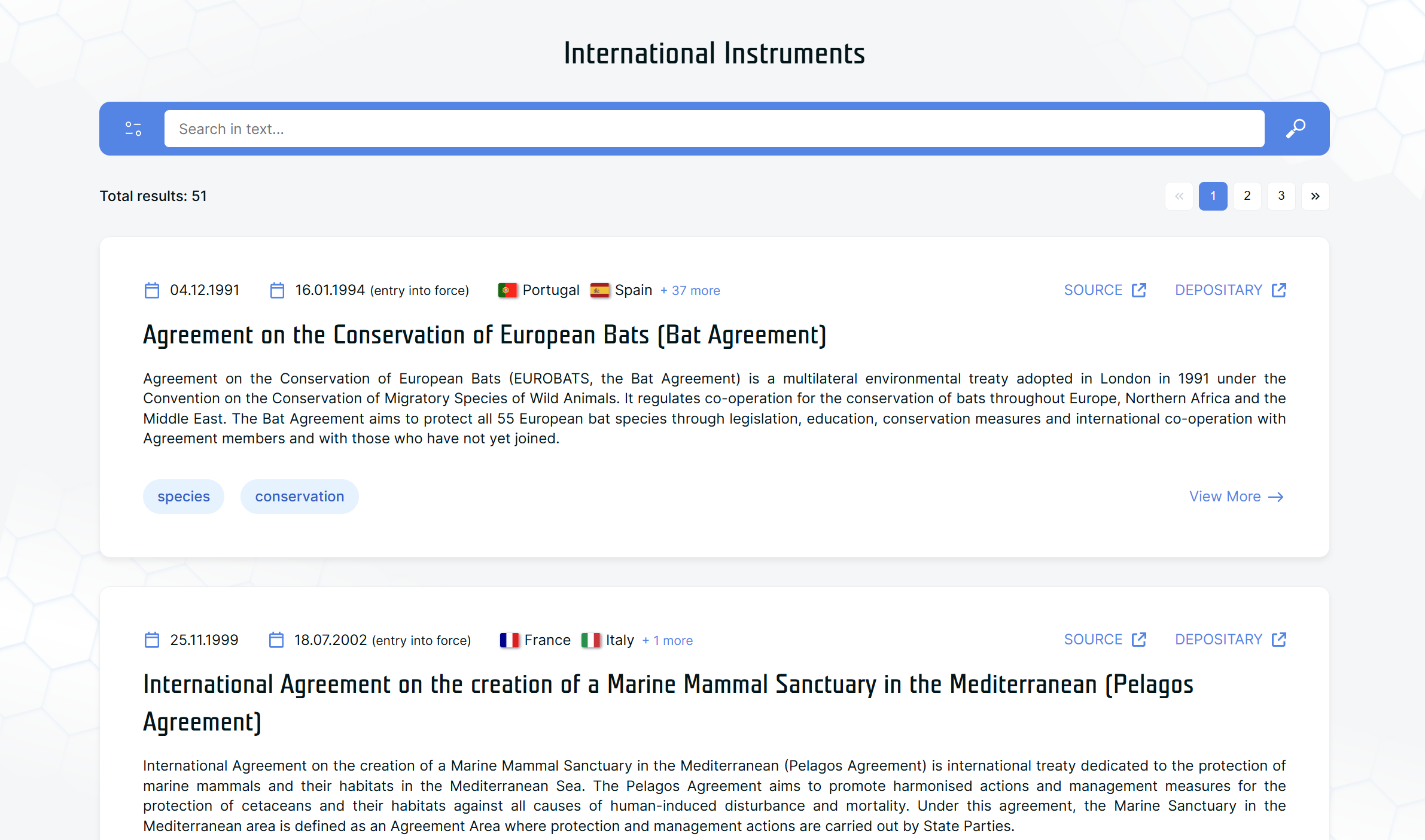
Our Database is organised into three categories: international instruments, international cases, and national cases. International instruments encompass binding (both multilateral and bilateral) and non-binding international agreements, such as conventions, treaties, memorandums, and more. Resolutions and other texts produced by international organisations or at intergovernmental conferences, however, are not included. International cases cover jurisprudence of international courts and tribunals, and other international bodies. National cases contain selected decisions of various domestic courts and other national bodies across multiple jurisdictions.
The Database is not an official source of publication for instruments or cases.
limitations
Although we use multiple sources and work with contributors from various countries, our data collection process is subject to several limitations. While we strive to identify the original or most authoritative source for each material — such as the official webpage of a treaty depositary — some information may be absent or inaccurate due to a range of factors in available to sources.
We aim to reflect the most up-to-date information and strive to keep the contents of the Database current. However, due to the limitations outlined above, we cannot guarantee the accuracy or completeness of every entry at all. If you come across new or more accurate information related to materials published in the Database, we encourage you to submit it using the ‘Suggest a correction’ button located in the upper right corner of the webpage.

The International and Comparative Law Research Center (ICLRC) is a Russian non-profit research organisation established in 2014. The ICLRC specialises in the study, development, and dissemination of knowledge in the field of international law, participates in the work of international organisations as an observer, and creates opportunities for research and study of law.
The ICLRC has observer status with UNFCCC, UNEA, and is the UNEP FI Supporting Institution. Its research covers general issues of international law and topical issues such as biodiversity, climate change, plastic pollution, the world ocean, and others.
The ICLRC aims to promote the study of international law. As part of this objective, it organises the Summer School on Public International Law and implements a number of other diverse projects. Its library provides free access to classical and contemporary printed publications in various languages on public and private international law, international arbitration, and comparative law, as well as electronic legal databases.